

This is the best pan-seared bavette steak recipe ever. I dry-brine the steak for deeper flavor, then sear it quickly over high heat to build a nice crust while keeping the inside juicy and pink. I serve it with garlic-herb compound butter for an extra-rich finish.

Unlike premium cuts such as ribeye or New York strip, bavette is generally lean, relatively thin, and has long, coarse muscle fibers. That makes it a little more challenging to cook well, but don’t worry, I’ll walk you through exactly how to turn it into a tender, flavorful steak.
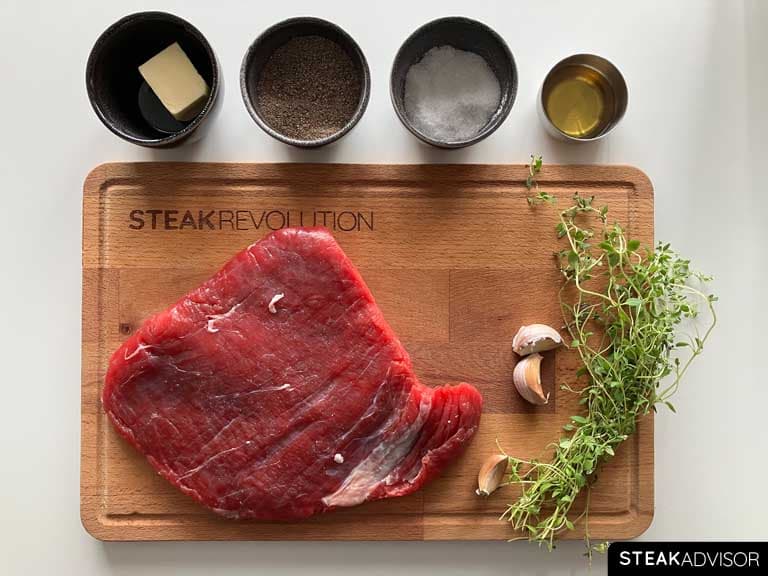
Ingredients You’ll Need
For the steak:
- Bavette steak (also sold in the U.S. as flap steak, sirloin flap, or flap meat): I like to buy a whole bavette, around 2 to 3 pounds (907-1,360 g), and cut it into steaks myself. Pre-cut pieces work fine too. Just choose thicker ones, about 1 inch (2.5 cm) thick, and skip anything butterflied or sliced too thin. The extra thickness gives you more time to develop a deep crust before the center reaches your target pull temperature.
- Salt: For dry-brining, use salt equal to about 1% of the steak’s weight. For a 1 lb (454 g) bavette steak, that’s about 0.16 oz (4.5 g) of salt. I prefer kosher salt because it’s easy to distribute evenly, but any type of salt works. The key is to measure by weight, since teaspoon measurements vary by salt type. Once you get a feel for the salt you use, you can easily eyeball it. I’ve listed approximate teaspoon amounts for different types of salt in the recipe below.
- Oil: Use a high-smoke-point oil for searing. Refined avocado oil is my favorite because it has a neutral flavor and a smoke point of about 500°F (260°C). If you don’t have it, use refined high-oleic safflower oil, refined high-oleic canola oil, refined olive oil, or refined peanut oil. Clarified butter (ghee) works well too. Don’t use regular butter for searing because it burns quickly at high heat.
For the garlic-herb compound butter:
This makes enough compound butter for about 1 lb (454 g) of bavette steak.
- Butter: 4 tablespoons (1/2 stick; 56 g) unsalted butter. Use real butter, not margarine.
- Garlic: 2 cloves, finely minced or pressed.
- Rosemary: 1/2 tablespoon finely chopped fresh rosemary, or 1/2 teaspoon dried rosemary.
- Parsley: 1/2 tablespoon finely chopped fresh parsley, or 1/2 teaspoon dried parsley.
- Salt and black pepper: Start with a generous pinch of each, about 1/8 teaspoon, then taste the butter and adjust as needed.
If using fresh rosemary, chop it very fine so you don’t get woody pieces in the butter.
Tools You’ll Need
- Wire rack and rimmed baking sheet: For dry-brining. The rack keeps the steak elevated and exposed to air on all sides, which helps dry out the surface, while the pan underneath catches any moisture released during the process.
- Heavy skillet: A cast-iron skillet is best for searing because it holds heat extremely well, helping the steak develop a deeper crust. Carbon-steel and heavy stainless-steel skillets are good alternatives. Don’t use a nonstick skillet for high-heat searing.
- Long tongs: For flipping and moving the steak while keeping your hands away from the hot skillet and oil splatter.
- Meat thermometer: Use an instant-read thermometer to quickly check the steak’s internal temperature so you know exactly when to pull it from the pan. Bavette steak is relatively thin, so an instant-read thermometer is the best choice for this recipe.
How to Pan-Sear a Bavette Steak
Optional: Cut Into Pan-Sized Portions
Skip this step if you have a pre-cut steak that fits easily in your pan.
A whole bavette is long and unevenly thick, ranging from about 1/2 inch (1.3 cm) to 1 inch (2.5 cm). It’s too big to cook in a skillet as one piece.
Pat the meat dry with paper towels, then cut it into smaller steaks that fit comfortably in the pan without touching the sides, about 6 to 10 inches (15–25 cm) long. Make these cuts with the grain. Try to portion the whole muscle into steaks that are fairly even in thickness from end to end so they cook at roughly the same rate.
Dry-Brine the Bavette Steak
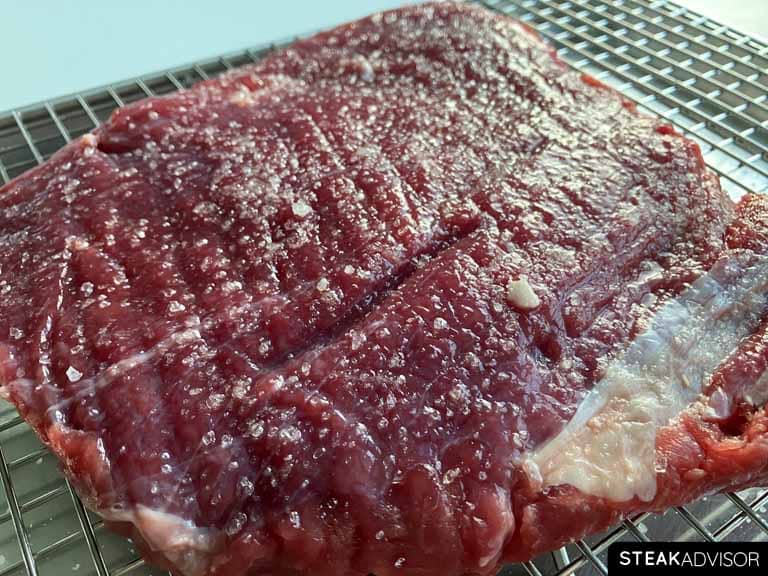
Pat the steak dry with paper towels, then season both sides evenly with salt. Use about 1% of the steak’s weight in salt. That’s enough to season it all the way through without making it taste overly salty.
For a 1 lb (454 g) bavette steak, use about 0.16 oz (4.5 g) of salt, or approximately:
- 1 1/2 teaspoons Diamond Crystal kosher salt,
- 1 teaspoon Morton kosher salt,
- or 3/4 teaspoon table salt.
Place the salted steak on a wire rack set over a baking sheet and refrigerate, uncovered, for at least 1 hour. For the best results, let it dry-brine for 3 to 4 hours. If you don’t have at least an hour, skip the dry-brine and season the steak just before searing, or salt it after slicing.
Make the Garlic-Herb Compound Butter
Cut the butter into small cubes, place them in a bowl, and let them soften at room temperature until easy to mash. Don’t let the butter melt. To soften it faster, microwave it in a microwave-safe bowl in 5-second bursts, checking after each one so it doesn’t melt.
Add the garlic, rosemary, parsley, salt, and pepper. Mash everything together with a fork until evenly combined. Taste, adjust the seasoning, then cover the bowl and refrigerate until you’re ready to use it.
Preheat the Pan
Take the bavette steak out of the refrigerator about 15 minutes before cooking. Take the compound butter out at the same time so it softens before serving.
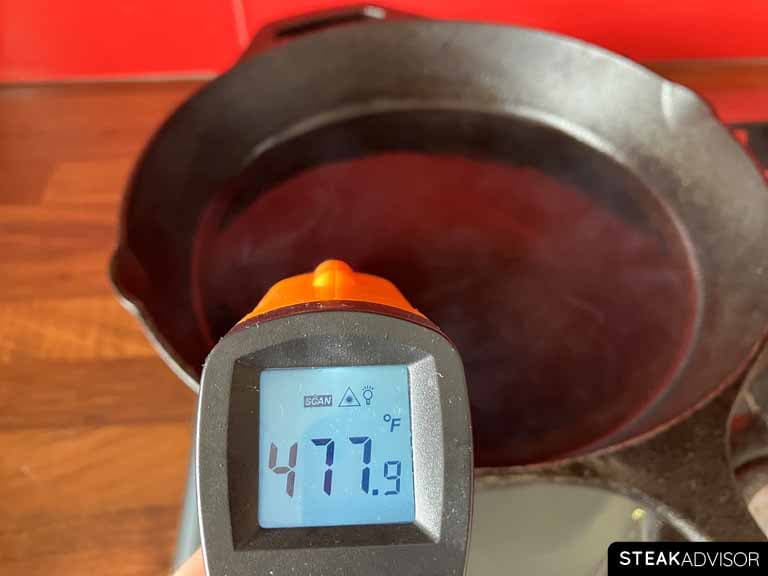
High-heat searing creates a lot of smoke, so turn on the exhaust fan or crack a window before you start. Heat the pan over medium-high heat for about 3 minutes, then add 2 tablespoons of high-smoke-point oil and heat for another minute.
While the pan heats, pat the steak dry one last time with paper towels. The drier the surface, the faster it browns and the better the crust.
Pan-Sear the Bavette Steak
Carefully place the bavette steak in the hot skillet and press it gently with tongs so the surface makes full contact with the pan. Flip the steak every 30 seconds so both sides brown evenly.
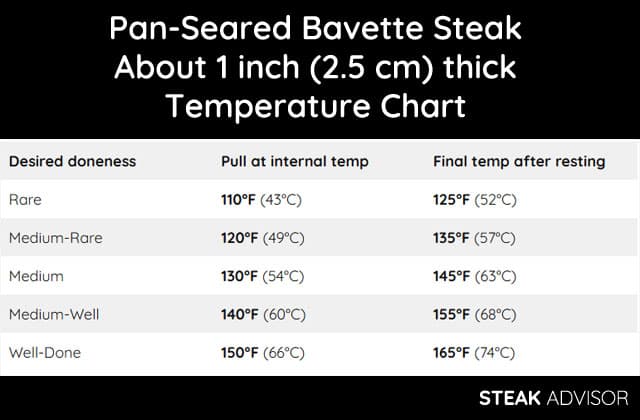
After about 2 minutes, start checking the internal temperature. Insert the thermometer sideways into the thickest part of the steak. Once it reaches the pull temperature for your preferred doneness listed in the chart below, transfer the steak to a cutting board or plate. Top with 1 to 2 tablespoons of compound butter and let it rest for 5 minutes.
Pan-Seared Bavette Steak Temperature Chart
| Desired doneness | Pull at internal temp | Final temp after resting |
| Rare | 110°F (43°C) | 125°F (52°C) |
| Medium-Rare | 120°F (49°C) | 135°F (57°C) |
| Medium | 130°F (54°C) | 145°F (63°C) |
| Medium-Well | 140°F (60°C) | 155°F (68°C) |
| Well-Done | 150°F (66°C) | 165°F (74°C) |

Slice and Serve
After the steak has rested for 5 minutes, slice it thinly against the grain. This matters with bavette because slicing with the grain leaves the long muscle fibers intact, which makes each bite tougher and chewier.
Slicing across the grain shortens those fibers and makes the meat much easier to chew. If you’re not sure which way the grain runs, scroll down to the photos below. I’ve also included a video showing exactly how to identify the grain and slice the steak properly.
Serve with your favorite sides and enjoy.

How to Slice Bavette Steak (Flap Steak) Against the Grain
Start by finding the direction of the grain. On bavette steak, the muscle fibers are easy to see because they’re long, coarse, and run in the same direction. Once you’ve identified them, cut across those fibers rather than along them.
Use the photo below as a guide:
- The yellow lines show the natural direction of the grain.
- The red line shows the correct cutting angle, which is the line you should follow to slice against the grain.

Slicing against the grain shortens the muscle fibers, making every bite easier to chew. Technically, it doesn’t make the meat more tender. It just feels that way because your knife does the work your teeth would otherwise have to do. Slice with the grain, and those fibers stay long and stringy, making each bite noticeably tougher.
The example below shows the difference between bavette sliced against the grain and bavette sliced with the grain.

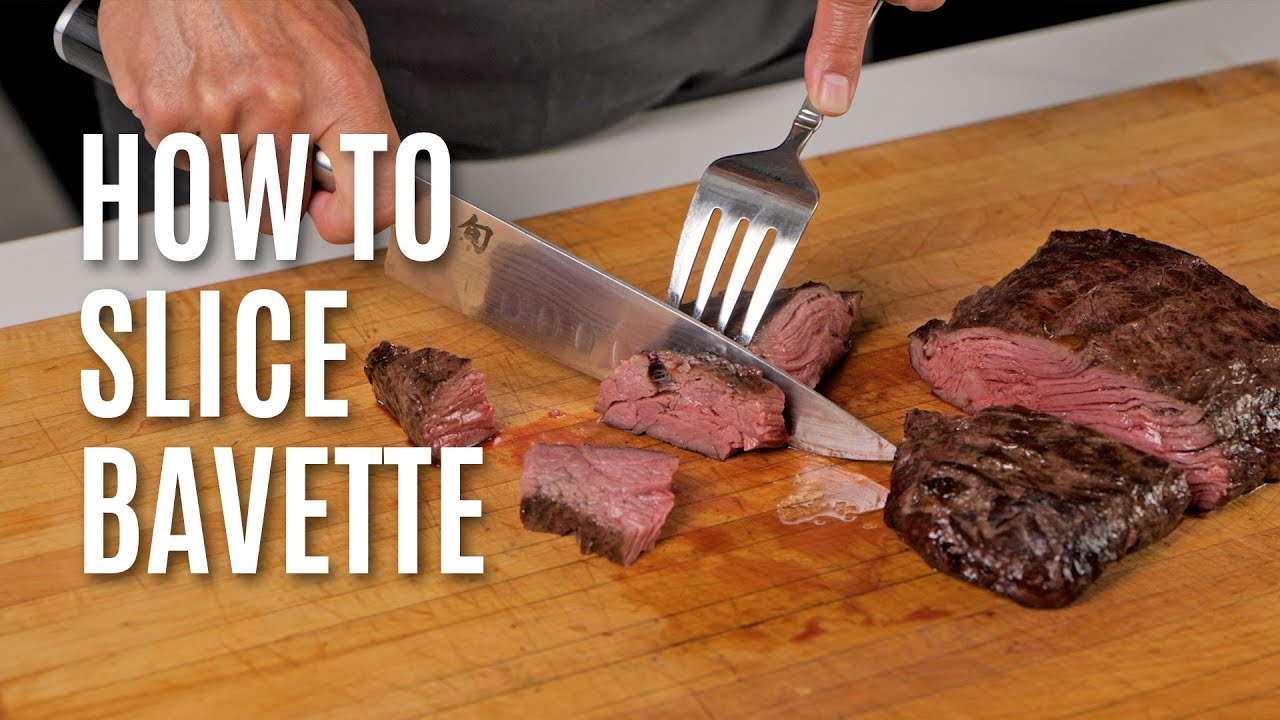
This video shows how to slice bavette against the grain.
What Is the Best Doneness for Pan-Seared Bavette Steak?
For the best balance of tenderness, juiciness, and flavor, stick with medium-rare to medium, ideally around 140°F (60°C). At that doneness, the meat has a slightly firmer bite while staying juicy and tender.
Bavette has long, coarse muscle fibers. Cook it too rare, and the texture turns soft and mushy. Cook it past medium, and those fibers become tough and chewy.
What to Serve with Pan-Seared Bavette Steak
Bavette has a bold, beefy flavor, and in this recipe I finish it with rich garlic-herb compound butter. I like to keep the sides simple, usually with some potatoes and a green vegetable. These are my favorites:
- Crispy Roasted Potatoes
- French Fries
- Mashed Potatoes
- Steakhouse Potato Wedges
- Roasted Asparagus
- Roasted Green Beans
- Roasted Broccolini
- Arugula Salad
- Tomato and Red Onion Salad
Tips for the Best Pan-Seared Bavette Steak – Key Takeaways
- Portion a whole bavette before cooking. Cut it with the grain into portions about 6 to 10 inches (15–25 cm) long that fit comfortably in your skillet. Keep each piece as even in thickness as possible.
- Choose thicker pieces. If you’re buying pre-cut bavette, look for pieces around 1 inch (2.5 cm) thick. Skip anything butterflied or sliced too thin.
- Dry-brine ahead of time. Salt the steak and refrigerate it uncovered for at least 1 hour, preferably 3 to 4 hours.
- Follow the 1% salt rule. Measure salt equal to about 1% of the steak’s weight.
- Skip advance salting if you’re short on time. If you don’t have a full hour, salt the steak immediately before searing instead.
- Use a heavy skillet. A cast-iron skillet is best. Carbon-steel and heavy stainless-steel skillets are solid alternatives.
- Use high-smoke-point oil. Refined avocado oil is a great option. Skip regular butter for searing.
- Preheat the skillet properly. Heat it over medium-high for about 3 minutes, add the oil, then let it heat for another minute.
- Pat the steak completely dry. Do this right before it goes into the skillet.
- Don’t crowd the pan. Cook in batches if the pieces don’t fit comfortably without touching.
- Press the steak against the pan. Use tongs to make sure the surface has full contact with the skillet.
- Flip every 30 seconds. Keep flipping until the steak reaches your pull temperature.
- Start checking the temperature after about 2 minutes. Insert the thermometer horizontally into the thickest part of each piece.
- Check each piece separately. Pull thinner sections first if they reach temperature sooner.
- Aim for medium-rare to medium. Aim for about 140°F (60°C) after resting.
- Finish with compound butter. Top the hot steak with 1 to 2 tablespoons of garlic-herb compound butter.
- Rest for 5 minutes. Let the steak sit before slicing.
- Slice thinly against the grain. Find the direction of the muscle fibers and cut straight across them before serving.
If you want to learn more about why these tips work, check out my complete guide on how to cook steak on the stove, where I break each one down in more detail.

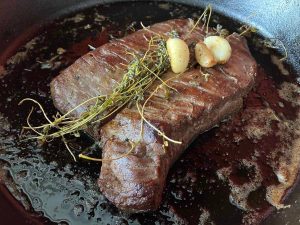
Pan-Seared Bavette Steak (Flap Steak) Recipe
- Prep Time: 20 minutes
- Dry-Brine Time: 1 to 4 hours
- Cook Time: 10 minutes
- Total Time: 1 hour 30 minutes
- Yield: 2 large or 3-4 moderate servings
Description
This pan-seared bavette steak is tender, juicy, and full of bold beefy flavor. It’s served with garlic-herb compound butter that melts over the hot steak and adds a rich, savory finish.
Ingredients
For Steak:
- About 1 lb (454 g) trimmed bavette steak (flap steak), whole or cut into thick pieces (skip butterflied cuts)
- Salt, 1% of the steak’s weight (see instructions for a 16 oz / 454 g example)
- 2 tablespoons (30 ml) high-smoke-point oil (I recommend refined avocado oil; see Notes for alternatives)
For the Garlic-Herb Compound Butter (For Serving):
- 4 tablespoons unsalted butter, softened (1/2 stick / 56 g)
- 2 cloves fresh garlic, minced or pressed
- 1/2 tablespoon fresh rosemary, finely chopped (or 1/2 teaspoon dried)
- 1/2 tablespoon fresh parsley, finely chopped (or 1/2 teaspoon dried)
- A generous pinch of salt and black pepper (about 1/8 teaspoon each)
Tools:
- Wire rack and rimmed baking sheet (for dry-brining steak)
- Heavy skillet (preferably a cast-iron skillet; carbon steel or heavy-bottomed stainless steel are good alternatives; do not use a nonstick pan)
- Long-handled tongs
- Meat thermometer
Instructions
Optional: Cut Into Pan-Sized Portions
- Skip this step if you have a pre-cut steak that fits easily in your pan.
- Pat the whole bavette dry with paper towels, then cut it with the grain into 6- to 10-inch (15–25 cm) steaks that fit comfortably in the skillet. Keep the pieces fairly even in thickness from end to end so they cook at about the same rate.
Dry-Brine the Bavette Steak
- If you haven’t already, pat the steak dry on all sides with paper towels.
- Season both sides with salt equal to about 1% of the steak’s weight. For a 1 lb (454 g) bavette steak, use about 0.16 oz (4.5 g) of salt, or approximately:
1 1/2 teaspoons Diamond Crystal kosher salt,
1 teaspoon Morton kosher salt,
or 3/4 teaspoon table salt. - Place the salted steak on a wire rack over a baking sheet and refrigerate uncovered for at least 1 hour, preferably 3 to 4 hours.
- If you have less than an hour, skip the dry-brine and salt the steak right before searing, or season the sliced steak with salt after cooking.
Make the Garlic-Herb Compound Butter
- Cut the butter into small cubes and place them in a bowl. Let it soften at room temperature until easy to mix but not melted. To soften it faster, microwave it in a microwave-safe bowl in 5-second bursts, checking after each one.
- Add the garlic, rosemary, parsley, salt, and pepper. Mash with a fork until fully combined, then taste and adjust the seasoning.
- Cover and refrigerate until ready to use.
Preheat the Pan
- Take the steak and compound butter out of the refrigerator about 15 minutes before cooking.
- Turn on the exhaust fan or open a window. Heat the skillet over medium-high for about 3 minutes, add 2 tablespoons of high-smoke-point oil, and heat for another minute.
- Pat the steak completely dry with paper towels just before searing.
Pan-Sear the Bavette Steak
- Place the bavette in the hot skillet and press it down gently with tongs so the surface makes full contact with the pan.
- Cook the steak, flipping every 30 seconds, until it reaches the pull temperature for your preferred doneness:
110°F (43°C) for rare,
120°F (49°C) for medium-rare,
130°F (54°C) for medium,
140°F (60°C) for medium-well,
150°F (66°C) for well-done.
See the complete steak temperature chart below. - Start checking the internal temperature after about 2 minutes. Insert a meat thermometer horizontally into the thickest part of the steak.
- Once the steak reaches your target pull temperature, transfer it to a cutting board or plate, top with 1 to 2 tablespoons of compound butter, and let it rest for 5 minutes.
Slice and Serve
- After the steak has rested for 5 minutes, slice it thinly against the grain and serve with your favorite sides. If you’re not sure which way to cut, see the slicing guide above the recipe card.
Temperature Chart
Notes
Oil/Fat: Use refined avocado oil, refined high-oleic safflower oil, refined high-oleic canola oil, refined canola oil, refined olive oil, refined peanut oil, or ghee (clarified butter). Do not use regular butter for initial searing (it burns at high heat).

The slicing guide was the best part. Bavette came out way more tender than I expected.
Thanks, Rachel.