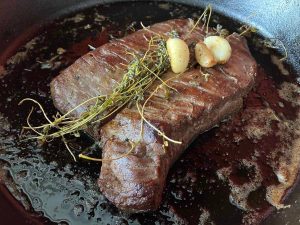
Description
This pan-seared bavette steak is tender, juicy, and full of bold beefy flavor. It’s served with garlic-herb compound butter that melts over the hot steak and adds a rich, savory finish.
Ingredients
For Steak:
- About 1 lb (454 g) trimmed bavette steak (flap steak), whole or cut into thick pieces (skip butterflied cuts)
- Salt, 1% of the steak’s weight (see instructions for a 16 oz / 454 g example)
- 2 tablespoons (30 ml) high-smoke-point oil (I recommend refined avocado oil; see Notes for alternatives)
For the Garlic-Herb Compound Butter (For Serving):
- 4 tablespoons unsalted butter, softened (1/2 stick / 56 g)
- 2 cloves fresh garlic, minced or pressed
- 1/2 tablespoon fresh rosemary, finely chopped (or 1/2 teaspoon dried)
- 1/2 tablespoon fresh parsley, finely chopped (or 1/2 teaspoon dried)
- A generous pinch of salt and black pepper (about 1/8 teaspoon each)
Tools:
- Wire rack and rimmed baking sheet (for dry-brining steak)
- Heavy skillet (preferably a cast-iron skillet; carbon steel or heavy-bottomed stainless steel are good alternatives; do not use a nonstick pan)
- Long-handled tongs
- Meat thermometer
Instructions
Optional: Cut Into Pan-Sized Portions
- Skip this step if you have a pre-cut steak that fits easily in your pan.
- Pat the whole bavette dry with paper towels, then cut it with the grain into 6- to 10-inch (15–25 cm) steaks that fit comfortably in the skillet. Keep the pieces fairly even in thickness from end to end so they cook at about the same rate.
Dry-Brine the Bavette Steak
- If you haven’t already, pat the steak dry on all sides with paper towels.
- Season both sides with salt equal to about 1% of the steak’s weight. For a 1 lb (454 g) bavette steak, use about 0.16 oz (4.5 g) of salt, or approximately:
1 1/2 teaspoons Diamond Crystal kosher salt,
1 teaspoon Morton kosher salt,
or 3/4 teaspoon table salt. - Place the salted steak on a wire rack over a baking sheet and refrigerate uncovered for at least 1 hour, preferably 3 to 4 hours.
- If you have less than an hour, skip the dry-brine and salt the steak right before searing, or season the sliced steak with salt after cooking.
Make the Garlic-Herb Compound Butter
- Cut the butter into small cubes and place them in a bowl. Let it soften at room temperature until easy to mix but not melted. To soften it faster, microwave it in a microwave-safe bowl in 5-second bursts, checking after each one.
- Add the garlic, rosemary, parsley, salt, and pepper. Mash with a fork until fully combined, then taste and adjust the seasoning.
- Cover and refrigerate until ready to use.
Preheat the Pan
- Take the steak and compound butter out of the refrigerator about 15 minutes before cooking.
- Turn on the exhaust fan or open a window. Heat the skillet over medium-high for about 3 minutes, add 2 tablespoons of high-smoke-point oil, and heat for another minute.
- Pat the steak completely dry with paper towels just before searing.
Pan-Sear the Bavette Steak
- Place the bavette in the hot skillet and press it down gently with tongs so the surface makes full contact with the pan.
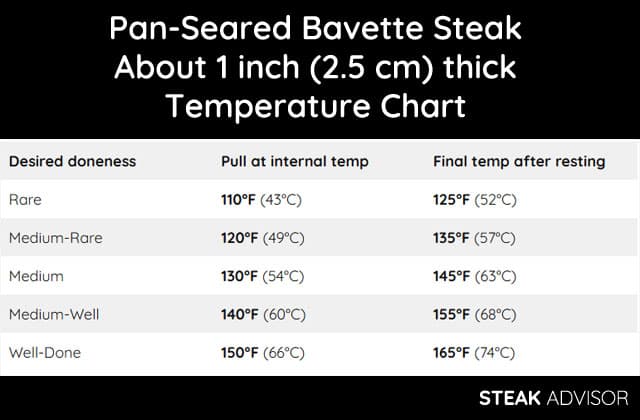
- Cook the steak, flipping every 30 seconds, until it reaches the pull temperature for your preferred doneness:
110°F (43°C) for rare,
120°F (49°C) for medium-rare,
130°F (54°C) for medium,
140°F (60°C) for medium-well,
150°F (66°C) for well-done.
See the complete steak temperature chart below. - Start checking the internal temperature after about 2 minutes. Insert a meat thermometer horizontally into the thickest part of the steak.
- Once the steak reaches your target pull temperature, transfer it to a cutting board or plate, top with 1 to 2 tablespoons of compound butter, and let it rest for 5 minutes.
Slice and Serve
- After the steak has rested for 5 minutes, slice it thinly against the grain and serve with your favorite sides. If you’re not sure which way to cut, see the slicing guide above the recipe card.
Temperature Chart
Notes
Oil/Fat: Use refined avocado oil, refined high-oleic safflower oil, refined high-oleic canola oil, refined canola oil, refined olive oil, refined peanut oil, or ghee (clarified butter). Do not use regular butter for initial searing (it burns at high heat).