
Get exact cook times based on your steak’s thickness, cut, and target doneness. Works for steaks between ¼ in (0.6 cm) and 2½ in (6.5 cm) thick.
🌡️ Temperature
⏱ Timing
🛡 Food Safety
🔥 After Sous Vide
- Pat completely dry – moisture kills crust
- Rest in the fridge 15-20 min on its side
- Sear on ripping-hot cast iron, 30 sec/side
- Serve immediately – no rest needed
Bath temperature = your target doneness. This calculator uses the standard home sous vide method where you set the bath to the exact temperature you want the steak – 135°F (57°C) for medium-rare, 145°F (63°C) for medium, and so on. The steak sits in the water until the center equilibrates to within a degree of the bath. It physically cannot exceed the bath temperature, so you can’t overcook it.
Why do 140°F (60°C), 150°F (66°C), and 156°F (69°C) show the same minimum time for thick steaks? Because the clock is set by heat diffusion through the meat – not by food safety. At 140°F (60°C), pathogens are already reduced to safe levels in roughly 2–3 hours for a 2″ steak. At 150°F (60°C), maybe 20 minutes. At 156°F (69°C), just a few minutes. But the time for heat to physically travel through 2 inches of meat is always 3h 35m – pure physics (thermal diffusivity of beef), independent of the absolute temperature.
So why not set the bath higher and pull early? You can – chefs do this with a probe thermometer. Set to 165°F (64°C), pull when the center hits 135°F (57°C), and a 2″ steak would be ready in roughly 1–1.5 hours. But you need a probe, you have to watch it, and overshooting is easy. The Baldwin method trades speed for foolproof hands-off cooking.
About This Sous Vide Steak Calculator
This calculator takes the guesswork out of sous vide steak by giving you precise cook times based on your exact cut, thickness, target doneness, and food safety requirements. Rather than relying on generic charts that assume a “standard” steak, it accounts for the two variables that actually matter: how long heat takes to reach the center of your specific piece of meat, and how long it needs to stay there to be safe to eat.
Cook times are derived mostly from Dr. Douglas Baldwin’s Practical Guide to Sous Vide Cooking – the most rigorous publicly available reference for home sous vide cooking, grounded in food science and thermal physics rather than chef intuition. Pasteurization times above 140°F (60°C) are extrapolated using Baldwin’s z-value methodology (z=7°C for Listeria in beef).
The calculator covers 16 cuts, temperatures from 118°F to 156°F (48–69°C), fresh and frozen starting points, and optional pasteurization – with clear explanations of what drives each number and where the real limits of the data are.
How to Use the Sous Vide Steak Calculator
How Long to Sous Vide a Steak?
How long to sous vide a steak depends on the cut, thickness, target temperature, whether you want it pasteurized, and the desired texture. To make it easy, I built a calculator that accounts for all of these factors at once. Below the calculator, I explain why these factors matter and how they affect the final cooking time.
The cooking times in the calculator are mostly based on the work of Douglas Baldwin and Amazing Food Made Easy, two of the most trusted references for sous vide cooking.
Why Does Cooking Time Matter When Cooking Steak Sous Vide?
When cooking steak sous vide, cooking time matters for a completely different reason than when pan-searing or grilling. With sous vide, temperature determines doneness, and time determines how evenly the steak reaches that temperature, plus how its texture changes.
With traditional high-heat methods like pan-searing or grilling, time is the main factor in how quickly the steak reaches your target internal temperature. You heat the steak until it’s close to your target doneness, then remove it from the heat to prevent it from overcooking.
Sous vide works differently. Because the steak cooks in a water bath set to a precise temperature, it will never reach a temperature higher than the water bath, so in that sense, it can’t overcook from temperature alone. For example, if the water bath is set to 131°F (55°C), the steak will never go above that temperature, no matter how long it stays in the bath.
However, this doesn’t mean that cooking time doesn’t matter.
The longer the steak stays at the target temperature, the more its texture changes. The meat gradually becomes more tender as the muscle fibers and connective tissue slowly break down. That’s what makes sous vide different from most other cooking methods, and why both cooking time and temperature matter so much.
The Three Goals of Cooking Steak Sous Vide
Cooking steak sous vide isn’t just about reaching the right doneness. In most cases, there are three main goals:
- Bring the steak to your target doneness
- Pasteurize the meat to make it safe to eat
- Tenderize the steak if the cut benefits from it
Let me explain each of these in more detail below.
1. Bring the steak to your target doneness
Like with any cooking method, the first goal of sous vide is to bring the steak to your desired level of doneness and, depending on the temperature and time, make it safe to eat.
What makes sous vide different from traditional methods is the level of temperature control. With sous vide, you can set the exact temperature you want, and the steak will slowly reach that temperature and cook evenly from edge to edge. There’s no guessing and no thick gray band under the crust. For example, if you set the water bath to 137°F (58°C) for a well-marbled steak, the entire steak will gradually reach that exact temperature.
This means sous vide cooking isn’t just about choosing a general range like 130-140°F (54–60°C) for medium-rare. Instead, you can choose a very precise temperature to get exactly the texture and doneness you prefer.
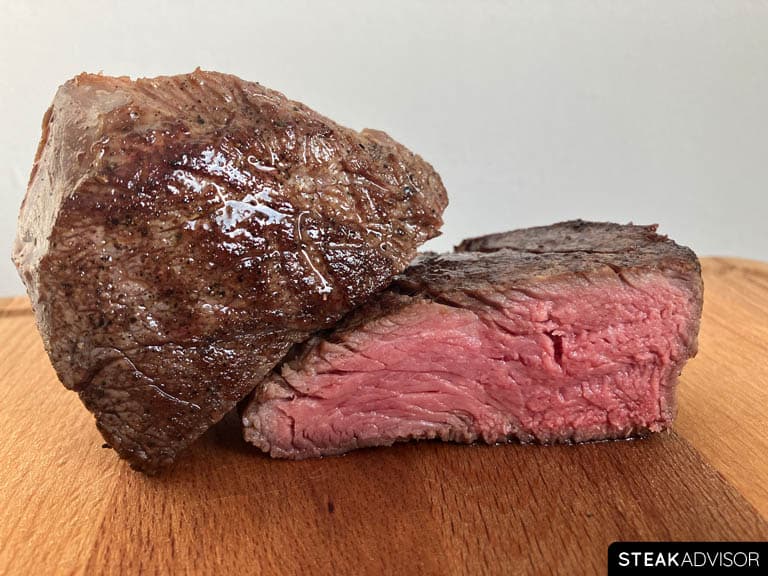
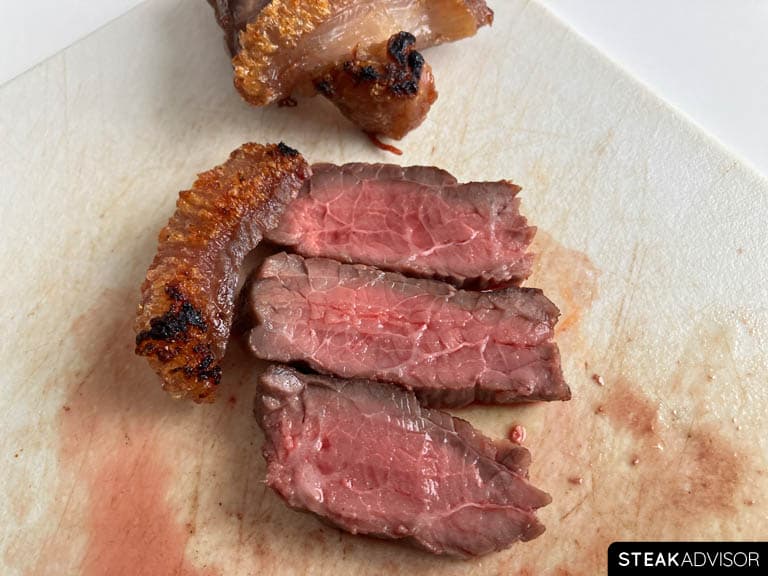
As mentioned earlier, temperature determines doneness, while time determines how evenly the steak reaches that temperature and how its texture changes. The longer the steak stays at the target temperature, the more tender it can become. Cooking time can also make the steak safer to eat by allowing the meat to pasteurize. That’s one of the biggest advantages of sous vide.
With pan-searing or grilling, steaks always form a gray band near the surface, and the inside is never as evenly cooked as with sous vide, no matter which steak-cooking technique you use. It’s also much easier to overcook the steak because the cooking temperature keeps changing, making timing harder to control. The only way to stay close to your target doneness is to monitor the internal temperature with a meat thermometer and take the steak off the heat earlier to account for carryover cooking.
Carryover cooking is another highly unpredictable factor that can significantly affect the final internal temperature, which is one of the most common reasons people overcook their steaks.
Sous vide works differently. Because the steak cooks at a precisely controlled temperature, you can predict how long it will take to reach the target doneness. This precision lets you cook the steak to the temperature you want, within a good degree of accuracy, every time, and it also allows you to pasteurize the meat if needed. More on pasteurization below.
2. Pasteurize the meat to make it safe to eat
Pasteurization reduces the levels of dangerous bacteria and parasites to very low levels considered safe for consumption. Food-safety guidelines often describe this using log reductions in pathogen levels. For example, the U.S. Department of Agriculture (USDA) recommends processes that achieve about a 6.5-log reduction of Salmonella in beef, which means reducing the bacteria by a factor of about 3 million to 1. In general terms, this means lowering pathogen levels to extremely low levels that pose a very low risk.
Pasteurization is achieved by holding food, in our case the steak, at a specific temperature for a certain amount of time (higher temperatures pasteurize food faster). That’s exactly what sous vide allows you to do, which makes it one of the best cooking methods if you want to cook steak at lower temperatures, like medium-rare or medium, and still make it safer to eat.
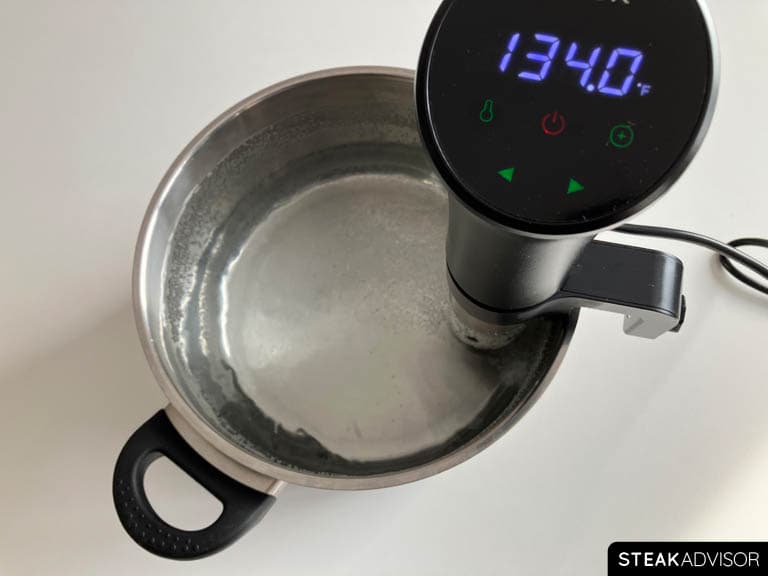
Pasteurization for beef is, in most cases, optional, but it’s very valuable. In many situations, it only takes a bit longer than simply heating the steak to the target temperature when cooking steaks about 1 to 2 inches (2.5–5 cm) thick at 130–140°F (54–60°C). Personally, I prefer to pasteurize all steaks cooked below 140°F (60°C) to make sure they’re safer to eat. That’s my personal choice based on past health issues. If you’re healthy and comfortable with it, you can still heat the steak to the target temperature and eat it without waiting for full pasteurization. However, if you’re cooking unusual types of meat or wild game, it’s generally better to pasteurize it to be on the safe side.
Keep in mind that with thicker naturally tender steaks, about 2.5 inches (6.3 cm) thick, pasteurization can happen before the center of the steak fully reaches the target temperature. The same can happen with tougher cuts cooked for many hours. In other words, by the time the steak finishes heating through, it may already be pasteurized, depending on the cooking time and the steak’s thickness.
You can learn more about sous vide pasteurization in this article.
So now you already understand the difference between simply heating the steak to the target temperature and pasteurizing it. You also know that the required time depends on the steak’s thickness and the cooking temperature.
Now let me explain how cooking time and temperature affect steak tenderness, and how this differs depending on the type of steak you’re cooking.
3. Tenderize the steak if the cut benefits from it
The last optional goal when cooking steak sous vide is tenderizing the meat. I say optional because naturally tender cuts, like a good-quality filet mignon or ribeye, don’t need any extra tenderizing. But some cuts are naturally tougher, and those benefit greatly from longer sous vide cooking. In fact, sous vide is the only cooking method that lets you tenderize a steak while still keeping it at a precise doneness like medium-rare, without needing marinades or mechanical tenderizing first.
Remember what I said earlier: temperature determines doneness, while time determines how the steak’s texture changes. As the steak cooks, the muscle, collagen, and proteins undergo transformations that change the meat’s overall texture. At first, the meat becomes more tender as connective tissue breaks down. But if you cook it too long, the texture can turn mushy, which is definitely not what we want.
What this means is that, depending on the cut of steak, you can cook it just long enough to heat it through, pasteurize it, or tenderize it. Sometimes you achieve all three goals at once, and sometimes only one or two. It all depends on the cut you’re cooking and the result you’re aiming for.
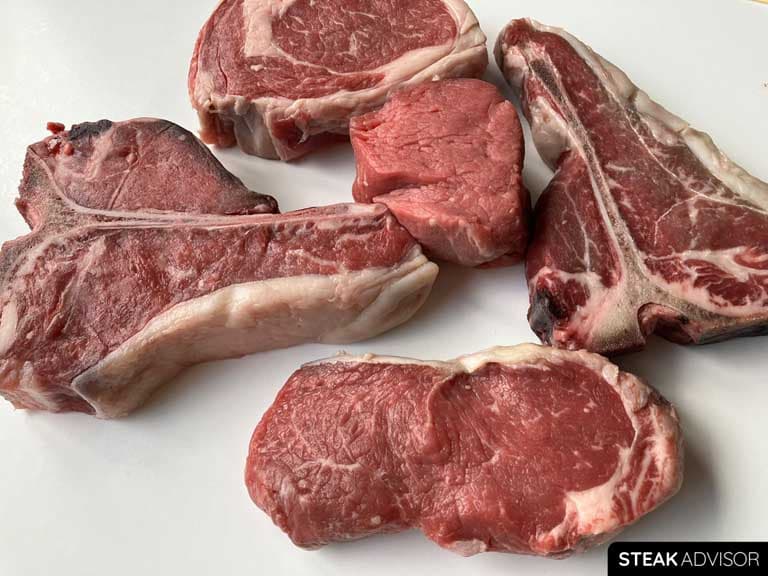
In short, do not cook naturally tender cuts much longer than the heat-through or pasteurization time, or the texture will become too tender, even mushy. On the other hand, you should cook naturally tough cuts much longer. A long sous vide cook slowly breaks down connective tissue, turning a tough cut into a much more tender steak while the inside stays medium-rare.
Yes, you can even turn a round steak into a surprisingly tender steak with sous vide. But it takes time, even 24 to 48 hours, depending on the cut, thickness, and target temperature.
Now you might start wondering about the difference between minimum and maximum sous vide cooking times. I built the Sous Vide Steak Time & Temperature Calculator based on the most widely used sous vide research to help you figure this out quickly. But below I want to explain why many sous vide steak charts show a range of cooking times, for example, 1 to 3 hours for a 1 1/2-inch (3.8 cm) steak.
What Minimum and Maximum Sous Vide Cooking Times Really Mean?
In most cases, the minimum cooking time is the time required to heat the steak through to reach the target temperature.
In my calculator, when you choose the “pasteurization” option, the minimum time becomes the time required to pasteurize the steak, which takes a bit longer for cuts up to about 2 inches (5cm) thick than simply heating it through, especially for naturally tender cuts. Naturally tough cuts cook long enough that they almost always become pasteurized anyway. In my calculator, when you choose a naturally tough cut, you’ll see the recommended “tenderization range”, which includes the minimum time required to change the steak’s texture significantly.
In most sous vide temperature charts available online, the minimum time usually refers only to the time needed to heat the steak through, and it does not include pasteurization time. As for the maximum cooking time, both in my calculator and in most other temperature charts, it refers to the point at which the steak’s texture starts to change in the wrong direction, becoming too tender.
Based on this, you should adjust the minimum and maximum cooking time depending on the type of steak. With naturally tender cuts such as filet mignon or ribeye, you only need to focus on reaching the heat-through or pasteurization minimum time. There is no need to cook these cuts any longer, as they are already tender. In fact, you shouldn’t cook them for too long in the water bath because they can become overly soft or even mushy.
With naturally tough cuts, things are simpler. They need to be cooked long enough to fall within the tenderization time range, and this usually takes so long that the steak is already fully heated through and pasteurized before the tenderization process is complete.
This is especially important for tender cuts because with sous vide, once the steak reaches the target temperature, you can technically leave it in the water bath for quite a long time. This can be very useful when you’re hosting a party and want to sear and serve steaks whenever someone is ready to eat. However, you should still be careful not to leave naturally tender steaks in the water bath for too long.
For example, if you cook a 2-inch (5 cm) filet mignon to 137°F (58.3°C) and the calculator gives you a time of 3 hours and 35 minutes, you shouldn’t leave it in the bath for more than 2–3 hours beyond that.

