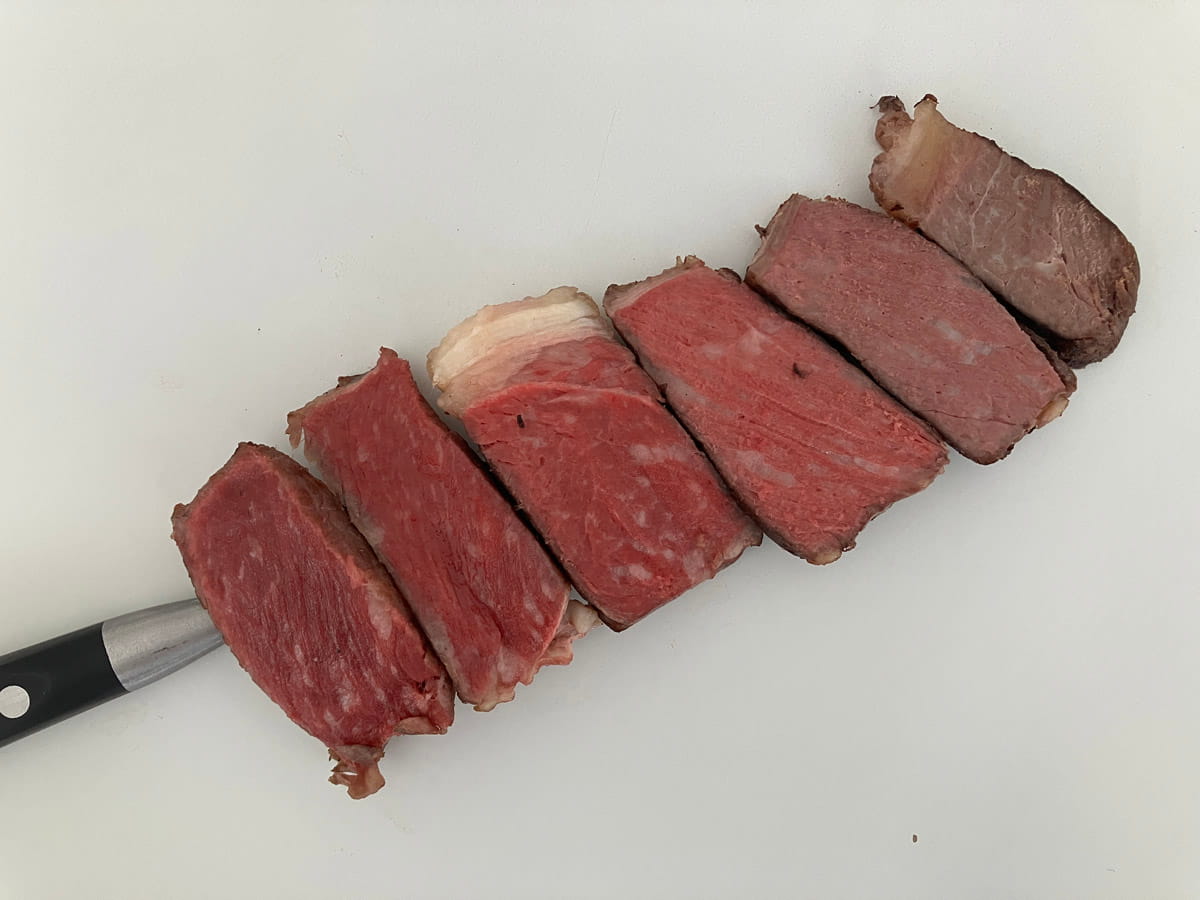

The perfect steak is one cooked to the doneness you prefer. Understanding steak doneness levels and the right internal temperature for each one helps you know what to expect, whether you’re cooking steak at home or ordering it at a steakhouse.
In this guide, I’ll show you what each level of steak doneness looks like, share a complete steak temperature chart you can download and save for later, and explain how to measure a steak’s internal temperature and when to remove it from the heat to avoid overcooking.
Note
All the photos in this article show steaks cooked to the target temperature using sous vide, the most precise method for cooking steak. So when I say a steak is medium-rare at 135°F (57°C), that means it was cooked and held at exactly 135°F (57°C) in a controlled water bath.
Because sous vide brings the steak to a precise, controlled temperature, these photos show clear and consistent color differences between doneness levels.
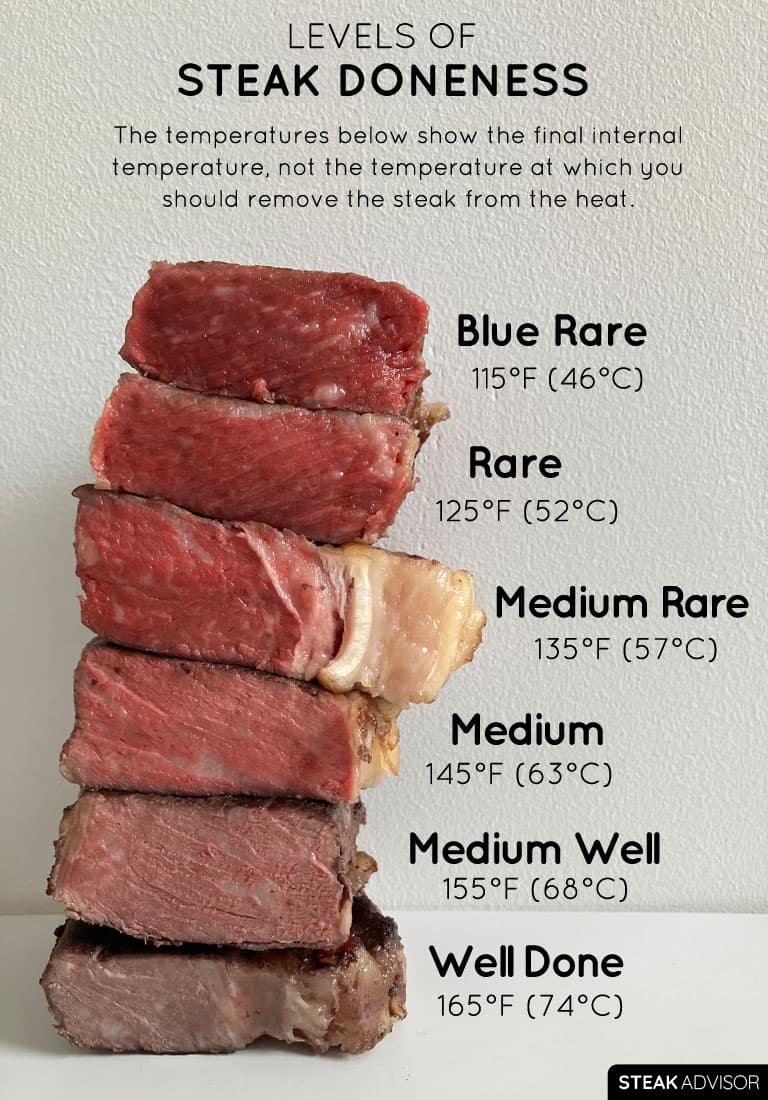
Download the steak temperature chart below and save it on your phone for quick reference.
Steak Temperature Chart at a Glance
The temperatures below show the final internal temperature, not the temperature at which you should remove the steak from the heat.
You need to take the steak off earlier because its internal temperature will continue to rise as it rests. See the section on when to remove steak from the heat to understand how it affects the final temperature.
| Steak Doneness | Internal Temperature (°F) | Internal Temperature (°C) |
| Blue Rare | 110-120°F | 43-49°C |
| Rare | 120-130°F | 49-54°C |
| Medium Rare | 130-140°F | 54-60°C |
| Medium | 140-150°F | 60-66°C |
| Medium Well | 150-160°F | 66-71°C |
| Well-Done | Over 160°F | Over 71°C |
Important
According to the USDA, the minimum internal temperature for steak is 145°F (63°C), followed by at least a 3-minute rest.
It’s also important to understand that 145°F (63°C) is a guideline mostly for fast, high-heat cooking methods like pan-searing or grilling. Other techniques, such as sous vide, work differently. With sous vide, you can pasteurize steak at a lower temperature by holding it there long enough, which means the meat can still be safe to eat without ever reaching 145°F (63°C).
What is Steak Doneness?
Steak doneness refers to how cooked a steak is on the inside. It ranges from blue rare to well done, with each level defined by a specific internal temperature. That temperature matters because it affects the steak’s:
- Texture: As the steak’s internal temperature rises, the muscle fibers gradually firm up and lose moisture.
- Juiciness: Higher temperatures increase moisture loss, but juiciness also depends on marbling and fat rendering.
- Flavor: Different internal temperatures change how a steak tastes by affecting moisture, texture, and fat rendering.
- Color: As the internal temperature rises, the center changes from red to pink to brownish-gray.
Steak temperature also gives you much better control over doneness and helps determine whether the steak is safe to eat. According to the USDA, the minimum internal temperature for steak is 145°F (63°C), which falls right in the medium doneness range.
That said, many steak lovers and chefs prefer cooking steak to a slightly lower internal temperature, especially with well-marbled cuts like ribeye or naturally tender, lean cuts like filet mignon. At those lower levels of doneness, the texture stays softer, the steak retains more moisture, and the flavor often comes through better.
For more details on steak safety, read my article on Is It Safe to Eat Raw Steak?
Important
Keep in mind that the same temperature can affect different cuts differently. What works well for one type of steak may not work as well for another. Later in this guide, I’ll explain how different temperatures affect different cuts and which doneness level works best for each one.
The 6 Steak Doneness Levels
Here’s a breakdown of the six steak doneness levels, including how each one looks, feels, and the temperature range most commonly associated with it.
Keep in mind that these are only rough guidelines. Different cuisines and cooking traditions may use slightly different terminology and target temperatures.
Blue Rare: 110-120°F (43-49°C)
Blue rare steak (also called extra rare) is almost raw inside. The center is very deep red, sometimes even purplish-red, especially right after cutting, and feels relatively cool. The texture is very soft and tender, but also noticeably wet and slippery.
Best for: Very tender, lean cuts such as filet mignon.
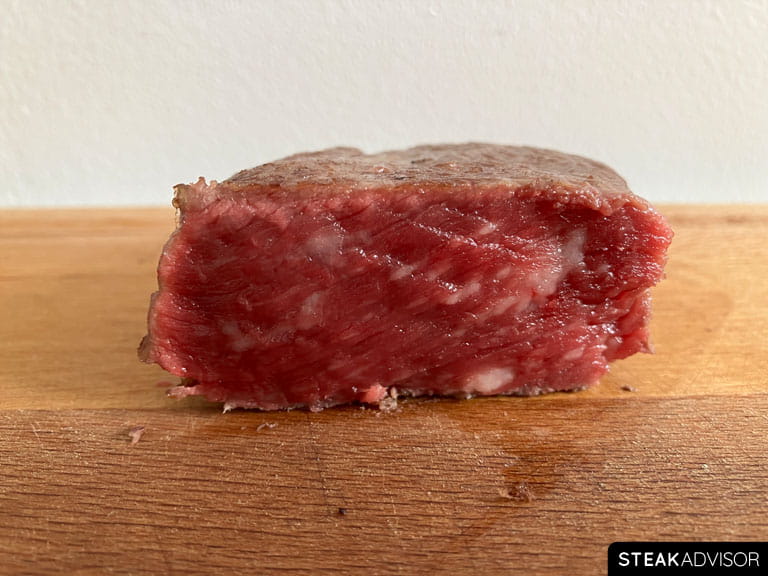
This level of doneness works best with naturally tender, lean cuts like filet mignon. It’s a poor choice for tougher cuts like hanger steak or bavette. Not simply because they feel wet or slippery, but because their coarse grain and connective structure can make them seem mushy yet still chewy at very low temperatures.
It’s also a bad choice for well-marbled steaks like ribeye or outside skirt steak, since the intramuscular fat (marbling) hasn’t had enough time to render properly, so it tastes waxy rather than rich and buttery.
Some people genuinely enjoy blue rare steak. If you like beef tartare or very lightly cooked meat, this level of doneness might appeal to you. But for most people, I wouldn’t recommend it. Very few steak lovers actually prefer blue rare, and if you’re new to steak, there’s a very high chance you won’t enjoy it. Personally, I’m not a fan.
Note
Blue rare steak is cooked to an internal temperature well below the 145°F (63°C) recommended by the USDA for whole cuts of beef. That doesn’t automatically mean it’s unsafe, but it does come with more risk than steak cooked to a higher internal temperature. If that’s a concern for you, choose a higher level of doneness.
Rare: 120-130°F (49-54°C)
Rare steak is slightly more cooked than blue rare. The center is still dark red, but it looks less raw than the purplish-red center of blue rare. It feels only lightly warmed through. The texture is very soft and tender, with a slightly wet, slippery feel, especially at the lower end of the range.
Best for: Tender, lean cuts such as filet mignon or sirloin.
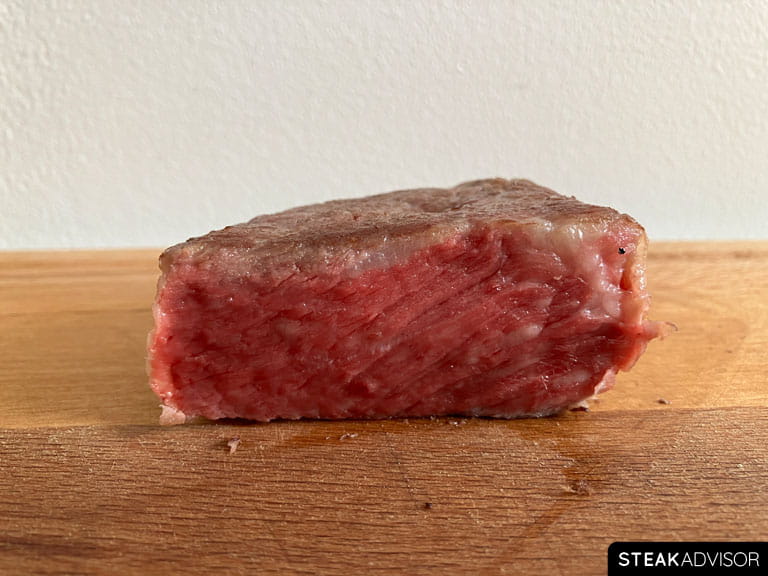
Closer to 130°F (54°C), the texture becomes a little firmer and more steak-like. It still feels very tender and juicy, but noticeably less wet and slippery than at the lower end of the range.
Rare doneness works best with naturally tender, lean cuts. At this temperature, tougher cuts can still feel chewy. Well-marbled steaks are a different story. They are not necessarily chewy, but the intramuscular fat (marbling) still has not had enough time to render properly. Even close to 130°F (54°C), the fat still feels firm and waxy, which is why well-marbled steaks taste better at a slightly higher doneness
Rare steak is far more popular than blue rare, but for many people, it still feels undercooked. It tends to appeal more to people who enjoy very lightly cooked beef or dishes like beef tartare. Personally, I feel much the same way about rare as I do about blue rare: it is simply not for me.
Note
Rare steak is also cooked to an internal temperature below the 145°F (63°C) recommended by the USDA for whole cuts of beef. That doesn’t automatically mean it’s unsafe, but it still does come with more risk than steak cooked to a higher internal temperature. If that matters to you, choose a higher level of doneness.
Medium Rare: 130-140°F (54-60°C)
Medium-rare steak has a light pink, slightly rosy center. It is warm throughout and still very juicy, with a tender, pleasant bite. For me, it is the best doneness for most steaks because it offers the best balance of tenderness, juiciness, and flavor.
Best for: Most steaks, especially ribeye, strip steak, and filet mignon.
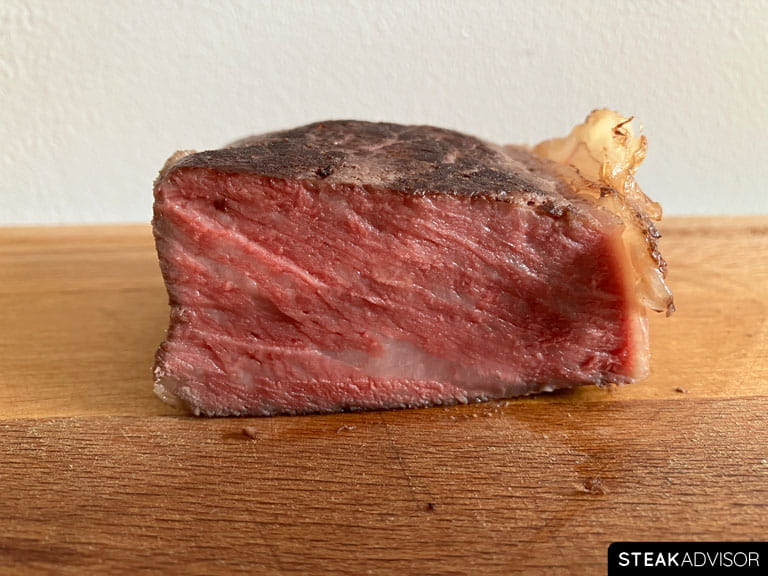
One of the main advantages of cooking steak to medium-rare is that, once the internal temperature rises above 130°F (54°C), especially around 137°F (58°C), the fat renders more noticeably. As more of the intramuscular fat renders, it helps lubricate the muscle fibers, which makes the steak juicier, more tender, and more flavorful. This is why medium-rare works so well for cuts like ribeye or strip steak.
The lower end of the medium-rare range, around 130°F (54°C), works very well for leaner steaks, as it helps preserve their juiciness and tenderness. However, lean cuts are best not cooked too close to 140°F (60°C), since they lack the marbling that helps protect them from drying out.
Note
Medium-rare steak is also cooked to an internal temperature below the 145°F (63°C) recommended by the USDA for whole cuts of beef. That recommendation is the standard consumer food-safety guideline. However, it does not fully reflect methods such as sous vide, where precisely controlled time and temperature can also pasteurize meat at temperatures above 130°F (54°C) when held long enough. Still, for fast, conventional cooking methods, this level of doneness is not considered safe by USDA standards.
That does not automatically mean it is unsafe, but it does carry more risk than steak cooked to a higher internal temperature. If that matters to you, choose a higher level of doneness.
Medium: 140-150°F (60-66°C)
A medium steak has a muted pink center and a noticeably hotter, firmer texture than a medium-rare steak. It is less juicy and slightly chewier because it loses more moisture during cooking. This doneness works best for well-marbled steaks. It is not a good choice for leaner cuts, which dry out more easily at this temperature.
Best for: Well-marbled cuts such as ribeye, strip steak, and highly marbled Wagyu.
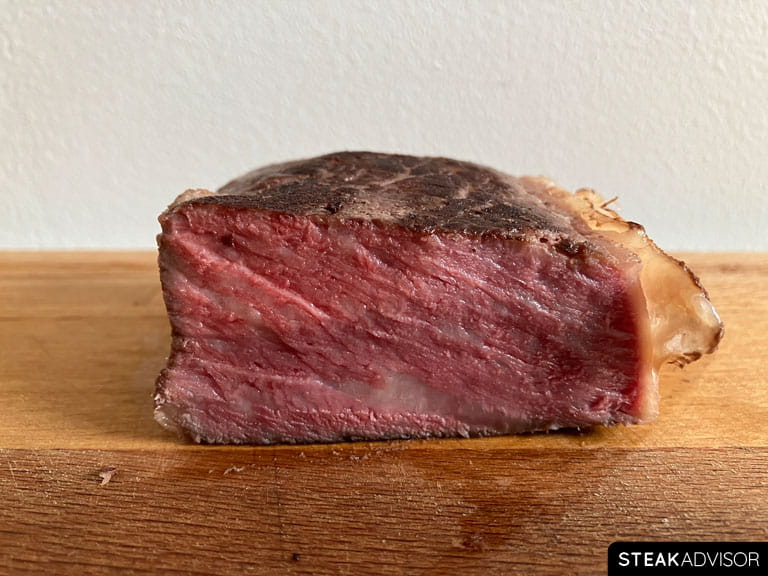
With well-marbled cuts, the extra rendered fat helps make up for some of that moisture loss. In those steaks, the softened fat adds richness, moisture, and flavor. That is why medium doneness works so well for cuts such as ribeye or strip steak. It is also a good choice for very highly marbled beef, such as A4 or A5 Japanese Wagyu, since the slightly higher temperature helps render much more fat.
Medium doneness is the best choice for people who do not like red in their steak.
Still, be careful not to push it too far. Once you get close to 150°F (66°C), the meat starts to lose juiciness and tenderness more noticeably, which means it’s very important not to go above that level for any cut, even the highly marbled one.
Leaner or more coarsely textured cuts, such as hanger, inside skirt, or flap steak, tend to suffer more at this doneness. They dry out more quickly and become noticeably firmer and chewier, especially near the upper end of the range.
Personally, I really like the lower end of medium for very well-marbled steaks. Think top USDA Prime or, even better, a good Wagyu.
Note
Medium is also the point at which steak reaches the USDA’s recommended minimum internal temperature for whole cuts of beef: 145°F (63°C), followed by at least a 3-minute rest.
Medium Well: 150-160°F (66-71°C)
A medium-well steak has a muted brownish-pink color, with much less pink than a medium steak. At this doneness, the steak is hot all the way through and noticeably firmer, with very little juice left inside. It’s a good choice for anyone who prefers very little pink in their steak and does not mind a firmer, drier, slightly chewier texture.
Best for: Highly marbled cuts such as ribeye, ribeye cap, or outside skirt steak.
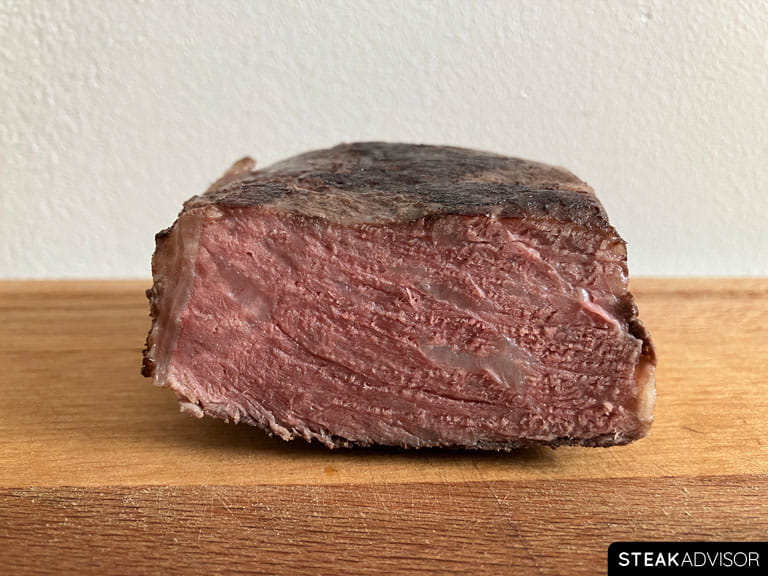
Medium-well is not a good choice for lean cuts because they lose too much moisture at this level of doneness. By the time they reach medium-well, they’re dry, firm, and tough.
If you want to cook a steak to medium-well, choose a highly marbled cut such as ribeye, ribeye cap, or outside skirt steak, and keep it closer to the lower end of the medium-well range. The rendered fat helps improve the texture, juiciness, and flavor, but medium-well is still not the best way to get the most out of a steak.
Personally, I’m not a fan of medium-well steak. For me, it loses too much of what makes steak great: tenderness, juiciness, and rich beef flavor. But that’s just my opinion. Taste is personal, and if you enjoy your steak medium-well, that’s perfectly fine. The most important thing is that you enjoy what you’re eating.
Well-Done: Over 160°F (71°C)
A well-done steak is cooked all the way through, with no pink left inside. The center is brownish-gray from edge to edge, the texture is firm, and most of the juices are gone.
Best for: Well-marbled or loose-grained cuts such as ribeye, flat iron, or outside skirt steak.
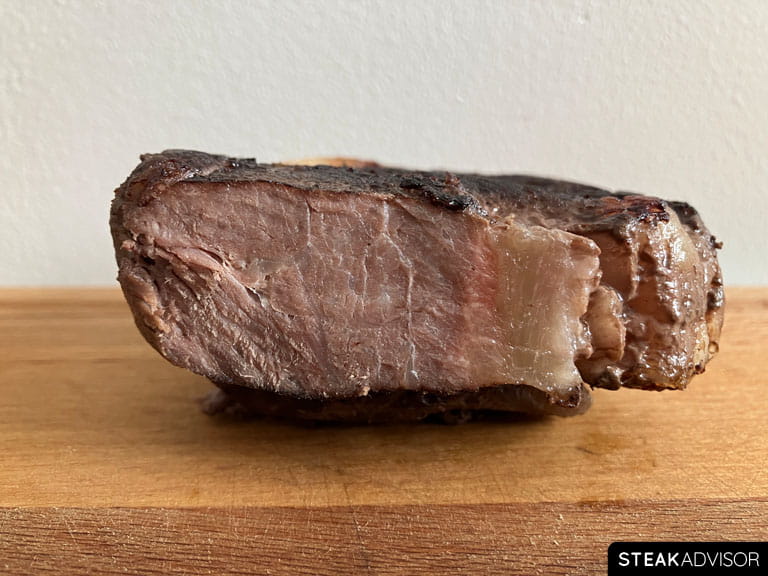
This is the worst doneness for naturally tougher cuts or leaner cuts, because they become even chewier once cooked this far. Even well-marbled cuts suffer at this level of doneness because the moisture loss is so high.
Most steak enthusiasts and chefs don’t recommend cooking steak well-done unless you truly enjoy it that way or need to for personal or health reasons. I agree with that completely. If you don’t like seeing red in the center, I’d recommend cooking the steak to medium or, at most, medium-well.
That said, don’t get me wrong. If well-done is how you like your steak, go for it. The key is choosing the right cut. Some steaks can still be relatively satisfying at this doneness, especially cuts with plenty of marbling or looser muscle fibers. Ribeye, flat iron steak, and outside skirt steak are good examples.
These are the cuts I’d choose if I had to cook a steak well done. They are still reasonably satisfying when cooked to 160°F (71°C), even for someone like me who prefers most steaks medium-rare or on the lower end of medium.
How to Measure Steak Temperature
The best way to check a steak’s internal temperature is to use a meat thermometer. It’s the only reliable way to know exactly what’s happening inside the steak without guessing. It’s also simple, fast, and inexpensive.
Here’s how to measure steak temperature properly:
- Insert the probe into the thickest part of the steak.
- Go in from the side, toward the center, for the most accurate reading.
- Avoid touching bone, fat, or the pan/grill.
No matter which type of thermometer you use, these basic rules stay the same.

For hot-and-fast cooking methods, such as pan-searing or grilling, an instant-read thermometer works great. For slower methods, such as reverse searing or smoking, a leave-in probe thermometer or a wireless thermometer works even better, as you can monitor the temperature from start to finish as the steak cooks.
Personally, I recommend having both if you cook steak often, especially expensive cuts. It may sound like too much, but trust me, these tools are incredibly useful. And not just for steak, they’re great for cooking all kinds of food.
You don’t need anything fancy. Sure, you can buy an expensive thermometer with a lot of extra features, but it’s not necessary. All you really need is a basic meat thermometer that reads accurately and relatively fast. For about $30, you can get a very solid one.
One more important thing
Don’t cook steak based on time alone. Use the internal temperature instead. Cooking time is just a rough estimate. It changes depending on the cut, thickness, cooking method, pan, grill, burner power, and a bunch of other factors. If you want consistent results, rely on the steak’s internal temperature, not the clock.
How Not to Measure Steak Doneness
Many chefs, especially older-school ones, still recommend the finger test as a reliable way to check steak doneness. The idea is simple: you press the steak and compare its firmness to the fleshy part of your hand under your thumb.
Unfortunately, this is one of the worst ways to check doneness.
Sure, if you cook dozens of steaks every day, you can develop a feel for when a steak is ready. But if you cook steak only from time to time, especially different cuts and thicknesses, this method is not reliable.
Not every steak feels the same when you press it. A tender filet mignon feels much softer than a strip steak, and a well-marbled ribeye won’t feel the same as a leaner cut. That’s why judging doneness by touch is unreliable. On top of that, everyone’s hand is different. The fleshy pad under your thumb won’t feel the same as mine, so using it as a reference point makes no sense if you want consistent results.
You can test this with a few different people, and I’m sure the results will vary a lot.
So no, don’t rely on the outdated finger test, even if a popular chef recommends it. Use a meat thermometer. It’s faster, easier, and removes the guesswork completely.
When to Remove Steak From Heat
Most steak temperature and doneness charts show the final temperature, not the temperature at which you should remove the steak from the heat. You need to remove the steak before it reaches your target temperature because its internal temperature will continue to rise as it rests – this is called carryover cooking.
How much it rises depends on the steak’s thickness, the cooking method, and how hot the steak’s surface gets during cooking. In most cases, the internal temperature can rise by about 5–25°F (3–14°C) after the steak comes off the heat. That’s why removing it early is so important.
Based on my experience, with slower methods like reverse searing at 225°F (107°C), the internal temperature usually rises by about 5°F (3°C) after the steak comes off the heat. If you cook it at a slightly higher temperature, around 275–300°F (135–149°C), expect closer to a 10°F (6°C) rise.
With direct high-heat cooking methods, like pan-searing or grilling, the carryover is much higher. For a steak about 1 inch (2.5 cm) thick, remove it from the heat at least 15°F (8°C) below your target temperature. For thicker cuts, around 1 1/2 inches (3.8 cm) or more, remove it about 20°F (11°C) below your target.
Note
The guidelines above are mostly for steaks cooked to medium-rare or medium. It’s hard to give one exact remove-from-heat temperature because carryover depends on the steak’s thickness, cooking method, pan or grill temperature, and how long the steak was exposed to high heat. Treat these numbers as a rough guide, and adjust based on your own cooking setup.
The key thing to remember is this: fast, high-heat methods create a much larger temperature difference between the steak’s surface and its center. That’s why steaks cooked hot and fast have much more carryover than steaks cooked at low temperatures.
Many recipes still suggest removing a pan-seared or grilled steak only 5°F (3°C) below the target doneness. That’s a big mistake. With steaks at least 1 inch (2.5 cm) thick, the real carryover after a few minutes of resting is usually closer to 15°F (8°C) or more.
The advice to remove a steak only 5°F (3°C) below your target temperature works only for very thin cuts, up to about 1/2 inch (1.3 cm) thick, or for steaks cooked with low-temperature methods, where the cooking temperature is around 200–250°F (93–121°C). For thicker cuts cooked over direct high heat, it’s simply not enough.
I ran a case study to see how much a steak’s internal temperature rises during resting, depending on thickness and cooking time. The steaks were cooked in a pan over high heat, above 400°F. You can read the full article here: Resting Steak After Cooking: Why You Should and for How Long.
The main takeaway from that test was simple: the hotter and faster you cook a steak, the more carryover cooking you should expect.
What Is the Best Doneness for Steak?
There is no single best doneness for steak. It depends on the cut, the amount of marbling, the muscle structure, the steak’s natural tenderness, and, of course, personal preference.
For example, cooking a heavily marbled steak, such as high-grade Wagyu, to 141°F (61°C), which falls into the medium range, is a great idea. But cooking filet mignon to that same temperature would be a mistake for many steak lovers.
Personally, I prefer most steaks cooked close to 140°F (60°C), which is the upper end of medium-rare / lower end of medium. But that’s just my personal preference. It’s completely fine if you like your steak cooked more or less than that.
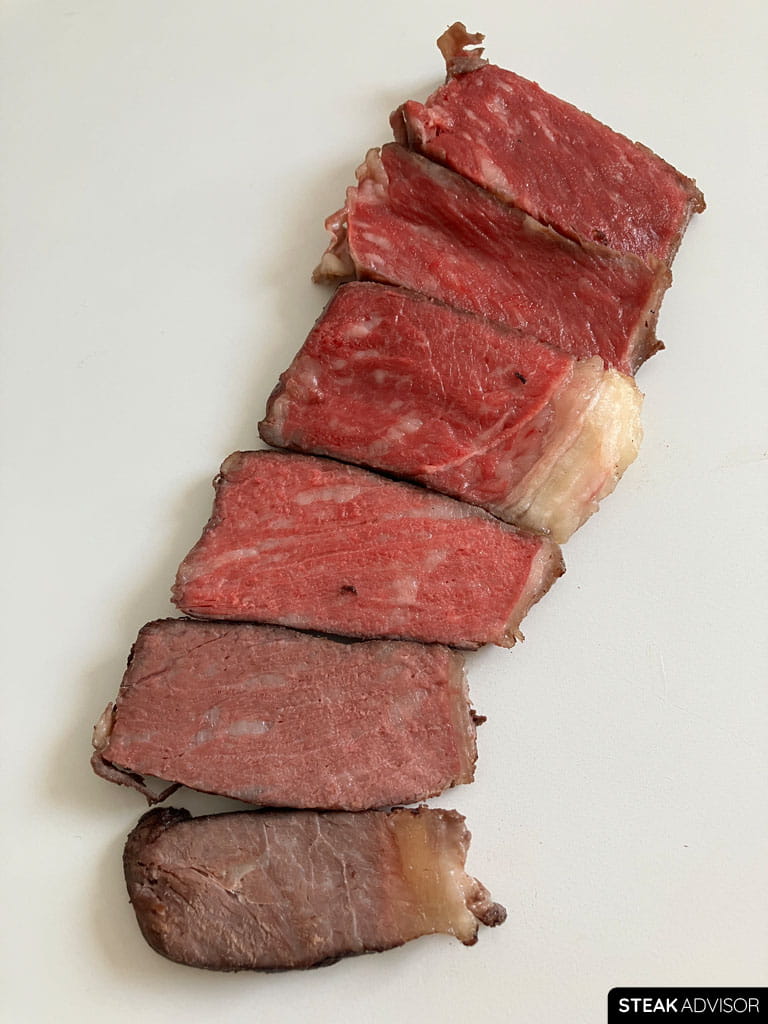
Best Steak Doneness by Cut
The best doneness depends mostly on how tender, lean, fatty, or well-marbled the cut is. As a general rule, lean and tender cuts are better at lower temperatures, while well-marbled cuts can handle slightly higher doneness because the fat has more time to render.
| Type of Cut | Examples | Best Doneness |
| Lean, tender cuts | Filet mignon, tenderloin | Rare to medium-rare |
| Well-marbled cuts | Ribeye, strip steak | Medium-rare to medium |
| Highly marbled beef | High-grade Wagyu | Medium to lower medium-well |
| Loose-grained fatty cuts | Outside skirt, ribeye cap | Medium-rare to medium-well |
| Leaner or coarser cuts | Hanger, bavette, flank | Medium-rare |
This is only a general guide. A thick, well-marbled ribeye can still be excellent at medium, while a lean filet mignon may taste dry at the same temperature. When in doubt, aim for medium-rare, then adjust based on the cut and your own preference.
What to Do If You Miss the Target Doneness
If you remove the steak from the pan or grill, or check its internal temperature while it’s still cooking, and notice that it’s already close to your target doneness or slightly above it, slice it right away into thin strips. That’s the best way to stop carryover cooking and prevent the steak from cooking even further.
Unfortunately, there is not much else you can do at that point.
If the steak is overcooked and you don’t like its tougher, drier texture, slice it very thinly and use it in a dish where steak is only one part of the meal, not the main focus. It can still work well in salads, tacos, quesadillas, sandwiches, or similar dishes.

The side-by-side photos are insanely helpful. Way easier than trying to judge doneness from a chart alone.
Thanks, Megan.
The photo showing the doneness levels is brilliant. Honestly more useful than any temperature chart I’ve seen.
Thanks for the comment. Glad the photo was helpful.
I never really thought about choosing doneness based on the cut. The part about ribeye and filet made a lot of sense – I’m definitely not going to treat every steak the same anymore.
Thanks for the feedback.
I love the photos in this guide. Seeing each doneness level side by side makes it so much easier to understand than just reading the temperatures.
Thanks, Noah.
The photos made a huge difference for me. I always knew the temperatures mattered, but actually seeing the difference between each doneness level was a real “wow” moment. Super helpful guide.
Love that it helped! The side-by-side photos make the temperature differences much easier to understand.
The steak temperature chart is super helpful. Great guide.
Thanks, Daniel!
Thank you for having the temperatures right at the top.
Thanks, Richard. I wanted the key temperatures easy to find.
Excellent!!
Thanks!!
Thank you, John. Appreciate the kind words.