

Most of the debate about resting steak after cooking focuses on one idea: that letting it rest for 5-10 minutes helps it retain more juices than if you slice it right away. But based on a range of tests, including my own, that idea doesn’t hold up. It’s a myth.
Don’t get me wrong: resting does matter, just not for the reason most people think. The real reason is carryover cooking: the steak keeps cooking after it leaves the heat, and that short rest helps it finish at the doneness you actually want. And that’s the part most people ignore.
Below, I’ll explain why resting steak matters, why the idea that it makes steak juicier is a myth, how carryover cooking changes the final result, and how long you should actually rest steak based on its thickness and cooking method.
Quick Overview
How Long Should You Let Steak Rest?
After testing steaks of different thicknesses and tracking their internal temperatures after cooking, I found that most steaks only need about 5 minutes of rest. In some cases, you can even skip resting, but that depends mostly on the cooking method.
I highly recommend reading the full article, especially the detailed test summary, to understand why this advice isn’t based on the “resting keeps steak juicy” theory.
Here’s a quick summary of how long I recommend resting steak depending on the cooking method:
| Cooking method | Resting recommendation |
| Pan-seared steak | 5 minutes for 1–1.5 inch (2.5-3.8 cm) thick steak; 6–7 minutes for thicker steaks |
| Grilled steak | Similar to pan-seared if cooked over direct high heat |
| Reverse sear | Rest after searing for 5 minutes, but pull earlier before sear |
| Sous vide | Chill/rest before searing; serve right after searing |
| Low oven steak | Minimal carryover; rest depends on final sear |
| Broiled steak | Expect high carryover; pull much earlier |
Why Resting Steak Matters: Carryover Cooking vs. Juice Loss
To understand why resting matters, you first need to understand what happens to a steak’s internal temperature after it comes off the heat. The amount of juice left on the cutting board after slicing does not tell you much on its own.
A steak doesn’t stop cooking the moment you remove it from the heat. Heat continues to move from the hotter outer layers toward the cooler center. During cooking, the surface of the steak gets much hotter than the inside, so once the steak comes off the heat, that stored heat keeps moving inward until the temperature starts to even out. This process is called carryover cooking.
In general, the hotter you cook the steak, the bigger the temperature difference between the surface and the center. And the bigger the difference, the more carryover cooking you can expect during resting. That’s why a steak cooked in a very hot pan has a much larger carryover effect than one cooked gently in a low oven, for example, at 225°F (107°C).
Based on my tests, the first 5 minutes of resting are the most important. That’s when most of the carryover temperature increase happens. After that, the increase slows down significantly as the steak approaches its peak internal temperature. This matters because resting changes the steak’s final internal temperature. And that final temperature matters because as a steak reaches higher internal temperatures, it loses more moisture. Even a 10°F (6°C) difference is enough to noticeably change the steak’s texture and juiciness.
Now imagine this common test: you cook two steaks in a very hot pan, slice one immediately, and let the other rest for 5–10 minutes before slicing. The rested steak leaves less juice on the cutting board, so the conclusion seems obvious: “Resting keeps more juice inside the steak.” But that conclusion ignores carryover cooking.
Measure the internal temperature of both steaks at the moment they are sliced, and you’ll likely see a clear difference. With a 1 1/2-inch (3.8 cm) thick steak cooked only over high heat in a pan, the rested steak can easily reach a final internal temperature 10–15°F (6–8°C) higher than the steak sliced immediately, sometimes even more. So this is not a fair comparison. You are not comparing two steaks at the same doneness. You are comparing one steak, sliced immediately at a lower internal temperature, with another steak, sliced later after its internal temperature has continued to rise for several minutes due to carryover cooking.
So the juice left on the cutting board does not prove that resting makes steak juicier. The test does not isolate the effect of resting. It mixes resting time with a change in final internal temperature, which confounds the result.
A better test would compare steaks sliced at the same final internal temperature, not simply after the same cooking or resting time. To do that, you would pull the steaks from the heat at different temperatures, so carryover cooking brings them to the same final temperature by the time they are sliced. You would also weigh each steak raw, just after cooking, and immediately after slicing. That way, you are measuring total moisture loss, not just the juice left on the cutting board.
In the tests I’ve seen and done myself, rested and non-rested steaks lose almost the same amount of juice as long as they are sliced at the same final internal temperature. Chris Young shows this well in his video “Proof Resting Doesn’t Keep Meat Juicy“, where he compares moisture loss from rested and non-rested steaks sliced at nearly the same final temperature.
That’s the key point. A steak sliced immediately may leave more juice on the cutting board, but that doesn’t mean it lost more juice overall. While resting, the other steak continues to cook; its internal temperature increases, so it keeps losing moisture through surface evaporation and drip loss. That means judging juiciness only by the juice left on the cutting board is not a reliable test.
Key Takeaway: Resting Matters, But Not Because It “Locks In Juices”
Resting steak matters, but not because it magically locks in the meat’s juices. That’s a myth. The real reason resting matters is carryover cooking. As the steak rests, its internal temperature continues to rise during the first few minutes, and that final temperature affects both doneness and moisture loss.
That’s why, in this article, I decided to focus more on testing how much carryover cooking changes the final result. In my experience, one of the most common reasons people overcook steak is the advice to “remove the steak just 5°F (3°C) below the target temperature and let it rest for at least 5 minutes.” As explained above, that advice can easily push the steak past the doneness you actually wanted. It also helps explain why the common cutting-board juice test is misleading: a steak sliced right away is often compared to a rested steak that has continued cooking to a higher final internal temperature.
In the tests below, I’ll show you the average carryover increase during 5–7 minutes of resting for steaks of different thicknesses cooked in a very hot pan. I’ll also explain why those results differ so much depending on the cooking method, and why the “pull 5°F (3°C) ” rule works better for gentle cooking than for high-heat pan cooking. Finally, I’ll explain why, based on my tests, a 5-minute rest is usually the best general advice for most steak-cooking methods.
How I Tested Steak Resting Times
My goal was to keep the testing process as consistent and controlled as possible, so the results would be fair and easy to compare. I wanted to see how much the steak’s internal temperature rises after removing it from the heat, how long it takes to reach its peak, and when the temperature starts to drop.
Here’s how I ran the tests:
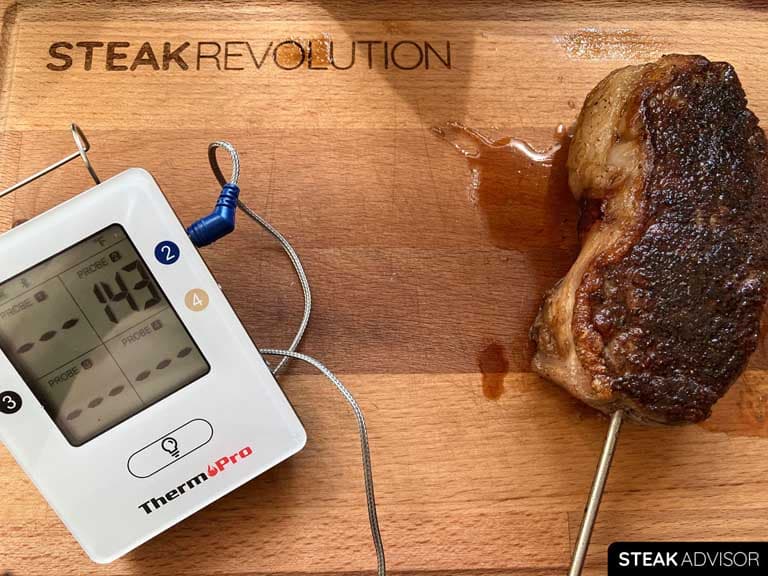
- For every test, I used a leave-in probe thermometer with an app. This setup let me track the steak’s internal temperature throughout cooking and resting, and clearly see when the carryover temperature peaked.
- I tested steaks of different thicknesses. I cut the steaks to different thicknesses to compare the average increase in temperature from carryover cooking after removing them from the heat.
- I tested different cooking techniques. I cooked steaks using different methods to see how carryover varies with cooking technique, cooking temperature, and total cooking time.
- For most tests, I removed the steak from the heat once its internal temperature reached 110°F (43°C). This gave me a consistent starting point for comparing the increase in internal temperature after cooking. My goal was to see if the steak would finish in the medium-rare range, about 130–140°F (54–60°C), after resting.
- I tracked the internal temperature during the entire cooking process. After removing each steak from the heat, I focused especially on what happened during the first 10 minutes. But I didn’t stop there. I kept tracking the temperature until it reached its carryover peak and started to fall. This helped me see when the carryover peak usually happens and how long the steak actually needs to rest.
My Steak Resting Tests
Below, I’ll show how the steak’s internal temperature changed after I removed it from the heat, along with graphs that track the carryover temperature rise over time.
Pan-Seared Steak Resting Test Results by Thickness
These results are from several eye of round steaks, each about 1 inch (2.5 cm) thick, cooked entirely in a cast-iron skillet on the stovetop.
For each test, I preheated the skillet over medium-high heat for 4–5 minutes, until the surface reached at least 450°F (232°C). I cooked the steak, flipping every 30 seconds, until the internal temperature reached 110°F (43°C). After removing the steak from the pan, I let it rest until the internal temperature peaked and began to fall.
The images below show the carryover temperature rise after cooking, including the peak temperature and the time needed to reach it.
1-Inch (2.5 cm) Pan-Seared Steak
Average carryover rise: 24°F (13°C), peaking after about 3-4 minutes of resting.


1.25-Inch (3.2 cm) Pan-Seared Steak
Average carryover rise: 25°F (14°C), peaking after about 4 minutes of resting


1.5-Inch (3.8 cm) Pan-Seared Steak
Average carryover rise: 25°F (14°C), peaking after about 5 minutes of resting.
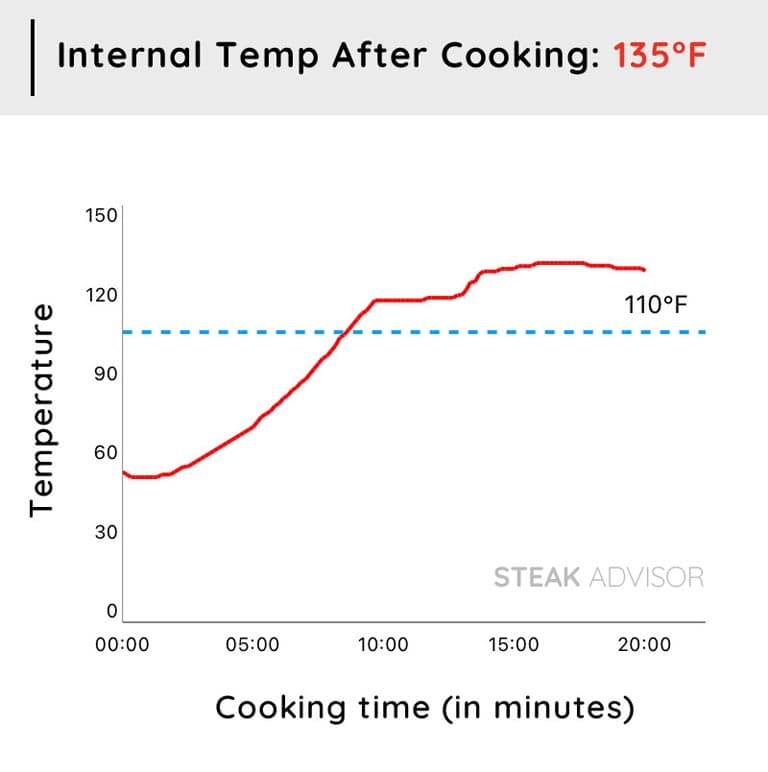

1.75-Inch (4.5 cm) Pan-Seared Steak
Average carryover rise: 26°F (14.4°C), peaking after about 5 minutes of resting.

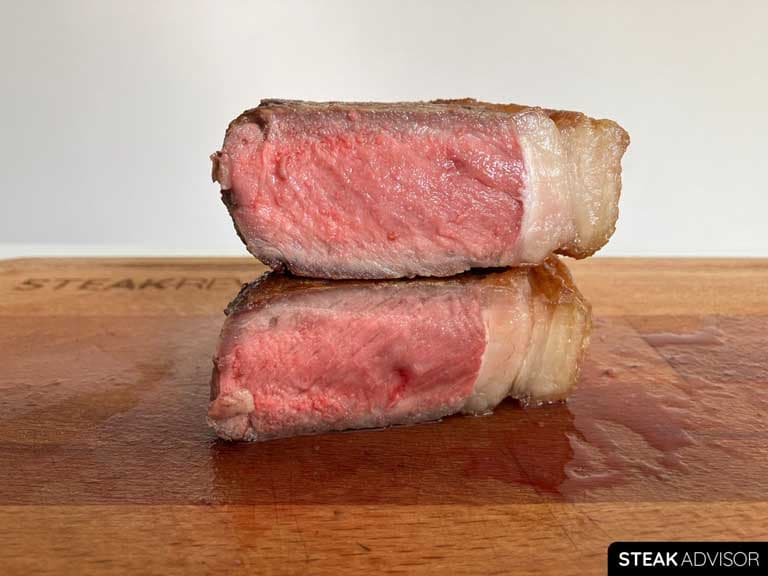
2-Inch (5 cm) Pan-Seared Steak
Average carryover rise: 28°F (15.5°C), peaking after about 5-6 minutes of resting.


What the Pan-Seared Steak Resting Tests Showed
Based on my tests, the ideal resting time for a steak cooked over direct high heat, either in a pan or on the grill, is 5 to 7 minutes. During that time, the steak’s internal temperature rises to its peak, stabilizes, and then slowly starts to drop. Resting it longer doesn’t really add any benefit.
For steaks cooked in a very hot pan, with the surface temperature around 500°F (260°C), and removed from the pan at 110°F (43°C), here’s what I usually see:
- Steaks 1 to 1.5 inches (2.5-3.8 cm) thick: The internal temperature typically rises by about 20–25°F (11–14°C) within the first 5 minutes.
- Steaks 1.75 to 2 inches (4.4–5 cm) thick: The internal temperature usually rises by about 25–28°F (14–15.5°C) within the first 6–7 minutes. Sometimes it can rise even higher, around 30°F (16.5°C), depending on the cooking time, steak thickness, and pan or grill temperature.
The biggest takeaway is simple: the carryover rise after pan-searing or grilling is much higher than most recipes suggest. Many guides say to expect only a 5–10°F (3–6°C) increase, but with direct high heat, that’s too low. Based on my tests, the rise is closer to 20–30°F (11–17°C).
That’s why removing the steak from the heat early is so important. If you wait until the steak reaches just 5°F (3°C) below your target temperature in the pan or on the grill, it will likely overcook while it rests.

If you’re not sure when to remove the steak from the pan, use this simple rule:
- For steaks 1 to 1 1/2 inches (2.5–3.8 cm) thick, remove them about 20°F (11°C) below your target temperature.
- For steaks thicker than 1 1/2 inches (3.8 cm), remove them about 25°F (14°C) below your target temperature.
Then let the steak rest:
- 5 minutes for steaks up to 1.5 inches (3.8 cm) thick.
- 6–7 minutes for thicker steaks.
This method won’t be perfect every single time, because steak thickness, pan temperature, grill temperature, flip timing, and total cooking time all matter. But it gives you a much better chance of landing close to your target doneness instead of overshooting it during resting.
Important
These results apply only to steaks cooked over direct high heat in a pan or on a grill, and flipped every 30 seconds. Don’t use these numbers for sous vide, reverse sear, oven finishing, or any slower cooking method. Those methods create a much smaller temperature difference between the surface and the center, so the carryover increase is completely different.
What About Other Steak Cooking Methods?
Reverse-Seared Steak: Why Carryover Still Matters After Searing
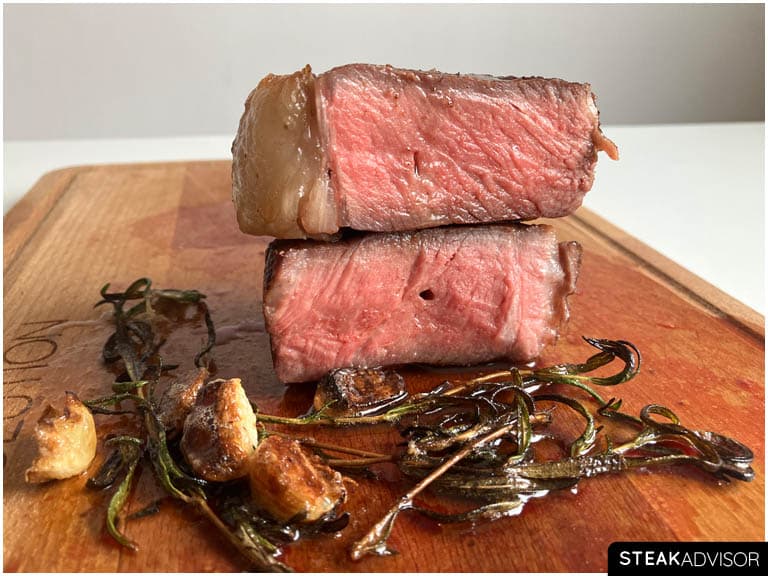
Most reverse-sear recipes tell you to cook the steak in the oven until it’s just about 5°F (3°C) below your target temperature, then move it straight to a very hot pan for a quick sear. No resting, no waiting, just sear it and serve.
Well, that advice is only half true.
Here’s the problem: when you take a warm steak straight from the oven and place it in a ripping-hot pan, you have almost no room for error. If the steak is already sitting at around 130°F (54°C) throughout, it doesn’t need much more heat to overshoot medium-rare. And let’s be honest, most people don’t sear for only 30 seconds per side. They sear longer because they want a nice crust. That’s where things go wrong.
What most reverse-sear recipes ignore is what happens after the steak leaves the pan. Even if the sear only takes 1–2 minutes, the steak continues to rise in temperature once it’s off the heat. A lot of people think skipping the rest solves the problem, but it doesn’t. Once the steak comes out of the pan, the heat is still moving from the surface toward the center. In practice, those first 3–4 minutes are often enough to push the steak past your target doneness.
And in real life, almost no one eats the steak the second it leaves the pan. You still need to move it to a board, plate it, finish the sides, take a photo, or bring it to the table. That can easily take 3–4 minutes, which is enough time for the internal temperature to rise due to carryover cooking and push the steak past your target doneness.
The Better Strategy
Based on my tests with resting steak, I use a safer approach for reverse-seared steak.
Instead of pulling the steak from the oven just 5°F (3°C) below the target temperature, I remove it 20°F (11°C) below the final temperature I want (for example, at 110°F / 43°C). Then I preheat a cast-iron skillet for 4–5 minutes, add a high-smoke-point oil, and sear the steak for 2 minutes total, flipping every 30 seconds.
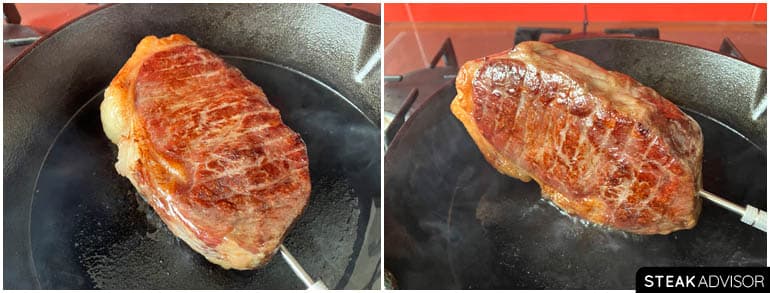
After searing, I remove the steak from the pan and let it rest for 5 minutes. During that rest, carryover cooking brings the steak up to the final target temperature, around 135°F (57°C) for medium-rare.
This gives me much better control. I get the crust from the hot pan, but I also leave enough room for the temperature to rise after searing. That way, I don’t end up with a steak that looked perfect in the oven but turned overcooked by the time it reached the plate.
For the full method, check out my Reverse-Seared Steak Recipe (Oven-to-Pan Method).
Note
Don’t underestimate carryover cooking just because the steak was cooked gently in the oven first. The final sear changes everything. A very hot pan creates a big temperature difference between the surface and the center, and that stored surface heat keeps cooking the steak after you remove it from the pan.
That’s why I don’t recommend taking a reverse-seared steak all the way to 5°F (3°C) below the target before searing. It gives you almost no room for error. Pulling it earlier, searing it hard, and letting the carryover finish the job is much more reliable.
Sous Vide Steak: Why You Should Rest It Before Searing, Not After
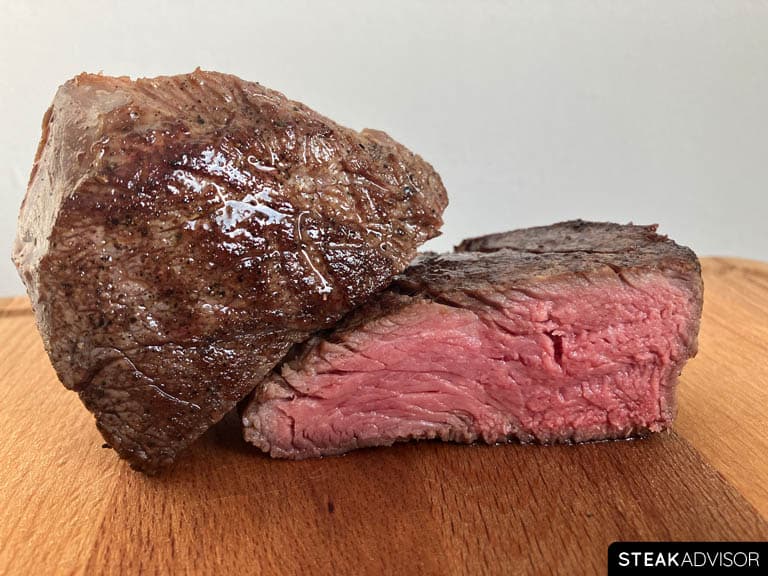
The problem with sous vide steak is that it’s already cooked through to your exact target temperature. If you cook it at 135°F (57°C), the whole steak is basically sitting at that temperature from edge to edge. That means you can’t just take it out of the bag and sear it immediately in a ripping-hot pan. Even a short 1-minute sear will push it past your target doneness.
That’s why, with sous vide steak, the key is to cool it down before searing, rather than resting it after searing.
Right after the sous vide bath, keep the steak sealed in the bag and place it in cold water for at least 10 minutes. After that, open the bag, remove the steak, pat it completely dry with paper towels, then place it on a plate on its side and refrigerate it uncovered for another 10 minutes.
This step does two important things. First, it lowers the steak’s internal temperature a bit, giving you more room for the final sear. Second, it helps dry the surface. And that matters because any moisture on the outside has to evaporate before browning can really start. The drier the surface, the faster the steak builds a crust.
Once the steak is chilled and dry, it’s ready for a hard sear. Use a very hot pan and keep the sear short, about 2–3 minutes total, flipping every 30 seconds. That’s enough time to build a good crust without creating a thick gray band under the surface.
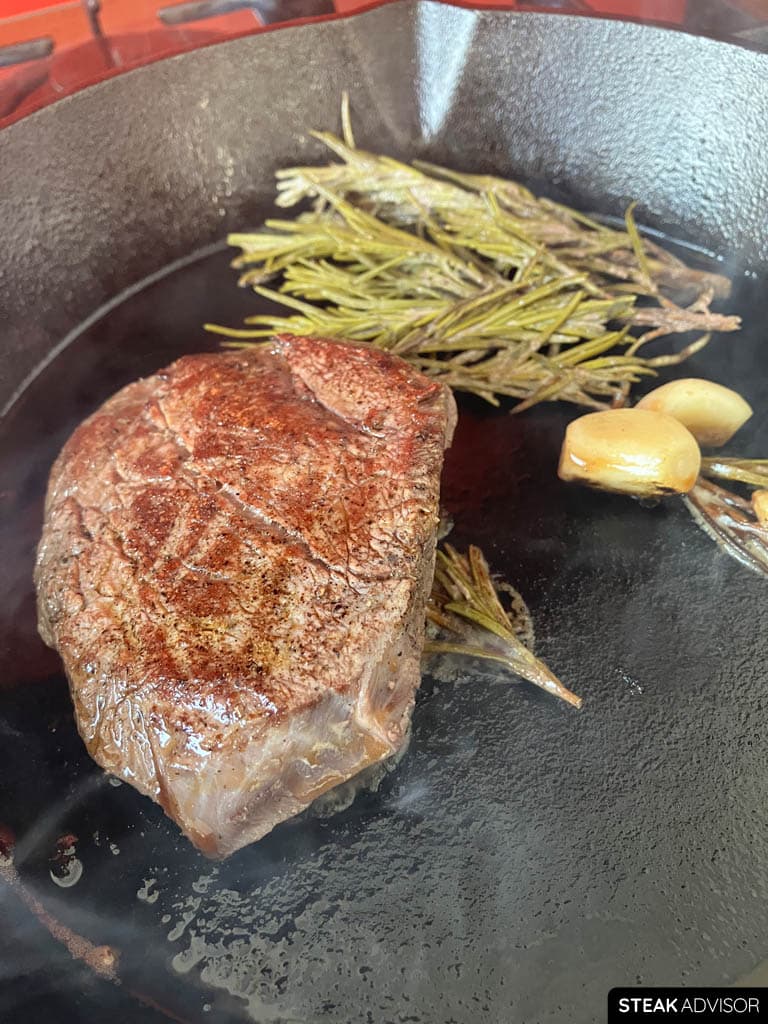
After searing, don’t rest the steak as you would with a pan-seared or grilled steak. Serve it right away. Sous vide steaks cool down quickly, especially when you chill them before searing, so the best time to eat them is immediately after they come out of the pan.
Remember, the steak is already cooked inside to your target temperature. Cooling it down first lowers the internal temperature, giving you some room for the final sear. Then, during the quick searing stage, the steak forms a nice crust and warms back up, but it doesn’t go past your target doneness. It ends up hot enough to eat, without being overcooked.
To learn more, check out my step-by-step guide on How to Sous a Vide Steak.
Oven-Baked Steak: Why Higher Oven Temperatures Mean More Carryover
When it comes to carryover cooking, remember one thing: the hotter you cook the steak, the bigger the temperature difference between the surface and the center. And the bigger the difference, the more carryover cooking you can expect during resting. This rule applies regardless of the cooking method you use. What matters most is the cooking temperature and how long the steak stays exposed to that heat.
With the oven, we can set one specific temperature and cook the steak in a stable environment from start to finish. That makes oven cooking great for testing carryover because the results are much easier to compare. When the temperature stays consistent, you can predict the carryover increase within a few degrees.
I tested this by cooking steaks of the same thickness to the same internal temperature, but at different oven temperatures. I started at 200°F (93°C), then increased the oven temperature in 25°F (14°C) increments. The results were clear: the hotter the oven, the higher the carryover.
That makes sense. The higher the oven temperature, the bigger the temperature difference between the steak’s surface and its center. After the steak comes out of the oven, the heat stored near the surface continues to move inward, raising the internal temperature during resting.
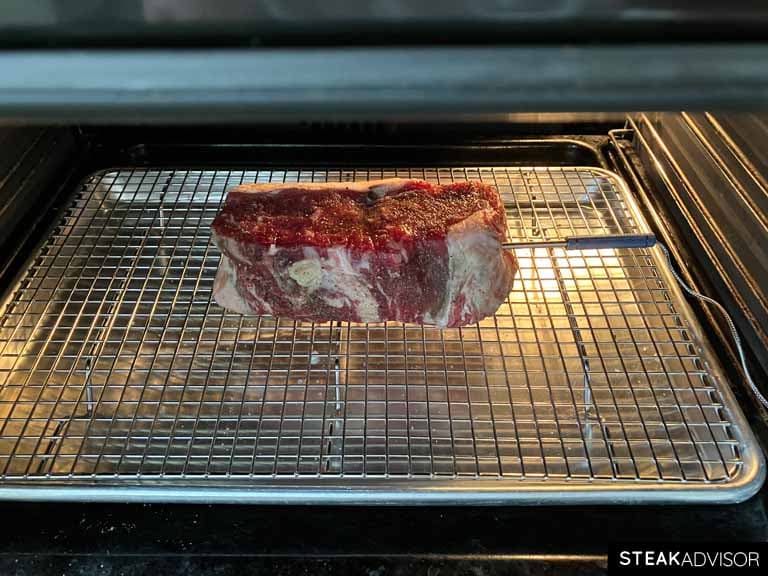
The main reason I ran these tests is that many oven-based steak recipes, especially reverse-sear recipes, tell you to cook the steak anywhere between 200°F and 300°F (93–149°C), then remove it only 5–10°F (3–6°C) below your target temperature.
That advice works at lower oven temperatures. If you cook a steak at 200°F (93°C), then let it rest for 5 minutes while you preheat the pan for the final sear, the carryover may be only 2–3°F (1–2°C), or even close to zero. This is especially true if you cooked the steak straight from the fridge, without letting it sit at room temperature first. But if you cook that same steak at 275°F (135°C), the result is different. From my tests, you can easily get at least 5°F (3°C) of carryover, and often closer to 10°F (6°C), before the steak even touches the pan.
And that’s the problem.
The final sear adds even more heat. If you sear the steak for about 2 minutes total in a preheated cast-iron skillet at around 450°F (232°C), you can expect the internal temperature to rise by another 10°F (6°C), sometimes more depending on the steak’s thickness and how hot the pan is.
So let’s say you cook a steak in a 275°F (135°C) oven and remove it 10°F (6°C) below your target temperature. Within 4–5 minutes of resting, the internal temperature may already rise by 5–10°F (3–6°C). Then you sear it in a very hot pan, and the temperature rises again by another 10°F (6°C). That’s how you easily overshoot your target by about 10°F (6°C), sometimes more.
This is one of the most common reasons people overcook reverse-seared steaks. They ignore the cumulative carryover from the oven stage and the final sear.
Key Takeaways for Oven-Cooked Steak
- If you want very little carryover, cook the steak gently, at no more than 225°F (107°C). At that temperature, the carryover will be small, close to zero, especially with thinner steaks.
- If you cook the steak at a higher oven temperature, for example, 275–300°F (135–149°C), leave more room before the final sear. Don’t remove the steak only 5°F (3°C) below your target temperature, because the carryover from the oven alone may already push it there before searing.
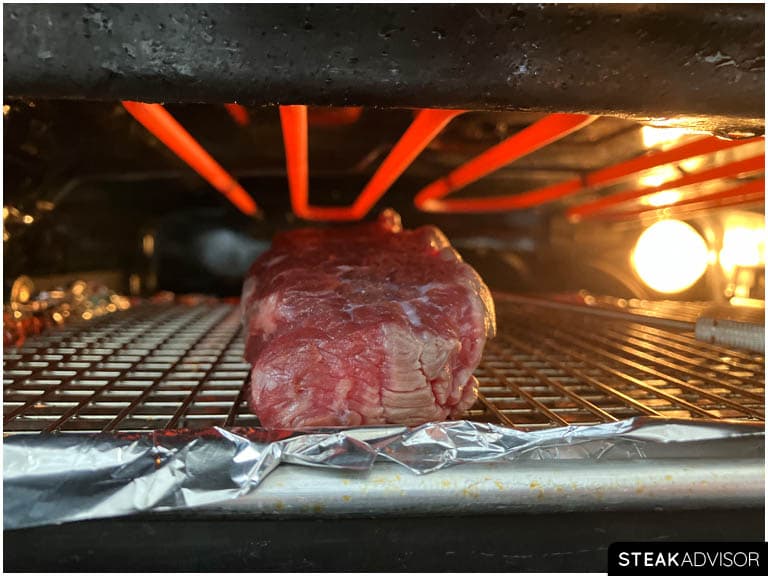
For example, when I broil a steak, I often get around 30°F (17°C) of carryover after removing it from the oven, especially with steaks about 1 1/2 inches (3.8 cm) thick. That’s because the steak cooks very close to an extremely hot broiler element. The surface gets much hotter than the center, so once the steak comes off the heat, the stored surface heat continues to move inward, raising the internal temperature much more during resting. That’s why broiled steaks can have a much higher carryover increase than steaks cooked gently in the oven at 200–225°F (93–107°C).
Steak Resting FAQs
How to rest a steak properly?
Resting a steak is simple. After you take the steak off the heat, place it on a wire rack, wooden cutting board, or plate. My favorite option is a wire rack set over a plate or baking sheet because it lets air circulate around the steak and keeps the crust from sitting in its own juices. A cutting board works well too, especially if you plan to slice the steak right after resting.
Should you cover a steak with foil while it rests?
In most cases, no. You don’t need to cover a steak with foil while it rests, especially if you’re cooking indoors. Just leave it uncovered on a wire rack or cutting board.
Covering a steak with foil helps keep it warmer for a little longer, but it also traps steam. That steam softens the crust you worked so hard to build. You can crisp the crust up again, but that takes extra effort and usually isn’t worth it.
The only time I’d consider using foil is when you’re resting the steak outside in cold or windy weather. Even then, cover it loosely so you don’t trap too much steam around the crust.
Why shouldn’t I rest the steak too long?
Resting gives the carryover cooking time to finish the steak, but if you leave it too long, it will start to cool down. Definitely don’t rest a steak for 10-15 minutes. There’s no real benefit to doing that. What’s worse, you’ll end up with a cold steak, which is one of the worst things you can do after cooking it properly.
Like I said earlier, resting doesn’t make steak more juicy. That’s a myth, and for years it was the main reason people rested steak for way too long. The real reason to rest a steak is to let carryover cooking finish the job, if needed. In most cases, that takes only about 5 minutes.
From my testing, in most cases, 5 minutes is enough for steaks up to about 1.5 inches (3.8 cm) thick. For thicker steaks, around 1.5 to 2 inches (3.8 to 5 cm), cooked over direct high heat, I recommend 6–7 minutes.
Is it ever okay to skip resting the steak?
Yes. It’s fine to skip resting the steak in some cases, especially if it’s already close to or at your target doneness when you remove it from the heat.
For example, if you’re aiming for medium-rare and the steak already hits 130°F (54°C) in the pan, don’t rest it for 5 minutes. With high-heat methods like pan-searing or grilling, carryover cooking can raise the internal temperature by another 15–20°F (8–11°C) within about 5 minutes of resting. That’s more than enough to push the steak past medium-rare.
In that case, it’s better to skip the rest and slice the steak immediately. Slicing helps release heat more quickly and reduces the carryover effect, giving you a better chance of preventing the steak from overcooking.
