

Reheating steak is easy to get wrong. Too much heat dries it out, and even a short extra minute can push a perfectly cooked steak past the doneness you want. To find out which methods actually keep steak juicy, I tested the most popular reheating techniques.
Below are my results, including what worked, what didn’t, and the method I’d use again.
Quick Overview
What’s the Best Way to Reheat a Steak?
After testing six ways to reheat steak, sous vide came out on top as the absolute winner. It evenly warmed the steak, kept it very juicy, and came closest to the freshly cooked control steak. It takes time, so it’s best for thick, well-marbled cuts.
For a quicker option, the air fryer is a solid alternative. If you don’t have a sous vide or an air fryer, reheat the steak in a low oven and finish it with a quick pan sear.
Here’s how all the methods performed in my tests.
| Reheating method | Overall rating* (0-10) | Reheating time** |
| In the oven | 8 | 30-40 minutes |
| On the stovetop | 7 | 10 minutes |
| In broth | 4 | 15 minutes |
| In the microwave | 3 | several minutes |
| Sous vide | 9 | 40-50 minutes |
| Air fryer | 8 | several minutes |
**The reheating time is approximate and does not include optional resting at room temperature before reheating.
How I Tested Each Steak Reheating Method
To keep the test as fair and consistent as possible, I used 1 1/2-inch-thick (3.8 cm) strip steaks cut from the same whole striploin.
For each test:
- I cut each steak in half.
- I salted both pieces and let them rest at room temperature for about an hour before cooking.
- One half was cooked in a pan to medium-rare (about 135°F/57°C), refrigerated overnight, and reheated the next day.
- The other half was cooked fresh for comparison using the same pan method and target temperature.
Because both halves came from the same steak, I was able to compare a reheated piece with a very similar piece cooked fresh. This made it easier to judge how each reheating method affected texture, juiciness, and overall eating quality.
Below are all the reheating methods I tested, along with my thoughts on how each one performed. I’ll also show you how long each method took for a steak of this thickness.
Detailed Results by Method
Method 1: Reheating the Steak in the Oven
Reheating time: 30-40 minutes
Overall rating compared to the control steak: 8/10
Best for: high-quality, marbled, thicker steaks
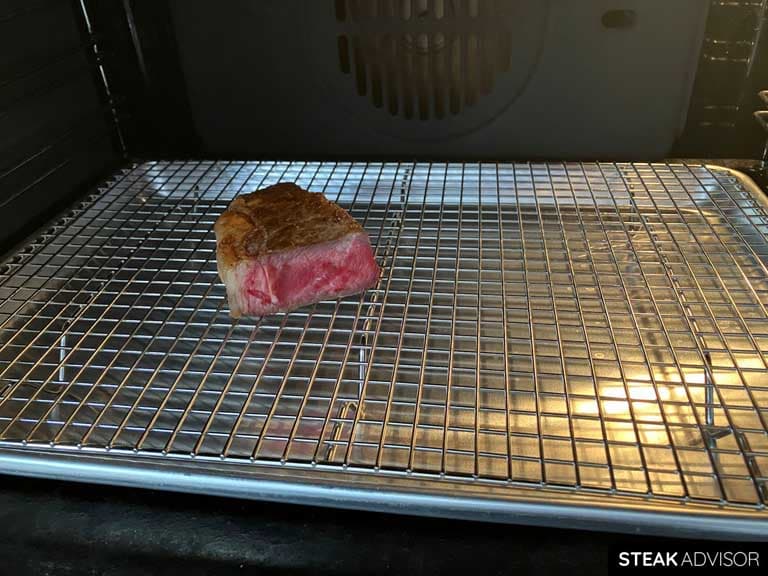
About this method: I preheated the oven to 250°F (121°C), placed the leftover steak on a wire rack set over a baking sheet, and reheated it until it reached an internal temperature of 110°F (43°C). Then I removed it from the oven, heated a pan over medium-high heat for 3 to 4 minutes, added one teaspoon of refined avocado oil, waited another minute, and seared the steak for 30-45 seconds on each side.
Results: Reheating steak in the oven and finishing it in a hot pan was one of the best methods I tested. The steak reheated evenly, stayed juicy and tender inside, and the quick pan-sear brought back a crispy crust. It also gave me consistent results with only a minimal gray band.
The main downside is convenience. It takes about 30-40 minutes to reheat a 1 1/2-inch (3.8 cm) thick steak, and afterward, you have to clean the wire rack, baking sheet, pan, and any other tools you used.
For cheaper cuts or thin steaks, I wouldn’t bother with this method. It’s too much work for what you get. But for a well-marbled, expensive steak, it’s a great option. In that case, the extra time and effort are worth it.

Method 2: Reheating the Steak on the Stovetop
Reheating time: 10 minutes, plus 30 minutes for the steak to rest at room temperature
Overall rating compared to the control steak: 7/10
Best for: 1-inch-thick (2.5 cm) steaks when you want a relatively quick reheating method that keeps the crust crispy.
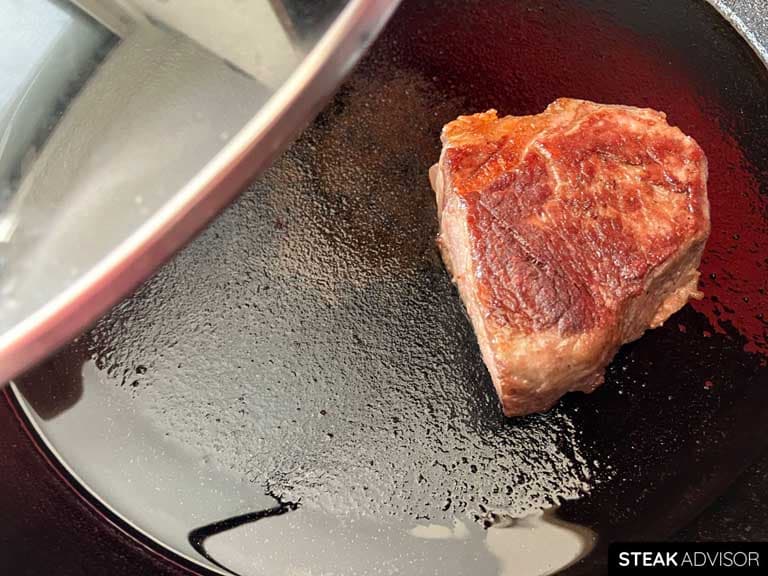
About this method: I removed the leftover steak from the refrigerator and let it sit at room temperature for 30 minutes. Then I preheated a pan over medium heat for 2 to 3 minutes, added one tablespoon of refined avocado oil, waited another minute, reduced the heat to low, and added the steak. I covered the pan with a lid and slowly reheated the steak, flipping it every 2 to 3 minutes, until it reached an internal temperature of 110°F (43°C). Then I removed it from the pan and let it rest for 5 minutes before serving.
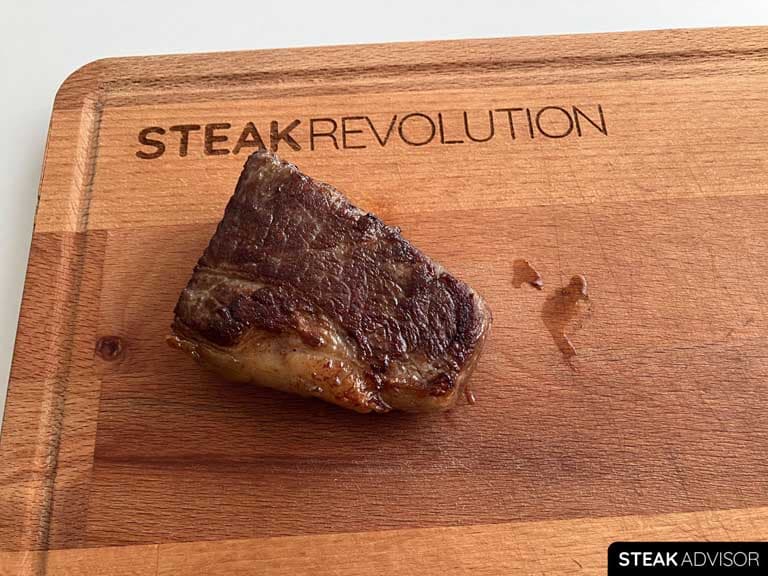
Results: Reheating steak on the stovetop was one of the fastest and easiest methods I tested, especially for steaks about 1 inch (2.5 cm) thick. It warmed the steak fairly evenly and gave the outside a nice crust. The reheated steak was slightly less juicy than the freshly cooked control steak, but the difference wasn’t huge. The only real downside was a slightly thicker gray band.
This method worked much better than reheating the steak the classic hot-and-fast way in a pan. Over very high heat, the outside browns before the center has time to warm through, so the steak looks good from the outside but is still barely warm in the middle. I don’t like that. With lower heat and regular flipping, the steak warmed more evenly and still developed a good crust.
I wouldn’t use this method for really thick steaks. In a pan, the outside of the steak gets hot much faster than the center, so by the time the middle is warm, the outer layers are already overcooked. For steaks thicker than 1 1/2 inches (3.8 cm), I’d use the oven method instead. It takes longer, but the slower, gentler heat warms the steak more evenly.
Note
One thing I noticed in my tests: flipping the steak less often creates a larger gray band inside. Personally, I don’t care much about a slightly larger gray band when reheating leftover steak, but if that matters to you, flip it every 1 minute. Or use the gentler oven method I mentioned earlier in the article.

Method 3: Reheating the Steak in Some Broth
Reheating time: 15 minutes
Overall rating compared to the control steak: 4/10
Best for: less flavorful or lower-quality cuts of steak
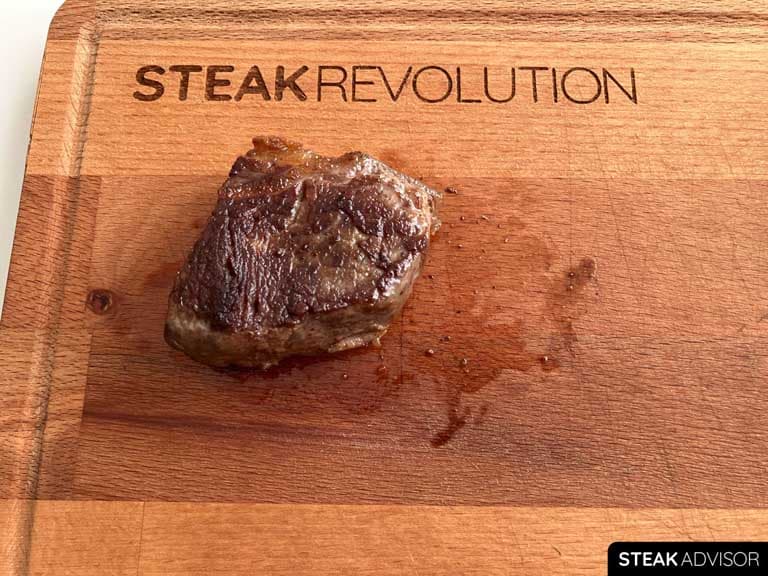
About this method: I used a small, deep skillet and added enough broth to fully submerge the steak. I heated the broth until it was steaming, but not bubbling, then added the steak and flipped it every 30 to 60 seconds, reheating it to 110°F (43°C). Once reheated, I removed the steak from the broth and served it immediately.
Results: Reheating steak in broth was quick, simple, and worked with steaks of almost any thickness. In my test, it warmed the steak evenly and kept it juicy. The downside is that the steak had no crust. The broth also changed the steak’s flavor, so it no longer tasted like a properly cooked steak.
That’s why, in my opinion, this method works best for cheaper, less flavorful cuts, where preserving the original steak flavor doesn’t matter as much. It’s also a good option if keeping the steak juicy matters more to you than getting the crust back.
For expensive, flavorful steaks, this method doesn’t make much sense. You’re basically losing the natural flavor of a good steak just to keep it a little juicier, and to me, that’s not worth it.
Method 4: Reheating the Steak in the Microwave
Reheating time: several minutes
Overall rating compared to the control steak: 3/10
Best for: thin slices of steak when you want to reheat them quickly and don’t care about getting a crust.

About this method: I removed the leftover steak from the refrigerator and let it sit at room temperature for 30 minutes. First, I tested reheating the whole steak. I placed it on a microwave-safe plate and reheated it on the microwave’s low-power setting in 10–15-second intervals, checking the temperature often to avoid overcooking.
After that, I tested the same method with thin slices of steak. I cut the steak into slices, placed them on a microwave-safe plate, and reheated them on low power in shorter 5- to 10-second intervals. Thin slices heat up much faster than a whole steak, so longer intervals would make them much easier to overcook.
Results: The microwave was the quickest and easiest way to reheat steak, but unfortunately, it was the worst method I tested. It reheated the steak unevenly. Some spots got hot quickly, while others stayed cooler, which hurt the texture and juiciness. The crust also turned soft and soggy.
Sure, it took almost no time or effort, but overall, I really didn’t like the results and don’t recommend this method, especially for reheating a whole steak.
It worked slightly better with thin slices, especially when I reheated them in short 5–10-second intervals. But even then, it was still too unpredictable for me.
If you don’t care much about the final result and just want to reheat a few thin slices as quickly and easily as possible, it can work. But if you want your steak reheated evenly, with a decent texture and a good crust, skip this method. I definitely wouldn’t use it for a good leftover steak.

Method 5: Reheating the Steak Sous Vide
Reheating time: 40-50 minutes
Overall rating compared to the control steak: 9/10
Best for: thick, well-marbled, expensive cuts
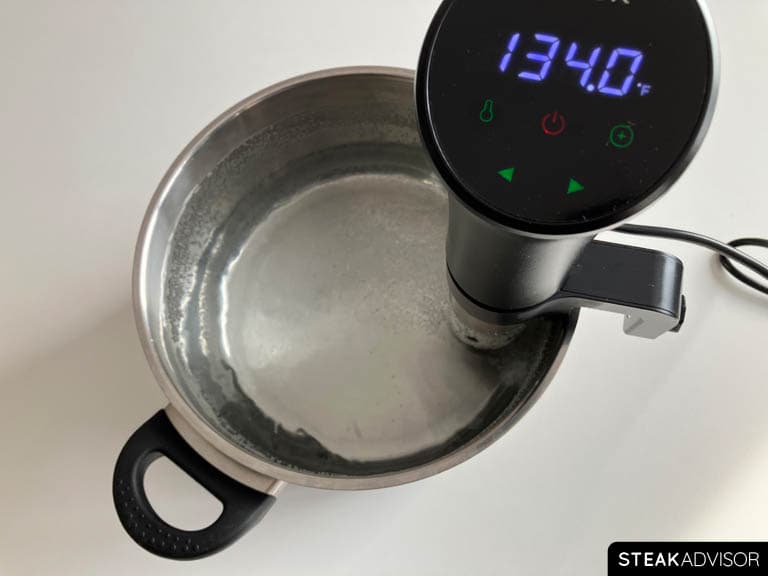
About this method: I vacuum-sealed the leftover steak, set the sous vide to 135°F (57°C), and let the steak warm for 30 minutes. Then I removed it from the water bath and placed it in an ice bath for 10 minutes. This cooled the surface slightly, so I could sear the steak afterward without overcooking the inside.
After the ice bath, I took the steak out of the bag and patted it very dry with paper towels. Then I preheated a pan over medium-high heat for 3–4 minutes, added a high-smoke-point oil, and waited another minute until the oil was hot.
Finally, I seared the steak for 2 minutes total, flipping it every 30 seconds, just to bring back the crust. Then I served it immediately.
Results: This was one of the best steak-reheating methods in my tests. It worked especially well on highly marbled, thicker cuts. Yes, it takes more time and prep, but the steak was reheated perfectly from edge to edge, stayed very juicy and flavorful, and still had a decent crust after searing. Of all the methods I tested, this one came closest to the freshly cooked control steak.
If you have a really nice steak and don’t want to ruin it, sous vide is the safest way to reheat it. I know it takes time and can feel like cooking the steak all over again, but for expensive or high-quality cuts, it’s worth it.
Note
Don’t skip the ice bath after reheating the steak sous vide. I set the water bath to 135°F (57°C), then chilled the steak shortly before searing. This cools the surface slightly, so you can sear it over high heat and rebuild the crust without overcooking the inside. If you take the steak straight from the sous vide bag to the pan, it’s very easy to overcook it during the sear. That short chill makes a big difference.
Method 6: Reheating the Steak in an Air Fryer
Reheating time: several minutes
Overall rating compared to the control steak: 8/10
Best for: when you want a quick reheating method that keeps the outside crisp
About this method: First, I preheated the air fryer to 400°F (204°C). Once it reached that temperature, I turned it off, placed the leftover steak inside, and let it warm for about 4–6 minutes. I warmed it until the center reached about 105–110°F (41–43°C). Then I served it immediately.
Results: Reheating steak in the air fryer was one of the easiest methods I tested, and honestly, it worked better than I expected. The steak warmed quite evenly inside, stayed reasonably juicy, and had a nice, crispy crust on the outside.
Overall, I really liked the results. That said, I see this method more as a good option for regular or medium-quality steaks. For the most precise results, especially with expensive, well-marbled cuts, I still prefer sous vide. But when it comes to the balance of texture, juiciness, time, and effort, the air fryer method is one of the best options I tested.
Just make sure to check the internal temperature with a meat thermometer as the steak reheats. It’s easy to overcook it, especially if the steak is thin.
Overall Key Takeaways
- Best overall method without special equipment: Reheat the steak gently in the oven, then quickly sear it in a hot pan. This gives the most consistent result: a warm, evenly reheated inside and a fresh crust on the outside. It takes more time, almost like cooking the steak again, but it’s the method I recommend for thick, expensive, or fatty steaks.
- Best overall method if you have the equipment: Reheat the steak sous vide, then quickly sear it in a hot pan. This gives you the most precise and evenly reheated result, because the steak warms gently without overcooking. The only downside is that it requires a sous vide setup, so it’s not the most practical option for everyone.
- Good, faster alternative to sous vide: Reheat the steak in an air fryer. It’s not as precise or gentle as sous vide, but it’s much faster and still reheats the steak fairly evenly. Just check the steak often, as it’s easy to overcook it.
- Best stovetop-only method: Slowly warm the steak in a pan with the lid on. This works especially well for whole steaks about 1 inch (2.5 cm) thick, because the lid traps heat around the steak rather than heating only the bottom. As a result, the steak warms more evenly.
- Best method for lean or inexpensive steak: Reheat it in broth. This is a good option when the steak is more likely to dry out, since the broth helps keep it moist and makes the reheated meat more forgiving.
- Best option for sliced steak: Reheat the slices in a pan. The microwave can work in a pinch for very thin slices, but it’s still easy to overcook them. I prefer the pan because the slices warm more evenly and keep a better texture, especially over low heat with frequent flipping.
- Worst method overall: The microwave. It makes the crust soggy, heats the steak unevenly, and can easily ruin the texture. I’d use it only when I don’t care much about the final result, and only for sliced steak.
When I reheat steak, I usually slice it into thin strips and quickly sear them in a hot cast-iron skillet. It’s a fast and easy method. Sometimes, I eat it alone, but I also like to use it in sandwiches, fajitas, or salads.
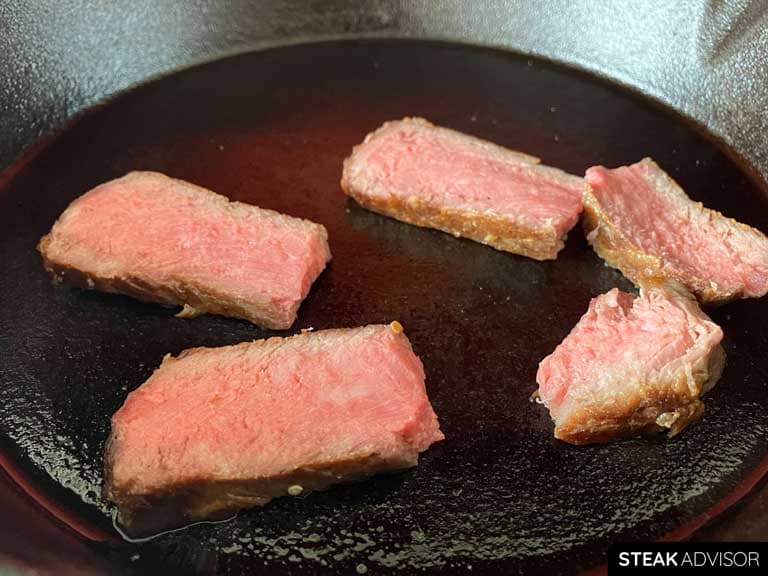
If the steak is lean but flavorful, I often eat it cold. But if it’s a well-marbled or expensive cut, I prefer to reheat it properly. For most steaks, I use the oven-and-pan method. For very well-marbled cuts, I sometimes use sous vide because it gently warms the steak to the exact target temperature without drying it out.
Fatty cuts of steak don’t taste good cold. The fat stays firm and waxy, and you lose a lot of what makes that cut taste great. With an expensive steak, it’s worth taking the extra time to reheat it properly.
The main takeaway is simple: if you have leftover steak after dinner, don’t throw it away. Leftover steak can still be delicious if you reheat it properly.

What to Do With Leftover Steak?
If it’s a regular leftover steak, I usually slice it into thin strips and reheat the pieces quickly in a hot cast-iron pan. Then I use them in salads, tacos, sandwiches, or other quick meals. If it’s a nice, well-marbled steak, I reheat it more gently using the oven-and-pan method or sous vide and eat it as it is.
Looking for more ideas? Check out my article with 10 tasty leftover steak recipes that turn yesterday’s steak into a completely new meal.
