

There are many ways to thaw a steak: overnight in the fridge, in cold water, with sous vide, or in the microwave. But the real question is which method works best, how long each one takes, and which one is actually worth using when you need to thaw a steak fast.
I ran a series of tests to compare the most common steak-thawing methods. Below, I’ll show you how long each method took, what the steak looked like after thawing, and which method I’d actually use when I need to thaw a steak quickly.
Quick Overview
What’s the Best Way to Defrost a Steak?
- If you have 24 hours, thaw in the refrigerator.
- If you have about 1 hour, use a cold-water bath.
- If you need to thaw steak very quickly: use cold-water circulation with a sous vide circulator.
- Do not thaw steak on the counter or in hot water.
In my tests, the best overall method was thawing the steak in the refrigerator. It takes the longest, but it best preserves the steak’s texture and quality. Among the fast methods, using a sous vide circulator in cold water worked best, while a cold-water bath was the best no-equipment option.
Steak Defrosting Methods Compared
Below is how each method performed in my tests.
| Defrosting method | Overall rating* (0-10) | Defrosting time* |
| In the microwave | 3 | A few minutes |
| Under cold running water | 7 | 50 minutes |
| In a cold water bath | 8 | 70 minutes |
| Cold-water circulation with sous vide | 9 | 40 minutes |
| In the refrigerator | 10 | 24 hours |
How I Tested Each Steak Defrosting Method
I wanted the results to be as fair and reliable as possible, so I kept the steak size, freezing conditions, and testing environment consistent across every test.
- I started with strip steaks cut fresh from the same strip loin. I cut each one to the same thickness, exactly 1 1/2 inches (3.8 cm), then vacuum-sealed the steaks individually and froze them in the same freezer, at the same temperature, for the same amount of time.
- For the actual thawing tests, I paid close attention to consistency. The room temperature stayed stable at about 20°C (68°F) throughout the tests, and for the water-based methods, I used the coldest tap water available.
When comparing each defrosting method, I looked at a few key things:
- how long the steak took to thaw,
- whether the steak entered the food-safety danger zone, between 40 and 140°F (4 and 60°C), where bacteria multiply rapidly,
- whether the texture changed,
- how easy or complicated the method was,
- and whether it required any extra tools.
Below, I’ll walk you through every steak defrosting method I tested, explain how each one worked, and share which methods I think are actually worth using.
Detailed Results by Method
Method 1: Defrosting the Steak in the Microwave
Defrosting time: a few minutes
Overall rating: 3/10
Best for: when you have no other option
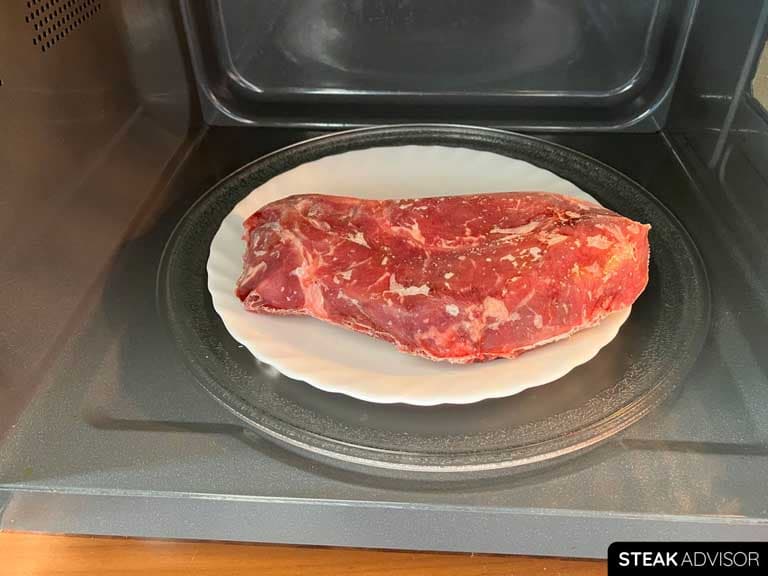
About this method: For this test, I removed the frozen steak from its vacuum-sealed bag, placed it on a microwave-safe plate, and thawed it in the microwave using the defrost setting.
Results: The microwave was the worst method I tested for thawing steak. Sure, it took only a few minutes, so it was the fastest method. But the overall result was terrible. The steak thawed unevenly, releasing a lot of liquid onto the plate. What’s worse, some parts of the steak started to cook while other areas were still partially frozen.
Food safety is another issue. With microwave thawing, the thinner or outer parts of the steak quickly enter the food-safety danger zone, between 40 and 140°F (4 and 60°C), while the center is still frozen. That’s a major food-safety issue. That’s why, according to the USDA, steak thawed in the microwave needs to be cooked immediately.
Personally, I will never use this method again. Luckily, there are safer and better methods available. Sure, they’re not as quick as the microwave, but some are still relatively fast. In my tests, a few methods thawed a 1 1/2-inch (3.8 cm) thick steak in under 1 hour, with much better results.
Method 2: Defrosting the Steak in a Cold Water Bath
Defrosting time: 70 minutes for a 1.5-inch (3.8 cm) thick strip steak
Overall rating: 8/10
Best for: thawing steak quickly while keeping its quality and texture intact
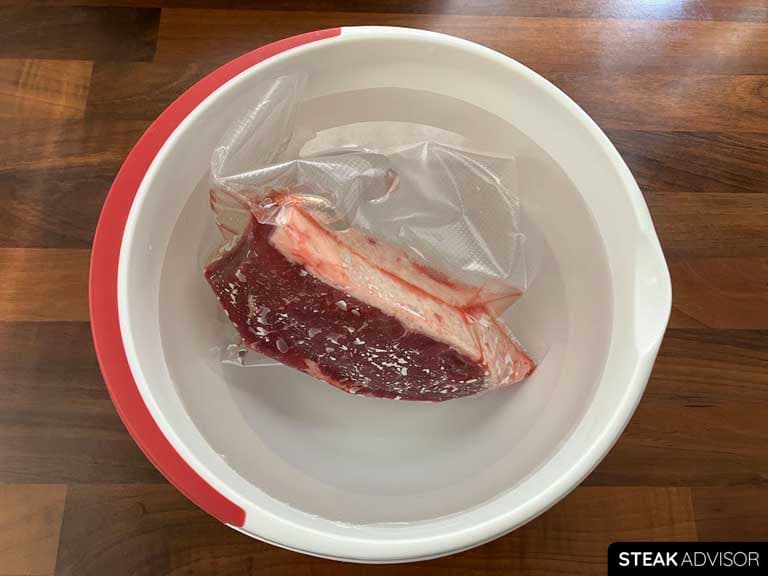
About this method: I took the steak out of the freezer and made sure it was tightly sealed, with no holes in the packaging. Then I filled a large, deep container with the coldest tap water available, fully submerged the frozen steak, and changed the water every 30 minutes to keep it cold until the steak thawed completely.
Results: My 1 1/2-inch (3.8 cm) thick strip steak thawed in about 70 minutes using this method. I really liked the overall results. The steak thawed evenly, with no noticeable effect on its texture or quality. It looked like a fresh steak, and you probably wouldn’t be able to tell it had been frozen.
The surface stayed cold to the touch the whole time, roughly as cold as the water. Still, according to the USDA, steak thawed in cold water needs to be cooked immediately. That’s actually the only downside of this method.
I also like how simple it is. You just put the sealed steak in cold water and change the water every 30 minutes. That’s it. This is my go-to method when I need to thaw steak quickly without any special equipment, just a container and cold water.
Why change the water?
The frozen steak keeps the water cold at first, but that effect doesn’t last forever. As the steak thaws, the water gradually warms up. Replacing the water every 30 minutes refreshes the cold water around the steak and helps keep the meat’s surface at a safer temperature during thawing.
According to the USDA, bacteria multiply rapidly between 40 and 140°F (4 and 60°C), which is why keeping the water cold matters. If your tap water isn’t very cold, add a few ice cubes each time you replace the water.
One more thing I noticed during testing: the steak needs to stay fully submerged to thaw evenly. A vacuum-sealed steak often floats, so place something heavy on top, like a small plate or bowl, to keep it submerged.
Easier Option: Cold Water in the Refrigerator (Optional)
If you don’t want to change the water every 30 minutes, there’s an easier variation: place the bowl with the sealed steak and cold water in the refrigerator.
Because the fridge keeps the water cold, you don’t need to refresh the water during thawing, as you would if the bowl were sitting at room temperature. The trade-off is that the steak will thaw more slowly than it would in cold water at room temperature.

Method 3: Defrosting the Steak Under Cold Running Water
Defrosting time: 50 minutes for a 1.5-inch (3.8 cm) thick strip steak
Overall rating: 7/10
Best for: quickly thawing thin steaks up to 1 inch (2.5 cm) thick

About this method: This method is a faster version of the classic cold-water method. I took the vacuum-sealed steak out of the freezer and made sure it was tightly sealed, with no holes in the packaging. Then I filled a large bowl with cold water, fully submerged the steak, and placed the bowl under a gently running cold tap until the steak thawed.
Results: Thawing steak under cold running water was very effective. It was definitely one of the fastest methods I tested. My 1 1/2-inch (3.8 cm) thick strip steak thawed in about 50 minutes, which is very quick for a steak of that thickness. The steak thawed evenly, and I did not notice any negative effect on its texture. However, like with any other fast-thawing method, you need to cook the steak immediately after thawing.
The only real problem I have with this method is that it requires a constant flow of cold water, and the thicker the steak, the more wasteful it becomes. Compared with the classic cold-water container method, it reduced thawing time by only 15–25%. In my opinion, that small time-saving is definitely not worth the waste of so much water.
Overall, the method works well, but I would not recommend it for regular use. If you really must use it, use it only for thinner cuts. Steaks about 1 inch (2.5 cm) thick or thinner thaw very fast with this technique. Better yet, use another method that wastes less water and gives very similar results. In my tests, sous vide was a better low-waste alternative.
But why does this method work so well?
In short, water transfers heat much better than air. And because the water is running, the cold water right around the steak is constantly replaced by new tap water. That’s why it thaws faster. With thick steaks, though, the middle still takes much longer because heat has to move through the meat.
I tested this method with a much thicker cut, and the result was disappointing. After about 45 minutes under cold running water, a 1.75-inch (4.4 cm) thick strip steak was still frozen in the center.
Method 4: Defrosting Steak with a Sous Vide Circulator in Cold Water
Defrosting time: 40 minutes for a 1.5-inch (3.8 cm) thick strip steak
Overall rating: 9/10
Best for: people who already have a sous vide setup and want to thaw a steak quickly without affecting its texture or quality
About this method: I removed the frozen, vacuum-sealed steak from the freezer and checked that the packaging was intact, with no holes or leaks. Then I filled a large, deep container with the coldest tap water available, placed the sous vide circulator in the water, and set it to 32°F (0°C), its lowest setting. I kept the steak fully submerged in the bath until it was completely thawed.
Note: This method only works if your sous vide circulator can be set low enough that the heating element does not turn on, or if it has a circulation-only mode. You are using it only to keep the cold water moving around the sealed steak, not to heat the water. If your sous vide machine cannot circulate without warming the bath, skip this method and thaw the steak using the regular cold-water method instead.
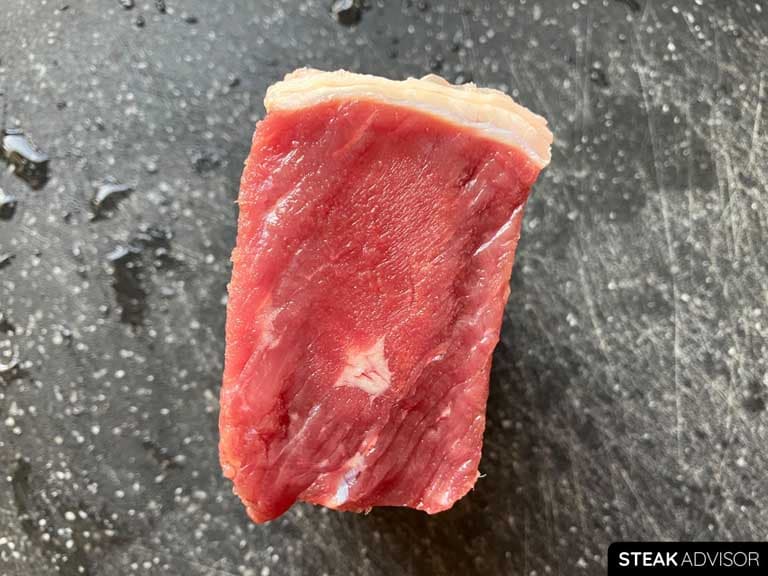
Results: Out of all the methods I tested, sous vide was the best for fast thawing. The steak took about 40 minutes to thaw, and it thawed evenly without any noticeable negative effect on the texture. Visually, it looked completely normal.
I also liked how simple the method was. You place the frozen, sealed steak in a deep container filled with cold water, set the sous vide machine to its lowest setting, and let the circulator keep the water moving around the steak. That’s it.
The reason I didn’t choose sous vide as the best overall method is that it has three clear downsides:
- It requires a sous vide machine, so it’s not a method everyone can use.
- Not every sous vide machine lets you circulate water without heating it.
- The steak needs to be cooked immediately after thawing.
Besides that, sous vide is the best way to thaw a steak fast. Personally, I still prefer thawing steak slowly in the refrigerator. But for anyone who needs the fastest possible method that doesn’t negatively affect the steak, sous vide was the best option in my test.
Technically, this method works very similarly to thawing a steak under cold running water. The main difference is that it doesn’t waste water. It was also slightly more effective in my test, probably because the sous vide machine kept the water moving more consistently around the steak.
Method 5: Defrosting the Steak in the Refrigerator
Defrosting time: 24 hours for a 1.5-inch (3.8 cm) thick strip steak
Overall rating: 10/10
Best for: preserving texture and quality when you can plan ahead
This is the most common and safest way to defrost steak. It’s also the method recommended by the USDA because the steak stays at a safe, steady refrigerator temperature while it thaws slowly.

About this method: For this test, I removed the vacuum-sealed steak from the freezer, placed it in a deep dish to catch any drips, and left it in the refrigerator until it was fully thawed.
Results: This was the best defrosting method I tested. It was simple, safe, and had no noticeable effect on the steak’s texture or quality. The steak thawed evenly, stayed cold the entire time, and never entered the food-safety danger zone, between 40 and 140°F (4 and 60°C), where bacteria multiply rapidly.
In my test, the steak fully defrosted in about 24 hours. That’s the main downside of this method: it takes planning. But in terms of effort, it’s hard to beat. All I had to do was move the steak from the freezer to the refrigerator and leave it there until it thawed completely.
Another advantage is that you don’t have to cook the steak immediately after it thaws. According to the USDA, steaks thawed in the refrigerator can be kept there for another 3 to 5 days before cooking. That gives you plenty of time to decide what you want to do with the steak. That said, as always, it’s still better to cook it as soon as possible.
If you’re the type of person who can remember to take the steak out a day or two before cooking, this is an excellent method. Personally, whenever I’m not in a rush, I use this method. It takes the longest, but it gives the best overall result. When the steak is vacuum-sealed properly and thawed slowly in the refrigerator, I can’t really tell the difference between a fresh steak and one that’s properly thawed.
Overall Key Takeaways
What is the best overall method for thawing steak?
The best overall method is thawing steak in the refrigerator, as described in method #5. It takes the longest, but it is the safest, most reliable option and does the best job preserving the steak’s texture and quality.
The biggest advantage is control. The steak stays cold the entire time, so it never enters the temperature danger zone, as long as your fridge is calibrated correctly. According to the USDA, once the steak is fully thawed in the refrigerator, you can keep it there for an additional 3 to 5 days before cooking.
That’s why this is the method I use most often. It doesn’t require any extra effort, special equipment, or constant checking. Just place the steak in the fridge and let time do the work.
The only downside is the thawing time. For thinner cuts, expect at least 12 hours. For thicker steaks, especially those around 1 1/2 inches (3.8 cm) thick or more, plan for about 24 hours.
What are the fastest thawing methods that don’t affect the texture too much?
If I had to rank the fastest good methods, it would be:
- Sous vide
- Cold running water
- Cold water in a container
The best fast-thawing method I tested was sous vide. It thawed a 1 1/2-inch (3.8 cm) thick strip steak in about 40 minutes, and I didn’t notice any negative effect on the texture.
Cold running water was also very fast. In my test, it thawed a 1 1/2-inch (3.8 cm) thick strip steak in about 50 minutes. The results were very close to refrigerator thawing, with only a slight difference in texture. But the method uses a lot of water, which is the main reason I don’t like it as much.
The third good option is the classic cold-water method. Place the steak in a sealed bag, submerge it in a container filled with cold water, and change the water every 30 minutes. In my test, it took about 70 minutes to thaw a 1 1/2-inch (3.8 cm) thick steak. It’s slightly slower than running water, but it wastes much less water and still gives excellent results.
All three methods work well, but they require more attention than refrigerator thawing. If you want the fastest method, go with sous vide. If you want a simple method without equipment, use cold running water or the cold-water bath method.
Just remember that steaks thawed using quick, cold-water methods need to be cooked immediately after thawing.
What is the worst method for thawing steak?
The worst method I tested was the microwave. It was super fast, but the results were terrible. The steak thawed unevenly, released a lot of liquid, and some parts started to cook while others remained partially frozen.
It’s also very easy to overshoot. If you’re not watching closely, the microwave can start cooking the steak before the center has fully thawed. For that reason, I don’t recommend this method unless you have no other choice.
Is it possible to refreeze defrosted steak?
Yes, but only if it was thawed safely. A steak thawed in the refrigerator can be refrozen raw as long as it stayed cold the whole time. However, refreezing is not great for quality. After another freeze-thaw cycle, the steak may lose some of its fresh texture and taste a bit drier or less juicy after cooking. If the steak was thawed in cold water or in the microwave, the USDA says it should be cooked before refreezing.
Why You Shouldn’t Thaw Steak on the Counter
It may seem like the easiest way to thaw steak, but from a food safety standpoint, it’s a risky method because it gives you little control over how long the surface of the meat stays in the bacterial growth temperature range.
The main problem is that the outside of the steak warms up much faster than the center thaws. This means the meat’s surface may spend too much time in the temperature range where bacteria multiply quickly, even while the inside is still partially frozen. USDA defines this range as the “danger zone”: 40–140°F / 4–60°C.
That doesn’t mean the steak becomes unsafe the moment its surface goes above 40°F (4°C). The problem is how long the surface stays in that temperature range while the center is still thawing. According to the USDA, perishable food shouldn’t stay in that range for more than 2 hours, or more than 1 hour if the room or outdoor temperature is above 90°F (32°C).
For this reason, I don’t recommend thawing steak on the counter. You have very little control over how long the surface stays in that unsafe temperature range, especially with thicker steaks. Use refrigerator thawing if you have time, or cold water if you need a faster option.

Can I Thaw Steak in Warm or Hot Water?
Technically, yes, but it’s better not to thaw steak in warm or hot water. USDA says perishable foods should never be thawed in hot water; it recommends thawing in the refrigerator or in cold water instead.
The problem with warm or hot water is not that the steak becomes unsafe instantly. The problem is that it increases risk. Hot water quickly heats the steak’s surface while the center is still frozen or only partly thawed. If the steak is small, thaws quickly, and is cooked immediately, the food-safety risk may be low. But with thicker steaks, the outside spends too much time in the bacterial growth temperature range before the middle thaws.
Hot water also creates a quality problem. It starts cooking the outer layer before the inside is thawed, leading to a thicker gray band, uneven cooking, and poorer texture – exactly what you don’t want with steak.
That’s why I didn’t include warm- or hot-water thawing in my tests. It adds unnecessary food-safety risk and starts cooking the outside before the inside is thawed. For the best balance of safety and quality, thaw steak in the refrigerator, or use cold water with the steak sealed in a leakproof bag, then cook it immediately after thawing.
Steak Thawing Tips
- Always check the steak packaging for holes before placing it in water. According to the USDA, if the bag leaks, water can get into the package, increasing the risk of contamination and making the steak’s texture watery.
- If you have a few thick steaks stuck together in the same bag, let them thaw until they soften slightly, then gently separate them. Don’t force them apart while they’re still rock-hard, because you can tear the packaging. If the original bag gets damaged, move them to a clean, leakproof bag before putting them back in the water.
- Keep the steak fully submerged. If the bag floats, the steak may thaw unevenly. Place a plate or another light object on top to hold it under the water.
- For better browning, remove the steak from the bag after thawing and pat it very dry with paper towels before seasoning or cooking.

Thanks for sharing. I read many of your blog posts, cool, your blog is very good. I especially liked the tip about defrosting steak overnight in the fridge to preserve quality and texture.