

Blue steak is one of those doneness levels people either love or avoid completely. Only a small group of steak lovers actually enjoys steak cooked this way. For most people, blue steak is too cold in the center, with a wet, slightly slippery texture that feels closer to raw beef than a cooked steak.
In this guide, I’ll explain what blue steak is, whether it’s safe to eat, and how to cook it properly if you want to try it.
What Is Blue Steak?
Blue steak, also known as blue rare or extra rare, refers to a level of doneness where the steak is cooked to an internal temperature of 110–120°F (43–49°C).
At this doneness, the steak is cooked very briefly over high heat, just enough to sear the outside and reduce the risk of bacteria on the surface while keeping the inside almost raw. As a result, the center is purplish-red, especially right after cutting, and feels relatively cool. The texture is very soft, tender, and juicy, but also noticeably wet and slippery. The flavor is strong and beefy, but keep in mind that the final result depends a lot on the cut you use.
Blue steak gets its name from the bluish or purplish-red color the meat can show right after it’s sliced open. Once the cut surface is exposed to air, myoglobin reacts with oxygen, and the color starts turning brighter red. If you want to understand this process better, check out my guide on why steak turns brown.

Blue Steak vs Rare Steak: What’s the Difference?
Blue steak (or blue rare) is cooked less than rare steak. According to my steak temperature chart, blue rare steak is cooked to 110–120°F (43–49°C), while rare steak is cooked to 120–130°F (49–54°C).

In practice, the difference is easy to notice. Blue steak stays almost raw inside, with a purplish-red center, a relatively cool temperature, and a very soft, wet, slippery texture. Rare steak is still red in the center, but it feels more warmed through, a little firmer, and more like a cooked steak, especially closer to 130°F (54°C).
Is Blue Steak Safe to Eat?
Here’s the short answer: eating raw or undercooked steak, including blue steak, always carries some risk, no matter how good the meat is. You can reduce that risk as much as possible by choosing the right steak, handling it properly, and searing it well on the outside, but you cannot guarantee that a blue steak is 100% safe. According to food safety guidelines, beef only meets the recommended safety standard when it reaches the proper internal temperature. For whole beef cuts, the USDA recommends 145°F (63°C) with a 3-minute rest.
Below, I explain in more detail the main risks of eating blue steak.
Note
I’ll show you later in the article how to cook blue steak as safely as possible. Just keep in mind that, according to food safety guidelines, eating raw or partially cooked beef is still a personal risk you choose to accept.
How Bacteria and Parasites Affect Blue Steak Safety
When you read about blue steak and whether it’s safe to eat, you’ll often see advice like this:
“Yes, blue steak is safe as long as you cook it properly. Just sear the outside of the steak to kill the bacteria.”
You’ll also see claims like:
“Studies show that bacteria, such as E. coli, are found on the outside of whole cuts of beef, so once you sear the surface, the steak is safe to eat.”
Unfortunately, it’s not that simple. That explanation is partly true, but it leaves out a few important details. And those details matter, especially when you’re talking about a steak that stays almost raw inside. Let me explain it as briefly as possible.
According to USDA food safety guidance, an intact beef steak meets the recommended safe minimum temperature only when cooked to 145°F (63°C) and rested for 3 minutes.
This only applies to intact, whole-muscle steaks. It does not apply to ground beef, blade-tenderized steak, injected steak, cubed steak, or meat that has been heavily pierced or scored.
That means blue steak, cooked to about 110–120°F (43–49°C), does not meet the USDA’s recommended safe internal temperature for beef steaks. That doesn’t automatically mean every blue steak is unsafe to eat, but it does mean it comes with more risk than a steak cooked to a higher internal temperature.
That said, real-world risk isn’t only about temperature; how the steak was handled matters just as much, from slaughter and processing to storage and preparation at home.
According to the USDA Food Safety and Inspection Service, the inside of an intact, whole-muscle beef cut, such as a regular steak, is generally protected from pathogens migrating below the exterior, meaning contamination with E. coli O157:H7 is primarily a surface concern unless the meat has been ground, injected, or mechanically tenderized.
So yes, in that specific case, searing the steak on all sides can reduce or kill the bacteria on the surface. But that still doesn’t make blue steak 100% risk-free. There are plenty of ways to recontaminate the steak, even after searing. For example, you can do it with dirty tongs, a dirty cutting board, or by piercing the raw steak and pushing bacteria from the surface into the center.
There is also another risk that almost no one mentions: parasites. Beef can carry parasites such as the beef tapeworm, and people can become infected by eating raw or undercooked contaminated beef. The overall risk of getting a parasitic infection from beef is considered very low as long as the meat comes from a reliable source with routine veterinary inspection. Still, a very low risk does not mean zero risk.
If you want to understand this topic better, read my article: Is Raw Steak Safe to Eat? Risks & Safety Tips. I explain the risks behind eating raw or undercooked steak in much more detail there.
Who Should Avoid Blue Steak?
Blue steak is not a good choice for people at higher risk of foodborne illness, including pregnant people, young children, older adults, and people with weakened immune systems.
Since blue steak is cooked very briefly, it carries a higher risk of foodborne illness from harmful bacteria than steak cooked to a higher internal temperature. If you’re in one of these groups, don’t go for blue steak. Choose a steak cooked to a higher internal temperature instead.
Best Cuts for Blue Rare Steak
The best cuts for blue rare steak are lean, naturally tender, and ideally at least 1 inch (2.5 cm) thick. Since the steak stays almost raw inside, you want a cut that is already tender and doesn’t rely on rendered fat for flavor or texture.
Here are some good options:
- Tenderloin steak/filet mignon – the best choice for blue steak.
- Sirloin steak – a good alternative if you want something lean but still flavorful.
You can also experiment with other lean cuts of steak.

Steak Cuts to Avoid for Blue Rare Steak
Blue rare is not a good doneness for fatty steak cuts. Cuts with a lot of intramuscular fat (marbling), like ribeye, flat iron, chuck eye, outside skirt, denver steak, or highly marbled Wagyu, need to be cooked to a higher internal temperature so the fat can render properly. At 110–120°F (43–49°C), the fat stays firm and waxy, making the steak unpleasant to eat.
How to Cook Blue Steak
Here’s a quick overview of the process, but to ensure success, I highly recommend following the step-by-step instructions, with photos and ingredient quantities, in the recipe card below.
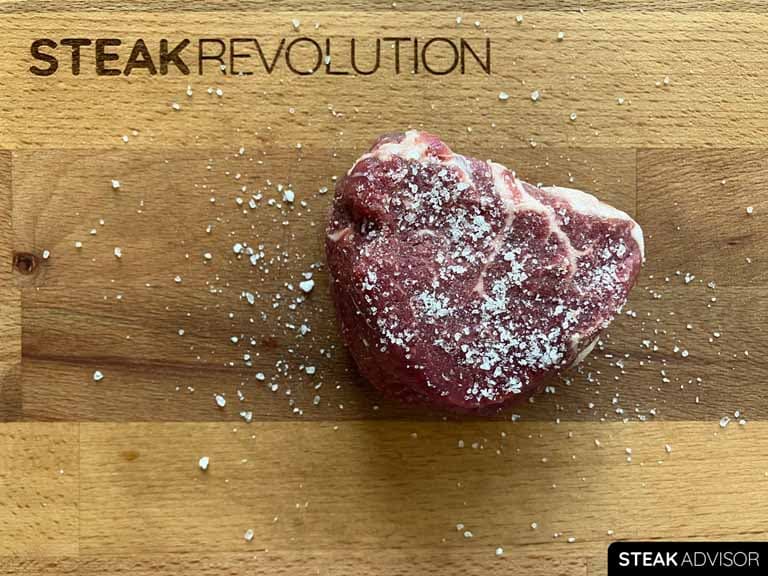
- Salt and prep the steak. Pat the steak dry and season all sides with kosher salt. Place it uncovered on a wire rack set over a baking sheet and let it rest at room temperature for 60 minutes, or dry-brine in the fridge for 2 to 8 hours for a richer, saltier taste. Remove it from the fridge 30 minutes before cooking.
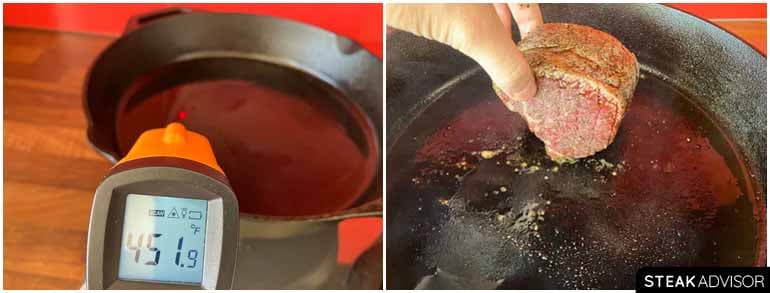
- Heat the pan. Place a heavy pan, preferably a cast-iron skillet, over medium-high heat and let it heat for 3–4 minutes. Add high-smoke-point oil and warm it for another 1 minute, until the pan reaches about 400–500°F (204–260°C). In the meantime, pat the steak dry again. If you want, season it with finely ground black pepper right before searing.
- Sear the steak. Place the steak in the skillet and sear both sides carefully. To sear the sides, gently roll the steak with tongs or your hand so the entire surface of the steak touches the pan, which helps reduce or kill potential surface bacteria. Press it down lightly for good contact with the skillet.
- Cook to blue. Cook the steak, flipping every 30 seconds. For a steak about 2 inches (5 cm) thick, remove it from the pan when the internal temperature reaches about 90°F (32°C). For a steak about 1 inch (2.5 cm) thick, remove it at around 100°F (38°C).
To keep things as safe as possible, clean or replace the tongs after handling the raw side of the steak. Once the surface is seared, use clean tongs for the rest of the cooking. - Rest and serve. Once the steak reaches the right temperature, remove it from the pan and let it rest for 6–7 minutes. Carryover cooking will bring the internal temperature up to the target, about 115°F (46°C). Then serve it as is, or finish it with garlic-herb compound butter.
Important Tips for Cooking Blue Steak
- To reduce the risk of food poisoning, sear and brown the entire outer surface of the steak, including the edges.
- To avoid cross-contamination, clean or replace your tongs after they touch the raw steak, especially after placing the steak in the pan and after the first flip.
Recipe Success Tips
Choose a Lean, Naturally Tender Cut
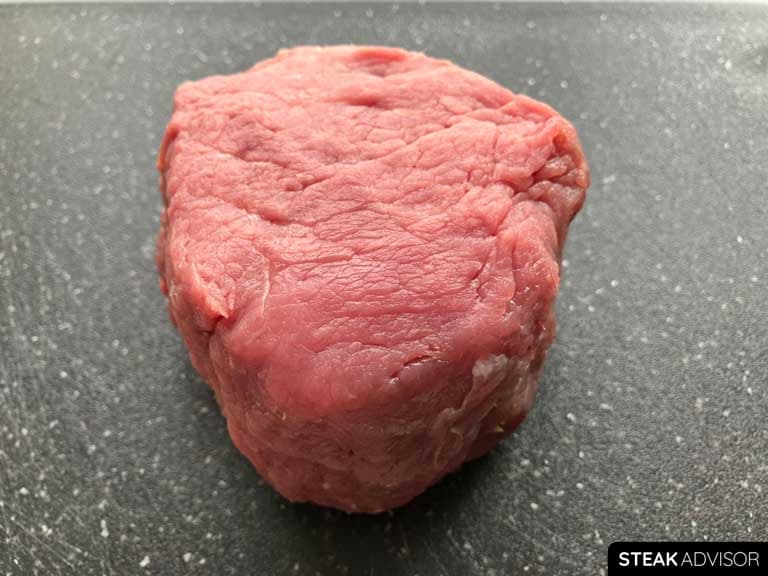
For the best results, choose a fresh, high-quality filet mignon with no visible marbling, or as little as possible. Ideally, choose one that’s about 1 1/2 inches (3.8 cm) thick to achieve the best balance between a nicely seared outside and a perfectly cooked inside.
Dry-Brine the Steak for Better Flavor and a Better Crust
I recommend dry-brining for basically any steak and recipe. It’s one of the biggest game changers when it comes to seasoning a steak and making it taste much better. A proper dry brine not only improves the flavor but also helps you achieve a better sear.
If you don’t have much time, salt the steak and let it rest, uncovered on a rack set over a baking sheet, at room temperature for 1 hour. If you have more time, ideally leave it in the fridge for 4–6 hours. You can even go for 12 hours or overnight, but with this option, you must accept the fact that you will get a slightly thicker gray band under the crust due to the longer dry-brining time.
If you want to understand these salting options better and see how each affects the steak, check out my guide on How to Salt a Steak.
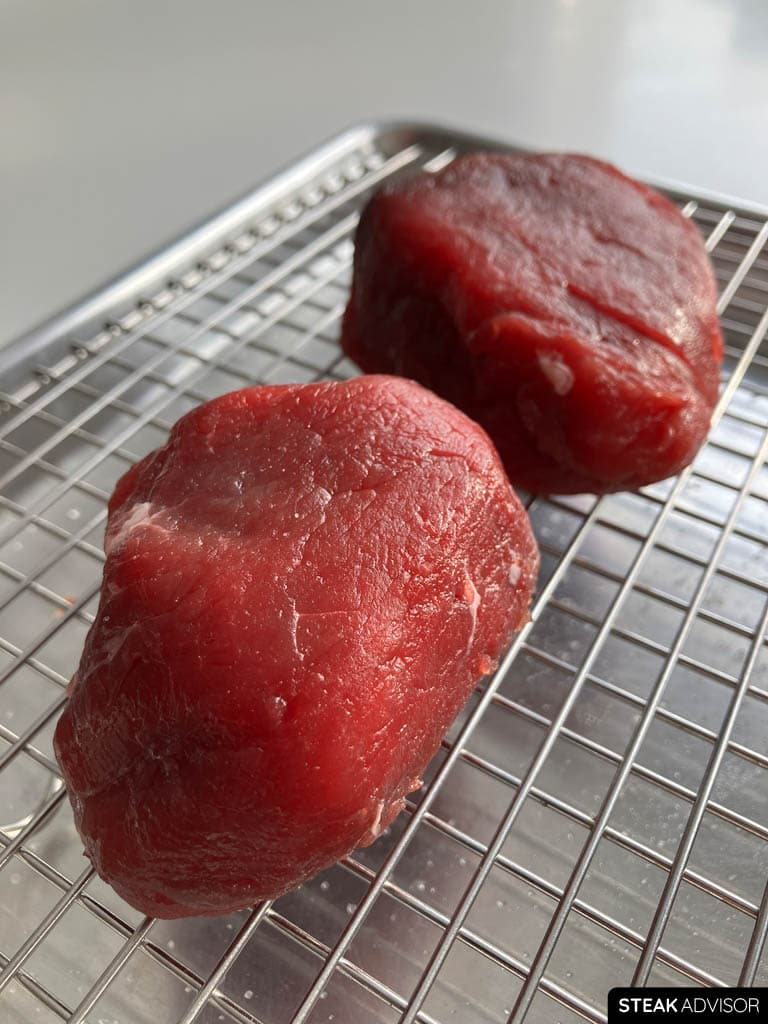
Dry-brining also helps with a better crust because the longer the steak sits uncovered in the fridge, the drier its surface gets. Moisture is the enemy of a good crust. That’s why the drier the steak’s surface, the better it will sear. After a few hours uncovered in the fridge, the steak’s surface becomes almost completely dry. As a result, the steak develops a much better crust in the pan.
Use Clean Tongs
To reduce any risk when cooking blue steak, make sure to use clean tongs and other clean tools, such as a cutting board, plate, etc. But pay attention especially to the tongs.
The tongs used to place the raw steak in the pan can become contaminated with bacteria. If you use the same tongs to remove the finished steak from the pan, you risk transferring bacteria back onto the steak.
That’s why I recommend using clean tongs when removing the steak from the pan.
Alternatively, you can place the steak in the pan with your hands, then wash them properly, and use clean tongs to flip and remove the steak. The key is simple: don’t use the same dirty tools from start to finish. Clean them properly between steps, or use a separate clean pair.
Sear the Entire Surface, Including the Edges
Don’t sear only the bottom and top of the steak. Make sure to sear all the edges as well.
If it’s a steak with a round shape, like filet mignon, roll it in the pan to sear the sides evenly. You can do it with clean tongs, or carefully with your hands if the steak is small and easy to control.

Remove the Steak Before It Reaches the Final Temperature
Cooking the steak over direct high heat creates a significant temperature difference between its surface and its center. As a result, the steak will have a significant carryover cooking increase after you remove it from the pan and let it rest.
Don’t follow outdated advice to remove the steak just 5°F (3°C) below the target temperature. That’s not enough for cooking methods that involve direct, high heat. Instead, follow my recipe’s instructions closely, depending on the thickness of your steak.
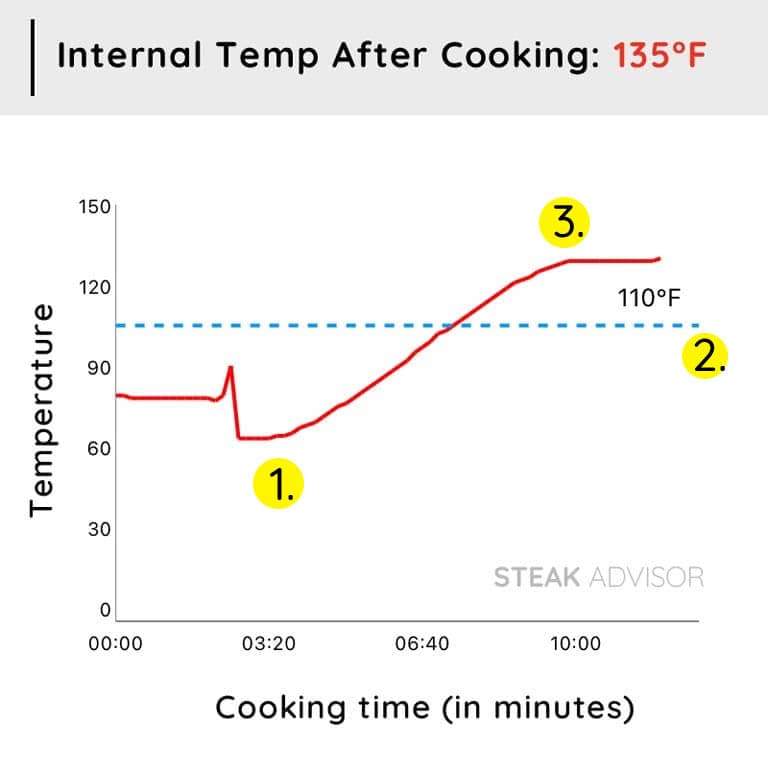
The graph below shows what happened after I removed a 1 1/4-inch (3.2 cm) thick steak from the pan: how much the internal temperature increased, how long it continued to rise, and what final temperature it reached after a few minutes.
- This is the moment I inserted the probe into the steak and placed it in the pan. The probe first showed room temperature, and the sharp drop marks the moment it went into the steak and started reading the steak’s internal temperature.
- The blue line marks 110°F (43°C), the temperature at which I removed the steak from the pan and let it rest.
- After that, you can see how the internal temperature continues to rise over the next few minutes due to carryover cooking, until it finally stabilizes.
I go into more detail on this topic in my article on how long to let a steak rest after cooking.
Insert the Probe Only After Searing the Surface
Don’t insert the probe into the steak before searing it. First, sear all edges to reduce or kill any surface bacteria, then insert the probe to measure the temperature. That way, you avoid contaminating the inside of the steak by inserting the probe through the raw surface and pushing bacteria toward the center.

Let the Steak Rest Before Serving
Don’t skip resting the steak after removing it from the pan. These few extra minutes are important because they allow the steak to reach the target temperature.
As the steak rests, the residual heat continues to cook it from the inside, bringing it to your target doneness. This is especially important when cooking over direct high heat, where carryover cooking can be significant.
Print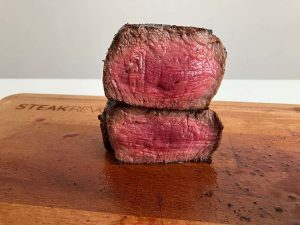
The Perfect Blue Steak Recipe
- Prep Time: 10 minutes
- Rest Time: 1 to 8 hours
- Cook Time: 5 minutes
- Total Time: 15 minutes
- Yield: 1 steak
Description
Here’s a simple, step-by-step recipe for cooking blue steak in a pan. This is the basic version, but you can always add herbs, garlic, and butter for extra flavor.
Ingredients
For Steak:
- Any lean and naturally tender steak that’s at least 1-inch (2.5 cm) thick (preferably filet mignon)
- 2–3 tablespoons (30–45 ml) high-smoke-point oil (I recommend refined avocado oil)
- 1–2 teaspoons (5-10g) kosher salt (use roughly 1-1.5% of the steak’s weight in salt)
- 1/2 teaspoon finely ground black pepper per pound (454 g) of steak (optional)
Tools:
- Pan (a cast-iron, carbon steel, or heavy-bottomed stainless steel skillet)
- Baking Sheet
- Wire Rack
- Instant-Read Meat Thermometer
- Tongs
Instructions
- Gather everything you need and follow the steps below.
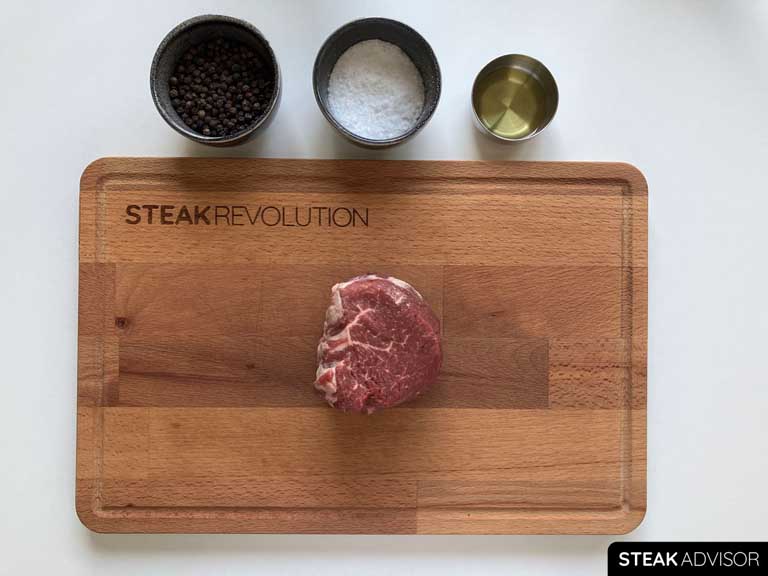
Prepare the Steak
- Pat the steak dry with paper towels, then season it generously on all sides (including the edges) with kosher salt (1–2 teaspoons, or about 1–1.5% of the steak’s weight). After that, decide on the next step based on the desired results and available time:
- If you’re short on time: place the salted steak on a wire rack set over a baking sheet and let it sit uncovered at room temperature for 1 hour. That’s the minimum amount of time the salt needs to do its job.
- If you have more time and want better flavor and a deeper crust: leave it in the fridge for 2 to 8 hours (this is the option I recommend).
- For maximum flavor: You can dry-brine the steak in the fridge for 12–24 hours, but with this option, you must accept the fact that you will get a much thicker gray band under the crust. You won’t get that even wall-to-wall doneness gradient inside. If the gray band isn’t an issue for you, go for it. After a long dry brine, the steak will have a much deeper flavor and a much better crust.
Preheat the Pan
- If you dry-brined the steak in the fridge, take it out about 30 minutes before cooking and let it sit at room temperature.
- Preheat a heavy pan, preferably a cast-iron skillet, over medium-high heat for 3–4 minutes. Add 2–3 tablespoons of high-smoke-point oil and let it heat for another minute.
- Meanwhile, pat the steak dry one more time. Optionally, season it on all sides with about 1/2 teaspoon of finely ground black pepper per pound (454 g) of steak.
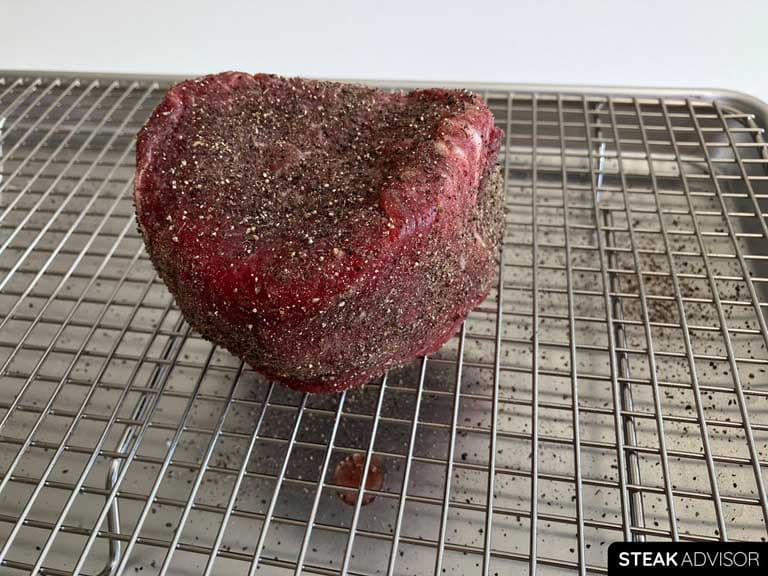
Cook the Steak
- Start by searing the top and bottom for 30 seconds each. Then sear the edges.
- Gently roll the steak with tongs or your hand so every side touches the pan. With blue steak, this step matters because the inside stays almost raw, so you want the outside seared as evenly as possible.
- After searing the edges, go back to the top and bottom. Continue cooking the steak, flipping it every 30 seconds, until it reaches the right internal temperature.
- For a steak about 2 inches (5 cm) thick, remove it from the pan when the internal temperature reaches about 90°F (32°C). For a steak about 1 inch (2.5 cm) thick, remove it at around 100°F (38°C) and let it rest.
- For safety, don’t use the same dirty tongs from start to finish. After searing the steak’s surface, clean the tongs thoroughly or switch to a clean pair before continuing.
Rest the Blue-Rare Steak
- Don’t cut into the steak right after removing it from the pan. Let it rest for about 6–7 minutes. During this time, the residual heat continues to move toward the center, bringing the steak to the right final temperature.
- After those 6 to 7 minutes, slice the steak and serve it with your favorite aromatics and sides.

Look at the chart.
Labeled.
Temp AFTER removal from heat.
No markers on the chart to indicate any other stages of the process.
Imagine only 80 degrees when done cooking and the temperature drops to 50 within minutes. Taking 10 minutes to get back to room temp.
Thanks for pointing that out – you’re right, the chart was confusing. I’ve fixed the labeling now. Sorry about that, and thanks again for catching it.