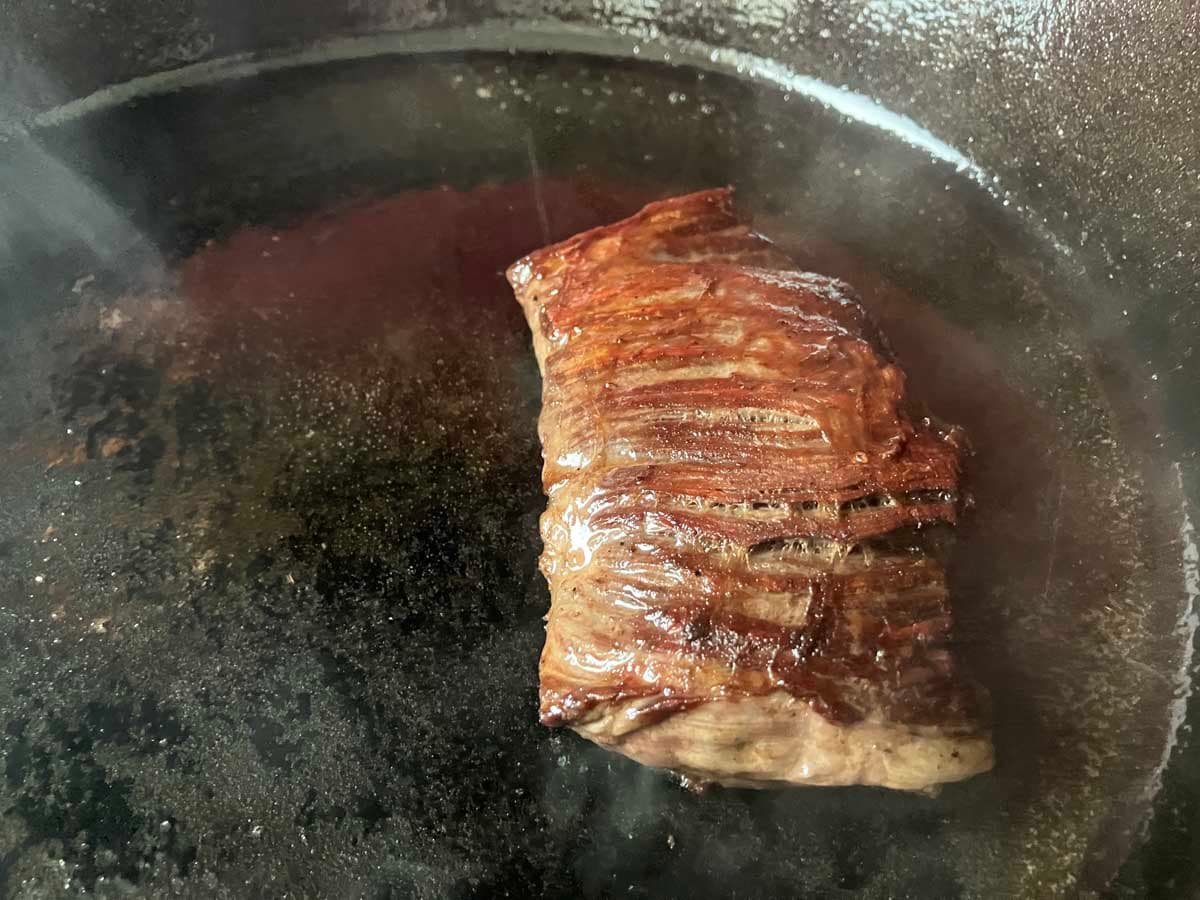

This pan-seared outside skirt steak is juicy, deeply flavorful, and topped with homemade compound butter. No marinade, just a few hours of dry brining followed by a hot sear.
Important
I developed this recipe for outside skirt steak, so make sure you’re using the right cut.
Most people don’t realize there are two types of skirt steak: inside and outside. Outside skirt is more tender, and more flavorful, so it only needs salt, pepper, and a quick sear over high heat. No marinade is required. Because of its superior texture and flavor, it is less common and more expensive.
Inside skirt is more widely available and budget-friendly, but it is naturally tougher and needs marinating to become moderately tender.
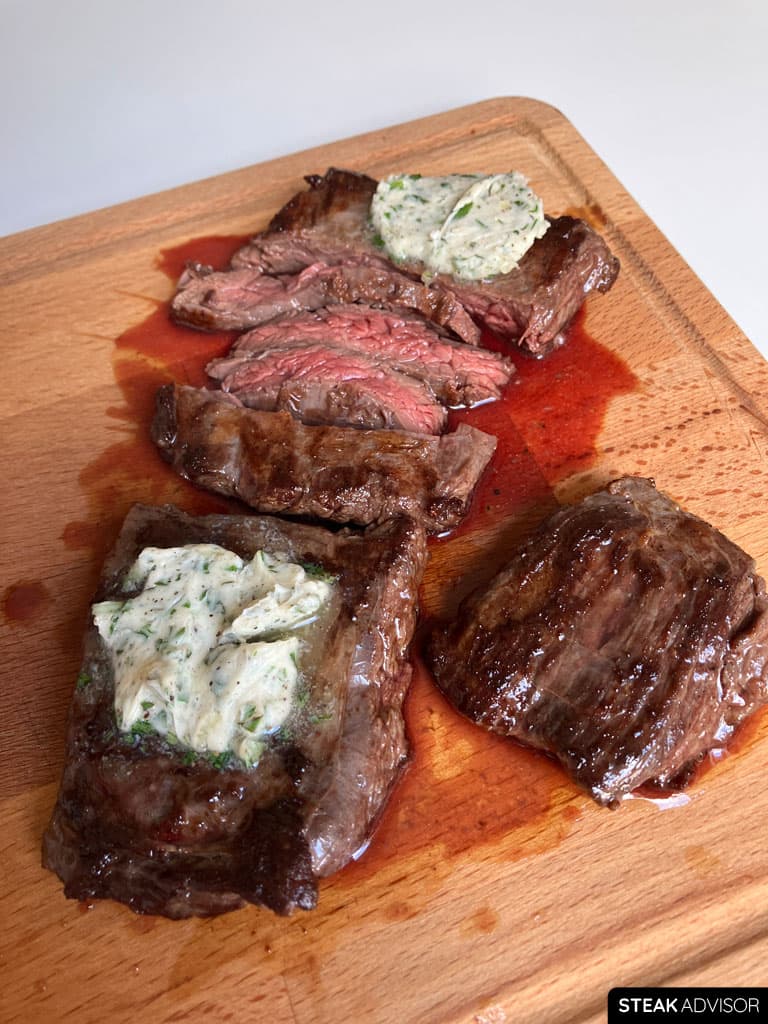
Why You’ll Love This Recipe
- Cooks very quickly on the stovetop
- Gets a deeply browned, flavorful crust
- No marinade or grill required
- Juicy and tender when sliced against the grain
- Tastes even better with melting compound butter
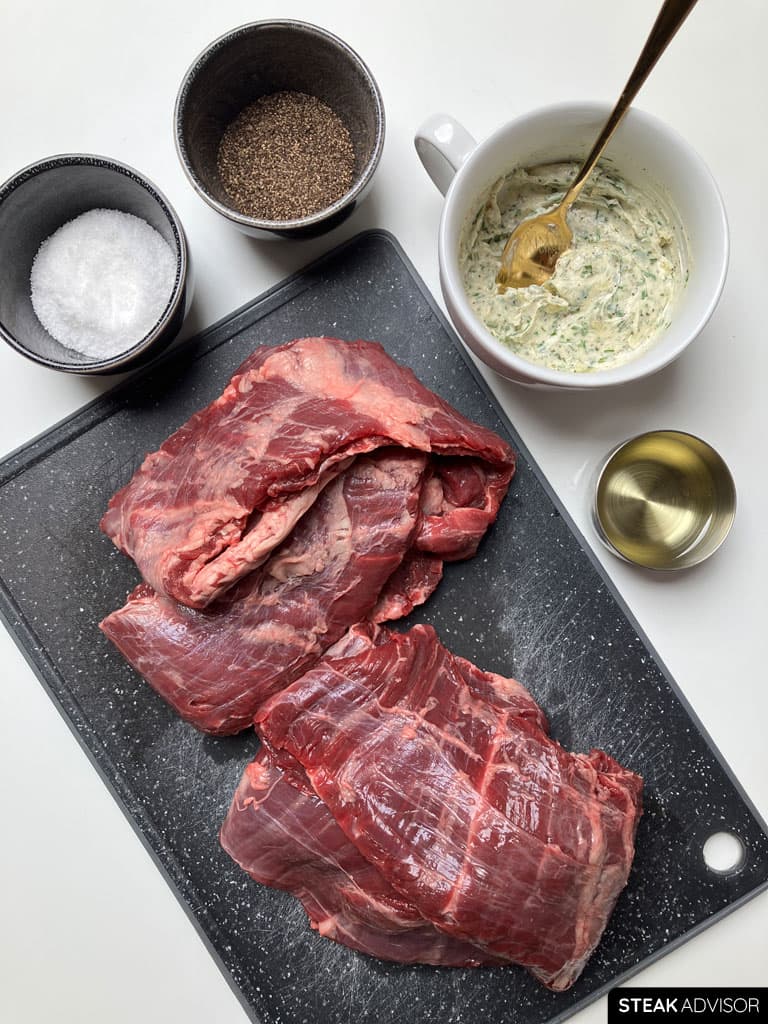
Ingredients You’ll Need
For the steak:
- Outside skirt steak: Make sure you buy outside skirt steak, not inside skirt steak. Outside skirt is harder to find in U.S. grocery stores and butcher shops because much of the supply goes to restaurants. If you can’t find it locally, order it online. Snake River Farms is one good source for high-quality outside skirt steak.
- Oil/Fat: Use a refined oil or another cooking fat with a high smoke point, since the steak will be seared over very high heat. I prefer refined avocado oil for its neutral flavor and smoke point of about 500°F (260°C). Refined high-oleic safflower oil, refined high-oleic canola oil, refined canola oil, refined olive oil, and refined peanut oil are also good choices. Clarified butter (Ghee) works well too. Don’t sear the steak in regular butter because it burns quickly over high heat.
- Salt: Use salt equal to about 1% of the steak’s weight. I prefer kosher salt because its larger crystals are easier to distribute evenly. For a 1 lb (454 g) outside skirt steak, use about 4.5 g (0.16 oz) of salt, or approximately 1 1/2 teaspoons of Diamond Crystal kosher salt or 1 teaspoon of Morton kosher salt. If using table salt, use about 3/4 teaspoon and sprinkle it evenly. Because different types and brands of salt vary in crystal size and density, measuring the salt by weight will give you the most consistent results. Once you know what the right amount looks like for the salt you use, you can season by eye.
- Black pepper (optional): The garlic-herb compound butter adds plenty of flavor, so black pepper is optional. For a peppery finish, season the steak to taste with a generous pinch of finely ground black pepper just before searing.
For the garlic-herb compound butter:
Compound butter is softened butter mixed with flavorful ingredients. As it melts over the hot steak, it coats the surface of the meat and adds rich, aromatic flavor to every bite.
- Butter: 1/2 stick (56 g) of good-quality unsalted butter containing at least 80% fat. I like to use unsalted butter because it gives me full control over the seasoning.
- Parsley: 1/2 tablespoon finely chopped fresh parsley or 1/2 teaspoon dried parsley. I prefer fresh parsley for its brighter color and fresher flavor, but dried parsley works just fine if that’s what you have on hand.
- Rosemary: 1/2 tablespoon finely chopped fresh rosemary or 1/2 teaspoon dried rosemary. I prefer fresh rosemary for its stronger aroma and flavor, but dried rosemary works well too. Chop fresh rosemary very finely so the pieces don’t feel tough or woody.
- Garlic: 2 fresh garlic cloves, finely minced, chopped, or pressed.
- Salt and black pepper: Start with about 1/8 teaspoon of each, then taste and adjust as needed.
Looking for a different flavor combination? Check out my other steak butter recipes.
Prefer something fresher?
Swap the compound butter for chimichurri, a bright and flavorful sauce made with fresh herbs, garlic, olive oil, and a touch of acidity. Its fresh, tangy flavor pairs perfectly with the richness of outside skirt steak.
You’ll find the full sauce recipe in my chimichurri steak recipe.
Tools You’ll Need
- Wire rack with baking sheet: I use this setup for dry-brining steak. The rack keeps the steak raised above the baking sheet, allowing air to circulate around it and helping the surface dry more evenly. The baking sheet catches any liquid and keeps the fridge clean.
- Pan: I highly recommend a heavy cast-iron skillet. Its thick construction stores plenty of heat, so the temperature does not drop as sharply when the steak hits the pan. This helps the surface brown quickly and form a deep crust. A carbon-steel pan or heavy-bottomed stainless-steel skillet will also work. Do not use a nonstick pan because it is not designed for the high heat required for searing.
- Long-handled tongs: Choose sturdy, comfortable tongs that give you good control when turning and moving the steak. Longer handles also keep your hands farther away from the hot skillet and splattering oil.
- Meat thermometer: I prefer an instant-read thermometer for outside skirt steak because the meat is relatively thin and cooks very quickly over direct heat. That said, use whichever thermometer you already have and feel most comfortable with.
How to Pan-Sear an Outside Skirt Steak
Optional: Trim the Steak
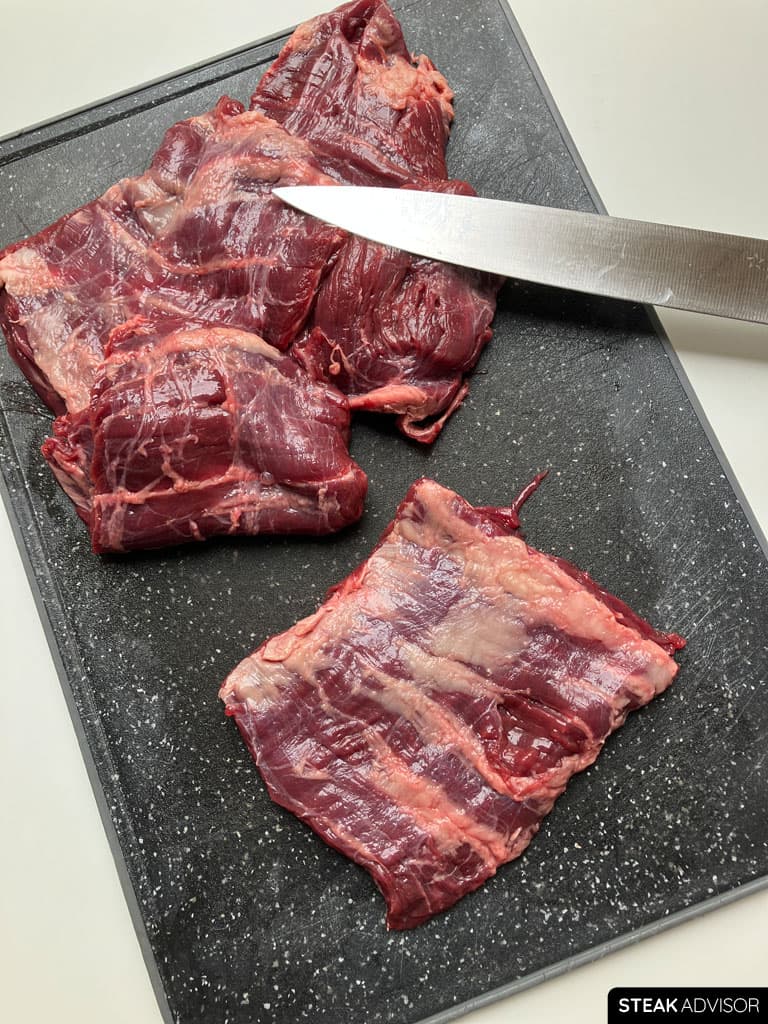
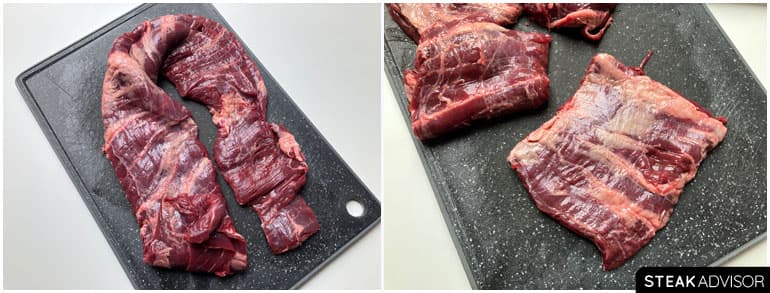
Outside skirt steak is usually sold already trimmed, but if yours doesn’t look like the one in the picture below, you may need to trim it slightly with a sharp knife.
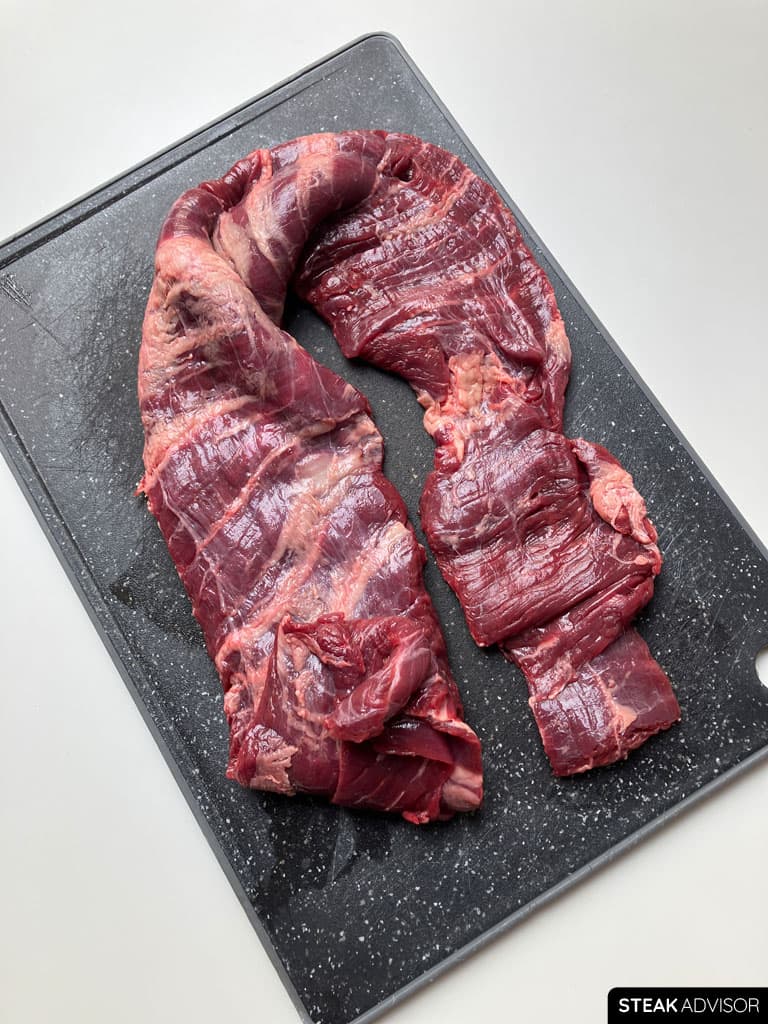
Pat the steak dry with paper towels, then trim away any thick or loose pieces of fat. Don’t overdo it. Just clean up anything that looks excessive. Flip the steak over and run your fingers across the surface. You may feel a thin, silvery membrane. If you find it, grip one edge with a paper towel and peel it away. It usually comes off in large pieces.
This membrane is tough and won’t break down during cooking, so it’s best to remove it. If you can’t find it, the steak was probably already trimmed before it was packaged.
Cut the Steak into Shorter Pieces
A whole outside skirt steak is quite long, and its thickness varies considerably along its length, ranging from about 1/2 inch (1.3 cm) to 1 inch (2.5 cm). This makes it impossible to cook the entire steak evenly if you try to sear it whole.
I recommend cutting it into several pieces about 5-6 inches (13-15 cm) long so they fit comfortably in the pan. Make these initial cuts with the grain. As you portion the steak, try to cut it into pieces that are relatively even in thickness from end to end so they cook at roughly the same rate.
Dry-brine the Steaks
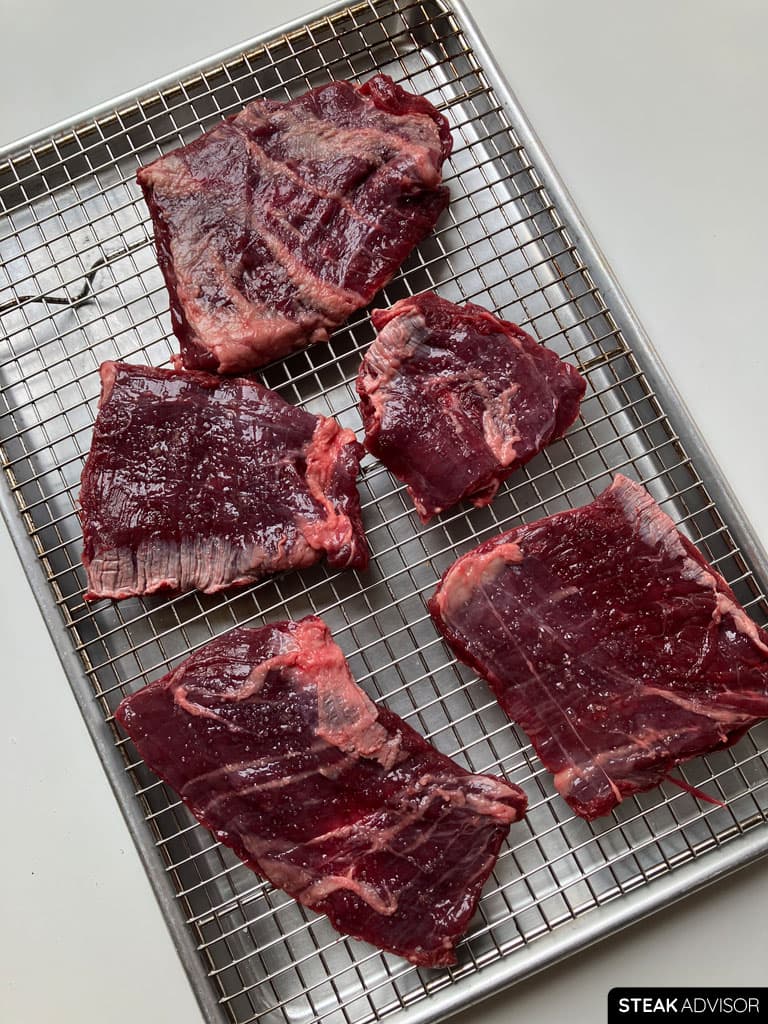
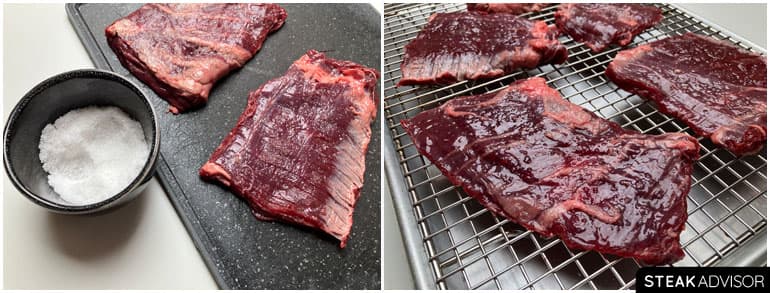
Pat the skirt steak pieces dry with paper towels to remove any surface moisture. Based on the steak’s weight, measure out an amount of salt equal to approximately 1% of that weight, then distribute it over both sides of the pieces.
For a 1 pound (454 g) outside skirt steak, use about 0.16 oz (4.5 g) of salt, or approximately:
- 1 1/2 teaspoons Diamond Crystal kosher salt,
- 1 teaspoon Morton kosher salt,
- or 3/4 teaspoon table salt.
Distribute the measured salt in proportion to the weight of each piece. Smaller pieces should receive less total salt, but the seasoning rate remains approximately 1% by weight.
Place the steak pieces on a wire rack set over a baking sheet and refrigerate them uncovered for at least 1 hour, or ideally for 2-3 hours for deeper flavor and a better crust. I highly recommend giving them the full 2-3 hours.
If you don’t have at least 1 hour, season the steak pieces immediately before they go into the pan, or salt them to taste immediately after searing.
Make the Garlic-Herb Compound Butter
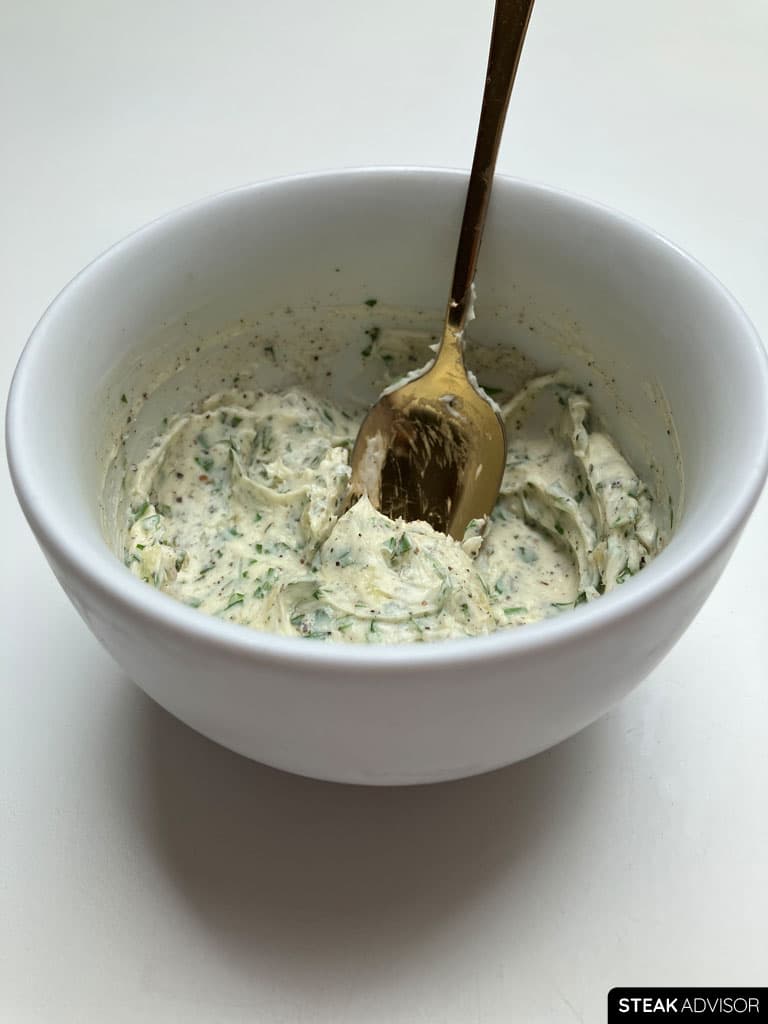
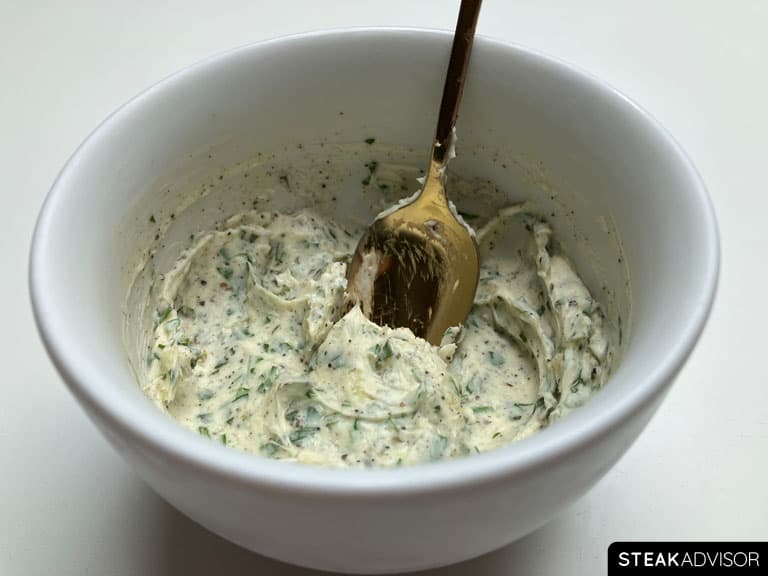
Cut the butter into small cubes, place them in a bowl, and let the butter soften at room temperature until it is easy to mix but still firm enough to hold its shape. To speed up the process, place the butter in a microwave-safe bowl and microwave it in 5-second intervals, checking after each one. Be careful not to melt it.
Add the finely chopped or pressed garlic, finely chopped parsley and rosemary, and the seasonings. Mix with a fork until well combined, then taste and adjust the salt and pepper as needed.
Refrigerate the compound butter until needed.
Preheat the Pan
If you dry-brined the steak, take it out of the refrigerator 15 minutes before cooking. Take the compound butter out at the same time so it can soften slightly.
Tip: Searing creates a lot of smoke, so turn on the exhaust fan or open a window before you begin.
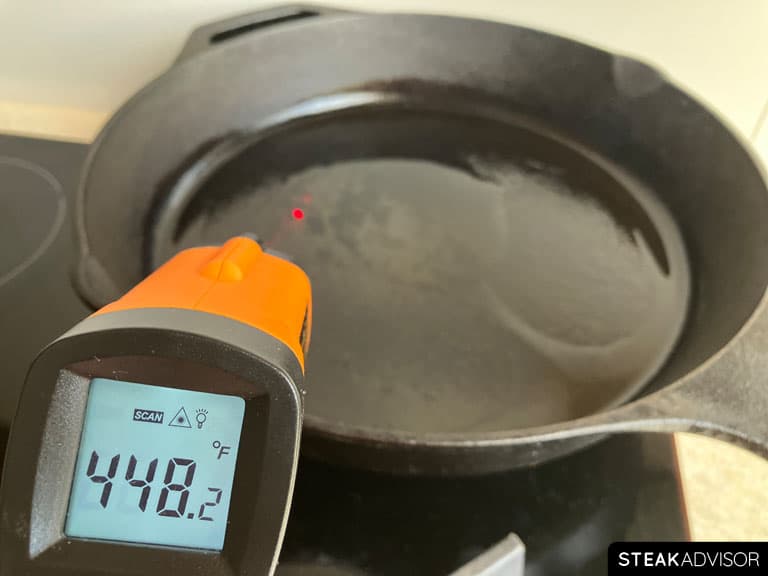
Heat a heavy skillet, such as cast iron, carbon steel, or heavy-bottomed stainless steel over medium-high heat for 3-4 minutes. Add 2 tablespoons of high-smoke-point oil and heat for another minute.
While the pan’s heating up, take a moment to pat the steak pieces again. Pat-drying the steak prevents heat from being wasted on evaporation, allowing browning to begin sooner and a better crust to form.
If using black pepper, season the steak with finely ground pepper just before searing.
Pan-Sear the Outside Skirt Steak
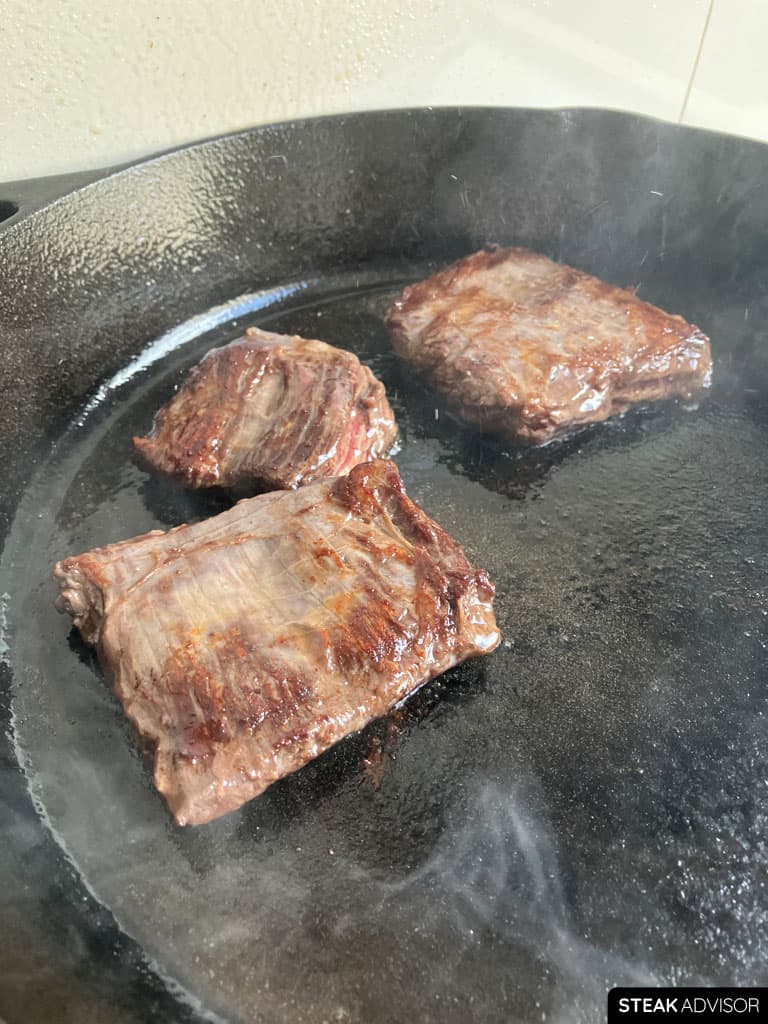
Place as many steak pieces flat in the pan as will fit comfortably without touching or overlapping. Work in batches rather than crowding the skillet. Skirt steak cooks very quickly, so cooking an additional batch should add only a few minutes.
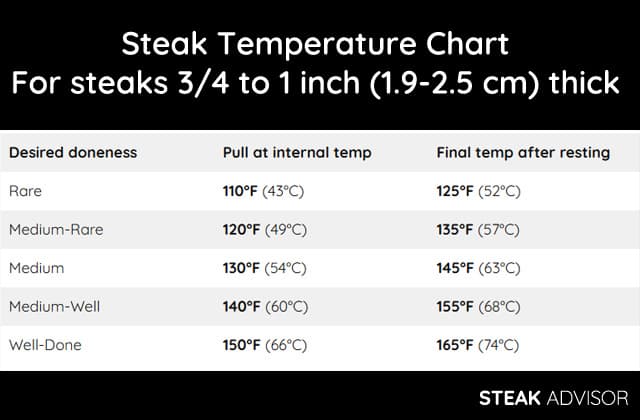
Flip the steaks every 30 seconds and cook until the center of each piece reaches the pull temperature for your desired doneness listed in the chart below. Check each piece separately and remove thinner pieces as soon as they reach the correct temperature.
Pan-Seared Outside Skirt Steak Temperature Chart
Not sure which doneness to choose? My preferred target is about 140°F (60°C) after resting, so I pull the steak at 125°F (52°C). See the doneness guide below for more details.
| Desired doneness | Pull at internal temp | Final temp after resting |
| Rare | 110°F (43°C) | 125°F (52°C) |
| Medium-Rare | 120°F (49°C) | 135°F (57°C) |
| Medium | 130°F (54°C) | 145°F (63°C) |
| Medium-Well | 140°F (60°C) | 155°F (68°C) |
| Well-Done | 150°F (66°C) | 165°F (74°C) |
In my experience, with a 12-inch (30 cm) cast-iron skillet, a steak about 3/4 to 1 inch (1.9 to 2.5 cm) thick usually takes 4 to 6 minutes total to reach a pull temperature of 130°F (54°C) for medium. But don’t rely on timing alone; always trust your thermometer.
Begin checking the temperature after about 2 minutes. Insert the thermometer horizontally through the side of the thickest part, aiming for the center. Check each piece separately and remove thinner pieces first.
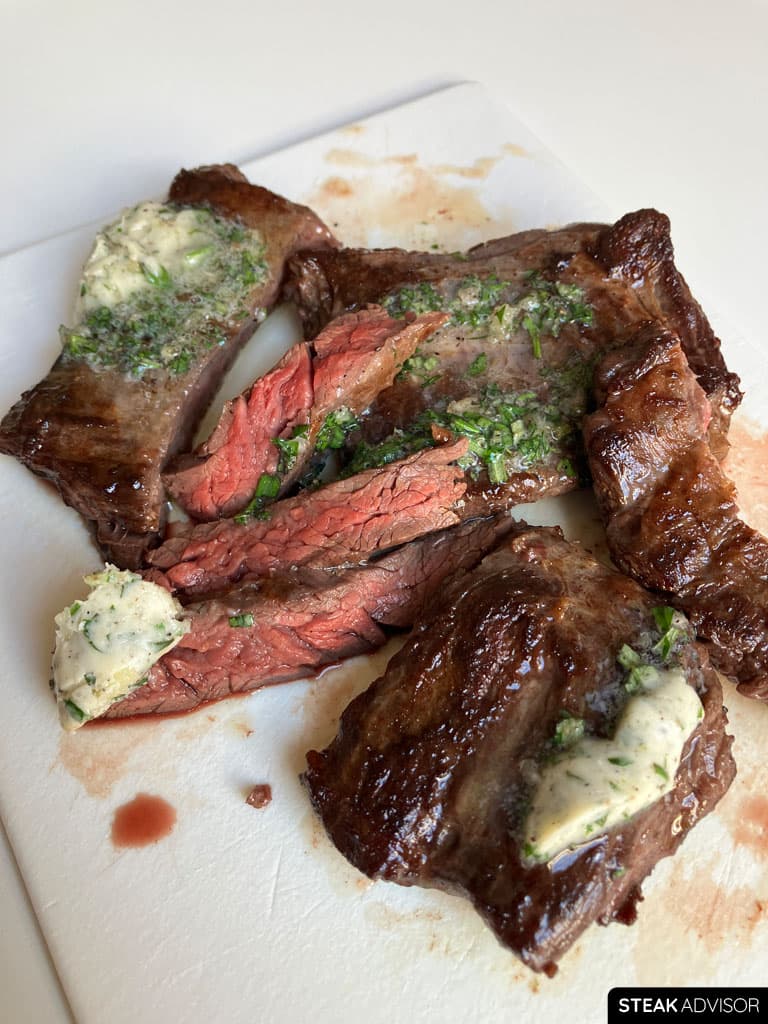
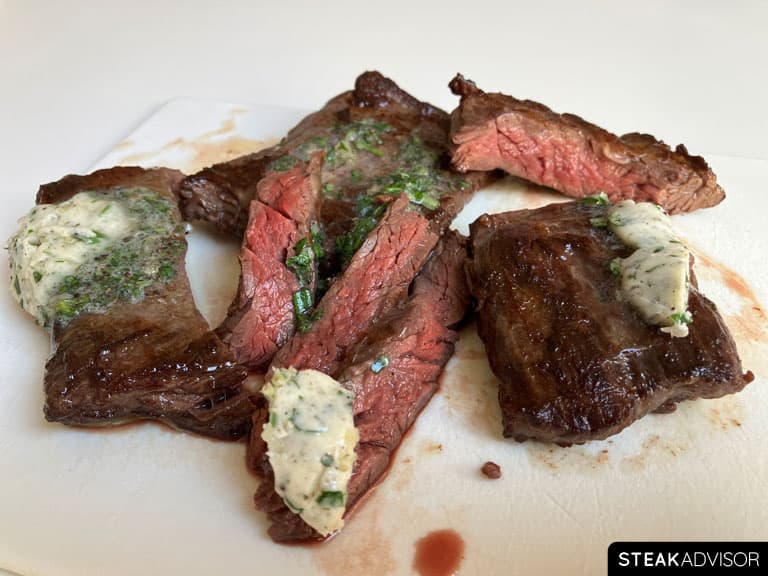
Once the steak reaches its pull temperature, transfer it to a cutting board, top with compound butter and let it rest for 5 minutes. It will continue cooking from residual heat (carryover cooking), and its internal temperature will rise as it rests. This carryover cooking brings the steak to its final doneness without overcooking it in the pan.
Tip #1: If you’re unsure how quickly the steak will cook on your stove, sear one piece first and use it to judge the cooking time for the remaining pieces.
Tip #2: Allow the skillet to reheat briefly between batches. If the surface looks dry, add a small splash of oil. You may not need much additional oil because outside skirt steak releases some of its own fat as it cooks.
Slice and Serve
After the steak has rested for at least 5 minutes, it’s time to slice it. One of the most common mistakes is slicing it along the grain and then wondering why the meat is tough and chewy.
Always slice outside skirt steak against the grain. This shortens the muscle fibers, making each bite much easier to chew. Later in the article, I show you exactly how to identify the grain and slice the steak correctly using photos.
Serve the steak with your favorite sides.
What to Serve with Pan-Seared Outside Skirt Steak
Because outside skirt steak has a rich, beefy flavor, I like to serve it with simple sides that balance the meat without competing with the garlic herb compound butter.
Crispy potatoes are always a good choice, while a fresh salad or lightly cooked vegetables make the meal feel less heavy.
Below are some of my favorite options.
- Crispy Roasted Potatoes
- Oven-Baked Steak Fries
- Mashed Potatoes
- Roasted Brussels Sprouts
- Garlic Green Beans
- Arugula and Tomato Salad
What Is the Best Doneness for Pan-Seared Outside Skirt Steak?
Doneness is always a matter of personal preference, but in my opinion, outside skirt steak is best cooked to a final internal temperature of 135-145°F (57-63°C), ranging from the upper end of medium-rare through medium. My preferred target is around 140°F (60°C).
Outside skirt steak is naturally well-marbled, so cooking it to around 140°F (60°C) gives the fat enough time to render while keeping the meat juicy and tender. If cooked too rare, its coarse-grained texture feels overly soft or slightly mushy rather than pleasantly tender.
That said, outside skirt steak is one of those cuts that still tastes great even when cooked to medium-well. Sure, it will lose some of its natural juiciness, but it will still be very flavorful.
How to Slice Outside Skirt Steak Against the Grain
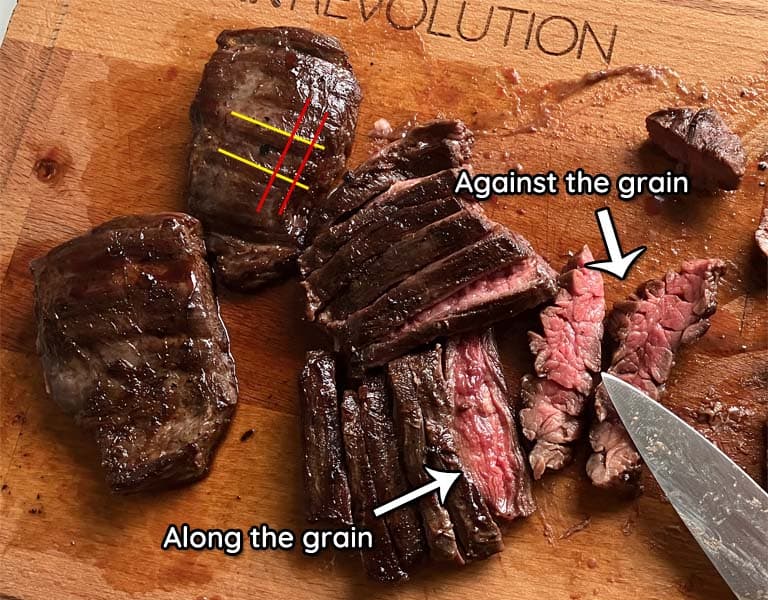
Slicing outside skirt steak properly makes a big difference in how tender it feels. The key is to slice it thinly and always against the grain.
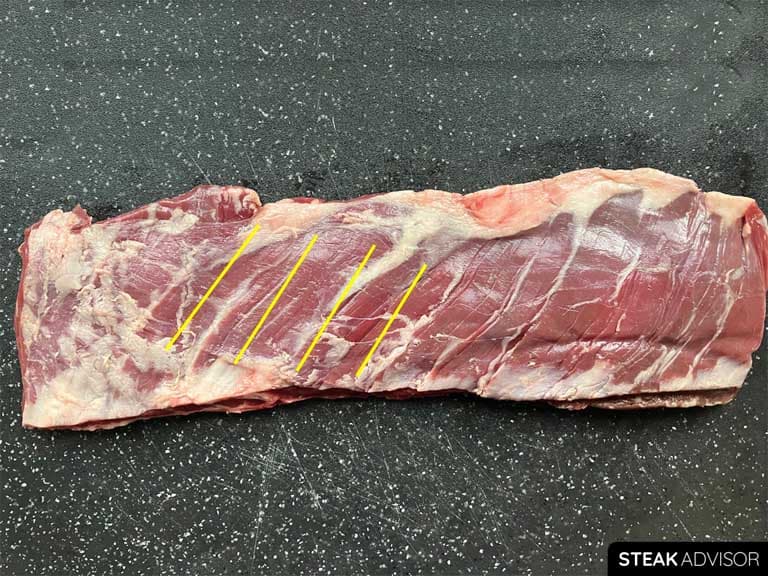
Skirt steak has long, clearly visible muscle fibers. If you slice in the same direction as those fibers, they remain long, and your teeth have to work harder to break them apart. Slicing across the grain shortens the fibers, making each bite noticeably easier to chew.
Below, I’ve included photos showing the direction of the grain in a raw outside skirt steak, how to slice it against the grain, and how the steak looks when sliced along the grain versus against it.

Tips for the Best Pan-Seared Outside Skirt Steak – Key Takeaways
- Use outside skirt steak, not inside skirt steak. It is naturally thicker and more tender, and when cooked properly and sliced against the grain, it does not need a marinade.
- Cut the raw steak into 5-6 inch (13-15 cm) pieces, making these initial cuts with the grain. This helps the pieces fit flat in the pan and cook more evenly, while making it easier to slice them against the grain after cooking.
- Dry-brine the steak uncovered for 2–3 hours for deeper seasoning, a drier surface, and a better crust.
- Use a heavy skillet, preferably cast iron, and preheat it well for 4-5 minutes before searing.
- Use a high-smoke-point oil, such as refined avocado oil. Do not sear in regular butter.
- Pat the steak completely dry before searing. A dry surface browns faster and develops a better crust.
- Do not overcrowd the pan. Cook the steak in batches so every piece stays flat against the hot surface.
- Flip the steak every 30 seconds for more even cooking and better control over doneness.
- Use an instant-read thermometer instead of relying on cooking time. Check each piece separately and remove thinner pieces first.
- Remove the steak much earlier than the old-school 5°F (3°C) rule suggests. With a hard, fast sear, carryover cooking is much greater than most people realize, so pull it about 15°F (8°C) below your target doneness.
- Top with compound butter and rest for 5 minutes, allowing residual heat to bring the steak to its final doneness.
- Always slice thinly against the grain. This shortens the muscle fibers and makes each bite easier to chew.
For the nerdy details and why this works, check out my complete guide to properly cooking steak on the stove.
Print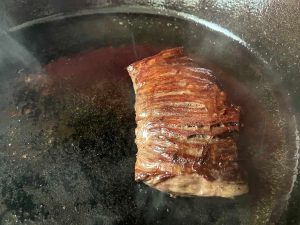
Pan-Seared Outside Skirt Steak Recipe
- Prep Time: 20 minutes
- Dry-Brine Time: 1 to 3 hours
- Cook Time: 10 minutes
- Total Time: 1 hour 30 minutes
- Yield: 2 generous servings
Description
Juicy pan-seared outside skirt steak with a deeply browned crust, topped with rich garlic-herb compound butter.
Ingredients
For the Steak:
- About 1 lb (454 g) outside skirt steak (not inside skirt!) see notes
- 2 tablespoons (30 ml) high-smoke-point oil, such as refined avocado oil (see notes)
- Salt, 1% of the steak’s weight (see instructions for a 16 oz / 454 g example)
- Black pepper (optional): A generous pinch of finely ground black pepper, or to taste.
For garlic-herb compound butter (for serving)
- 1/2 stick (56 g) of unsalted butter
- 2 garlic cloves, finely chopped or pressed
- 1/8 teaspoon salt (a generous pinch), or more to taste
- A generous pinch of finely ground black pepper (about 1/8 teaspoon), or to taste
- 1/2 tablespoon finely chopped fresh parsley or 1/2 teaspoon dried
- 1/2 tablespoon finely chopped fresh rosemary or 1/2 teaspoon dried rosemary
Tools
- Wire rack and baking sheet (for dry-brining the steak)
- Pan (cast-iron, carbon steel or heavy-bottomed stainless steel skillet)
- Tongs
- Meat thermometer (instant-read or leave-in probe thermometer)
Instructions
Optional: Trim the Steak
- If your steak is already well trimmed, skip this step.
- Pat the steak dry with paper towels. Trim away any thick or loose pieces of fat, but don’t overdo it. Remove only what looks excessive.
- Flip the steak over and run your fingers across the surface. If you feel a thin, silvery membrane, loosen one edge with a sharp knife, grip it with a paper towel, and peel it away. It usually comes off in large pieces.
Cut the Steak into Shorter Pieces
- If you have a whole outside skirt steak, cut it into several pieces about 5-6 inches (13-15 cm) long so they fit comfortably in the pan. Make these initial cuts with the grain.
- As you portion the steak, try to cut it into pieces that are relatively even in thickness from end to end so they cook at roughly the same rate.
Dry-brine the Steaks
- Pat the steak pieces dry with paper towels, then season both sides with salt equal to about 1% of the steak’s weight.
- For about 1 lb (454 g) of steak, use approximately:
1 1/2 teaspoons Diamond Crystal kosher salt,
1 teaspoon Morton kosher salt,
or 3/4 teaspoon table salt. - Distribute the measured salt in proportion to the weight of each piece. Smaller pieces should receive less total salt, but the seasoning rate remains approximately 1% by weight.
- Place the pieces on a wire rack set over a baking sheet and refrigerate uncovered for at least 1 hour, preferably 2-3 hours for deeper flavor and a better crust.
- If you don’t have at least 1 hour, season the steak pieces immediately before they go into the pan, or salt them to taste immediately after searing.
Make the Garlic-Herb Compound Butter
- Cut the butter into small cubes, place them in a bowl, and let them soften at room temperature until soft enough to mix. To speed this up, place the butter in a microwave-safe bowl and microwave it in 5-second intervals, checking after each one. Be careful not to melt it.
- Add the garlic, parsley, rosemary, salt, and black pepper. Mix with a fork until well combined, then taste and adjust the seasoning.
- Refrigerate until needed.
Preheat the Pan
- Tip: Searing creates a lot of smoke, so turn on the exhaust fan or open a window before you begin.
- If you dry-brined the steak, take it out of the refrigerator 15 minutes before cooking. Take the compound butter out at the same time so it can soften slightly.
- Heat a cast-iron, carbon-steel, or heavy-bottomed stainless-steel skillet over medium-high heat for 3-4 minutes. Add 2 tablespoons of high-smoke-point oil and heat for another minute.
- While the pan heats, pat the steak pieces dry again.
- If using black pepper, season the steak just before searing.
Pan-Sear the Outside Skirt Steak
- Place as many steak pieces in the pan as will fit without touching or overlapping. Cook in batches if necessary. If you are unsure about the timing, cook one piece first.
- Sear the steak, flipping every 30 seconds, until each piece reaches the pull temperature for your desired doneness:
120°F (49°C) for medium-rare,
130°F (54°C) for medium,
140°F (60°C) for medium-well150°F (66°C) for well-done.
See notes for the complete steak temperature chart. - Begin checking the temperature after about 2 minutes. Insert the thermometer horizontally through the side of the thickest part, aiming for the center. Check each piece separately and remove thinner pieces first.
- Once each piece reaches its pull temperature, transfer it to a cutting board, top it with compound butter, and let it rest for 5 minutes. Its internal temperature will rise from residual heat (carryover cooking) as it rests, bringing it to its final doneness without overcooking it in the pan.
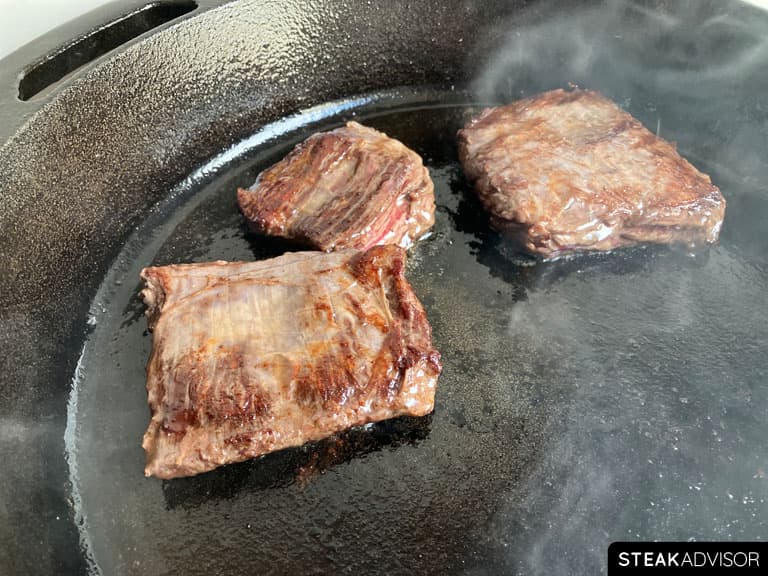
- In a 12-inch (30 cm) cast-iron skillet, pieces about 3/4 to 1 inch (1.9 to 2.5 cm) thick usually take 4 to 6 minutes total to reach 130°F (54°C). Do not rely on timing alone. Trust your thermometer.
- Let the skillet reheat briefly between batches. If the pan looks dry, add a small amount of oil.
Slice and Serve
- After resting for 5 minutes, slice the steak thinly against the grain. This shortens the muscle fibers and makes the meat easier to chew (see notes).
- Serve immediately with your favorite sides.
Notes
Choose the right cut: There are two types of skirt steak: inside and outside. Outside skirt is the one you want for this recipe. It is naturally more tender and has a richer, beefier flavor than inside skirt. Because of that, it needs only simple seasoning (salt and, optionally, black pepper) followed by a quick, high-heat sear. Inside skirt is naturally much tougher and requires marinating to help tenderize it, so it is not suitable for this recipe.
Oil: Instead of refined avocado oil, you can use refined high-oleic safflower oil, refined high-oleic canola oil, refined canola oil, refined olive oil, refined peanut oil, or ghee (clarified butter). Do not use regular butter for searing because it burns at high heat.
Slice against the grain: Always slice outside skirt steak against the grain. This shortens the muscle fibers in each slice, making the meat easier to chew. Slicing with the grain leaves them long, so the steak feels tough and chewy. See the photo below for an example.
Pan-Seared Outside Skirt Steak Temperature Chart: My preferred target is about 140°F (60°C) after resting, so I pull the steak at 125°F (52°C).

I didn’t know outside skirt and inside skirt were that different. This came out great with just salt, a hot pan, and slicing against the grain.
Thanks, Lauren. That cut makes a big difference.
A little longer than most steak recipes, but honestly very solid. I learned a lot, especially about outside vs inside skirt steak and why slicing against the grain matters so much.
Thanks, Mark. Skirt steak is one of those cuts where the details really matter.