

This chimichurri steak recipe is simple to make but still feels special. Pan-seared or grilled, the steak is juicy and savory, with a fresh, garlicky, slightly tangy flavor from the chimichurri.
Important
Use any steak cut you like for this recipe, as long as it’s about 3/4 to 1 inch (1.9-2.5 cm) thick. I tested the pan-searing and grilling instructions with steaks in that range. For thinner or thicker steaks, use a meat thermometer and cook to your target internal temperature.
You can also make the chimichurri sauce separately and serve it with any steak you like, cooked using your preferred method.
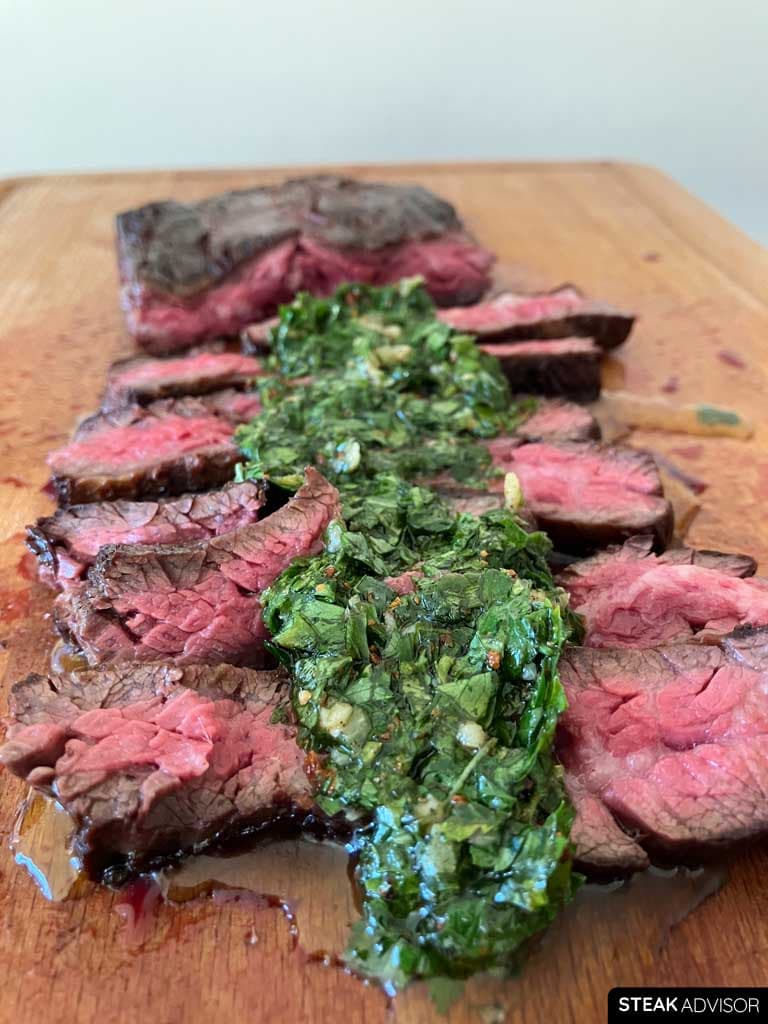
Chimichurri is one of the best sauces for steak. Its fresh herbs, garlic, and acidity cut through the richness of the beef, creating a balanced and flavorful combination. For me, it ranks alongside compound butter as a favorite steak topping.
Best Steak Cuts for Chimichurri
Chimichurri is a fresh, uncooked herb sauce traditionally served with grilled meat in Argentina and Uruguay. Its bright, garlicky flavor works well with any type of steak.
Personally, I prefer outside skirt steak or flank steak. Both have plenty of beefy flavor, cook quickly, and are large enough to serve several people without preparing individual steaks.
Other good options include flat iron, hanger steak, ribeye, New York strip, and filet mignon. Choose flat iron or hanger for bold beefy flavor, ribeye for extra richness, New York strip for a balance of flavor and tenderness, or filet mignon for the most delicate texture.
Ingredients You’ll Need
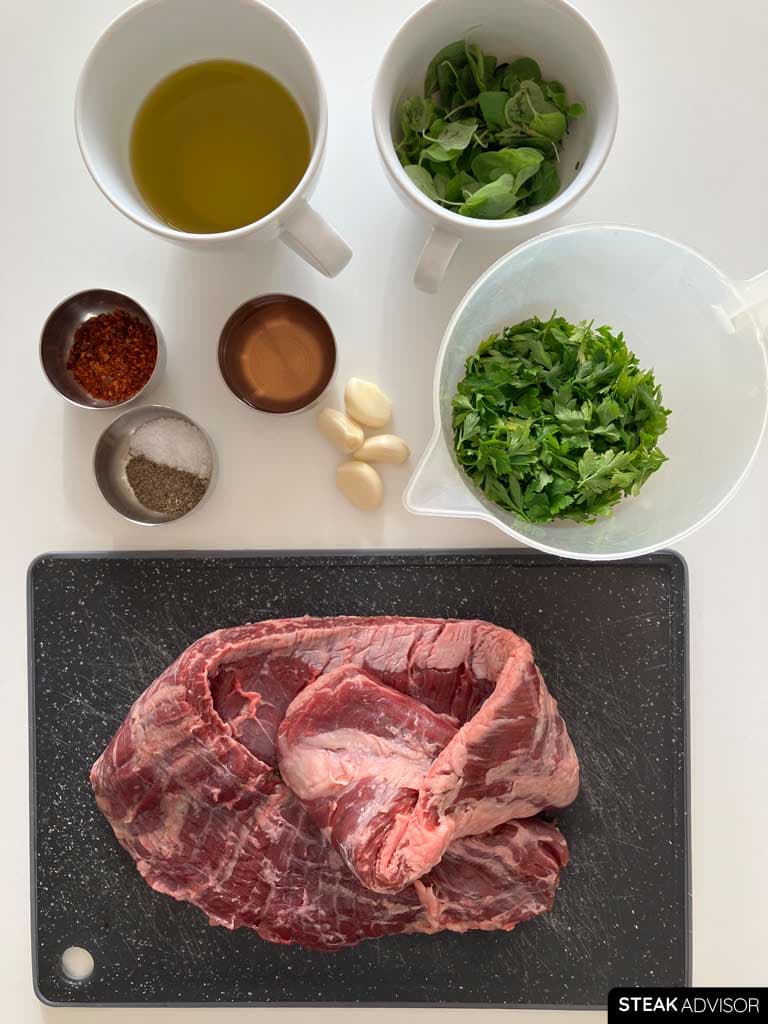
For the chimichurri sauce:
This is the simple, parsley-based chimichurri I make most often. This amount makes enough chimichurri for about 1 lb (454 g) of steak, or 2 generous servings.
- Olive oil: 1/4 cup (60 ml) good-quality extra virgin olive oil. Since the sauce is uncooked, use one you like the taste of.
- Red wine vinegar: 2 tablespoons (30 ml) to add acidity and balance the steak. Substitute white wine vinegar or lemon juice if needed.
- Parsley: 1/2 cup tightly packed fresh flat-leaf parsley leaves. Remove the thick stems before measuring.
- Garlic: 2 peeled cloves.
- Red pepper flakes: 1/2 teaspoon for mild heat, or adjust to taste.
- Oregano: 1 tablespoon fresh oregano leaves, with the thick stems removed, or 1 teaspoon dried oregano.
- Salt: 1/4 teaspoon fine salt or about 1/2 teaspoon kosher salt (plus more to taste).
- Black pepper: Use 1/8 teaspoon of finely ground black pepper, or more to taste.
Variations
- Fresh chili: Replace the red pepper flakes with 1/4 to 1/2 small red chili, finely chopped. Adjust the amount depending on its heat.
- Cilantro: Add 2 tablespoons finely chopped cilantro, or replace up to half of the parsley with an equal amount of cilantro.
- Onion: Add 2 tablespoons finely chopped red onion or shallot.
- Citrus: Add 1 tablespoon fresh lemon juice for a brighter, fresher flavor. For a more balanced acidity, replace 1 tablespoon of the red wine vinegar with the lemon juice.
For the steak:
- Steak: Use 1 lb (454 g) of almost any steak cut, about 3/4 to 1 inch (1.9-2.5 cm) thick. Outside skirt, flank, hanger, flat iron, sirloin, ribeye, New York strip, and filet mignon all work well. You can use a thicker steak, but you will need to adjust the cooking method for that specific cut, since I cannot cover every cut and thickness in one recipe. You can also use just the chimichurri recipe and follow a separate recipe for your preferred cut or cooking technique.
- Oil (optional): You only need it for pan-searing. Use just enough to lightly coat the bottom of the skillet, about 2-3 tablespoons (30 to 45 ml), depending on its size. I almost always use refined avocado oil because it has a neutral flavor and handles high heat well. Refined high-oleic safflower, canola, olive, or peanut oil and ghee (clarified butter) are also good options. Do not use regular butter because it burns quickly over high heat. Skip the oil if grilling.
- Salt: I prefer kosher salt because its larger crystals are easier to distribute evenly, but table salt works too. Use salt equal to about 1% of the steak’s weight. For a 1 lb (454 g) steak, that is about 0.16 oz (4.5 g) of salt, or roughly 1 2/3 teaspoons Diamond Crystal kosher salt, 1 teaspoon Morton kosher salt, or 2/3 teaspoon table salt. Weigh it the first few times, then season by eye once you know your preference.
How to Make Chimichurri Steak
Here’s a quick overview of the process. The dry-brine is optional, and you can cook the steak either in a pan or on the grill.
- Optional: Dry-brine the steak for 1-3 hours.
- Make the chimichurri and let it rest for at least 1 hour.
- Cook the steak in a hot skillet or on the grill.
- Rest the steak for 5 minutes.
- Slice and serve. For skirt, flank, hanger, or bavette, slice thinly against the grain and serve with chimichurri.
Optional: Dry-brine the steak
I am using outside skirt steak in the photos, but the same cooking instructions work with almost any steak cut about 3/4 to 1 inch (1.9-2.5 cm) thick.
Pat the steak dry with paper towels and trim any excess fat. If needed, cut it into pieces that are easier to cook. A whole outside skirt steak is quite long, so I cut it into sections about 4-8 inches (10-20 cm) long. Try to group pieces of similar thickness so they cook evenly.
Season the steak with salt equal to about 1% of its weight. For a 1 lb (454 g) steak, that is about 0.16 oz (4.5 g) of salt, or approximately:
- 1 2/3 teaspoons Diamond Crystal kosher salt
- 1 teaspoon Morton kosher salt
- 2/3 teaspoon table salt
Place the steak on a wire rack set over a baking sheet and refrigerate it uncovered for at least 1 hour, or ideally 2-3 hours for deeper seasoning and a better crust.

Make the Chimichurri Sauce
Timing tip: If you’re dry-brining the steak, make the chimichurri while it rests in the refrigerator. If you’re skipping the dry-brine, make the sauce first and let it sit for 1 hour before serving.
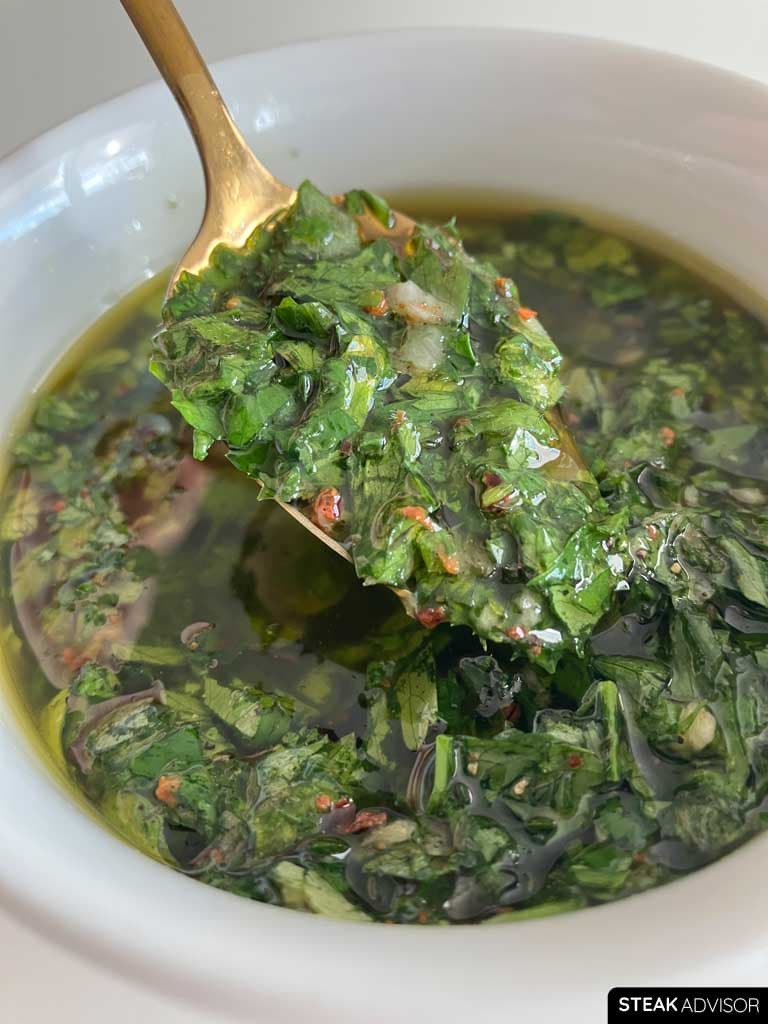
By hand: Finely chop the parsley, oregano, and garlic, then add them to a bowl with the remaining ingredients. Mix well, taste, and adjust the seasoning as needed.
In a food processor: Add all the ingredients except the olive oil and vinegar. Pulse until finely chopped, then add the oil and vinegar and pulse just until combined. Do not blend until smooth. The sauce should keep some texture.
Let the chimichurri sit for 1 hour before serving. Store it in an airtight container in the refrigerator for up to 3 days.
Cook the Steak
I included separate instructions for pan-searing and grilling, so choose the method you prefer.
If you dry-brined the steak, take it out of the refrigerator 15 minutes before cooking. Take the chimichurri out at the same time.
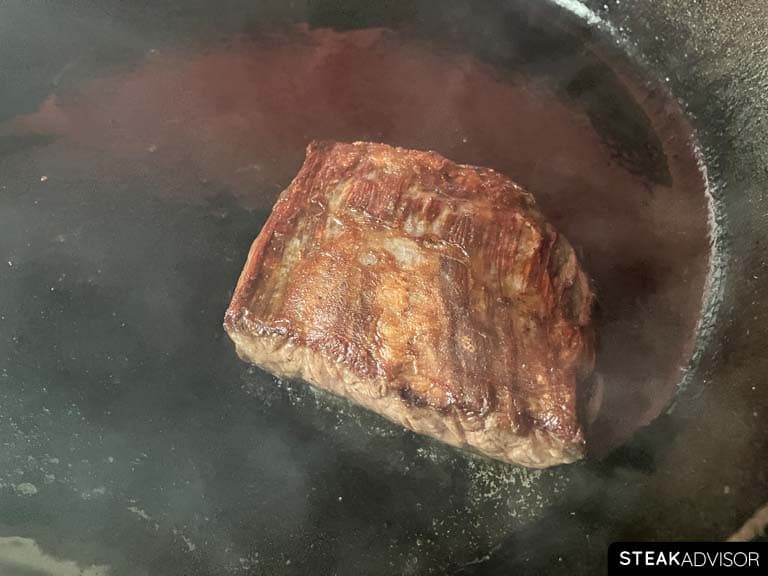
If Cooking in a Pan: Heat a heavy skillet, such as cast iron, carbon steel, or heavy-bottomed stainless steel, over medium-high heat for 3 to 4 minutes. Add 2-3 tablespoons of high-smoke-point oil and heat for another minute.
While the oil heats, pat the steak dry again. Surface moisture must evaporate before browning can begin, so drying the steak helps it develop a better crust.

Optional: If your steak has a thick fat cap, such as a strip steak, start by rendering it for 60 to 90 seconds, or until nicely browned.
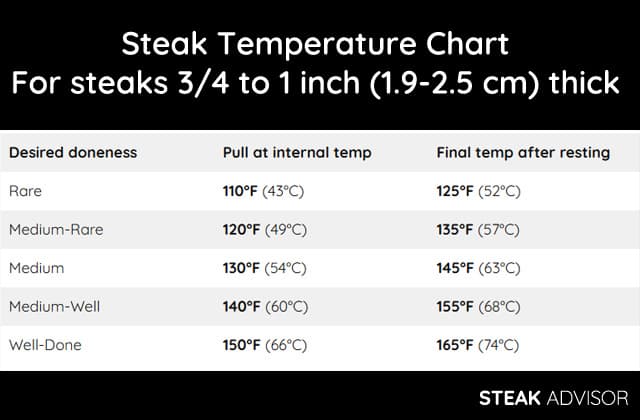
Lay the steak flat in the pan and sear, flipping every 30 seconds, until the center reaches the pull temperature for your desired doneness shown in the chart below.
| Desired doneness | Pull at internal temp | Final temp after resting |
| Rare | 110°F (43°C) | 125°F (52°C) |
| Medium-Rare | 120°F (49°C) | 135°F (57°C) |
| Medium | 130°F (54°C) | 145°F (63°C) |
| Medium-Well | 140°F (60°C) | 155°F (68°C) |
| Well-Done | 150°F (66°C) | 165°F (74°C) |
For a steak about 1 inch (2.5 cm) thick, reaching the 130°F (54°C) pull temperature for medium usually takes about 4 to 6 minutes total. Begin checking the temperature after about 3 minutes.
Once the steak reaches the pull temperature, transfer it to a cutting board and let it rest for 5 minutes.
If Cooking on the Grill: For a charcoal grill, light one full chimney of charcoal. When the coals are fully lit and covered with a thin layer of gray ash, pour them out and arrange them over one half of the charcoal grate. Set the cooking grate in place, cover the grill with the vents fully open, and preheat for 5 minutes.
For a gas grill, light all the burners on high, close the lid, and preheat for 10 to 15 minutes. Then leave the burners on one side on high and turn the burners on the other side off, creating a hot zone and a cooler safety zone. Clean and lightly oil the grates.
Place the steak directly over the hot side of the grill. Grill, flipping every 30 seconds, until a well-browned crust develops and the center reaches the pull temperature listed in the chart.
| Desired doneness | Pull at internal temp | Final temp after resting |
| Rare | 110°F (43°C) | 125°F (52°C) |
| Medium-Rare | 120°F (49°C) | 135°F (57°C) |
| Medium | 130°F (54°C) | 145°F (63°C) |
| Medium-Well | 140°F (60°C) | 155°F (68°C) |
| Well-Done | 150°F (66°C) | 165°F (74°C) |
For a steak about 1 inch (2.5 cm) thick, reaching a pull temperature of 130°F (54°C) usually takes about 5 to 8 minutes over the hot side of the grill. Because grill temperatures vary, begin checking after about 3 minutes and rely on a meat thermometer rather than cooking time alone.
If the steak browns too quickly or the fat causes flare-ups, move it temporarily to the cooler side of the grill. Once the steak reaches the pull temperature, transfer it to a cutting board and rest for 5 minutes before slicing.
Slice and Serve
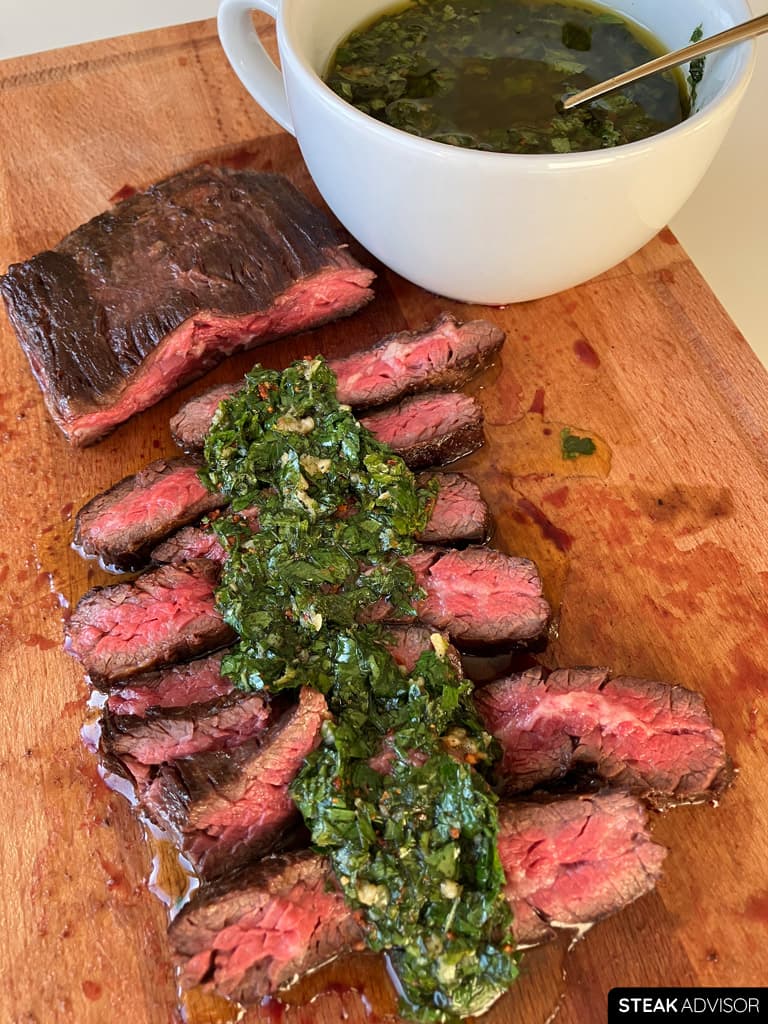
If using skirt steak, flank steak, hanger steak, bavette/flap steak, or another cut with a clearly visible grain, slice the steak thinly against the grain. Serve with the chimichurri sauce. Not sure which way to slice? See my guide to cutting steak against the grain.
What to Serve with Chimichurri Steak
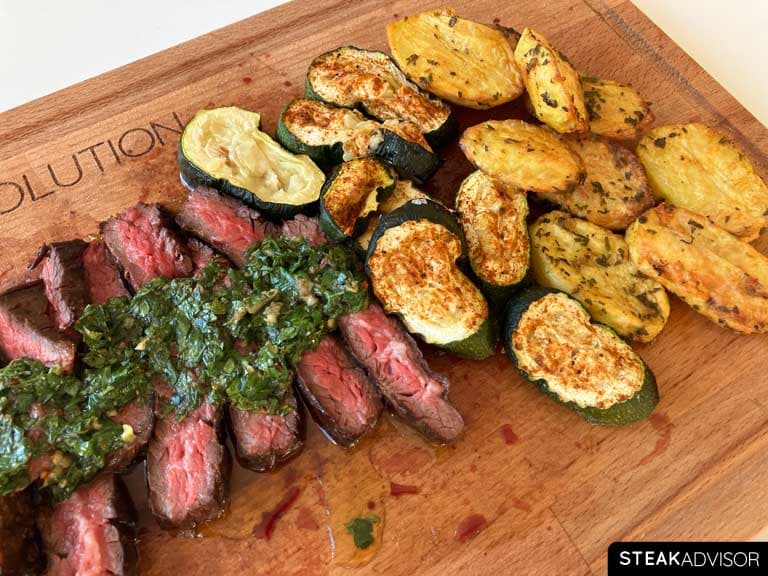
- Potatoes: Baked, roasted, or crispy potatoes.
- Vegetables: Grilled or roasted zucchini, peppers, asparagus, or broccoli.
- Rice: White rice, herbed rice, or garlic butter rice.
- Salad: Tomato, arugula, or mixed green salad.
- Bread: Crusty bread for soaking up extra chimichurri.
I usually serve chimichurri steak with potatoes and vegetables.
Tips for the Best Chimichurri Steak – Summarized
- Choose any steak cut you enjoy, but for the cooking instructions in this recipe, use one about 3/4 to 1 inch (1.9-2.5 cm) thick. Outside skirt is my first choice, while flank, hanger, flat iron, sirloin, ribeye, New York strip, and filet mignon also work well.
- Dry-brine the steak for at least 1 hour, preferably 2 to 3 hours for deeper flavor and a better crust.
- Make the chimichurri at least 1 hour before serving to give the flavors time to blend.
- Do not blend the chimichurri until smooth.
- Preheat the skillet until very hot, about 450°F (232°C).
- Do not sear the steak in regular butter.
- Use a high-smoke-point oil for pan-searing.
- Pat the steak dry one more time, just before placing it in the pan or on the grill. A dry surface browns more effectively and develops a better crust.
- If you are not dry-brining, either cook the steak immediately after salting or wait at least 45 minutes.
- Flip the steak every 30 seconds for even cooking and browning.
- Use a meat thermometer and remove the steak when it reaches the pull temperature listed in the chart.
- Let the steak rest uncovered for 5 minutes before serving.
- For skirt, flank, hanger, or bavette, slice the steak thinly against the grain.
- Spoon the chimichurri over the steak just before serving. Do not cook the sauce.
Chimichurri Steak Recipe
- Prep Time: 30 minutes
- Dry-Brine Time (Optional): 0 to 3 hours
- Cook Time: 10 mins
- Total Time: 40 minutes
- Yield: 2 generous servings
Description
Tender, juicy steak with fresh, garlicky chimichurri sauce. Pan-sear or grill almost any steak cut about 3/4 to 1 inch (1.9 to 2.5 cm) thick using the step-by-step instructions below.
Ingredients
For the Chimichurri Sauce:
- 1/4 cup (60 ml) extra-virgin olive oil
- 2 tablespoons (30 ml) red wine vinegar
- 1/2 cup tightly packed fresh flat-leaf parsley leaves, thick stems removed
- 1 tablespoon fresh oregano leaves, thick stems removed, or 1 teaspoon dried oregano
- 2 garlic cloves, peeled
- 1/2 teaspoon red pepper flakes, or to taste
- 1/4 teaspoon fine salt (or 1/2 teaspoon kosher salt), plus more to taste
- 1/8 teaspoon finely ground black pepper, or to taste
For the Steak:
- 1 lb (454 g) steak of your choice, about 3/4 to 1 inch (1.9–2.5 cm) thick (see notes)
- 2–3 tablespoons (30 to 45 ml) high-smoke-point oil, such as refined avocado oil, for pan-searing only (see notes)
- Salt, 1% of the steak’s weight (see instructions for a 16 oz / 454 g example)
Instructions
Optional: Dry-brine the steak
- Pat the steak dry with paper towels and trim any excess fat. If using a long skirt steak, cut it crosswise into 4- to 8-inch (10- to 20-cm) sections so it fits the pan.
- Season with salt equal to about 1% of its weight. For about 1 lb (454 g) of steak, use approximately:
about 1 2/3 teaspoons Diamond Crystal kosher salt
about 1 teaspoon Morton kosher salt
about 2/3 teaspoon table salt - Place the steak on a wire rack set over a baking sheet and refrigerate uncovered for at least 1 hour, ideally 2-3 hours for better flavor and crust.
Make the chimichurri sauce (see notes)
- By hand: Finely chop the parsley, oregano, and garlic. Add them to a bowl with the remaining chimichurri ingredients and mix well.
- Using a food processor: Pulse all the ingredients except the olive oil and vinegar until finely chopped. Add the oil and vinegar and pulse just until combined. Do not blend until smooth.
- Taste and adjust the seasoning.
- Let the chimichurri sit for 1 hour before serving.
Cook the steak: pan-searing
- If you dry-brined the steak, take it out of the refrigerator 15 minutes before cooking. Take the chimichurri out at the same time.
- Heat a heavy skillet, such as cast iron, carbon steel, or heavy-bottomed stainless steel, over medium-high heat for 3-4 minutes. Add enough high-smoke-point oil (2-3 tablespoons) to lightly coat the bottom and heat for another minute.
- Pat the steak dry once more. If you skipped the dry-brine, season it with salt now.
- Optional: if it has a thick fat cap, hold it fat-side down for 60 to 90 seconds, until browned.
- Lay the steak flat in the pan and sear, flipping every 30 seconds, until it reaches the pull temperature listed below.
120°F (49°C) for medium-rare,
130°F (54°C) for medium,
140°F (60°C) for medium-well. - A steak about 1 inch (2.5 cm) thick usually takes about 4-6 minutes for medium; begin checking after 3 minutes.
Cook the steak: grilling
- If you dry-brined the steak, take it out of the refrigerator 15 minutes before cooking. Take the chimichurri out at the same time.
- Prepare a two-zone grill. For charcoal, light one full chimney and arrange the hot coals over one half of the grill. Cover and preheat for 5 minutes.
- For gas, preheat all burners on high for 10-15 minutes. Leave one side on high and turn the other side off. Clean and lightly oil the grates.
- Pat the steak dry once more. If you skipped the dry-brine, season it with salt now.
- Grill the steak over the hot side, flipping every 30-60 seconds, until it reaches the pull temperature listed below.
120°F (49°C) for medium-rare,
130°F (54°C) for medium,
140°F (60°C) for medium-well. - Begin checking after about 3 minutes. A steak about 1 inch (2.5 cm) thick usually takes 5 to 8 minutes to reach the medium pull temperature.
- Move the steak temporarily to the cooler side if it browns too quickly or the fat causes flare-ups.
Rest and Serve
- Transfer the steak to a cutting board and let it rest uncovered for 5 minutes.
- For skirt, flank, hanger, bavette, or another cut with a clearly visible grain, slice thinly against the grain (see notes).
- Spoon the chimichurri sauce over the steak just before serving.
Temperature Chart for Steaks 3/4 to 1 inch (1.9-2.5 cm) thick
Notes
Choose any steak cut you enjoy, but for the cooking instructions in this recipe, use a boneless steak about 3/4 to 1 inch (1.9-2.5 cm) thick. Outside skirt steak is my first choice, but flank, hanger, flat iron, sirloin, ribeye, New York strip, and filet mignon also work well. Cooking time will vary depending on the cut, shape, and fat content, so use a meat thermometer rather than relying on time alone.
Chimichurri sauce variations:
Fresh chili: Replace the red pepper flakes with 1/4 to 1/2 small red chili, finely chopped. Adjust the amount depending on its heat.
Cilantro: Add 2 tablespoons finely chopped cilantro, or replace up to half of the parsley with an equal amount of cilantro.
Onion: Add 2 tablespoons finely chopped red onion or shallot.
Citrus: Add 1 tablespoon fresh lemon juice for a brighter, fresher flavor. For a more balanced acidity, replace 1 tablespoon of the red wine vinegar with the lemon juice.
Chimichurri sauce notes:
Make the chimichurri while the steak dry-brines. When skipping the dry-brine, prepare the sauce first so it can rest for 1 hour.
Do not blend the chimichurri into a smooth paste.
Refrigerate leftover chimichurri in an airtight container for up to 3 days.
Oil: Use just enough to coat the skillet lightly, about 2-3 tablespoons (30-45 ml), depending on its size and the steak’s fat content. For leaner cuts, use the higher end of the range; for example, 3 tablespoons (45 ml) in a 12-inch (30 cm) skillet. I prefer refined avocado oil, but refined high-oleic safflower, refined high-oleic canola, refined canola, refined olive, refined peanut oil, or ghee (clarified butter) also work well. Do not use regular butter because it burns quickly over high heat.
Cooking times are approximate; use a meat thermometer to determine doneness.
Slicing against the grain: For cuts with long, visible muscle fibers, such as skirt steak, flank steak, or flap (bavette), always slice them against the grain. Slicing against the grain shortens those muscle fibers, making every bite a lot easier to chew. If you slice with the grain, the meat turns out chewy and tough instead. See the photo below for an example of how to slice skirt steak properly against the grain.


Made this with flank steak and the chimichurri was excellent. Garlicky, a little tangy, and way better than any steak sauce from a bottle.
Thanks, Luke.