Description
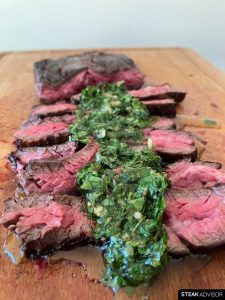
Tender, juicy steak with fresh, garlicky chimichurri sauce. Pan-sear or grill almost any steak cut about 3/4 to 1 inch (1.9 to 2.5 cm) thick using the step-by-step instructions below.
Ingredients
For the Chimichurri Sauce:
- 1/4 cup (60 ml) extra-virgin olive oil
- 2 tablespoons (30 ml) red wine vinegar
- 1/2 cup tightly packed fresh flat-leaf parsley leaves, thick stems removed
- 1 tablespoon fresh oregano leaves, thick stems removed, or 1 teaspoon dried oregano
- 2 garlic cloves, peeled
- 1/2 teaspoon red pepper flakes, or to taste
- 1/4 teaspoon fine salt (or 1/2 teaspoon kosher salt), plus more to taste
- 1/8 teaspoon finely ground black pepper, or to taste
For the Steak:
- 1 lb (454 g) steak of your choice, about 3/4 to 1 inch (1.9-2.5 cm) thick (see notes)
- 2-3 tablespoons (30 to 45 ml) high-smoke-point oil, such as refined avocado oil, for pan-searing only (see notes)
- Salt, 1% of the steak’s weight (see instructions for a 16 oz / 454 g example)
Instructions
Optional: Dry-brine the steak
- Pat the steak dry with paper towels and trim any excess fat. If using a long skirt steak, cut it crosswise into 4- to 8-inch (10- to 20-cm) sections so it fits the pan.
- Season with salt equal to about 1% of its weight. For about 1 lb (454 g) of steak, use approximately:
about 1 2/3 teaspoons Diamond Crystal kosher salt
about 1 teaspoon Morton kosher salt
about 2/3 teaspoon table salt - Place the steak on a wire rack set over a baking sheet and refrigerate uncovered for at least 1 hour, ideally 2-3 hours for better flavor and crust.
Make the chimichurri sauce (see notes)
- By hand: Finely chop the parsley, oregano, and garlic. Add them to a bowl with the remaining chimichurri ingredients and mix well.
- Using a food processor: Pulse all the ingredients except the olive oil and vinegar until finely chopped. Add the oil and vinegar and pulse just until combined. Do not blend until smooth.
- Taste and adjust the seasoning.
- Let the chimichurri sit for 1 hour before serving.
Cook the steak: pan-searing
- If you dry-brined the steak, take it out of the refrigerator 15 minutes before cooking. Take the chimichurri out at the same time.
- Heat a heavy skillet, such as cast iron, carbon steel, or heavy-bottomed stainless steel, over medium-high heat for 3-4 minutes. Add enough high-smoke-point oil (2-3 tablespoons) to lightly coat the bottom and heat for another minute.
- Pat the steak dry once more. If you skipped the dry-brine, season it with salt now.
- Optional: if it has a thick fat cap, hold it fat-side down for 60 to 90 seconds, until browned.
- Lay the steak flat in the pan and sear, flipping every 30 seconds, until it reaches the pull temperature listed below.
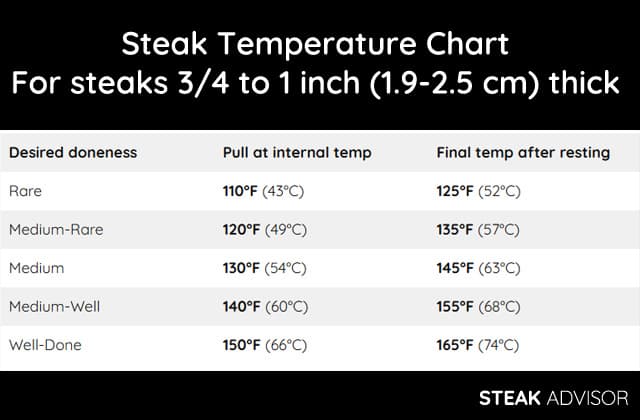
120°F (49°C) for medium-rare,
130°F (54°C) for medium,
140°F (60°C) for medium-well. - A steak about 1 inch (2.5 cm) thick usually takes about 4-6 minutes for medium; begin checking after 3 minutes.
Cook the steak: grilling
- If you dry-brined the steak, take it out of the refrigerator 15 minutes before cooking. Take the chimichurri out at the same time.
- Prepare a two-zone grill. For charcoal, light one full chimney and arrange the hot coals over one half of the grill. Cover and preheat for 5 minutes.
- For gas, preheat all burners on high for 10-15 minutes. Leave one side on high and turn the other side off. Clean and lightly oil the grates.
- Pat the steak dry once more. If you skipped the dry-brine, season it with salt now.
- Grill the steak over the hot side, flipping every 30-60 seconds, until it reaches the pull temperature listed below.
120°F (49°C) for medium-rare,
130°F (54°C) for medium,
140°F (60°C) for medium-well. - Begin checking after about 3 minutes. A steak about 1 inch (2.5 cm) thick usually takes 5 to 8 minutes to reach the medium pull temperature.
- Move the steak temporarily to the cooler side if it browns too quickly or the fat causes flare-ups.
Rest and Serve
- Transfer the steak to a cutting board and let it rest uncovered for 5 minutes.
- For skirt, flank, hanger, bavette, or another cut with a clearly visible grain, slice thinly against the grain (see notes).
- Spoon the chimichurri sauce over the steak just before serving.
Temperature Chart for Steaks 3/4 to 1 inch (1.9-2.5 cm) thick
Notes
Choose any steak cut you enjoy, but for the cooking instructions in this recipe, use a boneless steak about 3/4 to 1 inch (1.9-2.5 cm) thick. Outside skirt steak is my first choice, but flank, hanger, flat iron, sirloin, ribeye, New York strip, and filet mignon also work well. Cooking time will vary depending on the cut, shape, and fat content, so use a meat thermometer rather than relying on time alone.
Chimichurri sauce variations:
Fresh chili: Replace the red pepper flakes with 1/4 to 1/2 small red chili, finely chopped. Adjust the amount depending on its heat.
Cilantro: Add 2 tablespoons finely chopped cilantro, or replace up to half of the parsley with an equal amount of cilantro.
Onion: Add 2 tablespoons finely chopped red onion or shallot.
Citrus: Add 1 tablespoon fresh lemon juice for a brighter, fresher flavor. For a more balanced acidity, replace 1 tablespoon of the red wine vinegar with the lemon juice.
Chimichurri sauce notes:
Make the chimichurri while the steak dry-brines. When skipping the dry-brine, prepare the sauce first so it can rest for 1 hour.
Do not blend the chimichurri into a smooth paste.
Refrigerate leftover chimichurri in an airtight container for up to 3 days.
Oil: Use just enough to coat the skillet lightly, about 2-3 tablespoons (30-45 ml), depending on its size and the steak’s fat content. For leaner cuts, use the higher end of the range; for example, 3 tablespoons (45 ml) in a 12-inch (30 cm) skillet. I prefer refined avocado oil, but refined high-oleic safflower, refined high-oleic canola, refined canola, refined olive, refined peanut oil, or ghee (clarified butter) also work well. Do not use regular butter because it burns quickly over high heat.
Cooking times are approximate; use a meat thermometer to determine doneness.
Slicing against the grain: For cuts with long, visible muscle fibers, such as skirt steak, flank steak, or flap (bavette), always slice them against the grain. Slicing against the grain shortens those muscle fibers, making every bite a lot easier to chew. If you slice with the grain, the meat turns out chewy and tough instead. See the photo below for an example of how to slice skirt steak properly against the grain.
[caption id="attachment_13714" align="aligncenter" width="768"] Cut skirt steak against the grain: The yellow line indicates the grain direction, while the red line shows the cutting direction with the knife[/caption]