

Japan is the first thing that comes to mind for most people when they hear “Wagyu beef”, but that doesn’t mean all Wagyu comes from Japan. There are different types of Wagyu raised in other parts of the world, and they’re not all the same.
In this guide, I’ll focus on Australian Wagyu: what it is, where it comes from, how it tastes, and where you can buy it. I’ll also compare it with other types of Wagyu, especially Japanese and American Wagyu, so you can better understand what makes Australian Wagyu different.
What Is Australian Wagyu?
The word Wagyu literally means “Japanese cattle” (“Wa” means Japanese, and “gyu” means cattle). Australian Wagyu refers to Wagyu cattle and beef produced in Australia. It may include fullblood, purebred, or crossbred cattle with verified Wagyu genetics, with breed registration and classification administered through the Australian Wagyu Association.
Highly graded Australian Wagyu combines Japanese Wagyu genetics with Australian breeding and production systems. The result is a premium beef known for exceptional marbling, tenderness, and rich flavor. It is widely considered one of the best Wagyu types available outside Japan.

Please remember, though, that Australian Wagyu does not automatically mean high quality. The label alone does not tell you much. A steak can still be Australian Wagyu and have a relatively low marbling score. If you want a really good steak, focus more on the marbling than on the country of origin.
How Australian Wagyu Is Classified
The Australian Wagyu Association classifies Wagyu cattle based on their genetics and generation. The main categories are Fullblood, Purebred, Base Animals, and Crossbred Wagyu. Crossbred cattle are then broken down by generation, from F1 to F4.
Fullblood Wagyu: To be registered as Fullblood, every animal in the bloodline must trace back to the original Wagyu cattle imported from Japan, with no crossbreeding with other breeds.
Purebred Wagyu: These cattle are F4 or higher. To be classified as Purebred in Australia, they must have at least 93% Wagyu genetics and be DNA parent-verified to both parents.
Crossbred Wagyu: These cattle come from crossing Wagyu with another breed. In Australia, crossbred Wagyu are classified by generation, from F1 to F4.
- F1 Wagyu: 50% and above Wagyu.
- F2 Wagyu: 75% and above Wagyu.
- F3 Wagyu: 87% and above Wagyu.
- F4 Wagyu: 93% and above Wagyu. If both parents are verified, this is the point where the animal can be classified as Purebred.
Base animals: In the Australian Wagyu Association grading system, Grade 0 refers to a base animal with less than 50% Wagyu genetics.
What Is the History of Australian Wagyu?
The story of Australian Wagyu dates back to the late 1980s and early 1990s, when a window of opportunity opened for the export of Japanese Wagyu genetics. The Australian Wagyu Association was established in 1989, and the first live Wagyu animal arrived in Australia in 1990, while the first purebred Wagyu born in Australia followed later.
From the late 1970s through the 1990s, Wagyu cattle and genetics were exported from Japan in limited numbers. Some of those bloodlines later reached Australia through early industry pioneers, and imported bloodlines helped form the foundation of the Australian Wagyu herd.
Since then, the Australian Wagyu industry has grown significantly. Today, Australia has the largest Wagyu herd outside Japan and is a major global exporter of Wagyu beef. The Australian Wagyu Association now maintains the world’s largest database of Wagyu cattle, with more than 22,000 male breeding animals, 150,000 female breeding animals, and over 25,000 calves added each year.

For more on the history of Australian Wagyu, check the Australian Wagyu Association website. It also has a news section for the latest industry updates.
What Does Australian Wagyu Beef Taste Like?
Australian Wagyu beef has a rich, buttery flavor and a very tender, juicy texture when cooked properly. Thanks to its high level of marbling, it tastes noticeably richer and feels more luxurious than regular beef. However, it doesn’t reach the same extreme marbling, richness, or melt-in-your-mouth texture as top-grade A5 Japanese Wagyu.
In my opinion, that’s what makes Australian Wagyu a great middle ground. It offers much more richness than regular beef, but without being quite as intense or heavy as the highest-grade Japanese Wagyu. That said, not all Australian Wagyu is the same. The flavor, tenderness, and overall eating experience can vary a lot depending on whether it’s fullblood or crossbred, as well as its grade.
Please remember also that Australia uses a different Wagyu grading system than Japan. Because of that, you can’t compare Australian Wagyu grades directly to Japanese Wagyu grades.
How Australian Wagyu Beef Is Graded
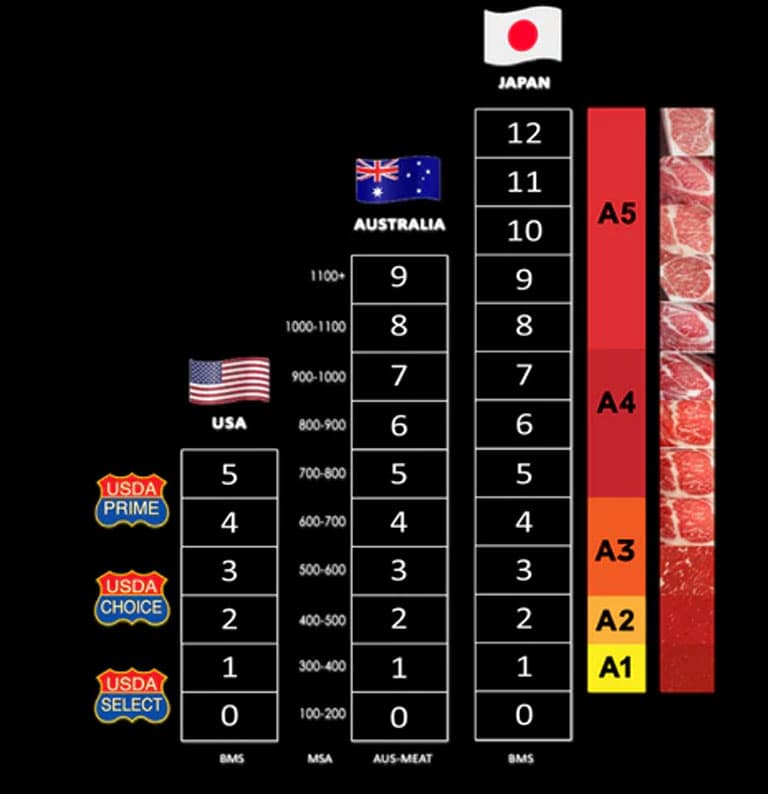
In Japan, Wagyu is graded using a combined system that includes a yield grade (A, B, or C) and a meat quality grade (1 to 5), which is why you see grades like A4 or A5. In Australia, the grading works differently. Australian Wagyu is assessed using two separate systems: AUS-MEAT and Meat Standards Australia (MSA).
For most people, AUS-MEAT is the system that matters most because it gives you the marbling score. Australian Wagyu is graded on an AUS-MEAT marbling scale from 0 to 9+, with higher numbers indicating more intramuscular fat. AUS-MEAT also records other carcass traits, but for most consumers, the marbling score is the number that matters most.
MSA adds another layer. It doesn’t focus solely on marbling. It also takes other factors into account to better predict eating quality. MSA marbling is scored on a finer scale, from 100 to 1,190 in increments of 10, and it evaluates both the amount and distribution of marbling. Beyond that, MSA also considers other factors that affect eating quality, including carcass weight, maturity, rib fat, and pH.
One important thing to remember: AUS-MEAT and MSA score marbling separately, so you can’t match one score directly to the other.
Fullblood Australian Wagyu vs. Japanese Wagyu
On paper, fullblood Australian Wagyu and Japanese Wagyu share the same breed origin. But in practice, they’re not the same beef. Fullblood Australian Wagyu traces back to original Japanese Wagyu exports, while Japanese Wagyu must be born and bred in Japan and verified through Japan’s traceability system.
That difference matters because Wagyu quality depends on much more than genetics alone. Breeding standards, feeding practices, rearing conditions, and grading systems all play major roles. Japan has a much longer history with Wagyu, and Japanese Wagyu is produced and graded under a different domestic system. That’s a big part of why the best Japanese Wagyu usually develops more intense marbling than typical fullblood Australian Wagyu.
That said, fullblood Australian Wagyu is still highly marbled beef. In fact, the Australian Wagyu Association says Australian Fullblood Wagyu typically averages an AUS-MEAT marbling score of 8. By Australian standards, that is a high marbling score. The best Japanese Wagyu reaches BMS 10 to 12, which is on another level. Just keep in mind that this is only a rough comparison, because Japanese Wagyu is graded under a different system, so those scores are not directly comparable.

Please also remember not to confuse fullblood Australian Wagyu with standard Australian Wagyu crossbreeds.
Not all Australian Wagyu is fullblood. A lot of it is crossbred, meaning Japanese Wagyu genetics are mixed with those of other cattle breeds. This kind of beef can still be very good, but it has less marbling and a firmer texture than fullblood Wagyu. On the other hand, it has a stronger, beefier flavor and a much lower price, making it a more affordable option for most people.
American Wagyu vs. Australian Wagyu
The biggest differences come down to genetics, feeding, and grading. Both countries produce fullblood and crossbred Wagyu.
Australian Wagyu, especially fullblood, is generally closer to Japanese Wagyu in terms of marbling and overall eating quality. A big reason is that Australia has a higher proportion of fullblood cattle. In the United States, most American Wagyu is crossbred, often with Angus. There are farms in the U.S. raising 100% fullblood Wagyu, but that is not what most American Wagyu beef is.
Much of American Wagyu is crossbred and usually shows less marbling than highly graded Australian fullblood Wagyu, but the comparison depends heavily on the specific producer and grade. Australian Wagyu, especially fullblood, is usually more heavily marbled, richer, and more buttery. If you want something closer to a traditional steak, American Wagyu is usually a better choice. If you want more marbling, more richness, and a more luxurious texture, Australian Wagyu is usually the better choice.
How Much Does Australian Wagyu Beef Cost?
Australian Wagyu usually costs much less than top-tier Japanese Wagyu, but it is still more expensive than a regular USDA Choice or most USDA Prime steaks. Based on current Crowd Cow prices (as of April 4, 2026), Australian Wagyu steaks range from about $50.64/lb ($111.65/kg) to $146.64/lb ($323.28/kg), depending on the cut.
I listed below a few Australian Wagyu beef examples from Crowd Cow (as of April 4, 2026):
- Ribeye steak, 16 oz (454 g): $108.99 ($108.99/lb; $240.28/kg)
- New York strip steak, 12 oz (340 g): $68.99 ($91.99/lb; $202.91/kg)
- Filet mignon, 6 oz (170 g): $54.99 ($146.64/lb; $323.29/kg)
- Top sirloin steak, 6 oz (170 g): $18.99 ($50.64/lb; $111.64/kg)
- Tomahawk steak, 2 lb (907 g): $179.99 ($90.00/lb; $198.45/kg)
Source: Crowd Cow, Australian Wagyu collection page.
Why Is Australian Wagyu Beef So Expensive?
Australian Wagyu beef is expensive for a few simple reasons:
- It costs more to raise: Australian Wagyu cattle are raised longer than regular beef cattle, which increases total production costs.
- They stay on feed longer: Longer feeding programs require more grain, more time, and more day-to-day management, all of which push the final price higher.
- The genetics are expensive: Wagyu cattle are carefully bred for marbling. Fullblood Australian Wagyu costs even more because those genetics are rarer and more valuable.
- The marbling is the product: A big part of what you are paying for is the rich marbling Wagyu is known for. That quality does not happen by accident and takes strict breeding and feeding to achieve.
- Supply is limited: Premium Australian Wagyu, especially fullblood Wagyu, is much less common than regular beef. Because it takes more time, money, and specialized breeding to produce, the supply stays more limited.
- Demand stays strong: Wagyu has a premium reputation, and buyers are willing to pay more for that level of quality and eating experience.
- Retail costs add even more: The final price is not just about raising the animal. Processing, shipping, import costs in some markets, and retailer markup also increase the final price.
Is Australian Wagyu Worth It?
Yes, premium, highly graded Australian Wagyu beef is definitely worth trying if you enjoy richly marbled steak. It comes from one of the most successful Wagyu breeding programs outside Japan and offers excellent tenderness and rich beefy flavor thanks to its high level of marbling.
That said, not every piece of Australian Wagyu beef is automatically amazing. Just because a steak comes from Wagyu cattle does not guarantee top quality. Genetics matter, but the final quality also depends heavily on how the cattle are raised, fed, and graded.
That is why I recommend paying attention to the grade and, if possible, evaluating the marbling visually before buying. This matters even more in restaurants, where you often do not know the exact grade or overall quality of the Australian Wagyu being served. The quality can vary a lot because Australian Wagyu includes fullblood, purebred, and crossbred cattle.

Where to Buy Authentic Australian Wagyu Beef in the United States?
In my opinion, the best way to buy authentic Australian Wagyu beef in the United States is through a reputable online store. It is usually much easier to verify what you are buying there because many online sellers clearly show the origin, genetics, marbling score, and product details.
A few U.S. sellers that currently offer Australian Wagyu are:
When buying Australian Wagyu, I recommend using the marbling score as one of the main factors to consider. In general, the higher the marbling score, the better the eating quality you can expect. Most shops show the Australian marbling score (MS), but many also use the Japanese BMS scale. Since those systems are not the same, I recommend checking a grading chart that lets you compare them side by side. I included it earlier in this article.
Additionally, always verify the source of the beef and buy only from reputable sellers that clearly state what they are selling. Because Australian Wagyu is expensive, I would be extra careful with restaurants, steakhouses, and local butcher shops if they do not clearly tell you the grade, origin, or genetics. If they cannot tell you exactly what you are buying, I would move on.
