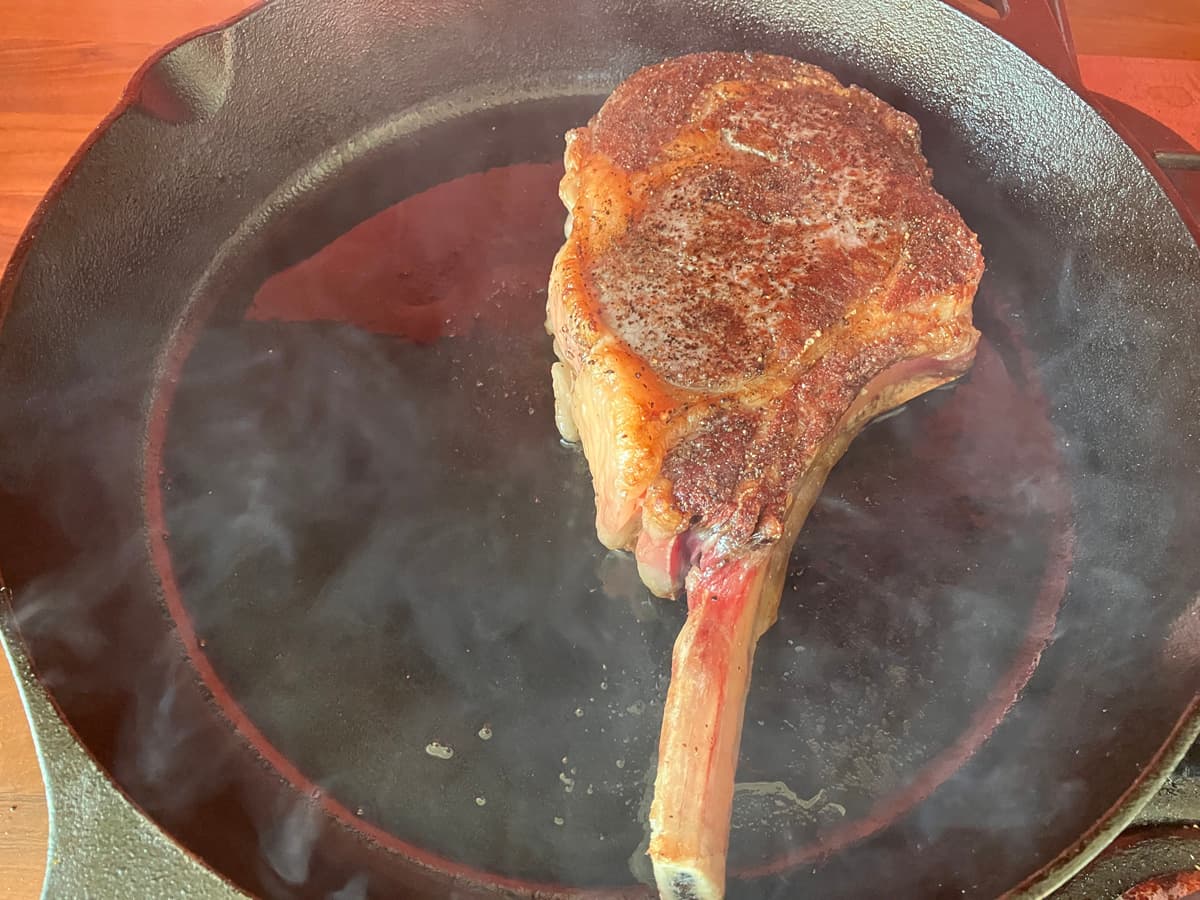

This cowboy steak is cooked from start to finish in a hot skillet, with no oven required. It gets a deep brown crust on the outside while staying juicy and tender in the center, then gets butter-basted with garlic and fresh herbs for extra richness and flavor.
Important
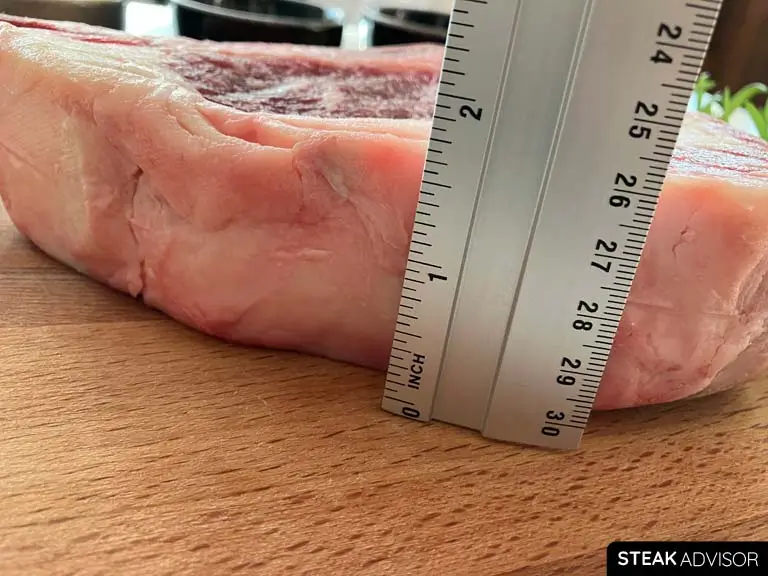
I developed this recipe for cowboy steaks that are 1 to 1 1/2 inches (2.5-3.8 cm) thick. For thicker steaks, go with forward searing, reverse searing, or sous vide.

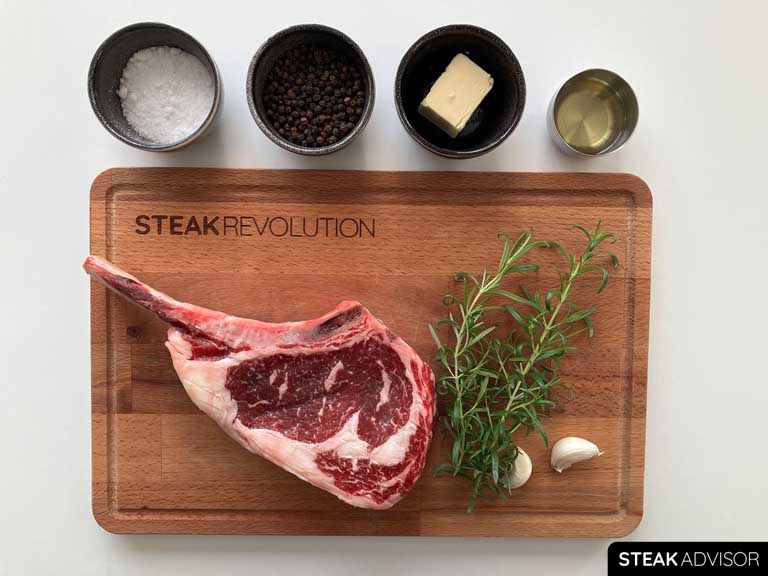
Ingredients You’ll Need
For the steak:
- Steak: For best results, choose a well-marbled cowboy steak about 1 to 1 1/2 inches (2.5-3.8 cm) thick (16-28 oz / 450-800 g). A thicker steak gives you a little more margin for error and makes it easier to build a good crust without overcooking the center. Don’t go much thicker than this. With this skillet-only method, a thicker steak cooks unevenly in the center.
- Salt: Use about 1% of the steak’s weight in salt. That’s enough to get the benefits of dry brining without making the steak too salty. For a 16 oz (454 g) steak, that’s about 0.16 oz (4.5 g). Salt density varies by brand, so weighing it gives you the most consistent results. Once you know what that amount looks like with the salt you normally use, you can season by eye. I prefer kosher salt because the larger crystals are easier to sprinkle evenly, but any salt will work. See the recipe instructions below for approximate teaspoon amounts.
- Oil: Choose an oil with a high smoke point for searing. I like refined avocado oil because it has a neutral flavor and a smoke point around 500°F (260°C). Refined high-oleic safflower oil, refined high-oleic canola oil, refined canola oil, refined olive oil, and refined peanut oil all work well too. Clarified butter (ghee) is another good choice. Don’t use regular butter for searing, since it burns quickly over high heat.
- Black pepper: Use finely ground black pepper. It sticks to the steak better and lets more of the meat stay in direct contact with the pan, which helps with browning.
For the butter-basting:
- Butter: 2 tablespoons unsalted butter (about 28 g). I don’t like using a huge amount of butter for basting because, in my opinion, most of it just goes to waste. Two tablespoons is plenty to melt in the pan and give the steak a rich, buttery flavor.
- Garlic: 2 to 3 garlic cloves. There’s no need to peel them. Just give them a light smash with the flat side of a knife, or even with your hand, before adding them to the pan.
- Herbs: 2 sprigs of thyme or rosemary. I love how they crisp up in the hot butter and add even more flavor.
Tools You’ll Need
- Wire rack and baking sheet: I use these for dry-brining the steak. The rack keeps air moving around the meat so the surface dries evenly, and the baking sheet catches any drips so they don’t end up all over your fridge.
- Heavy skillet: I like cast iron best because it stays hot and gives the steak a deep, even crust. Carbon steel or a heavy-bottomed stainless-steel skillet will work too. Don’t use a nonstick pan, since it’s not designed for the high heat you need for searing.
- Long-handled tongs: A sturdy pair with a good grip makes the steak easier to flip and move around the pan. The extra length also keeps your hands farther away from the heat and any splattering oil.
- Meat thermometer: I usually use an instant-read thermometer. If you’re worried about overcooking the steak, use a leave-in probe thermometer instead. It lets you keep track of the internal temperature the entire time the steak is cooking.
How to Pan-Sear a Cowboy Steak
Prepare the Steak
Pat both sides of the cowboy steak dry with paper towels to remove any surface moisture. Then season it with salt equal to about 1% of the steak’s weight.
For a 16 oz (454 g) steak, that comes out to about 0.16 oz (4.5 g) of salt, or roughly:
- 1 1/2 teaspoons Diamond Crystal kosher salt,
- 1 teaspoon Morton kosher salt,
- or 3/4 teaspoon table salt.
Dry-Brine the Steak
Set the salted steak on a wire rack over a baking sheet and refrigerate it uncovered for 4 to 6 hours for the best results; 1 hour is the minimum. If you can’t give it at least an hour, don’t salt it in advance. Salt the steak just before it goes into the pan, or season it after cooking.

Preheat the Pan
If you dry-brined the steak, take it out of the fridge 15 minutes before cooking.
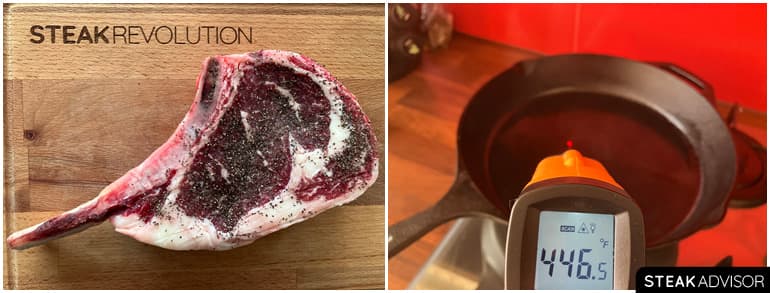
Set a heavy skillet over medium-high heat and let it heat for 3 to 4 minutes. Add 2 tablespoons of high-smoke-point oil and heat for another minute. Tip: Turn on the exhaust fan or crack a window. Searing gets smoky.
While the pan preheats, pat the steak dry one last time and season both sides with finely ground black pepper. As soon as the oil starts to smoke, the pan is hot enough to start searing.
Pan-Sear the Cowboy Steak
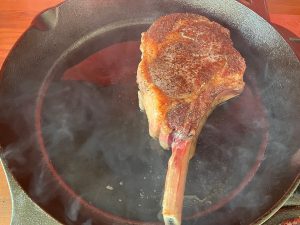
Place the seasoned cowboy steak in the hot skillet and press it down lightly with tongs so the whole surface is touching the pan. This helps the crust develop evenly.
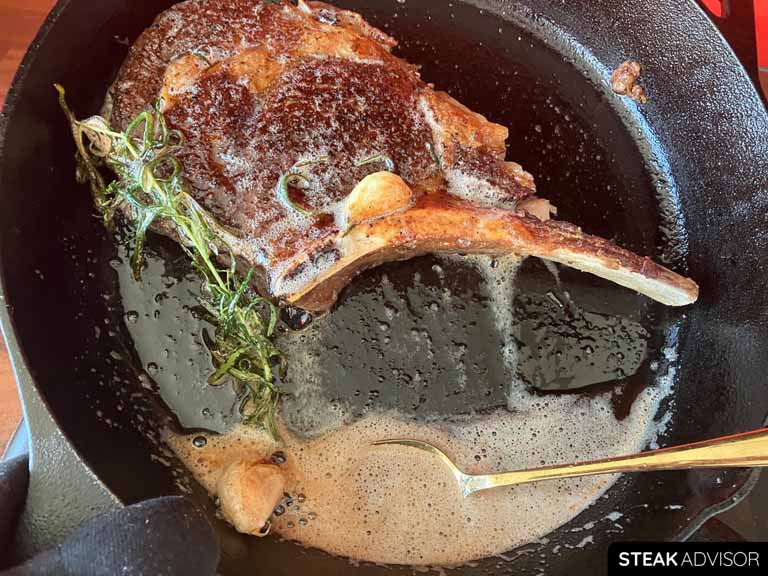
Flip the steak every 30 seconds until the internal temperature reaches 90°F (32°C). Then turn the heat down to medium. Add the butter, garlic, and rosemary or thyme, and let the butter melt completely. Then move on to the next step: butter basting.
Keep flipping the steak every 30 seconds while the butter melts. Or use that time to sear the edges for a few seconds.

Baste the Cowboy Steak with Butter
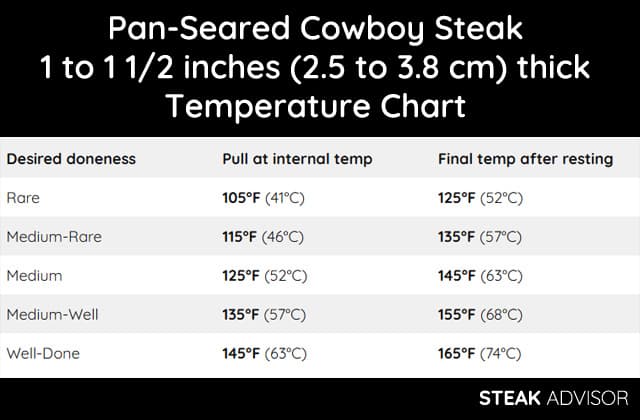
Once the butter has melted, turn the heat down to low. Tilt the pan so the butter pools along one side, then spoon it over the steak. Keep basting and flipping the steak every 30 seconds until the internal temperature is 20°F (11°C) below your target temperature (see the temperature chart below).
If you don’t want to spoon-baste, let the butter pool on one side of the pan and set the steak directly in it. Keep flipping it every 30 seconds until it reaches the same target temperature.
| Desired doneness | Pull at internal temp | Final temp after resting |
| Rare | 105°F (41°C) | 125°F (52°C) |
| Medium-Rare | 115°F (46°C) | 135°F (57°C) |
| Medium | 125°F (52°C) | 145°F (63°C) |
| Medium-Well | 135°F (57°C) | 155°F (68°C) |
| Well-Done | 145°F (63°C) | 165°F (74°C) |
Once the steak reaches the target pull temperature, remove it from the pan and let it rest for 5 minutes. Carryover cooking will bring it up to the final temperature as it rests. Turn off the burner once the steak is out of the pan so the butter left in the skillet doesn’t burn.
Slice and Serve
After the steak has rested for 5 minutes, slice it however you like. That’s what I usually do. If you want to enjoy the eye and cap separately, separate them first, then thinly slice each piece and serve with your favorite sides.
Don’t forget about the leftovers in the pan. Briefly reheat the butter, garlic, and herbs, then spoon the melted butter over the sliced steak and top with the garlic and herbs. Those aromatics take the steak’s flavor to another level.

What to Serve with Pan-Seared Cowboy Steak
Cowboy steak is basically a bone-in ribeye, so it’s rich and beefy. I like to serve it with classic steakhouse sides or something fresh to balance the butter, garlic, and herbs.
- Mashed Potatoes: Creamy and perfect with the pan juices.
- French Fries: Thin and crisp.
- Steakhouse Wedges: Thick, crispy fries with a classic steakhouse feel.
- Crispy Roasted Potatoes: Golden, crisp, and great with the garlic-herb butter.
- Roasted Asparagus: Lightly charred with lemon to cut through the richness.
- Arugula Salad: Peppery arugula with a bright lemon vinaigrette for contrast.
Tips for the Best Pan-Seared Cowboy Steak – Key Takeaways
- Choose a thick, well-marbled steak: Aim for about 1 1/2 inches (3.8 cm) thick. A thicker steak gives you more time to build a deep crust before the center reaches your pull temperature.
- Pat it dry: Dry the steak thoroughly with paper towels before salting, then again right before searing. A dry surface browns much better.
- Dry-brine for 4 to 6 hours: This gives the salt time to season the meat more deeply while drying out the surface for a better crust.
- Follow the 1% salt rule: If you don’t cook steak often, use salt equal to about 1% of the steak’s weight. It’s an easy way to season it properly without overdoing it.
- Don’t salt 2 to 45 minutes before cooking: Salt pulls moisture to the surface during this window, and there isn’t enough time for it to be reabsorbed. If you have less than an hour, salt the steak right before cooking or after it’s cooked.
- Use a large, heavy skillet: Make sure the steak fits comfortably in the pan, and preheat the skillet for 4 to 5 minutes before searing. Cast iron works best here.
- Use a high-smoke-point oil: Look for an oil with a smoke point around 450°F to 500°F (230°C to 260°C). Don’t use regular butter for the initial sear because it burns at high heat.
- Cook to temperature, not time: Use a meat thermometer instead of relying on cooking times.
- Flip every 30 seconds: Frequent flipping helps the steak cook more evenly and gives you better control over the crust.
- Turn the heat down once the butter melts: Regular butter has a relatively low smoke point, which is why it goes in near the end. Lowering the heat keeps it from burning while you baste.
- Aim for medium-rare to medium: Cowboy steak has plenty of marbling, and cooking it to this range gives the fat enough time to render while keeping the meat juicy and tender.
- Pull the steak early: Follow the pull temperatures in the chart instead of waiting for the steak to reach its final temperature in the pan. Carryover cooking will finish the job while it rests.
- Don’t skip the rest: The steak will continue cooking as it rests, bringing the center up to the final temperature.
- Save the pan aromatics: Warm the butter, garlic, and herbs briefly, then spoon them over the sliced steak.
For a deeper look at the science and technique behind these tips, check out my complete guide to pan-searing steak.

FAQs
Why should I remove the cowboy steak from the pan early?
Once the steak comes off the heat, the hotter outer layers keep transferring heat toward the cooler center. That means the steak continues cooking even after it leaves the pan. Based on my tests, a steak about 1 1/2 inches (3.8 cm) thick can rise by about 20°F (11°C) during a 5-minute rest.
Example: I pulled a 1 3/4-inch (4.4 cm) cowboy steak from the pan at 117°F (47°C). After resting for 6 minutes, the internal temperature had increased by 17°F (10°C) and finished at 134°F (57°C), right in the medium-rare range. That’s carryover cooking, and it’s why you need to pull a thick steak before it reaches your final target temperature.


What is the best doneness for a pan-seared cowboy steak?
Medium-rare to medium, around 135 to 145°F (57 to 63°C), is the sweet spot. That range gives you the best balance of tenderness, juiciness, and flavor.
Because cowboy steak is basically a bone-in ribeye, it has a lot of marbling. That fat needs enough heat to soften and render. Below about 130°F (54°C), much of it stays firm and waxy. But once you go past medium, the steak starts losing tenderness and juiciness. So I recommend cooking cowboy steak at least to medium-rare, but not much past medium. That said, the best doneness is still the one you enjoy most.
Why is a 1 1/2-inch (3.8 cm) cowboy steak better for this recipe?
A steak around 1 1/2 inches (3.8 cm) thick gives you more time to build a deep crust without overcooking the center. It stays in the pan longer, so the outside has time to brown while the inside reaches medium-rare to medium. A thinner steak, around 1 inch (2.5 cm), cooks much faster. The center can reach medium-rare before the crust has fully developed, which makes it harder to get both good browning and the doneness you want.
Pan-Seared Cowboy Steak Recipe
- Prep Time: 10 minutes
- Dry-Brine Time: 1 to 6 hours
- Cook Time: 10 minutes
- Total Time: 1 hour 20 minutes
- Yield: 1 steak
Description
This pan-seared cowboy steak comes out juicy and tender with a deep, crispy crust. Butter, garlic, and fresh herbs add plenty of rich, savory flavor.
Ingredients
For Steak
- 1 cowboy steak, 1 to 1 1/2 inches thick (about 16 to 28 oz / 450 to 800 g)
- salt, about 1% of the steak’s weight (see instructions for a 16 oz / 454 g example)
- 2 tablespoons (30 ml) refined avocado oil (see Notes for alternatives)
- Finely ground black pepper, about a generous pinch
For the butter-basting
- 2 tablespoons unsalted butter (about 28 g)
- 2 to 3 garlic cloves, lightly smashed
- 2 sprigs of thyme or rosemary
Tools:
- Wire rack and baking sheet (for dry-brining)
- Heavy skillet (cast iron, carbon steel, or heavy-bottomed stainless steel; not nonstick)
- Long-handled tongs
- Meat thermometer (instant-read or leave-in probe)
Instructions
Prepare the Steak
- Pat the steak dry on both sides with paper towels, then season with salt equal to about 1% of its weight. For a 16 oz (454 g) steak, use about 0.16 oz (4.5 g) salt, or roughly:
1 1/2 teaspoons Diamond Crystal kosher salt,
1 teaspoon Morton kosher salt,
or 3/4 teaspoon table salt.
Dry-Brine the Steak
- Set the salted steak on a wire rack over a baking sheet and refrigerate uncovered for 4 to 6 hours for the best results. One hour is the minimum.
- If you have less than an hour, don’t salt the steak in advance. Salt it right before cooking or after it comes out of the pan.
Preheat the Pan
- If the steak was dry-brined, take it out of the fridge 15 minutes before cooking.
- Heat a heavy skillet over medium-high for 3 to 4 minutes. Add 2 tablespoons of high-smoke-point oil and heat for another minute. Tip: Turn on the exhaust fan or crack a window. Searing gets smoky.
- While the pan preheats, pat the steak dry again and season both sides with finely ground black pepper. Once the oil starts smoking, the pan is ready for searing.
Pan-Sear the Cowboy Steak
- Place the steak in the hot skillet and press it down lightly so the entire surface makes contact with the pan.
- Flip the steak every 30 seconds until it reaches an internal temperature of 90°F (32°C). Then reduce the heat to medium and add the butter, garlic, and rosemary or thyme. Let the butter melt completely.
- Keep flipping the steak every 30 seconds while the butter melts. Or use that time to sear the edges for a few seconds.
Baste the Cowboy Steak with Butter
- Once the butter has melted, reduce the heat to low. Tilt the pan so the butter pools on one side, then spoon it over the steak. Keep basting and flipping every 30 seconds until the steak reaches the pull temperature for your desired doneness:
105°F (41°C) for rare,
115°F (46°C) for medium-rare,
125°F (52°C) for medium,
135°F (57°C) for medium-well,
145°F (63°C) for well-done.
See the complete steak temperature chart below. - Once the steak reaches its pull temperature, remove it from the pan and rest for 5 minutes. Carryover cooking will bring it to the final temperature.
- Turn off the burner once the steak is out so the butter left in the pan doesn’t burn.
Slice and Serve
- After the steak has rested for 5 minutes, slice it however you like. If you want to serve the two main parts separately, cut the center eye away from the outer cap, then slice each piece thinly.
- Warm the butter, garlic, and herbs left in the pan for a few seconds, then spoon everything over the sliced steak. Serve with your favorite sides.
Temperature Chart
Notes
Oil/Fat: Use refined avocado oil, refined high-oleic safflower oil, refined high-oleic canola oil, refined canola oil, refined olive oil, refined peanut oil, or ghee (clarified butter). Do not use regular butter for initial searing (it burns at high heat).

Tried this with a 1 1/4-inch cowboy steak and it came out great. For the really thick ones, I’d probably use reverse sear or sous vide.
Exactly. That’s why this recipe is for thinner cowboy steaks. The really thick ones need a different approach.