
A steak that’s 1/2 inch (1.27 cm) thick, with a lightly browned crust and a medium-rare to medium center? Yep, it’s possible. The key is to prepare the steak properly and sear it quickly over high heat.
I’ll show you how to cook a steak this thick in a pan and get it just right, then finish it with a garlic-herb compound butter for extra flavor. It’s a quick, straightforward method that works especially well with well-marbled cuts.
Important
If your steak is 1 inch (2.5 cm) thick or thicker, I recommend using this recipe instead:

Ingredients You’ll Need
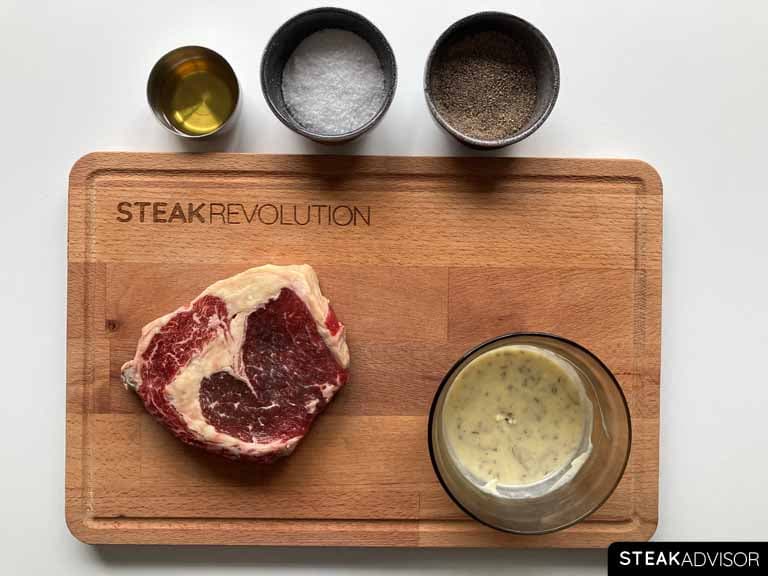
For the steak:
- Steak: Use a steak about 1/2 inch (1.27 cm) thick, preferably a tender, flavorful cut such as ribeye, strip steak, or outside skirt steak.
- Oil: Choose an oil with a high smoke point. Refined avocado oil is one of my favorites, but refined safflower, refined canola, refined olive, or refined peanut oil all work well, as does clarified butter (ghee). Regular butter isn’t a good choice here because it burns quickly over high heat.
- Salt: Use salt equal to about 1% of the steak’s weight. I recommend weighing it the first few times, then seasoning by eye once you know what the right amount looks like. I prefer kosher salt because the larger crystals make it easier to season the steak evenly. With a steak this thin, it’s easy to use too much salt, so measure carefully.
- For a 6 oz (170 g) steak, use about 1.7 g of salt. That’s roughly 1/2 teaspoon Diamond Crystal kosher salt, 3/8 teaspoon Morton kosher salt, or 1/4 teaspoon table salt.
- Black pepper: Season with a generous pinch of finely ground black pepper.
For the garlic-herb compound butter:
Makes enough for about 4 thin steaks.
- Butter: Use 4 tablespoons (1/2 stick; 56 g) of good-quality unsalted butter with at least 80% butterfat. Use real butter, not margarine.
- Garlic: Use 2 fresh garlic cloves, finely minced or pressed.
- Parsley: Use 1/2 tablespoon finely chopped fresh parsley or 1/2 teaspoon dried parsley.
- Rosemary: Use 1/2 tablespoon finely chopped fresh rosemary or 1/2 teaspoon dried rosemary. Chop fresh rosemary very finely so it mixes evenly into the butter without leaving tough, woody bits.
- Salt and black pepper: Start with a generous pinch of each (about 1/8 teaspoon), then taste and adjust as needed.
Want to switch things up? Try one of my other compound butter recipes for steak.
As soon as the steak comes out of the pan, I top it with about 1 tablespoon of compound butter. The heat from the steak melts the butter, coating the surface with rich garlic-herb flavor.
Tools You’ll Need
- Wire rack and baking sheet: I use a wire rack set over a baking sheet for dry-brining. This allows air to circulate around both sides of the steak, helping the surface dry more evenly. That’s especially important with a steak this thin.
- Pan: Cast iron is my first choice because it holds heat extremely well and gives the steak a strong sear. A smaller skillet works just fine; cook one or two steaks at a time and repeat with the rest. Thin steaks cook so quickly that working in batches is easy. Carbon steel and heavy-bottomed stainless steel are also good choices. Don’t use a nonstick pan for this. It’s not made for the high heat you need to get a proper sear.
- Tongs: Use a good pair of long tongs. They make it easy to flip the steaks quickly without getting your hands too close to the hot pan.
How to Pan-Sear a Half-Inch Steak

Prepare the steak.
Pat the steak dry on both sides with paper towels, then season it with salt equal to about 1% of the steak’s weight.
For a 6 oz (170 g) steak, that’s 0.06 oz (1.7 g), or roughly:
- 1/2 teaspoon Diamond Crystal kosher salt,
- 3/8 teaspoon Morton kosher salt,
- or 1/4 teaspoon table salt.
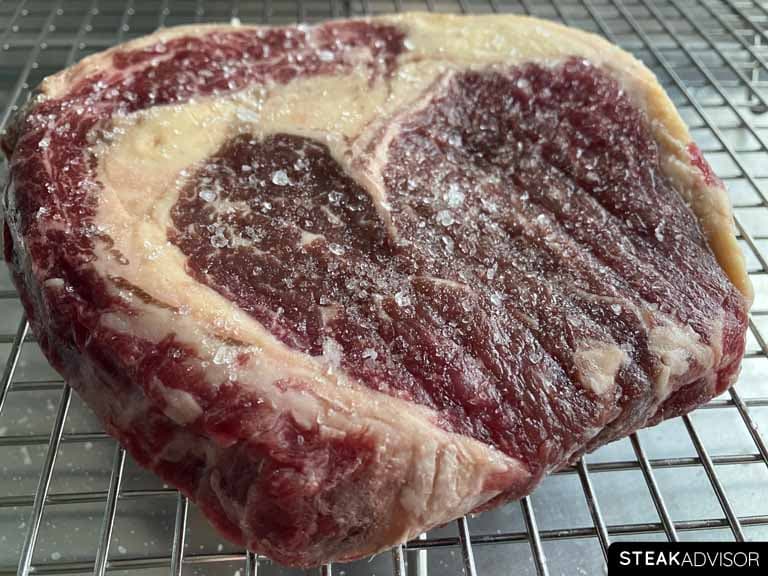
Dry-brine the steak.
Place the steak on a wire rack set over a baking sheet and refrigerate it uncovered for 3 to 4 hours. This gives the steak’s surface plenty of time to dry, which helps it brown better in the hot pan, while the salt has more time to work its way into the meat and deepen the flavor. If you’re short on time, 1 hour is the minimum.

Make the Garlic-Herb Compound Butter.
Cut the butter into small pieces and place them in a bowl. Let the butter sit at room temperature until soft enough to mix easily, but not melted. To soften it faster, microwave it in a microwave-safe bowl in 5-second intervals, checking after each one to make sure it doesn’t melt.
Add the rosemary, parsley, garlic, salt, and black pepper. Mash and stir everything together with a fork until well combined. Taste and adjust the salt and pepper as needed.
Cover the bowl and refrigerate until you’re ready to cook the steak.
Preheat the Pan.
Tip: Turn on the exhaust fan and open a window before heating the pan.
Take the compound butter out of the refrigerator at least 15 minutes before cooking the steak so it has time to soften.
Set the pan over medium-high heat and let it preheat for 3 to 4 minutes. Add 2 tablespoons of high-smoke-point oil and heat for about 1 minute more, until the oil begins to smoke.
While the pan is heating, take the steak out of the fridge, pat it dry again with paper towels, then season both sides with finely ground black pepper. Once the oil begins to smoke, the pan is hot enough, and you’re ready to start searing.
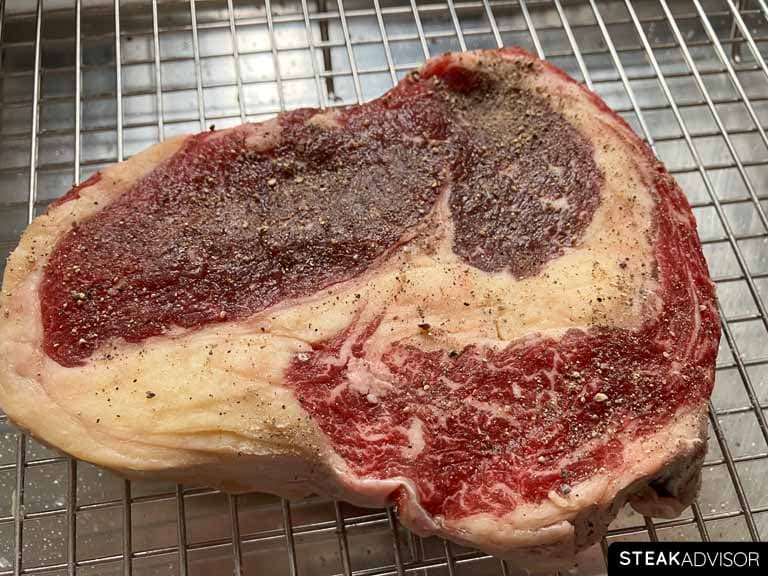
Sear the Steak.
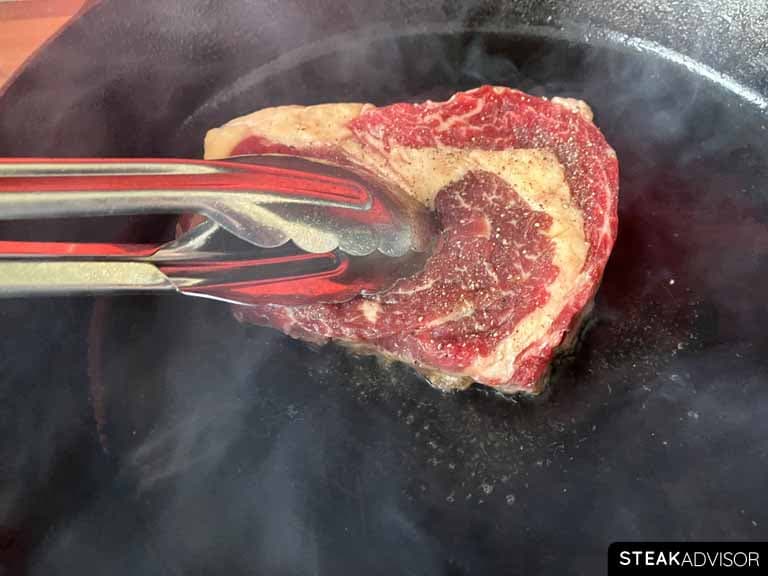
Place the steak in the hot pan and gently press it down with tongs to ensure good contact with the pan.
For a 1/2-inch (1.3 cm) steak, sear the first side for about 60 seconds. Every 15 seconds, move the steak to a fresh spot in the pan so it stays in contact with hotter metal instead of sitting over the area it just cooled. This helps it brown more evenly and develop a better crust.
Flip the steak and sear the second side for 90 seconds, continuing to move it to a fresh hot spot every 15 seconds. This timing should give you a medium-rare to medium center, depending on the steak and how hot your pan is.
If you prefer your steak medium-well, cook for about 30 seconds longer on each side.
For a slightly thicker 3/4-inch (1.9 cm) steak, add about 30 seconds of cooking time per side.
Optional: If your steak has a noticeable fat cap (as a strip steak often does), use tongs to hold it upright and sear the fat edge for 15 seconds, just until lightly browned.

Once you’ve finished searing, transfer the steak to a plate, top it with 1 tablespoon (14 g) of compound butter, and let it rest uncovered for 5 minutes. The internal temperature will continue to rise as the steak rests, bringing it to the desired doneness.
Serve the Steak.
After the steak has rested, slice it thinly. With tender cuts like ribeye or strip, slice however you prefer. For cuts with long, coarse muscle fibers (such as skirt, flank, hanger, or similar), always slice against the grain. This shortens the muscle fibers, making every bite more tender and easier to chew.

Tips for the Best 1/2-Inch-Thick Steak
Pat the steak dry
Moisture is the enemy of a good sear, so pat the steak thoroughly dry with paper towels before it hits the pan. The drier the surface, the faster and more evenly it will brown.
Many people pat their steak dry before seasoning and leave it at that, but I recommend doing it again right before cooking. This is especially important with a thin steak. You want the surface as dry as possible so you can develop a deep, flavorful crust before the center has a chance to overcook.
Salt the steak ahead of time
Right after you salt the steak, the salt starts drawing moisture to the surface, and that’s exactly when you don’t want to put it in a hot pan. As the salt dissolves, it creates a brine on the surface. Over the next 45 to 60 minutes, that brine gradually gets drawn back into the steak, and the surface starts to dry out again.
That’s why, for the best results, I recommend salting the steak and leaving it uncovered in the fridge for about 4 hours. This is especially helpful with thin steaks because they cook so quickly. A dry surface lets the steak start browning almost immediately, giving you a better chance to build a good crust.
Don’t over-salt a thin steak
Go easy on the salt. About 1% of the steak’s weight is plenty. Season it evenly on all sides.
Don’t dry brine it too long
For a thin steak, keep the dry brine short. Around 4 hours is enough. After 8 to 12 hours, the gray band gets noticeably thicker. On a thin cut, it takes up too much of the interior and makes the steak look overcooked.
Preheat the pan before searing
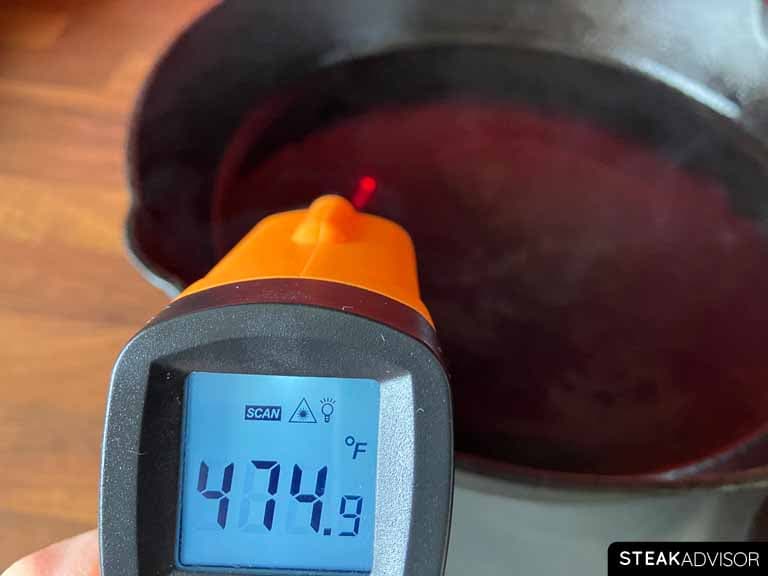
A thin steak, about 1/2 inches (1.27 cm) thick, only needs about 2 to 3 minutes over medium-high heat to reach medium-rare to medium doneness. That’s why the pan has to be hot from the start – but don’t overthink it. You don’t need to blast it until it smokes like crazy. Preheat a cast-iron skillet over medium-high heat for 4-5 minutes, and it’ll reach a temperature of around 450-500°F (232-260°C). At least, that’s what I get on my gas stove at medium-high – hot enough to sear fast without burning.
Use the Right Pan and High-Smoke-Point Oil
For this recipe, choose a pan that can hold high heat evenly. Cast iron is my top choice, but you can also use a carbon steel or heavy stainless steel skillet. And use the right oil; refined avocado oil is my favorite, with a smoke point of 500°F (260°C). Here are a few solid alternatives:
| Type of Fat | Smoke Point ºF/ºC | Flavor profile |
|---|---|---|
| Refined Avocado Oil | 520ºF / 271°C | Neutral to very mild |
| Refined Pecan Oil | 470ºF / 243°C | Mildly nutty |
| Refined Canola Oil | 468°F / 242°C | Neutral |
| Refined Olive Oil | 465°F / 241°C | Mild to neutral |
| Refined Peanut Oil | 450ºF / 232°C | Neutral to mildly nutty |
| Refined Soybean Oil | 450°F / 232°C | Neutral |
| Clarified Butter / Ghee | 450°F / 232°C | Rich, buttery, mildly nutty |
| Refined Rice Bran Oil | 450°F / 232°C | Neutral to mildly nutty |
| Refined Corn Oil | 450°F / 232°C | Neutral to slightly sweet |
| Refined Sunflower Oil | 450°F / 232°C | Neutral |
Smoke points are approximate and may vary depending on the product, degree of refinement, freshness, and method of measurement.
Check doneness carefully
Usually, I recommend checking the temperature with a thermometer, but with such a thin steak, it’s not always easy or even possible to get the probe in the right spot. If you can, hold the steak with tongs and slide the probe in from the side, directly into the center. Aim to remove the steak about 10°F (6°C) below your target doneness (see the temperature chart below). Carryover cooking will raise the temperature during the 5 minutes of resting, bringing the steak right to your target.
Temperature Chart for a 1/2-Inch-Thick Steak Cooked in a Pan
In my tests with 1/2-inch steaks cooked using this method, the internal temperature typically rises about 10°F during the 5-minute rest.
| Desired doneness | Pull from the pan at | Expected temperature after a 5-minute rest |
| Rare | 115°F (46°C) | 125°F (52°C) |
| Medium-Rare | 125°F (52°C) | 135°F (57°C) |
| Medium | 135°F (57°C) | 145°F (63°C) |
| Medium-Well | 145°F (63°C) | 155°F (68°C) |
| Well-Done | 155°F (68°C) | 165°F (74°C) |
If you don’t have a thermometer, stick closely to the timing and watch for visual cues. Around the 2-minute mark, the surface should be lightly browned. At that point, take the steak out of the pan and check the doneness. If it still looks underdone, put it back in the pan and keep cooking, flipping it every 30 seconds, until it reaches the doneness you want. Keep track of the total cooking time and use it as a reference the next time you cook a steak of the same thickness on the same setup. Just remember: an undercooked steak is easy to fix, but once it’s overcooked, there’s no going back.

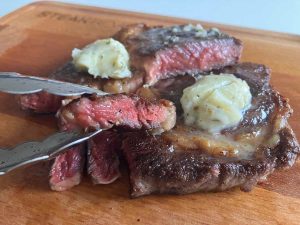
1/2-Inch (1.27 cm) Thick Steak in a Pan Recipe
- Prep Time: 20 minutes
- Dry-Brine Time: 1 to 4 hours
- Cook Time: 5 mins
- Total Time: 1 hour 25 minutes
- Yield: 1 steak; compound butter makes enough for about 4 steaks
Description
Quick and easy way to cook a very thin steak, about 1/2 inch (1.27 cm) thick, in a pan. This method keeps the center medium-rare to medium while giving the outside a light, browned crust. It works best with well-marbled cuts like ribeye or strip steak.
Ingredients
For Steak:
- 1 steak, about 1/2 inch thick (1.27 cm), preferably ribeye, strip steak, or outside skirt steak
- 2 tablespoons (30 ml) high-smoke-point oil (I recommend refined avocado oil; see Notes for alternatives)
- salt, 1% of the steak’s weight (see instructions for a 6 oz / 170 g example)
- finely ground black pepper, a generous pinch, or to taste
For garlic-herb compound butter (for serving)
- 4 tbsp (1/2 stick; 56 g) unsalted butter
- 2 fresh garlic cloves, finely minced or pressed
- 1/2 tablespoon finely chopped fresh parsley or 1/2 teaspoon dried parsley
- 1/2 tablespoon very finely chopped fresh rosemary or 1/2 teaspoon dried rosemary
- About 1/8 teaspoon salt, plus more to taste
- About 1/8 teaspoon finely ground black pepper, plus more to taste
Tools:
- Wire rack and baking sheet
- Pan (cast-iron, carbon steel or heavy-bottomed stainless steel skillet, not nonstick)
- Tongs
Instructions
Prepare the steak
- Pat the steak dry on both sides with paper towels.
- Season with salt equal to about 1% of the steak’s weight.
- For a 6 oz (170 g) steak: use 0.06 oz (1.7 g) salt, about:
1/2 tsp Diamond Crystal kosher salt,
3/8 tsp Morton kosher salt,
or 1/4 tsp table salt.
Dry-Brine the Steak
- Set the steak on a wire rack over a baking sheet. Refrigerate uncovered for 3-4 hours (1 hour minimum).
Make the Garlic-Herb Compound Butter
- Cut the butter into small cubes and place in a bowl. Let it soften at room temperature, or microwave in 5-second intervals until soft but not melted.
- Add the rosemary, parsley, garlic, salt, and black pepper; mash with a fork until combined. Taste and adjust seasoning.
- Cover and refrigerate until ready to use.
Preheat the Pan
- Remove the compound butter from the refrigerator at least 15 minutes before cooking.
- Turn on the exhaust fan and open a window.
- Preheat the pan over medium-high heat for 3-4 minutes. Add 2 tablespoons high-smoke-point oil and heat for about 1 minute, until it begins to smoke.
- Meanwhile, take the steak out of the fridge, pat it dry again with paper towels, then season both sides with finely ground black pepper.
- Once the oil begins to smoke, the pan is hot enough and you’re ready to start searing.
Sear the Steak
- Place the steak in the hot pan and gently press it down with tongs for good contact.
- For a 1/2-inch (1.3 cm) steak, sear the first side for 60 seconds, moving it to a fresh spot in the pan every 15 seconds for better browning.
- Flip and sear the second side for 90 seconds, moving it to a fresh spot every 15 seconds. This should give you a medium-rare to medium center, depending on the steak and how hot your pan is. For medium-well, cook for about 30 seconds longer on each side.
- Optional: If the steak has a noticeable fat cap, as a strip steak often does, hold it upright with tongs and sear the fat edge for 15 seconds, just until lightly browned.
- Once seared, transfer the steak to a plate and top with 1 tbsp (14 g) compound butter. Rest uncovered for 5 minutes; the internal temperature will continue to rise as it rests, bringing the steak to the desired doneness.
- For a 3/4-inch (1.9 cm) steak: add about 30 seconds of cooking time per side.
Serve the Steak
- After resting, slice the steak thinly. For tender cuts like ribeye or strip steak, slice however you prefer.
- For cuts with long, coarse muscle fibers, such as skirt, flank, or hanger steak, always slice against the grain. This shortens the muscle fibers, making each bite more tender and easier to chew.
Notes
Oil: If you don’t have refined avocado oil, use refined peanut oil, refined high-oleic safflower oil, refined high-oleic canola oil, refined canola oil, refined olive oil, or clarified butter (ghee).

I’m so sorry, that was a typo. I meant to ask about doing three 1/2 inch ribeyes or strip steaks at the same time in a larger cast iron skillet. I can’t get 2” thick grass fed steaks here.
No worries at all, thanks for clarifying.
Yes, if the skillet is large enough and you still have room to move the steaks to unused, hotter areas of the pan, you can cook more than one thin steak at a time. The key is not to crowd the pan completely. You want some open space so the pan stays hot and so you can move each steak around during that first minute, especially with 1/2-inch (1.27 cm) steaks.
In a 12-inch (30 cm) cast-iron skillet, I’d be comfortable cooking two 1/2-inch ribeyes or strip steaks at once. If your pan is a little larger, or the steaks are on the smaller side and you still have plenty of open surface area, you could try three. Just keep in mind that this method is very fast. A steak that thin usually only needs about 2–4 minutes total, depending on your desired doneness, so it’s also perfectly fine to cook two first and then the last one right after.
Hope that helps.
This method worked fantastically. I cooked 2 thin steaks and followed your advice cooking them for a short time since they were so thin. No grey band, excellent browning from Maillard reaction (thank you cast iron!) and super juicy. Thanks Adam!
Thank you so much for the kind feedback, Holly! I’m really glad the method worked so well and that your steaks turned out juicy with great browning.
Hi Adam, this is a great method for my thin cut 1/2” grass fed supermarket steaks. I usually get my recipes and methods from seriouseats.com or Americastestkitchen.com where I am a member. But they only advise cooking 1.5-2” thick steaks, which not all of us can get at all times. I was so happy to find your site.
I’m wondering if you think I could do three 2” thick cut ribeyes in a little bit larger cast-iron skillet successfully with this method? Just wondering because you’re only advising cooking one steak at a time here.
Thanks in advance. Love your recipes so far!
Hi, thank you so much for the kind words. I’m really glad the thin steak method helped.
For three 2-inch (5 cm) ribeyes, I wouldn’t recommend cooking them start-to-finish in a skillet, even in a larger cast-iron pan. At that thickness, the outside cooks much faster than the center, so you can end up with a very dark crust, a thick gray band, and an undercooked middle.
For steaks around 2 inches (5 cm) thick, a two-step method works much better and is more predictable, such as sous vide, reverse sear, or forward sear. If you want a fairly easy method, I’d recommend forward sear: sear the steaks first in the skillet for the crust, then finish them gently in a low-temperature oven.
I actually have a guide specifically for 2-inch (5cm) thick steaks here:
https://steakadvisor.com/steak-cooking/how-to-cook-a-thick-steak/
And a full forward sear guide here:
https://steakadvisor.com/steak-recipes/forward-sear-steak/