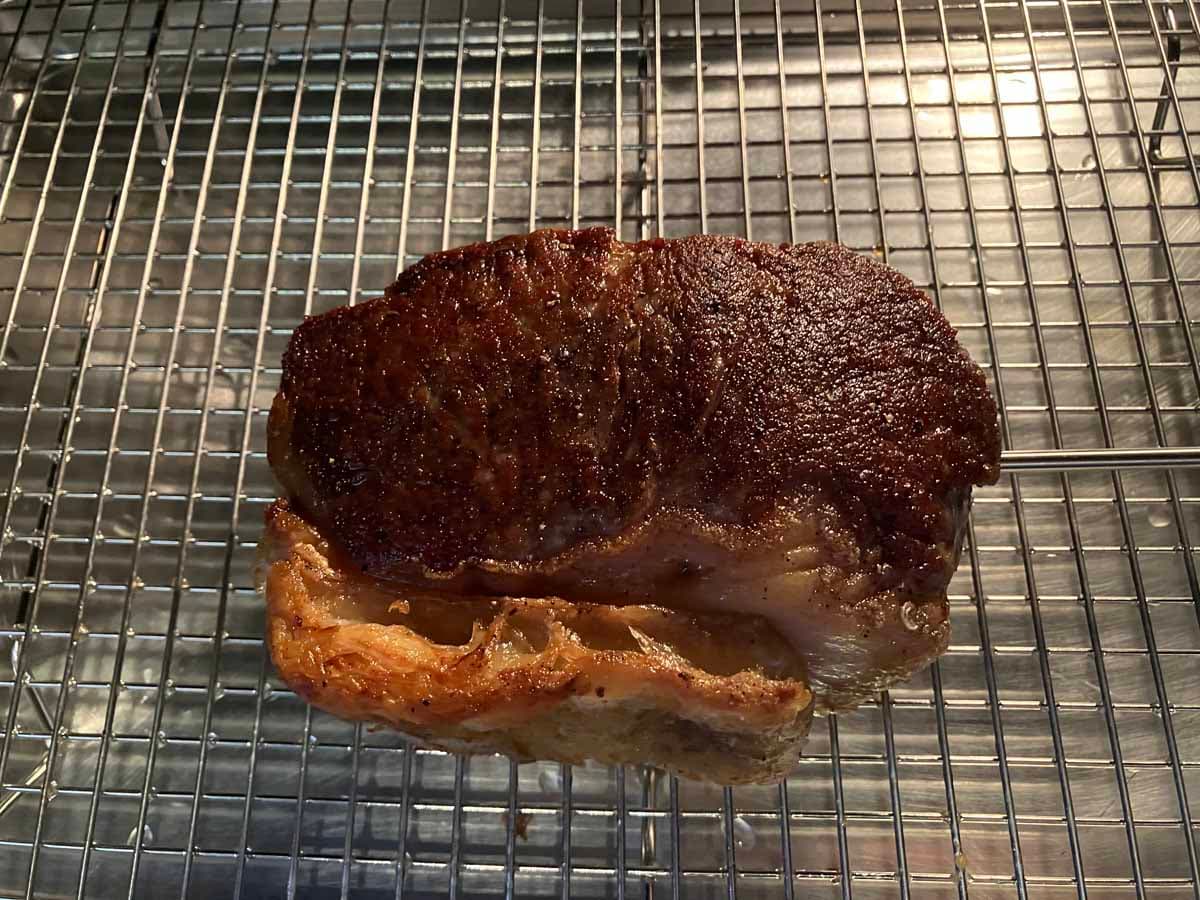

In this recipe, I’ll show you how to forward-sear a steak by searing it in a hot pan, then finishing it in the oven. I’ll also cover how to dry-brine the steak for deeper flavor and a better crust, and how to finish it with compound butter.
Important
The forward-sear method works best for steaks at least 1 1/2 inches (3.8 cm) thick.

Forward Sear Steak: What Is It?
Forward sear, also known as front sear, is a two-stage method for cooking steak. You start by searing the steak at a higher temperature to build a deep, golden-brown crust, then finish it gently over lower heat to let the inside reach doneness more gradually and evenly.
For the high-heat stage, you can use a very hot pan, broiler, or grill – anything that can reach around 450°F (232°C) to build that dark, deeply browned crust. For the gentle finishing stage, use a smoker, oven, or the cool side of a two-zone grill. The key is simple: start with steady, direct high heat for the sear, then move to gentle heat to finish.
I’ve listed the main advantages and disadvantages of the forward-sear method in the FAQs to help you decide if it’s the right technique for the steak you’re planning to cook.
Ingredients You’ll Need

For the steak:
- Steak: This recipe is ideal for any tender steak that’s at least 1 1/2 inches (3.8 cm) thick, such as strip steak, ribeye steak, or filet mignon. For best results, I recommend choosing a well-marbled cut because it will be juicier, more tender, and more flavorful.
- Oil: Use a neutral-flavored, high-smoke-point oil for searing. I recommend refined avocado oil because it has a neutral flavor and a high smoke point of about 500°F (260°C). Refined high-oleic safflower oil, refined canola oil, refined olive oil, and refined peanut oil are also good options. For more alternatives, see here.
- Salt: I prefer kosher salt because its larger crystals are easier to spread evenly over the steak. Use salt equal to about 1% of the steak’s weight. For a 20 oz (567 g) steak, that is about 0.2 oz (5.7 g) of salt. This equals roughly 2 teaspoons of Diamond Crystal kosher salt, 1 1/4 teaspoons of Morton kosher salt, or slightly less than 1 teaspoon of table salt. Weigh the salt the first time; once you know your preference, season by eye.
- Black pepper (optional): Use finely ground black pepper. Add fine pepper before searing for a darker, toasted flavor, or after cooking if you want a fresher pepper aroma and less risk of bitterness.
For the compound butter:
- Butter: 1/2 stick (56 g) of good-quality unsalted butter with at least 80% fat. Unsalted butter makes it easier to control the seasoning.
- Garlic: 2 garlic cloves, finely chopped, minced, or pressed.
- Salt: 1/8 teaspoon salt (a generous pinch), plus more to taste
- Black pepper: 1/8 teaspoon finely ground black pepper (a generous pinch), or to taste
- Parsley: 1/2 tablespoon finely chopped fresh parsley or 1/2 teaspoon dried.
- Rosemary: 1/2 tablespoon finely chopped fresh rosemary, or 1/2 teaspoon dried. Chop fresh rosemary very finely so it blends evenly into the butter and doesn’t leave tough, woody pieces.
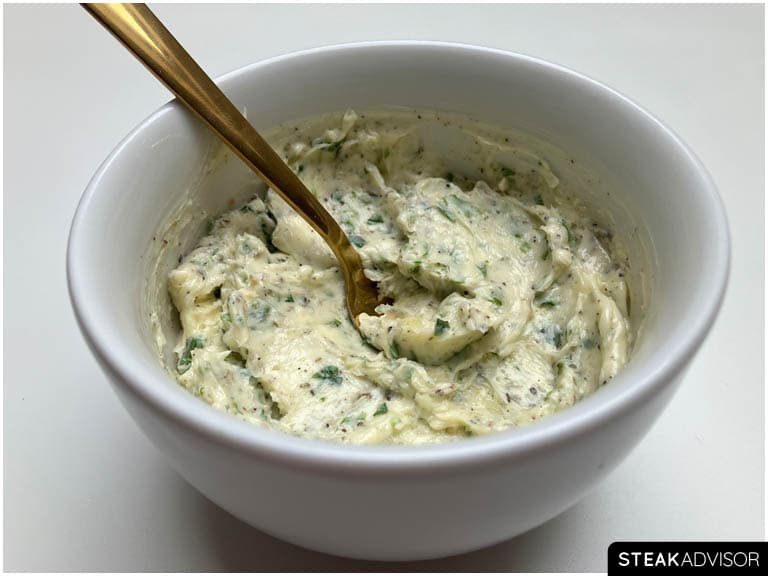
Compound butter is softened butter mixed with herbs, spices, or other flavorings. It melts over the steak as it rests, adding richness and flavor with almost no extra effort. In this recipe, I’ll show you how to make garlic-herb compound butter, one of my favorites.
If you prefer a different compound butter for the steak, see my other steak butter recipes.
Tools You’ll Need
- Oven-safe wire rack with baking sheet: I use this setup for both dry-brining and finishing the steak in the oven. It allows air to circulate around the steak, helping the surface dry evenly. During the oven finish, the rack also keeps the steak away from the residual heat of the skillet, reducing the risk of overcooking the bottom.
- Pan: I highly recommend a cast-iron skillet because it retains heat exceptionally well and produces a deep, golden-brown crust. A carbon-steel pan or heavy-bottomed stainless-steel skillet will also work.
- Tongs: I recommend using tongs long enough to turn the steak comfortably while keeping your hands away from hot oil splatter.
- Meat thermometer: I highly recommend a leave-in probe thermometer, especially for the oven finish. It lets you monitor the steak’s internal temperature without repeatedly opening the oven. An instant-read thermometer also works, but you’ll need to check the steak more often.
- Oven: I prefer the regular bake setting for this recipe. Convection also works, but the steak may reach the pull temperature sooner, so monitor the internal temperature closely.
How to Forward Sear a Steak
Prepare the steak.
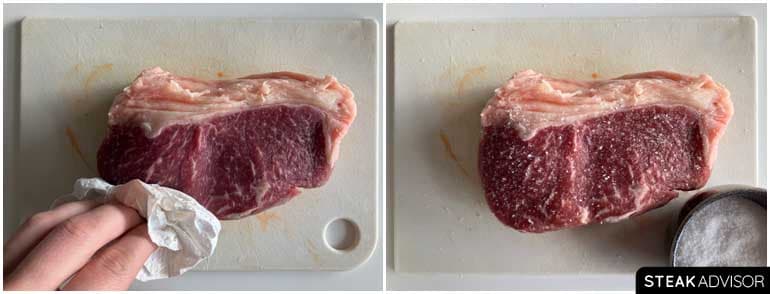
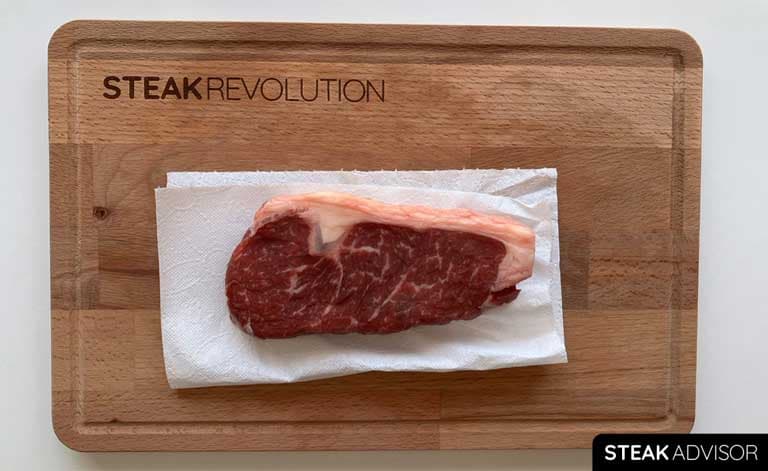
Pat it completely dry with paper towels, then season it evenly on all sides with kosher salt equal to about 1% of the steak’s weight.
For a 20 oz (567 g) steak, use about 0.20 oz (5.7 g) of salt, or roughly 2 teaspoons of Diamond Crystal or 1 1/4 teaspoons of Morton kosher salt. If you don’t have kosher salt, use about 1 teaspoon of fine table salt.
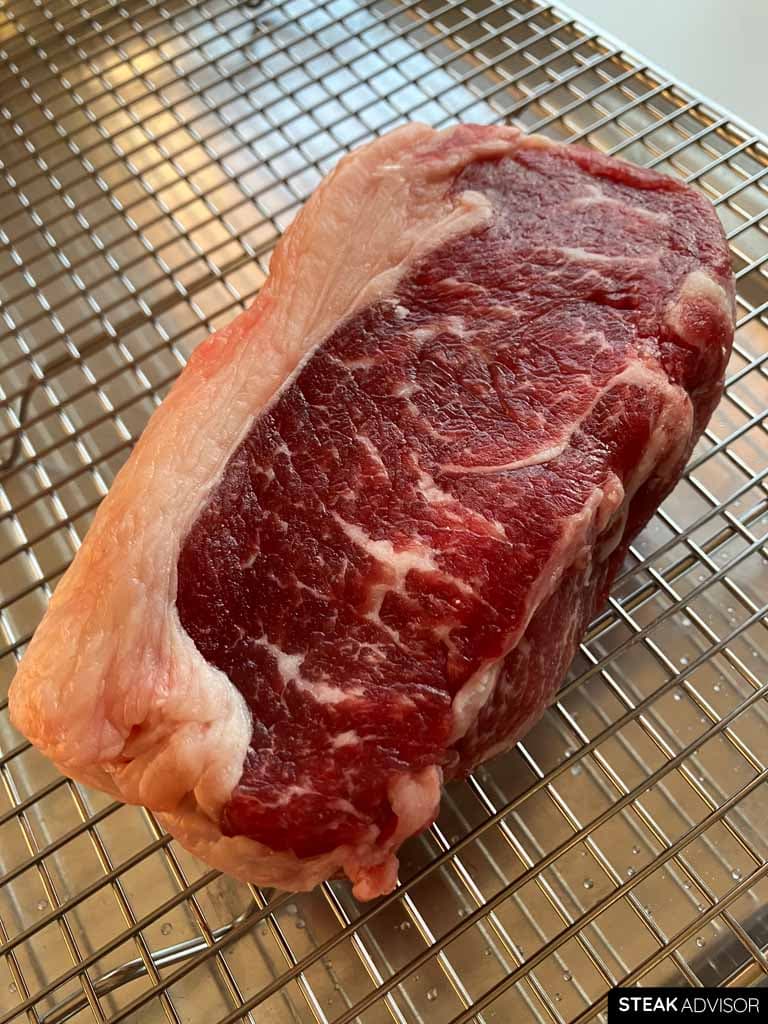
Place the steak uncovered on an oven-safe wire rack set over a baking sheet and refrigerate it. This process, known as dry-brining, seasons the meat and dries the surface for a better crust.
- If you plan to cook it soon, refrigerate it for about 1 hour. This is the bare minimum.
- For better flavor and crust, refrigerate it for 4 to 6 hours. This is the option I highly recommend.
- If you don’t have at least 1 hour, season the steak right before it goes into the pan, or salt it to taste after searing.
Make the compound butter while the steak rests in the fridge.
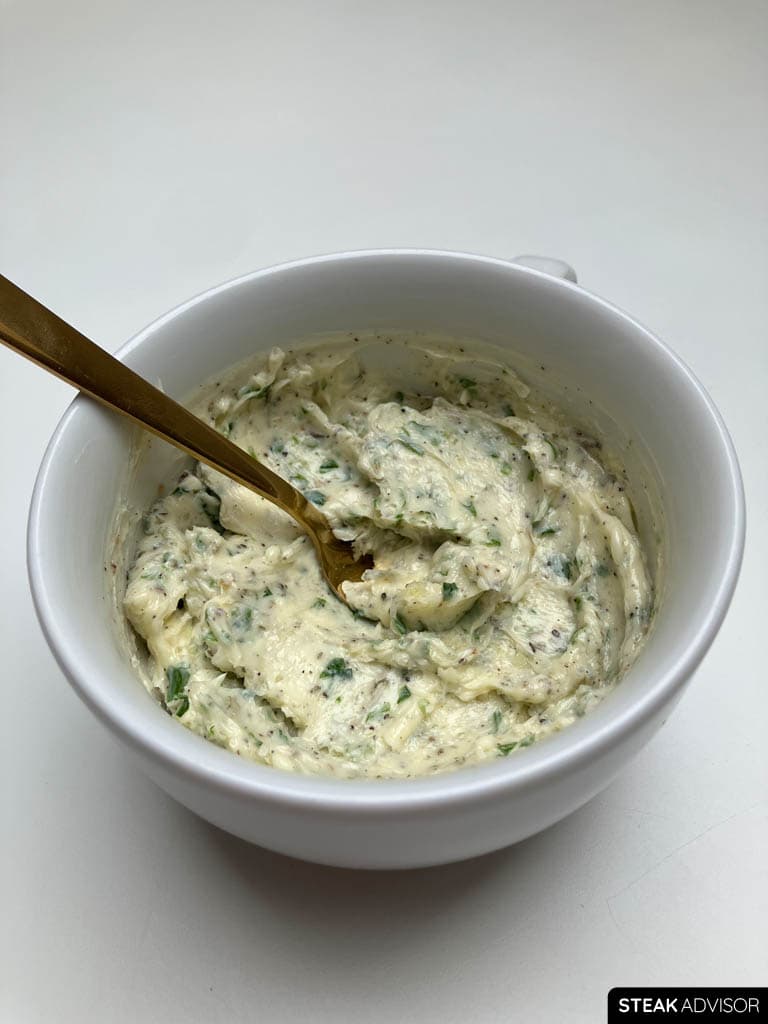
Cut the butter into small cubes, place them in a bowl, and leave them at room temperature until softened but still firm enough to hold their shape. To speed things up, you can microwave it in a microwave-safe bowl in 5-second intervals, checking after each one to make sure it does not melt.
Add the remaining prepared ingredients and mix well with a fork. Refrigerate the compound butter until needed.
Preheat the Pan & Oven
Remove the steak and compound butter from the fridge 15 minutes before cooking.
Preheat the oven to 225°F (110°C). When the oven is nearly ready, preheat the skillet.
Tip: Searing creates a lot of smoke, so turn on the exhaust fan or open a window before you begin.
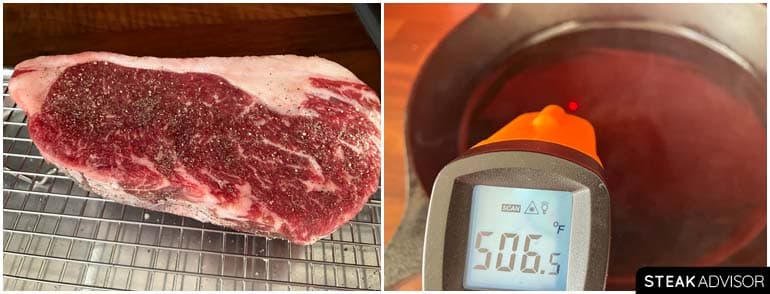
Place a heavy skillet over medium-high heat. Cast iron works best, but carbon steel or heavy-bottomed stainless steel will also work. Heat the skillet for 3 to 4 minutes, then add 2 tablespoons of high smoke point oil and heat for another minute.
Sear the steak.
Once the pan is fully preheated, it’s time to sear the steak.
Just before placing the steak in the pan, pat it dry again. If using black pepper, season both sides with finely ground pepper.
If the steak has a fat cap, sear it first until nicely browned. Then lay the steak flat in the pan and sear, flipping every 30 seconds, for about 3-5 minutes total.
Lean cuts and steaks closer to 1 1/2 inches (3.8 cm) thick need about 3-4 minutes of searing in total, while thicker or well-marbled cuts need 4 to 5 minutes. The goal is to develop a deep brown crust, not cook the steak through. It will finish cooking in the oven.

Finish the steak in the oven on a wire rack.
After searing, transfer the steak to a wire rack set over a baking sheet. Insert the probe from the side into the center of the thickest part, away from bone and large pockets of fat.
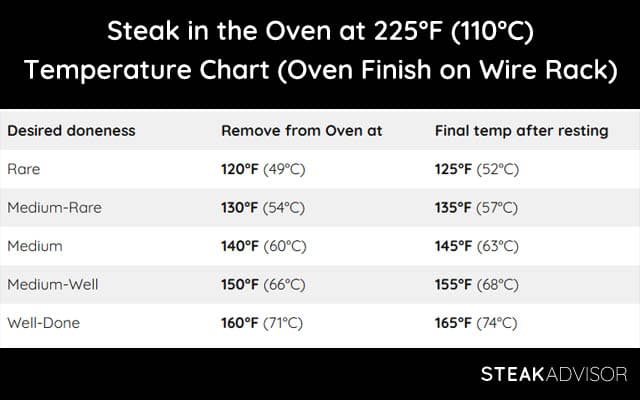
Place the baking sheet in the center of the oven and cook at 225°F (110°C) until the steak reaches the temperature listed in the “Remove from Oven at” column for your desired doneness (see the table below).
Remove the steak from the oven, top with compound butter, and let it rest uncovered for 5 minutes. The temperature will rise by about 5°F (3°C) while resting, reaching the final temperature shown below.
| Desired doneness | Remove from Oven at | Final temp after resting |
| Rare | 120°F (49°C) | 125°F (52°C) |
| Medium-Rare | 130°F (54°C) | 135°F (57°C) |
| Medium | 140°F (60°C) | 145°F (63°C) |
| Medium-Well | 150°F (66°C) | 155°F (68°C) |
| Well-Done | 160°F (71°C) | 165°F (74°C) |
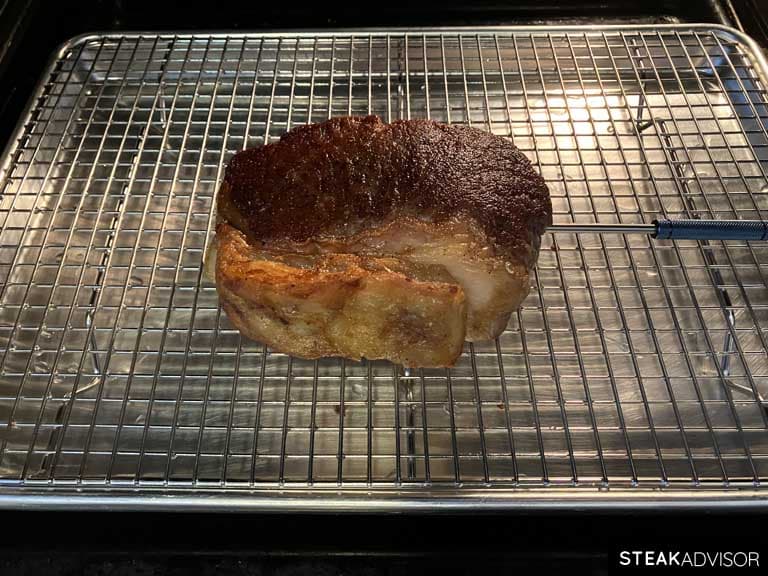
Time to enjoy your steak.
Once the steak has rested, slice it thinly and serve with your favorite sides.
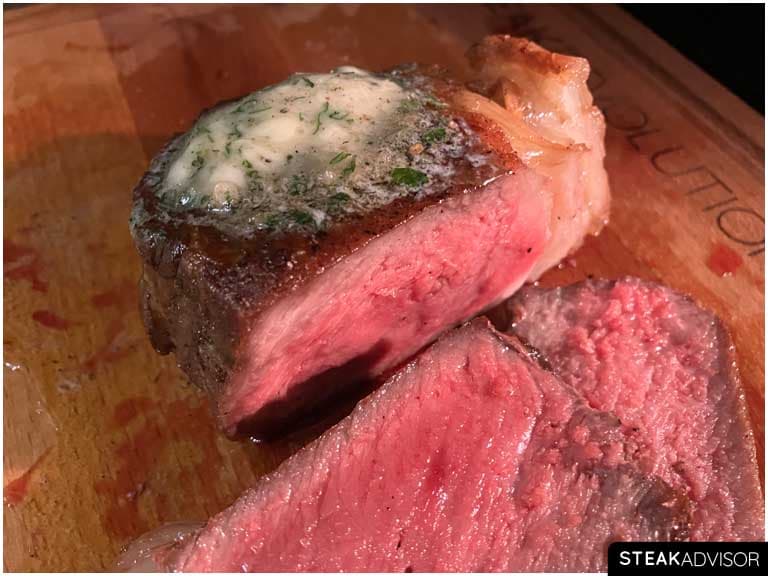
Optional: Pan-to-Oven Finish
If you do not have an oven-safe wire rack, leave the steak in the oven-safe skillet used for searing and transfer the skillet directly to the oven.
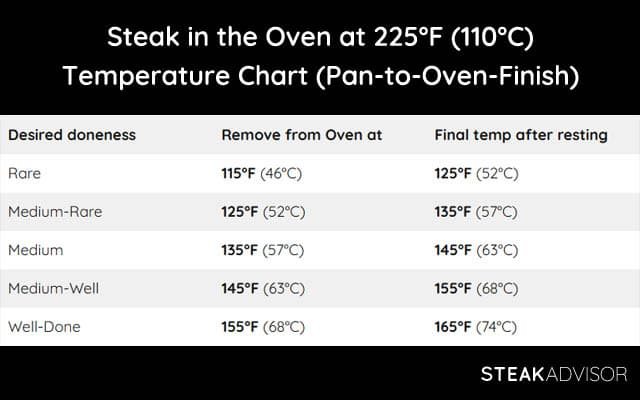
Because the steak cooks in direct contact with the hot skillet, remove it from the oven 10°F (6°C) below your final target temperature instead of the 5°F (3°C) used for the wire-rack method. Use the Remove from Oven temperatures listed below.
Remove the skillet from the oven and immediately transfer the steak to a plate. Top with compound butter and let it rest uncovered for 5 minutes. After resting, slice the steak thinly and serve.
| Desired doneness | Remove from Oven at | Final temp after resting |
| Rare | 115°F (46°C) | 125°F (52°C) |
| Medium-Rare | 125°F (52°C) | 135°F (57°C) |
| Medium | 135°F (57°C) | 145°F (63°C) |
| Medium-Well | 145°F (63°C) | 155°F (68°C) |
| Well-Done | 155°F (68°C) | 165°F (74°C) |
Recipe Success Tips for Forward-Seared Steak
Dry-Brine for 4-6 Hours for Better Flavor and a Better Crust
Dry brining for a few hours does three key things for your steak: it dries the surface for a better sear, deepens the flavor, and slightly improves the meat’s texture. If you want to learn more about how it works and why it makes such a difference, check out my guide to dry-brining steak. Here’s the short version.
Salt needs time to work. One hour is the absolute minimum. Avoid searing the steak 2 to 30 minutes after salting, because that’s when the surface is usually at its wettest. The salt pulls moisture out of the steak first, and that moisture needs time to be reabsorbed or dry from the surface. That matters because moisture is the enemy of a good sear. If the surface is wet when the steak hits the pan, that moisture has to evaporate before browning can start. By the time the surface finally starts to brown, the inside may already be closer to your target doneness than you want, leaving you with a weaker crust and less room for error.
For the best results, refrigerate the salted steak uncovered for 4-6 hours. That’s the sweet spot for this recipe. It gives the salt enough time to season the meat, dries the surface nicely, and helps you build a better crust while keeping the gray band under the crust as small as possible.
You can dry-brine the steak longer if you want. After about 8 hours, the gray band under the crust usually becomes more noticeable, and after 24 hours, it can be much more pronounced. The flavor also becomes more deeply seasoned, which some people love, but not everyone likes that stronger salted-steak flavor.
If you don’t mind a thicker gray band and want maximum flavor, you can dry-brine the steak for 12-24 hours. But if you want the best balance of flavor, crust, and a minimal gray band, stick to the 4-6 hour window. That’s what I recommend for this recipe.
Preheat the Pan
Heat is the key to a good sear. Even if the steak is dry-brined and patted completely dry, you won’t get a good crust if the pan isn’t hot enough.
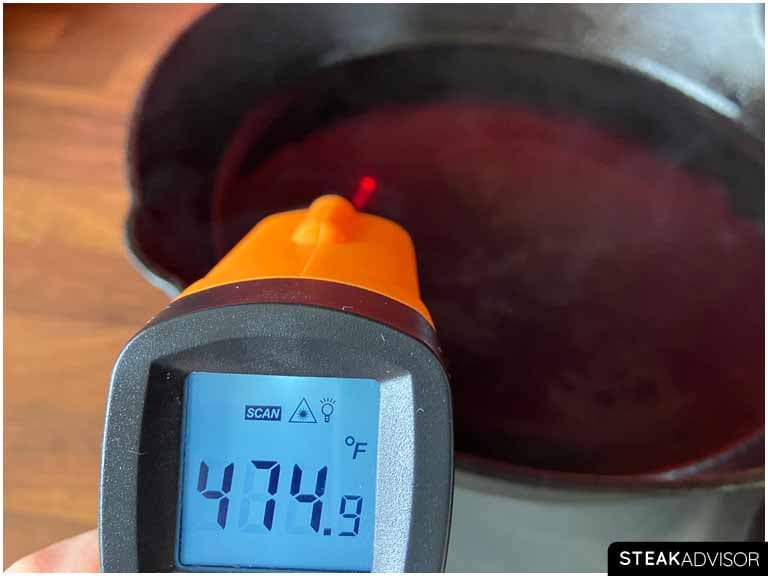
The Maillard reaction, responsible for browning, occurs rapidly at 285-340°F (140-170°C), but the pan cools as soon as the steak touches it. That’s why I recommend preheating the skillet to about 450°F (232°C). This gives it enough heat reserve to keep searing hard after the steak goes in.
In my experience, a 12-inch (30 cm) cast-iron skillet over medium-high heat on a large gas burner usually takes about 4-5 minutes to reach that range. At that point, the pan is hot enough to build a deep crust without keeping the steak in the pan longer than necessary.
Pat the Steak Dry Right Before Searing
Even after dry-brining, always pat the steak dry one more time right before it goes into the pan.
Moisture is one of the biggest enemies of a good sear. If the steak’s surface is wet, that moisture has to evaporate first before the meat can start browning properly. That wastes valuable time in the pan, especially when you’re trying to build a deep crust without overcooking the inside.
A dry surface starts browning much faster. It’s a small step, but it makes a big difference in how quickly and evenly the crust forms.
Right before searing, pat the steak dry with paper towels on all sides, then season it with black pepper, if using. After that, place it in the hot pan and start searing immediately.
Use a High-Smoke-Point Oil for the Initial Sear
In this recipe, you’ll start by searing the steak in a very hot pan. This step takes only a few minutes, depending on how deep and dark you want the crust. However, to do it right, you need an oil that can handle serious heat without burning. Look for something with a smoke point around 450°F (232°C) or higher.
My top pick is refined avocado oil. It has a high smoke point and a neutral flavor, making it perfect for searing, especially when you plan to finish the steak with aromatics like butter, garlic, and herbs.
If you don’t have refined avocado oil on hand, here are a few other great high-smoke-point options you can use:
| Type of Fat | Smoke Point ºF/ºC | Flavor profile |
|---|---|---|
| Refined Avocado Oil | 520ºF / 271°C | Neutral to very mild |
| Refined Pecan Oil | 470ºF / 243°C | Mildly nutty |
| Refined Canola Oil | 468°F / 242°C | Neutral |
| Refined Olive Oil | 465°F / 241°C | Mild to neutral |
| Refined Peanut Oil | 450ºF / 232°C | Neutral to mildly nutty |
| Refined Soybean Oil | 450°F / 232°C | Neutral |
| Clarified Butter / Ghee | 450°F / 232°C | Rich, buttery, mildly nutty |
| Refined Rice Bran Oil | 450°F / 232°C | Neutral to mildly nutty |
| Refined Corn Oil | 450°F / 232°C | Neutral to slightly sweet |
| Refined Sunflower Oil | 450°F / 232°C | Neutral |
Smoke points are approximate and may vary depending on the product, degree of refinement, freshness, and method of measurement.
Sear Long Enough to Build a Crust, Not to Cook the Steak Through
For steaks 1 1/2 to 2 inches (3.8-5 cm) thick, I usually sear for about 4-5 minutes total, but treat that as a rough guide, not a strict rule.
The goal of this step is not to cook the steak through. It’s to build a deep, flavorful crust before the steak goes into the oven, where it will finish cooking more gently.
For steaks thinner than 1 1/2 inches (3.8 cm), be careful not to sear for too long, as this can overcook the inside before the steak even goes into the oven. Thicker, well-marbled steaks give you more room for error and can handle a slightly longer sear.
Flip the Steak Every 30 Seconds
Flipping the steak every 30 seconds helps build an even crust on both sides and gives you better control over the cooking process.
Forget the old rule about flipping only once. There’s no real benefit to it here. Frequent flipping helps both sides cook more evenly, reduces the risk of overheating one side, gives you a more consistent sear, and can even speed up cooking slightly.
Use a Meat Thermometer Instead of Relying on Oven Times
I don’t include exact oven times here because they depend on too many variables: the cut type, thickness, starting temperature, your preferred doneness, and how long you seared the steak before transferring it to the oven.
A 1 1/2-inch (3.8 cm) strip steak and a 2 1/2-inch (6.4 cm) ribeye won’t finish at the same time. That’s why I always recommend using a meat thermometer instead of relying on the clock. It’s the only reliable way to hit your target doneness without guessing.
Add Butter and Aromatics at the End
Regular butter burns easily, with a smoke point around 300°F (150°C). That’s why I don’t recommend adding butter, garlic, or herbs during the initial high-heat sear.
For the best results, sear the steak first, finish it in the oven, then add compound butter while the steak rests. If you’re making a quick garlic-herb butter in the pan, do it after the steak comes out of the oven, while it’s resting.
Remember That the Steak Keeps Cooking as It Rests
As the steak rests, its internal temperature continues to rise due to carryover cooking. That final temperature increase is what brings the steak to your target doneness.
The hotter you cook the steak in the oven, the more carryover cooking you can expect afterward. For example, if you finish it at 275°F (135°C), don’t be surprised if the internal temperature rises by more than 10°F (6°C) during the first 5 minutes of resting.
That’s why, for this recipe, I use a lower oven temperature of 225°F (110°C). With lower heat, the carryover rise is usually more predictable. Depending on the cut, thickness, and searing time, I expect the internal temperature to rise by about 5-10°F (3-6°C) during a 5-minute rest. This makes it much easier to hit your target doneness without overshooting it.
FAQs
What are the advantages of the forward-sear steak cooking method?
- Fast cooking time: The forward-sear (pan-sear, oven-finish) method is one of the quickest ways to cook thick-cut steaks. It’s significantly faster than reverse searing, sous vide, or smoking. If you want steakhouse-quality results without spending hours in the kitchen, this is your go-to technique. Once the steak is salted and ready to cook, the pan-sear-and-oven-finish process usually takes about 20-40 minutes.
- Impressive crust: Searing the steak directly over high heat at the start gives you plenty of time to build a deep, flavorful crust. While the surface might not be quite as perfectly dry as with a reverse sear, the longer searing time still does its job. The result is a dark, deeply browned, flavorful crust – one of the best of any steak-cooking method. In fact, aside from traditional pan-searing (from start to finish), the forward-sear (pan-sear, oven-finish) approach is one of the best techniques for building that amazing crust.
- More even cooking: Thicker steaks require a different cooking method than thinner ones. Cook them only over direct high heat, and you’ll end up with an overcooked outer layer and a red center. The key to fixing that is low, gentle heat. The forward sear method does exactly that. You start by searing the steak in a hot pan to build a well-browned crust, then finish it more gently in the oven until it’s close to your target doneness. The result is a much more even cook throughout, with a juicy center and only a slightly thicker gray band near the edges.
- Versatility: One of the biggest advantages of the forward-sear method is its flexibility. While most home cooks use a pan to sear the steak and finish it in the oven, you’re not limited to that setup. You can forward-sear on a grill or with any equipment that allows you to cook with high, direct heat first and then finish at a lower temperature. The key is the temperature control, not the specific tools.
- Perfect for thick cuts: You can’t cook very thick steaks, about 2 1/2 inches (6.4 cm) or thicker, entirely over direct high heat. The outside will overcook long before the center is done. For the best results (evenly cooked inside), you need to cook them slowly at a lower temperature; however, this unfortunately takes a lot of time. The pan-sear, oven-finish method is the perfect middle ground. It lets you build a beautiful crust while still cooking the inside evenly, and it takes far less time than methods like reverse searing, smoking, or sous vide.
What are the disadvantages of the forward-sear steak cooking method?
- Gray band: One of the main downsides of the forward-sear method (pan-sear, oven-finish) is the thicker gray band that forms just beneath the crust. Compared to techniques like reverse searing or sous vide, where that band is minimal or almost nonexistent, the pan-sear, oven-finish approach naturally creates a more noticeable one. That’s simply because the steak spends more time over direct, high heat during the searing stage. Flipping the steak every 30 seconds helps reduce it, but even with good technique, a slightly thicker gray band is just part of the deal with this method. If you want an absolutely minimal gray band inside, consider reverse-searing or sous vide instead.
- Not for thinner steaks: Thin cuts cook so quickly that by the time you build a good crust, the inside is often already done. Moving them to the oven after searing increases the risk of overcooking. For steaks around 1 inch (2.5 cm) thick, skip the oven and cook them entirely in the pan.
How long should you cook a steak using the forward sear method?
Unfortunately, there’s no single answer for this question. The best way (really the only reliable way) is to use a meat thermometer. A leave-in probe thermometer is ideal because you can set an alarm for the exact internal temperature you want and focus on other things instead of constantly checking with an instant-read thermometer.
Why can’t I give you an exact time? Because too many factors affect how long the steak takes to finish in the oven: how long you seared it, how hot the pan was, the type of pan you used, the cut of steak (lean vs. fatty), the steak’s thickness, and even the type of oven. I’ve tested this recipe many times, doing everything the same way, and the oven time still varies by a few minutes. And those few minutes can easily take your steak past your target doneness. Just use a meat thermometer with an alarm. It’s not an expensive tool, and it guarantees perfect doneness every single time.
Should I bake or broil the steak in the oven?
For this recipe, stick with baking. The steak already gets its crust from the hot pan, so there’s no need to broil it afterward. The oven’s job is to finish cooking the center gently and evenly until the steak reaches your target temperature.
Print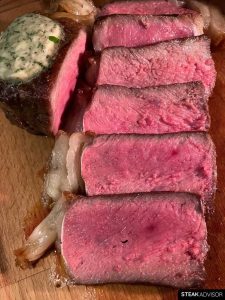
Forward-Seared Steak Recipe
- Prep Time: 15 minutes
- Dry-Brine Time: 1 to 6 hours
- Cook Time: 30 minutes
- Total Time: 1 hour 45 minutes
- Yield: 1 steak
Description
A foolproof pan-sear, oven-finish method for thick-cut steak: start with a hot sear for a rich, flavorful crust, then finish gently in the oven for juicy, evenly cooked results. Served with garlic-herb compound butter, this steak is perfect for any special meal at home.
Ingredients
For Steak:
- Any naturally tender steak, at least 1 1/2 inches (3.8 cm) thick, such as ribeye, filet mignon, porterhouse, T-bone, or New York strip
- 2 tablespoons (30 ml) high-smoke-point oil (I recommend refined avocado oil) see Notes below for alternatives
- salt, about 1% of the steak’s weight (see instructions for a 20 oz / 567 g example)
- optional: about 1/3 teaspoon of finely ground black pepper
For garlic-herb compound butter (for serving)
- 1/2 stick (56g) of unsalted butter
- 2 garlic cloves, finely chopped or pressed
- 1 generous pinch salt (about 1/8 teaspoon), or more to taste
- 1/8 teaspoon finely ground black pepper (a generous pinch), or to taste
- 1/2 tablespoon finely chopped fresh parsley or 1/2 teaspoon dried
- 1/2 tablespoon finely chopped fresh rosemary or 1/2 teaspoon dried rosemary
Tools:
- Oven-Safe Wire Rack
- Baking Sheet
- Pan (a cast-iron, carbon steel, or heavy-bottomed stainless steel skillet)
- Tongs
- Oven
- Meat Thermometer (See notes)
Instructions
Prepare the Steak
- Pat the steak dry on all sides with paper towels, then season all sides evenly with salt, using about 1% of the steak’s weight.
- For a 20 oz (567 g) steak, that is about 0.2 oz (5.7 g) of salt. This equals roughly 2 1/8 teaspoons of Diamond Crystal kosher salt, 1 1/4 teaspoons of Morton kosher salt, or slightly less than 1 teaspoon of table salt.
- Place the salted steak uncovered on a wire rack set over a baking sheet.
- If you plan to cook it soon, refrigerate it for about 1 hour. That’s the bare minimum.
- For better flavor and crust, refrigerate it for 4 to 6 hours. This is the option I highly recommend.
- If you don’t have at least 1 hour, don’t salt the steak in advance. Season it right before it goes into the pan, or salt it after searing.
Make the Compound Butter while the steak rests
- Cut the butter into small cubes and place them in a bowl. Let soften at room temperature. Alternatively, use a microwave safe bowl and microwave in 5 second intervals until soft but not melted.
- Add the garlic, parsley, rosemary, salt, and pepper. Mix with a fork, then adjust the seasoning if needed.
- Refrigerate until needed.
Preheat the Pan & Oven
- Tip: Searing creates a lot of smoke, so turn on the exhaust fan or open a window before you begin.
- Remove the steak and compound butter from the fridge 15 minutes before cooking.
- Preheat the oven to 225°F (110°C).
- When the oven is almost preheated, place a heavy cast iron, carbon steel, or stainless steel skillet over medium-high heat and let it warm for 3-4 minutes. Add 2 tablespoons (30 ml) of high-smoke-point oil and let it heat for another minute.
Pan-Sear the Steak
- Right before searing, pat the steak dry with paper towels again.
- (Optional) If using black pepper, season the steak with about 1/3 teaspoon of finely ground black pepper.
- If your steak has a fat cap, start by holding it fat-cap side down and sear it until nicely browned. Then lay the steak flat in the pan, press it down gently for full contact, and sear, flipping every 30 seconds.
- Sear the steak for 3 to 5 minutes total, then proceed to the oven-finishing step.
- Lean cuts and steaks closer to 1 1/2 inches (3.8 cm) thick need about 3-4 minutes, while much thicker or well-marbled cuts need 4-5 minutes. The goal here is to build the crust; the steak will finish cooking gently in the oven.
Finish the Steak in the Oven (Wire Rack Method)
- Transfer the steak to an oven-safe wire rack set over a baking sheet.
- Insert a leave-in probe thermometer from the side, positioning the tip in the center of the thickest part, away from bone and large pockets of fat. Place the baking sheet in the center of the oven.
- Cook at 225°F (110°C) until the center of the steak reaches the temperature listed in the “Remove from Oven at” column – 5°F (3°C) below the final target temperature – for your desired doneness (see the chart below).
- Then, remove the steak from the oven, top with compound butter, and let it rest uncovered for 5 minutes.
Serve the Forward-Seared Steak
- After the steak has rested, slice it thinly and serve it with your favorite sides.
(Optional) Pan-to-Oven Finish
- If you don’t have a wire rack but you do have an oven-safe pan, you can place the pan with the steak directly in the oven. With this method, cook the steak until the internal temperature reaches about 10°F (6°C) below your final target temperature.
- See notes for how the wire rack method differs from the pan-to-oven finish.
Notes
Oil/Fat Alternatives: Use refined high oleic safflower oil, refined high oleic canola oil, refined canola oil, refined olive oil, refined peanut oil, or ghee. Do not use regular butter for searing because it burns quickly over high heat.
Meat thermometer: I highly recommend using a leave-in probe thermometer for this recipe. Before placing the steak in the oven, insert the probe from the side into the thickest part, positioning the tip in the thermal center and away from bone or large pockets of fat. Adjust it slightly to locate the coldest point.
Compound Butter: Use any compound butter you like. Garlic herb butter is a classic choice for steak, but many other flavors work just as well. See my full collection of steak butter recipes for more ideas.
Dry brining for 12-24 hours: You can dry-brine the steak for 12-24 hours, but expect a thicker gray band under the crust. The flavor and crust will be excellent, but not everyone likes the deeper, saltier flavor that develops after a long dry brine, especially when the steak sits closer to 24 hours. If you want to try a longer dry brine, I recommend starting with 12 hours first. Then, next time, you can go longer and see if you like the difference. Just keep in mind that the closer you get to 24 hours, the more noticeable the gray band under the crust becomes.
Difference between the wire rack method and pan-to-oven finish: You can finish the steak in the oven two different ways. The method you choose affects how evenly it cooks inside and how much of a gray band forms under the crust.
Option 1: Wire Rack Method (my preferred method): With air circulating all around, the steak cooks more evenly on both sides, and you get a much smaller gray band under the crust.
Option 2: Pan-to-Oven Method (if you don’t have a wire rack): With this method, the steak cooks less evenly because the bottom sits on a very hot pan while the top is exposed to the gentler oven heat. A larger temperature difference creates a stronger temperature gradient inside the steak, leading to a thicker gray band just under the crust, and may also lead to a slightly bigger carryover rise as the steak rests.
Alternative to Compound Butter (Quick Garlic and Herb Butter): While the steak rests, place the pan used for searing over medium heat. If the pan is dry, add 1 to 2 tablespoons of oil. Add a few peeled garlic cloves and cook until lightly browned. Reduce the heat to low, then add a couple of sprigs of rosemary or thyme and 2 tablespoons (30 g) of unsalted butter. Once the butter has melted, turn off the heat. Slice the steak, spoon the garlic and herb butter over the top, and serve.

The wire rack step made a lot of sense to me. Sear first then finish gently in the oven instead of leaving the steak in a hot pan. Simple and easy. Thanks
Thanks, Kelly.
I liked this more than I expected. Fast, simple, and my steak came out evenly cooked.
Appreciate the comment.
I liked how this method gives you the crust first, then lets the oven finish the steak without overthinking it. Mine came out juicy, evenly cooked, and way easier than I expected.
I didn’t expect to like this method as much as I did. Searing first gave me the crust I wanted right away, and finishing in the oven made the rest feel way less stressful. My steak came out juicy and had a great crust. Thanks for the recipe.
That’s exactly the idea – great crust without the stress. Glad it worked!
This was a great middle ground between pan searing and reverse searing. I tried it with a thick strip steak, and the crust came out excellent while the center stayed nice and juicy.
Nice! Glad the crust and center both came out well.