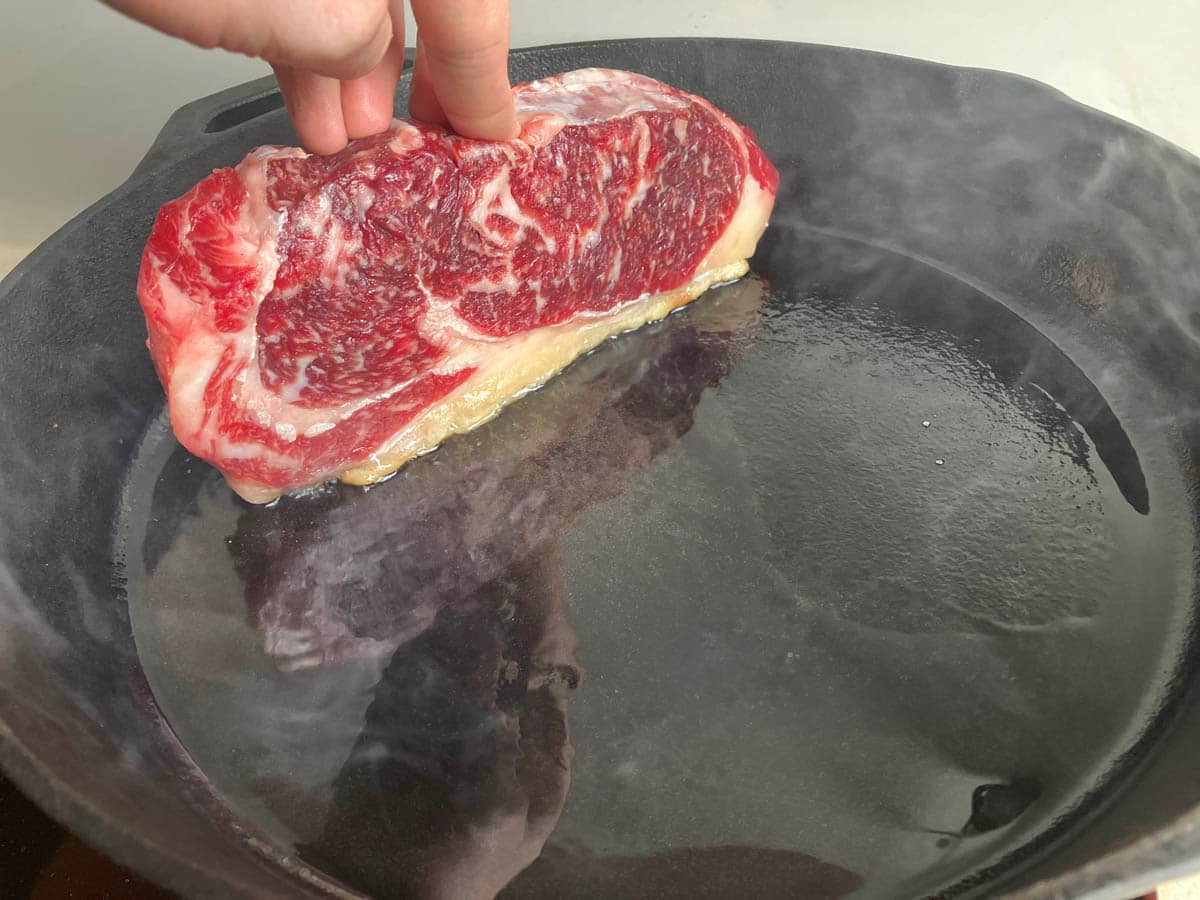

This cast-iron skillet steak recipe is one of my favorite ways to cook steak at home. The steak comes out juicy, with a deeply browned crust and a rich compound butter finish.
Important
I developed this recipe for steaks that are 3/4 to 1 1/2 inches (1.9-3.8 cm) thick. For thinner or thicker steaks, see:
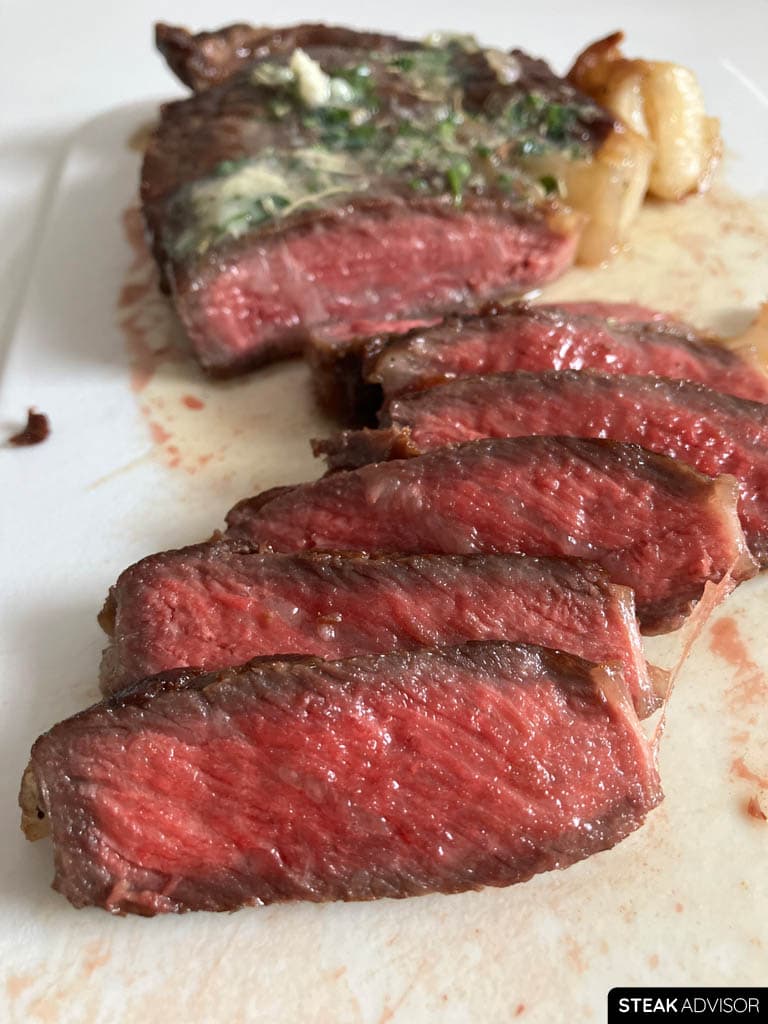
Cooking steak in a cast-iron skillet is quick, practical, and works year-round. After cooking hundreds of steaks, I’ve fine-tuned the timing and technique to make the process simple and consistent at home.
Why You’ll Love This Cast-Iron Skillet Steak Recipe
- A deep, crispy crust
- No complicated butter basting
- Better control over doneness
- Rich garlic-herb butter flavor
- Quick, reliable, and easy to repeat
Ingredients You’ll Need
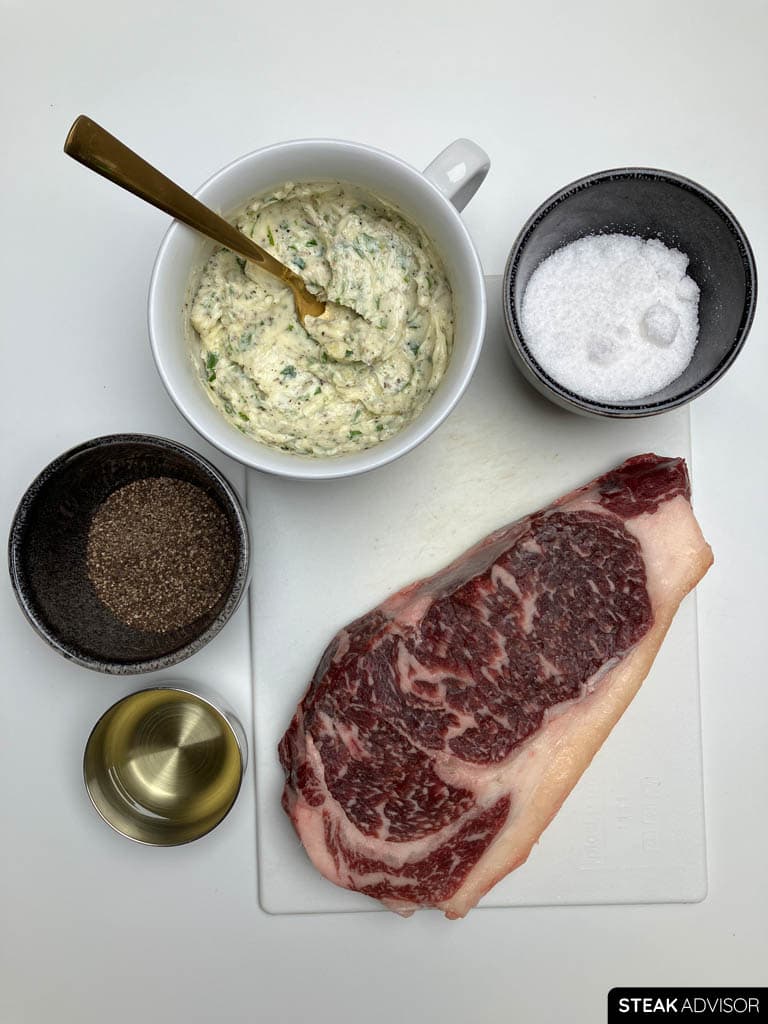
For the steak:
- Steak: I recommend a naturally tender, flavorful cut that’s 3/4 to 1 1/2 inches (1.9 to 3.8 cm) thick, such as ribeye, strip steak, or filet mignon. For best results, go with a steak closer to 1 1/2 inches (3.8 cm) thick. The extra thickness gives you more time to build a good crust without overcooking the center, especially when cooking to medium rare or medium. See the FAQ section for more recommended cuts.
- Oil: Use a high-smoke-point oil for cooking over high heat in a cast-iron skillet. For this type of recipe, I use refined avocado oil almost exclusively because it has a neutral flavor and a smoke point of about 500°F (260°C), making it well suited for a hot skillet. Refined high oleic safflower oil, refined canola oil, refined olive oil, refined peanut oil, and clarified butter (ghee) also work well. Do not use regular butter because it burns quickly over high heat.
- Salt: I prefer kosher salt because its larger crystals are easier to distribute evenly, but table salt also works. Use salt equal to about 1% of the steak’s weight. For a 12 oz (340 g) steak, that’s 0.12 oz (3.4 g), or roughly 1 1/4 teaspoons Diamond Crystal kosher salt, 3/4 teaspoon Morton kosher salt, or 1/2 teaspoon table salt. Weigh the salt the first few times, then season by eye once you know your preference.
- Black pepper (optional): Use finely ground black pepper. I usually skip it because I finish the steak with compound butter, but I leave it as an option. Use about 1/4 teaspoon for a smaller steak and a little more for a larger one.
For the garlic-herb compound butter:
- Butter: 1/2 stick (56 g) of good-quality unsalted butter with at least 80% fat. Unsalted butter gives you better control over the seasoning.
- Garlic: 2 cloves, finely chopped, minced, or pressed.
- Salt: Start with a generous pinch (about 1/8 teaspoon), then taste and adjust as needed.
- Black pepper: Start with a generous pinch (about 1/8 teaspoon) of finely ground black pepper, then taste and adjust as needed.
- Parsley: 1/2 tablespoon finely chopped fresh parsley or 1/2 teaspoon dried parsley.
- Rosemary: 1/2 tablespoon finely chopped fresh rosemary, or 1/2 teaspoon dried rosemary. Chop fresh rosemary very finely so it blends smoothly into the butter without leaving tough, woody pieces.
It is one of my favorite easy ways to make steak more flavorful. As the steak rests, the compound butter melts over the surface, adding rich garlic and herb flavor. I use garlic herb compound butter for this recipe, but you can use any compound butter you like. See my other compound butter recipes for more ideas.
Tools You’ll Need
- Wire rack with baking sheet: I recommend this setup if you plan to dry-brine the steak. It keeps the meat raised so air can circulate around it and dry the surface evenly on all sides. A drier surface browns more effectively, making it easier to develop a deeper crust.
- Cast-iron skillet: Use a 10-inch (25 cm) skillet for one steak or a 12-inch (30 cm) skillet for two steaks. Make sure the steaks fit without touching each other or the sides of the pan. The entire bottom surface of each steak must stay in contact with the skillet for even browning and a proper crust. You don’t need anything fancy. A basic Lodge skillet or any other sturdy cast-iron skillet in the $30-$50 range will work perfectly.
- Tongs: Choose tongs that feel comfortable and are long enough to keep your hands away from the heat and oil splatter.
- Meat thermometer: Don’t rely on cooking time or guesswork. Use a meat thermometer to cook the steak perfectly. You can use either an instant-read thermometer or a leave-in probe. Personally, I prefer a leave-in probe because I can monitor the temperature as the steak cooks without stopping to check it repeatedly.
How to Cook Steak in a Cast-Iron Skillet
Prepare the Steak.
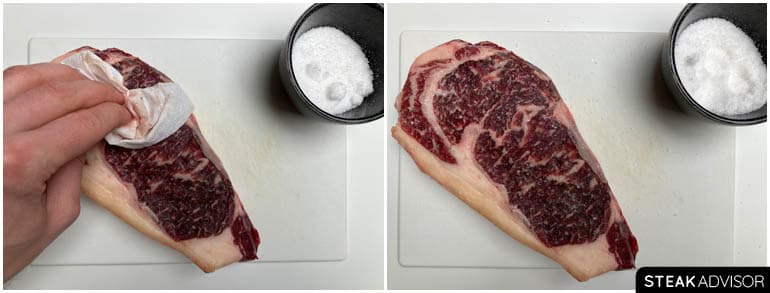
Pat it dry with paper towels to remove any surface moisture, then season all sides, including the edges, using salt equal to about 1% of the steak’s weight.
For a 12 oz (340 g) steak, that’s 0.12 oz (3.4 g), or roughly:
- 1 1/4 teaspoons Diamond Crystal kosher salt,
- 3/4 teaspoon Morton kosher salt,
- or 1/2 teaspoon table salt.
Use a scale at first; once you know how much salt you prefer, you can season by eye.
Dry-brine the steak (optional). Place it uncovered on a wire rack set over a baking sheet and refrigerate for at least 1 hour, preferably 4 to 6 hours. This gives the salt enough time to draw out moisture and then be reabsorbed into the steak. Leaving the steak uncovered also dries the surface, so it browns faster and forms a deeper crust.
If you have less than 1 hour, skip the dry brine. Season the steak immediately before placing it in the cast-iron skillet, or salt it after cooking.
Make the Compound Butter.
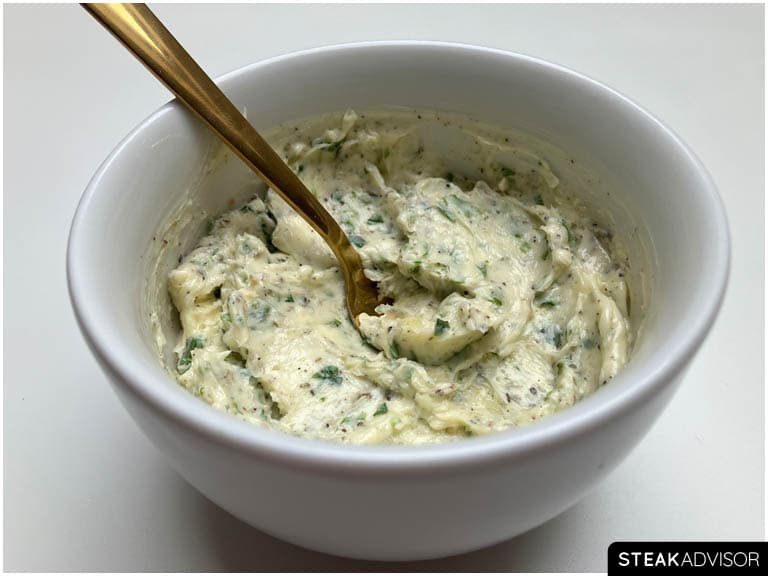
While the steak dry-brines, cut the butter into small cubes and place them in a bowl. Let the butter soften at room temperature until soft enough to mix but not melted. Alternatively, microwave it in a microwave-safe bowl in 5-second intervals, checking after each one to prevent it from melting.
Add the garlic, herbs, salt, and pepper, then mix thoroughly with a fork. Cover the bowl with plastic wrap, foil, or a fitted lid, and refrigerate until needed.
You can double or even triple the recipe and refrigerate the leftover compound butter for up to 4 days. I do this all the time and use the extra butter on bread or other meats.
Heat the Cast-Iron-Skillet.
If you dry-brined the steak in the refrigerator, remove it 15 minutes before cooking. If using compound butter, take it out at the same time so it can soften slightly.
Place a cast-iron skillet over medium-high heat and preheat it for 3-4 minutes. Add 2 tablespoons of oil and heat it until it just begins to smoke, about 1 minute.
While the oil heats, pat the steak dry one more time. Any moisture left on the surface must evaporate before browning can begin, so a drier steak develops a better crust.
If using black pepper, season all sides, including the edges, with finely ground pepper.

Cook the Steak.
Tip: Cooking over high heat in a cast-iron skillet creates a lot of smoke, so turn on the exhaust fan or open a window before you start.
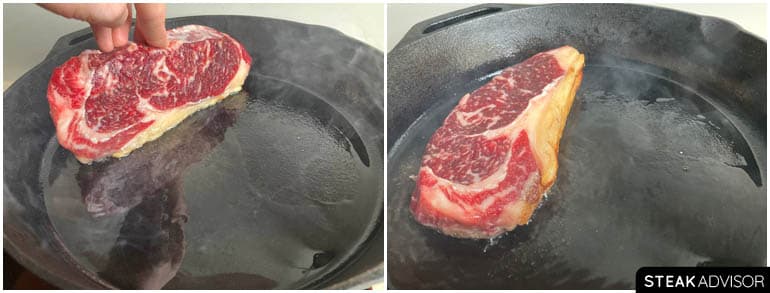
If you’re cooking a steak with a thick fat cap, such as a strip steak or picanha, start by rendering the fat cap for 60-90 seconds or until it’s nicely browned.
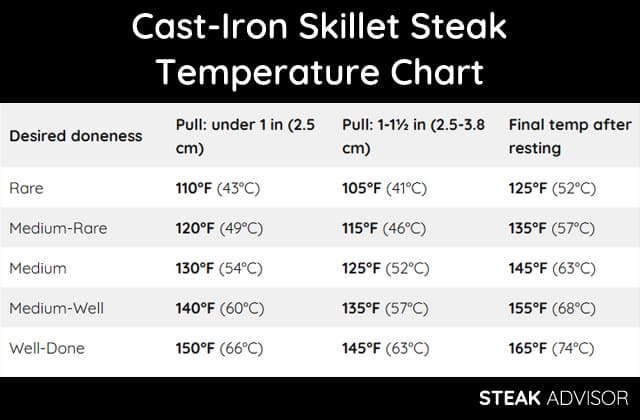
Lay the steak flat in the cast-iron skillet and cook it, flipping every 30 seconds, until the center reaches the pull temperature for its thickness and desired doneness in the chart below
Cast-Iron Skillet Steak Temperature Chart
These guidelines apply only to steaks cooked in a cast-iron skillet from start to finish using this method. Choose the column that matches your steak’s thickness.
| Desired doneness | Pull: under 1 in (2.5 cm) | Pull: 1-1½ in (2.5-3.8 cm) | Final temp after resting |
| Rare | 110°F (43°C) | 105°F (41°C) | 125°F (52°C) |
| Medium-Rare | 120°F (49°C) | 115°F (46°C) | 135°F (57°C) |
| Medium | 130°F (54°C) | 125°F (52°C) | 145°F (63°C) |
| Medium-Well | 140°F (60°C) | 135°F (57°C) | 155°F (68°C) |
| Well-Done | 150°F (66°C) | 145°F (63°C) | 165°F (74°C) |
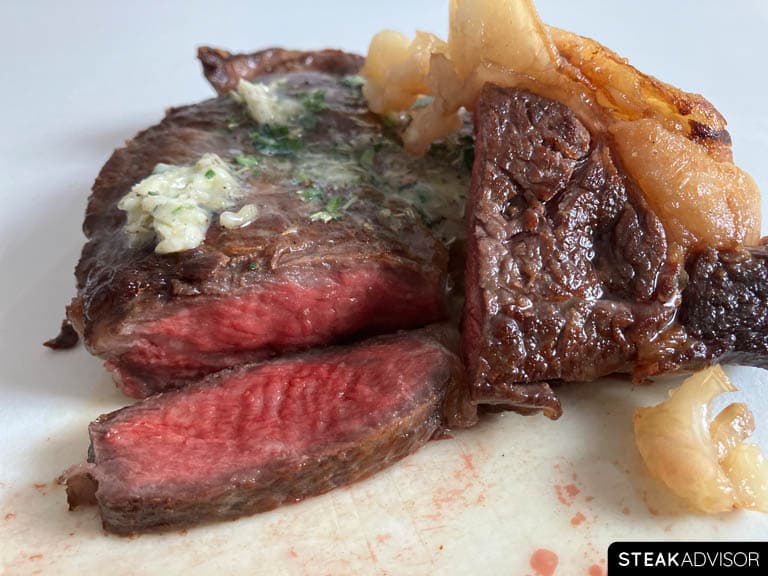
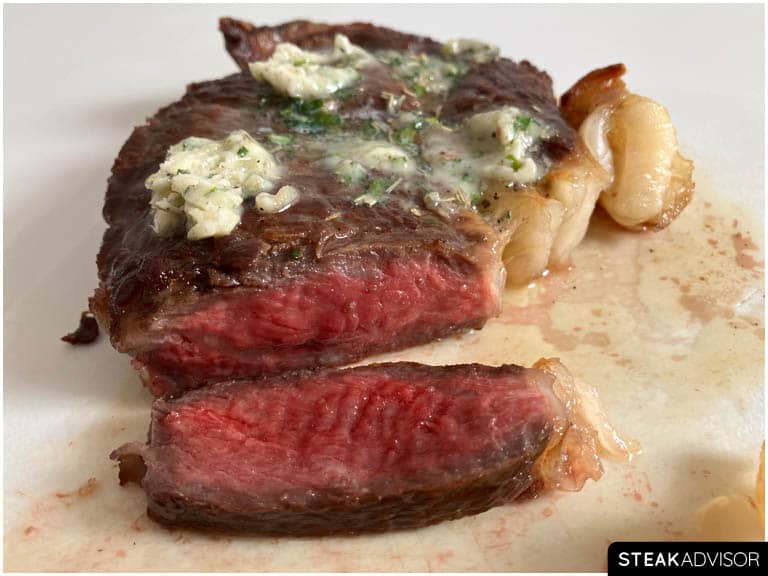
Once the steak reaches its pull temperature, remove it from the skillet, top it with 1 tablespoon (14 g) of compound butter, and let it rest uncovered for 5 minutes. Its temperature will continue to rise as it rests.
Serve the Steak.
After the 5-minute rest, serve the steak whole or slice it just before serving.
For well-marbled, naturally tender cuts, slice it however you like. For cuts with longer, coarser muscle fibers, such as skirt steak, hanger steak, or flank steak, slice thinly against the grain for a more tender bite. For more details, see my guide on how to cut a steak.
Optional: If you don’t have compound butter on hand, you can make a quick garlic-herb butter in the same skillet while the steak rests. After removing the steak, reduce the heat to medium. If the skillet is dry, add 1 to 2 tablespoons of oil.
Add the garlic, and cook briefly until lightly browned. Reduce the heat to low, add the herbs and butter, and let the butter melt. Remove the skillet from the heat and spoon the garlic-herb butter over the steak just before serving.
What to Serve with Cast-Iron Steak
I love serving cast-iron steak finished with compound butter with potatoes in almost any form. The quickest and easiest options are creamy mashed potatoes or crispy French fries. Oven-baked potatoes are another great choice. They are still simple to prepare, although they require a little more cooking time.
Steak also pairs beautifully with a wide variety of vegetables, including roasted green beans and asparagus. And, of course, you cannot go wrong with a fresh, classic salad.
Below are some of the best side dish ideas to serve with cast-iron skillet steak:
- Mashed potatoes
- Crispy roasted potatoes
- French fries
- Creamed spinach
- Sautéed mushrooms
- Roasted asparagus
- Green beans almondine
- Caramelized onions
- Roasted Brussels sprouts
- Caesar salad
- Arugula and Parmesan salad
Tips for the Best Cast-Iron Skillet Steak
Always Pat the Steak Dry Before Cooking
Moisture is the biggest enemy of a good sear.
The goal of this recipe is to brown the outside quickly while keeping the inside juicy and cooked to your preferred doneness. To do that, the steak needs to be as dry as possible before it hits the skillet.
If the steak goes into the skillet wet, the surface moisture has to evaporate first before the steak can start browning properly. This hurts the sear on any steak, but the problem is especially noticeable with thinner cuts, around 1 inch (2.5 cm) thick or less. They cook so fast that by the time the surface starts to brown properly, the inside may already be close to your target doneness. That’s one of the main reasons people struggle to get a really good crust.
Pat the steak dry thoroughly with paper towels on all sides before seasoning, then pat it dry one more time right before cooking.
It’s a simple step, but it makes one of the biggest differences in building a better crust on steak, assuming the cast-iron skillet is properly preheated before the steak goes in.
Salt the Steak The Right Way
The best way to salt a steak is to season it on all sides and place it on a wire rack set over a baking sheet.
- If you’re short on time, let it rest for at least 1 hour.
- For a much better balance of flavor and crust, refrigerate it uncovered for 4-6 hours.
For most 1-1.5 inch (2.5-3.8 cm) steaks, 4-6 hours is my preferred window.
Let me explain why this works so well.
After you salt a steak, the salt draws moisture to the surface, then dissolves in that moisture, creating a salty liquid on the steak’s surface. Within 2-3 minutes after salting, the steak starts to look wet, and this usually peaks around 15-20 minutes. Over the next 20-30 minutes, most of that salty liquid gets reabsorbed into the meat, and the surface starts to dry again. In total, this process takes about 45-60 minutes. Once it’s done, the steak will have a noticeably drier surface.
If you leave the steak uncovered in the refrigerator for a few more hours, the surface will dry even more due to air exposure. At the same time, the salt has more time to penetrate the meat, giving it a deeper, better-seasoned flavor that pairs perfectly with the natural beefy taste.
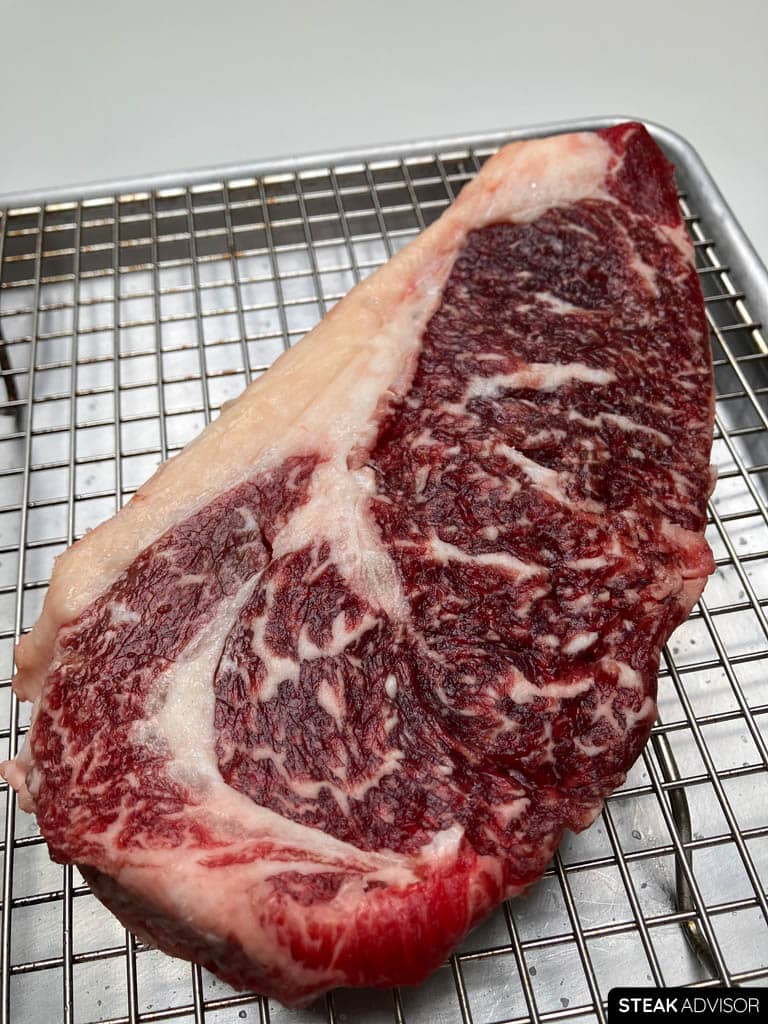
That’s why I recommend waiting at least 1 hour after salting before cooking, although this is really just the bare minimum. After that time, the steak will brown much better and taste noticeably better.
The difference between a dry-brined steak and a steak salted right before cooking is huge.
That said, don’t dry-brine the steak too long unless you know what to expect. A very long dry brine, especially around 24 hours, gives the steak a deeper flavor and an even drier surface, but it also creates a thicker gray band under the crust. Not everyone likes that stronger, saltier flavor either. For the best overall result, stick to 4-6 hours.
If you don’t have at least 1 hour to let the steak rest after salting, don’t salt it in advance. Either season the steak right before placing it in the skillet, or salt it after cooking.
I tested this side-by-side and published a case study on how to salt a steak, with photos, timing notes, and an explanation of exactly why I recommend salting the steak ahead of time rather than right before cooking.
Preheat the Cast-Iron Skillet Well
A cast-iron skillet is great for cooking steak because it can reach very high temperatures and holds heat well. But you need to remember one thing: for searing, heat is everything. If the skillet isn’t hot enough, you won’t get a good crust, no matter how well you prepared the steak before cooking.
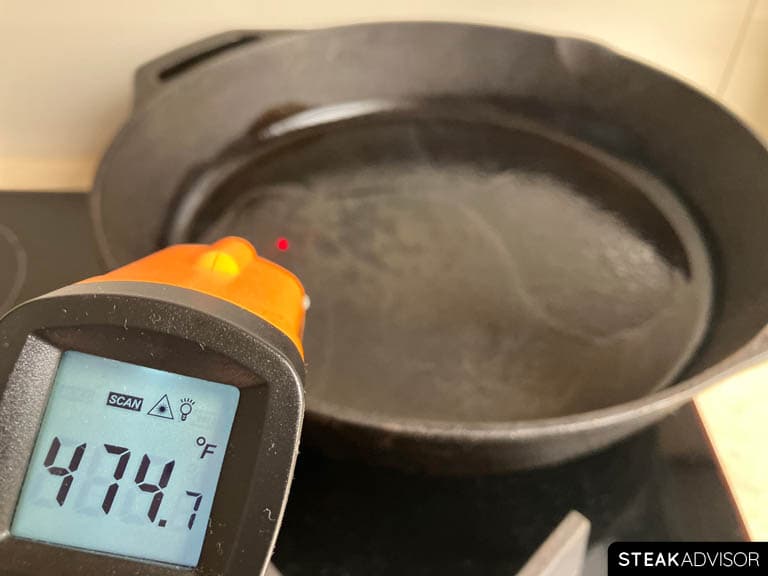
The Maillard reaction, responsible for browning, starts around 285-340°F (140-170°C). The problem is that the skillet cools down the moment the steak touches it. That’s why you need to preheat it hotter than that, ideally to about 450-500°F (232-260°C). This helps the skillet stay hot enough to cook the steak properly, even after the initial temperature drop.
In my experience, a cast-iron skillet usually needs about 4-5 minutes over medium-high heat to reach that range. You can use an infrared thermometer to check the temperature of your skillet. It’s a cheap tool that shows exactly how hot your skillet gets on your stove.
Use the Right Oil
Another key factor is the oil. When cooking in a cast-iron skillet over high heat, always use a neutral oil with a high smoke point. The skillet needs to reach at least 400°F (204°C), and ideally closer to 500°F (260°C), so you can’t use just any oil.
Many common cooking oils start to burn at those temperatures, which can leave the steak with a bitter flavor. That’s why I recommend using an oil with a smoke point around 500°F (260°C). My go-to is refined avocado oil because it has a high smoke point and a neutral flavor, but there are several other good options too. See the table below.
| Type of Fat | Smoke Point ºF/ºC | Flavor profile |
|---|---|---|
| Refined Avocado Oil | 520ºF / 271°C | Neutral to very mild |
| Refined Pecan Oil | 470ºF / 243°C | Mildly nutty |
| Refined Canola Oil | 468°F / 242°C | Neutral |
| Refined Olive Oil | 465°F / 241°C | Mild to neutral |
| Refined Peanut Oil | 450ºF / 232°C | Neutral to mildly nutty |
| Refined Soybean Oil | 450°F / 232°C | Neutral |
| Clarified Butter / Ghee | 450°F / 232°C | Rich, buttery, mildly nutty |
| Refined Rice Bran Oil | 450°F / 232°C | Neutral to mildly nutty |
| Refined Corn Oil | 450°F / 232°C | Neutral to slightly sweet |
| Refined Sunflower Oil | 450°F / 232°C | Neutral |
Smoke points are approximate and may vary depending on the product, degree of refinement, freshness, and method of measurement.
Do not cook the steak in butter. Butter burns quickly over the kind of heat you need for a proper sear. If you want that butter flavor, add it later, once the steak is already cooked. You can melt it in the skillet and pour it over the sliced steak, or simply place a slice of compound butter on top while the steak rests.
Render the Side Fat
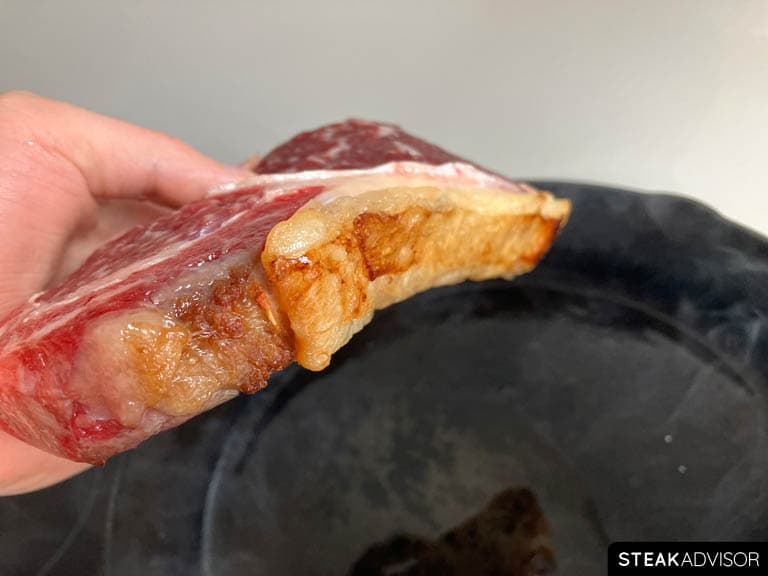
If your steak has a side fat cap, like a strip steak or picanha, I highly recommend rendering it first before cooking the meat side, just as I do in this recipe.
Properly rendered fat should be nicely browned and slightly crispy, not pale and chewy. Over high heat, it doesn’t take long, usually about 1-2 minutes, depending on how thick the fat cap is and how hot your skillet is.
You can also render the fat cap near the end of cooking, but I prefer doing it at the beginning. As the fat renders, some of it melts into the skillet, adding extra flavor. It also makes the whole cooking process easier to control. Once the steak gets close to your target temperature, you don’t have to keep it in the hot skillet to finish rendering the fat cap. That extra time in the skillet can lead to more carryover and a higher risk of overshooting your target doneness.
Flip the Steak More Often
The advice to flip a steak only once doesn’t make much sense in most cases. Based on my tests, it’s much better to flip the steak every 30 seconds.
Letting the steak sit too long on one side can make it cook less evenly, especially with thicker cuts around 1 1/2 inches (3.8 cm) thick.
Flipping every 30 seconds helps the steak cook more evenly from both sides and gives you better control over the crust. It also helps reduce the gray band under the crust. Each side gets a short break from direct pan contact between flips, so the outer layers don’t stay extremely hot for too long. The result is a more even doneness inside.
Skip the Butter Basting
Yeah, I know, this is a bit controversial. But unless you’re very comfortable cooking steak in a cast-iron skillet, or you’re okay with a little less control over the final doneness, I recommend skipping the butter basting.
I’m skipping it in this recipe because it makes the cooking process harder, especially with thinner steaks. It looks simple, but in practice, you have to add butter, lower the heat, tilt the skillet, spoon hot butter over the steak, and keep an eye on the internal temperature. That’s a lot to control when the steak is already cooking fast. One small error is enough to overshoot your target doneness.
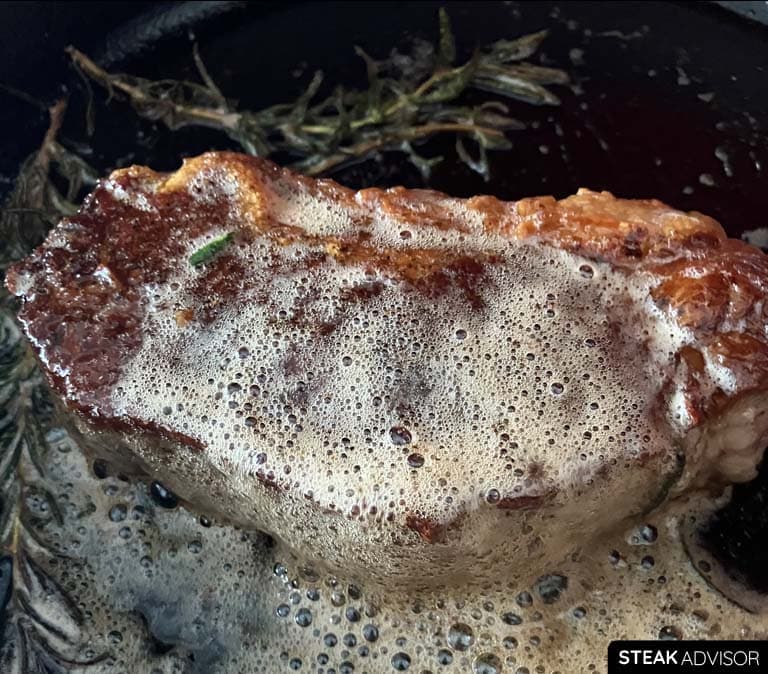
Butter basting also changes how the steak cooks. When you flip the steak every 30 seconds, the side facing up gets a short break from direct contact with the pan and cools slightly. But when you keep spooning hot butter over it, that cooling effect is much smaller. The steak cooks faster, the outer layers get hotter, and the carryover increase is usually stronger after you remove it from the skillet.
That’s why, for this recipe, I don’t think butter basting is worth the extra effort or the extra risk. You can get almost the same rich garlic-herb butter flavor in a much simpler way. Place a slice of compound butter on top of the steak as it rests, or melt butter with garlic and herbs in the skillet after cooking, then pour it over the sliced steak.
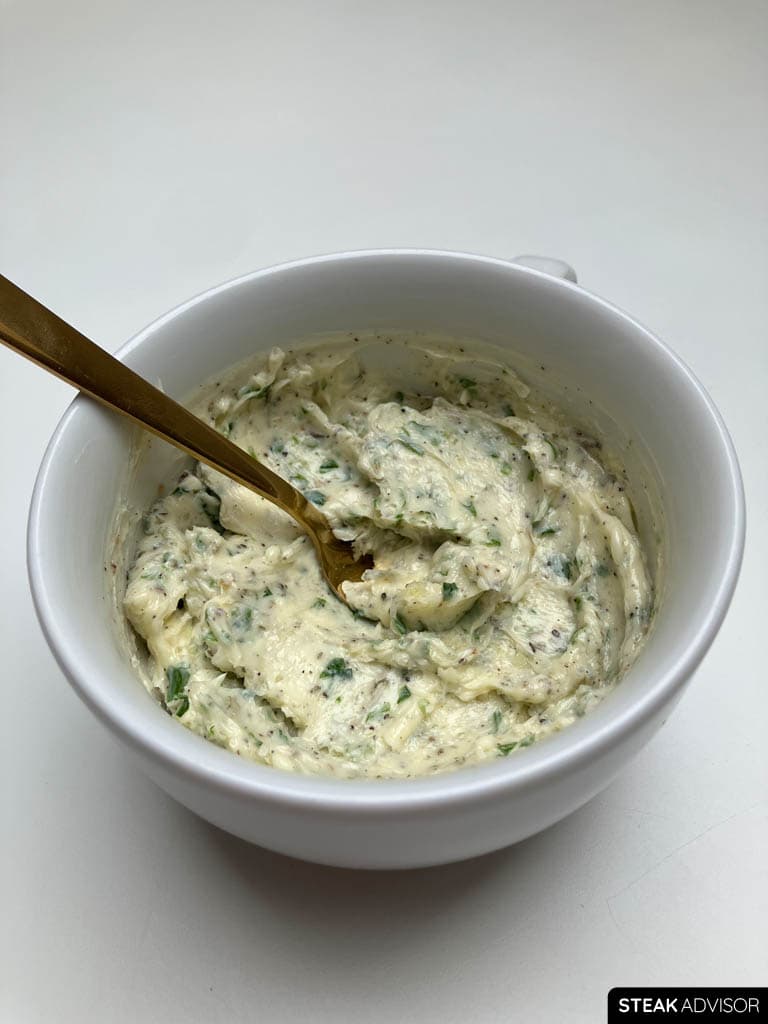
You also save a lot of butter, because classic butter basting usually requires a lot of it, and much of that butter stays in the skillet anyway. It’s also not very practical when cooking more than one steak. With compound butter, things are much easier: place a slice on top of each steak while it rests, and you’re done.
Use a Meat Thermometer, Don’t Cook by Time
Please note that I don’t provide strict timing in this recipe. Why? There are too many variables: steak thickness, cut, skillet temperature, stove power, starting temperature, and your target doneness. Relying on time alone is one of the easiest ways to overcook a steak.
That’s why I strongly recommend using a meat thermometer. Track the steak’s internal temperature and remove it from the skillet early enough to account for carryover cooking. Even a basic instant-read thermometer or probe-style thermometer will do the job. They’re not expensive, but they make a huge difference.
Tip: When using a meat thermometer, insert the probe into the center of the thickest part of the steak for the most accurate reading.

Also, don’t rely on the touch test to check doneness. Some chefs still recommend pressing the steak and comparing its firmness to the fleshy part of your hand, but this method is unreliable unless you cook dozens of steaks every day. Different cuts feel different: filet mignon is much softer than strip steak, and a well-marbled ribeye won’t feel the same as a leaner cut. On top of that, everyone’s hand feels different, so using it as a reference point makes no sense if you want accurate results.
A thermometer removes the guesswork. It’s one of the most useful tools in my kitchen, and I use it every time I cook steak, especially with high-quality, more expensive cuts.
Remove the Steak Early and Let It Rest
The steak doesn’t stop cooking the moment you take it out of the skillet. As it rests, heat from the outer layers continues to move toward the center, so the internal temperature continues to rise. This is called carryover cooking, and with fast, high-heat methods like pan-searing, the increase can be much bigger than most people expect.
With this recipe, the steak’s internal temperature can rise by about 15-20°F (8-11°C) within 5 minutes after you remove it from the skillet, depending on the steak’s thickness and how hot the skillet was. That’s why you need to remove the steak before it reaches your target temperature. If you wait until it hits your final doneness in the skillet, it will keep cooking as it rests and overshoot your target doneness.
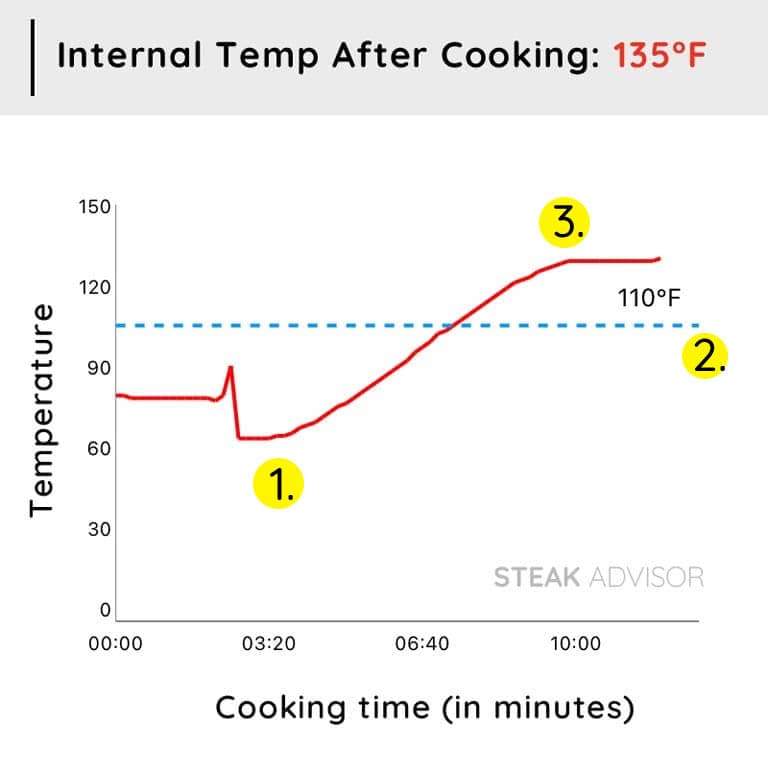
Here’s an example. The graph below shows what happened after I removed a 1 1/4-inch (3.2 cm) thick steak from the pan: how much the internal temperature increased, how long it continued to rise, and what final temperature it reached after a few minutes.
Here is a description of what the image above shows:
- This is the moment I inserted the probe into the steak and placed it in the pan. The probe first showed room temperature, and the sharp drop marks the moment it went into the steak and started reading the steak’s internal temperature.
- The blue line marks 110°F (43°C), the temperature at which I removed the steak from the pan and let it rest.
- After that, you can see how the internal temperature continues to rise over the next few minutes due to carryover cooking, until it finally stabilizes.
For resting, 5 minutes is enough for this recipe. Don’t cover the steak with foil. Just place it on a wire rack, cutting board, or even a plate, and leave it untouched.
For more details on resting time and carryover cooking, check out my guide: Resting Steak After Cooking: Why You Should and for How Long.
Cast-Iron Skillet Steak FAQs
Why is a cast-iron skillet so good for cooking steak?
There are two main reasons. First, cast-iron can handle very high heat, which is exactly what you need for a strong sear. Second, it holds heat really well. It takes longer to preheat than most pans, but once it’s hot, it stays hot.
That matters because the pan cools down the moment you place a cold steak in it. A properly preheated cast-iron skillet retains heat better, so the steak starts searing right away instead of sitting in a pan that’s too cool. That’s exactly what you need if you want a deep, crisp crust on the outside while keeping the center juicy and medium-rare to medium.
What are the best steak cuts for cooking in a cast-iron skillet?
You can cook almost any steak in a cast-iron skillet, but for the best results, choose cuts that are naturally tender, well-marbled, and about 1-1 1/2 inches (2.5-3.8 cm) thick. That thickness gives you enough time to build a beautiful golden-brown crust while keeping the inside medium-rare to medium.
Some of the best cuts for cast-iron include ribeye, New York strip, filet mignon, picanha, hanger steak, flat iron steak, porterhouse, T-bone, Denver steak, chuck eye steak, and teres major.
Thinner steaks, under 1 inch (2.5 cm), can be cooked in a cast-iron skillet too, but they cook much faster. Because of that, it’s harder to build a deep crust while keeping the inside medium-rare to medium. This is especially true for naturally thin cuts like outside skirt steak, ribeye cap, flank steak, flap steak (bavette), spider steak, or tri-tip. They can still turn out great in a skillet, but the pan needs to be very hot, and the searing time needs to be short to avoid overcooking the steak.
Can I cook a thicker steak in a skillet, for example, 2 inches (5 cm) thick?
Technically, yes. The problem is that once you go thicker than about 1 1/2 inches (3.8 cm), the steak starts to cook unevenly when seared from start to finish in a skillet.
With a steak that thick, the outside cooks much faster than the center. Depending on the thickness, you can end up with a very dark crust, a thicker gray band under the surface, and a center that is still undercooked. With steaks thicker than 2 inches (5 cm), the crust can even start to burn before the inside reaches your target doneness.
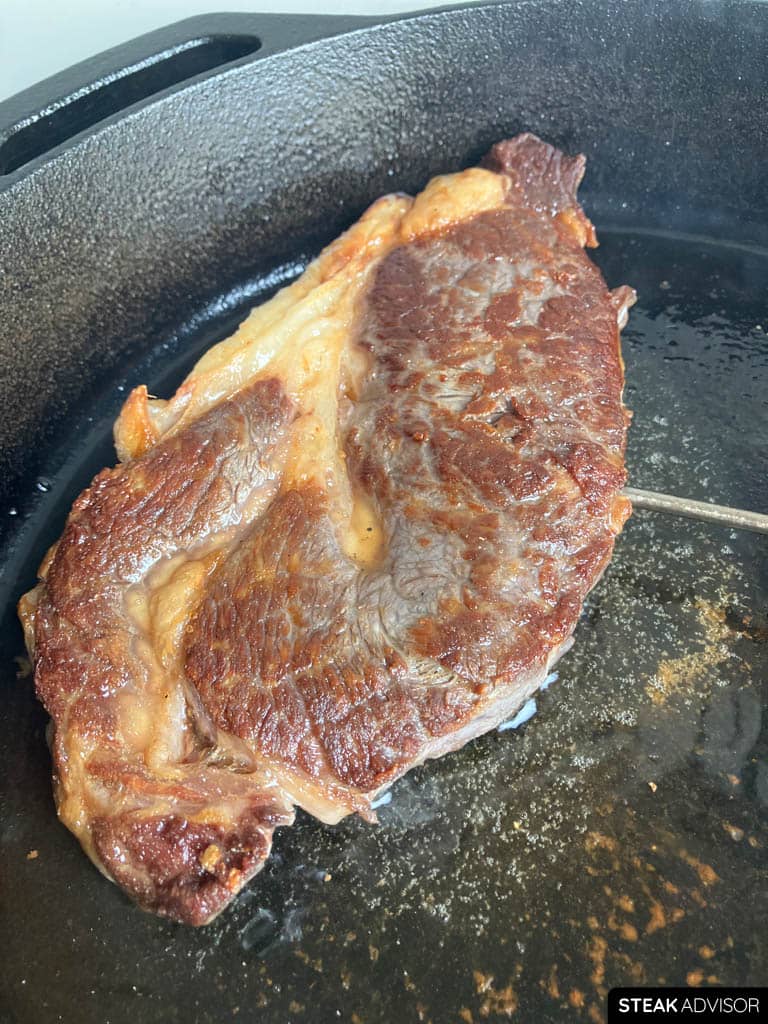
When you slice into a thick steak cooked this way, the doneness gradient is usually uneven. It goes from gray near the surface, through some pink, to a red or undercooked center. See the example below.

For thicker steaks, it’s better to combine hot-and-fast searing with a slower cooking method. Use reverse sear, forward sear, or sous vide instead. These methods give you better control over the inside while still letting you build a great crust.
Is it a good idea to preheat a cast-iron skillet in the oven before cooking?
Technically, yes. Preheating a cast-iron skillet in the oven heats the whole pan more evenly. That means fewer hot and cold spots once you move it to the stove and start cooking.
You can see the difference clearly with an infrared thermometer. On a gas stove, the flame heats the spots where it hits the bottom of the skillet, so the pan develops hotter and cooler zones. In the oven, the heat surrounds the skillet from all sides, so the surface heats more evenly.
That said, I personally don’t see a big enough difference to make oven preheating worth the extra time for this recipe. When I preheat the cast-iron skillet on the stove for 4-5 minutes over medium-high heat, the steak still turns out great every time. So I stick to the easier and quicker option: preheating the skillet directly on the stove.
To what doneness should steak be cooked?
That’s very personal, and it also depends on the type of steak. Personally, for most steaks, I like the final internal temperature to land around 135-145°F (57-63°C), which is the upper side of medium-rare or the lower side of medium.
As a general rule, leaner cuts like filet mignon are best cooked to rare or medium-rare, definitely no higher than 140°F (60°C). Since they don’t have much intramuscular fat, they don’t benefit much from higher doneness. Once you push them past medium-rare, they quickly lose moisture and become noticeably less juicy and tender. For example, for filet mignon, many people prefer a temperature closer to 130-135°F (54-57°C),
Well-marbled cuts, such as a USDA Prime ribeye, are a little different. For those, in my opinion, the best doneness is the upper side of medium-rare or the lower side of medium, around 140°F (60°C). At that temperature, the intramuscular fat, or marbling, melts more noticeably, making the steak juicier and more flavorful. If you cook a well-marbled steak too rare, the fat doesn’t have enough time to melt properly and can feel firm, cold, or waxy.
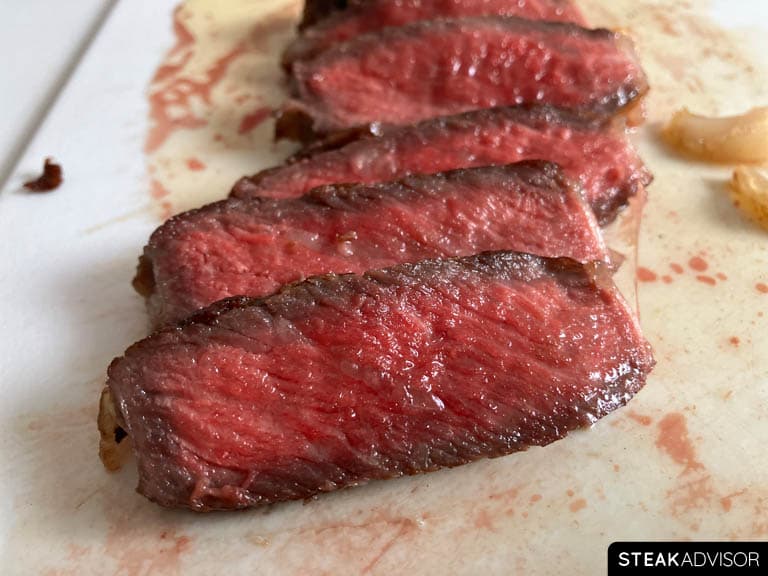
If you’re not sure which doneness you prefer, check out my steak doneness and temperatures guide. I show the temperature range for each doneness level, explain the texture differences, and include real photos so you can see exactly how steak looks at each stage.
One important food safety note: according to the USDA, whole cuts of beef should reach at least 145°F (63°C) and rest for at least 3 minutes to be considered safe to eat.
I also have an article on eating raw steak, explaining whether it’s safe and what risks you should know about.
What should I do if the steak reaches my target temperature in the skillet?
If the steak reaches your target temperature while it’s still in the skillet, remove it immediately and slice it right away. Don’t let it rest.
At that point, the steak is already at your desired doneness. If you let it rest, carryover cooking will push the temperature even higher, and the steak will overshoot your target doneness. Slicing it right away releases heat faster and helps prevent the steak from overcooking further.
Why does steak cooked in a cast-iron skillet have a thicker gray band?
A thicker gray band is normal with cast-iron searing because the steak cooks over very high direct heat.
A thicker gray band is normal when cooking steak over high, direct heat in a cast-iron skillet. The meat near the surface gets much hotter than the center, so that outer layer cooks more before the inside reaches your target doneness.
You can’t avoid it completely with hot-and-fast cooking methods, but you can minimize it. And this recipe already does that in two important ways: dry-brining for 4-6 hours instead of overnight, and flipping the steak every 30 seconds while cooking. This helps you build a good crust while keeping the gray band as thin as possible.
Print
Cast-Iron Skillet Steak Recipe
- Prep Time: 20 minutes
- Dry-Brine Time (Optional): 0 to 6 hours
- Cook Time: 10 minutes
- Total Time: 30 minutes
- Yield: 1 steak
Description
A simple cast-iron skillet steak recipe with a deep crust and a tender, juicy center. Finished with garlic-herb compound butter for rich flavor, it tastes like a restaurant-quality steak made at home.
Ingredients
For steak:
- Choose a naturally tender steak, approximately 10-16 oz (285-450 g), 3/4 to 1 1/2 inches (1.9-3.8 cm) thick, such as ribeye or strip steak. For best results, use a steak closer to 1 1/2 inches (3.8 cm) thick.
- 2 tablespoons (30 ml) high-smoke-point oil (I recommend refined avocado oil; see Notes for alternatives)
- salt, 1% of the steak’s weight (see instructions for a 12 oz / 340 g example)
- optional: about 1/4 teaspoon of finely ground black pepper
For garlic-herb compound butter (for serving)
- 1/2 stick (56g) of unsalted butter
- 2 garlic cloves, finely chopped or pressed
- 1/8 teaspoon salt (a generous pinch), plus more to taste
- A generous pinch of finely ground black pepper (about 1/8 teaspoon), to taste
- 1/2 tablespoon finely chopped fresh parsley or 1/2 teaspoon dried parsley
- 1/2 tablespoon finely chopped fresh rosemary or 1/2 teaspoon dried rosemary
Tools
- Wire rack and baking sheet
- Cast-iron skillet (Use a 10-inch / 25 cm skillet for one steak or a 12-inch / 30 cm skillet for two steaks)
- Tongs
- Meat thermometer (instant-read or leave-in probe thermometer)
Instructions
Prepare the Steak
- Pat the steak completely dry on all sides with paper towels.
- Season it evenly on all sides with salt equal to about 1% of the steak’s weight. For a 12 oz (340 g) steak, use 0.12 oz (3.4 g): about 1 1/4 teaspoons Diamond Crystal kosher salt, 3/4 teaspoon Morton kosher salt, or 1/2 teaspoon table salt.
- Place the steak uncovered on a wire rack set over a baking sheet.
- For the best flavor and crust: Refrigerate the steak uncovered for 4-6 hours.
- If you’re short on time: Refrigerate it uncovered for about 1 hour.
- If you have less than 1 hour: Season the steak immediately before it goes into the pan.
- For a longer dry brine: See the notes.
Make the Compound Butter
- While the steak dry-brines, cut the butter into small cubes and place them in a bowl. Let it soften at room temperature, or microwave it in 5-second intervals until soft but not melted.
- Add the remaining compound butter ingredients and mix thoroughly with a fork.
- Cover and refrigerate until needed. This recipe makes enough for up to three steaks; double it for four to six. For substitutions or a larger make-ahead batch, see the notes.
Preheat the Cast-Iron Skillet
-
If the steak was refrigerated, remove it about 15 minutes before cooking. Take the compound butter out at the same time so it can soften slightly.
- Place a cast-iron skillet over medium-high heat and preheat it for 3-4 minutes. Add 2 tablespoons of oil and heat it until it just begins to smoke, about 1 minute.
-
While the oil heats, pat the steak dry again.
-
Optional: If using black pepper, season all sides with finely ground pepper.
- Then immediately move on to the next step.
Cook the Steak in a Cast-Iron Skillet
- Cooking over high heat in a cast-iron skillet creates a lot of smoke, so turn on the exhaust fan or open a window before you start.
- If the steak has a thick fat cap, such as a strip steak or picanha, place it fat-side down in the hot skillet. Render the fat for 60-90 seconds, or until nicely browned. Lay the steak flat in the skillet.
- If it doesn’t have a thick fat cap, place it flat in the skillet right away.
- Cook over medium-high heat, flipping every 30 seconds, until a thermometer inserted into the center reads the pull temperature for the steak’s thickness and desired doneness in the chart below.
- Once the steak reaches its pull temperature, remove it from the skillet, top it with 1 tablespoon (14 g) of compound butter, and let it rest uncovered for 5 minutes.
- As the steak rests, its internal temperature will rise from the pull temperature to approximately the final temperature shown in the chart.
Slice and Serve the Steak
- After the steak has rested for 5 minutes, serve it whole or slice it just before serving.
- For well-marbled, naturally tender cuts, slice the steak however you like. For cuts with longer, coarser muscle fibers, such as outside skirt, hanger, or flank steak, slice thinly against the grain for a more tender bite (see notes).
- Serve with your favorite sides.
Notes
Oil/Fat Alternatives: Instead of avocado oil, you can use refined high-oleic safflower, refined high-oleic canola, refined canola, refined olive, refined peanut oil, or ghee. Regular butter is unsuitable for searing because it burns at high heat.
Dry brining for 12-24 hours: You can dry-brine the steak for 12-24 hours, but expect a thicker gray band under the crust. The flavor and crust will be excellent, but not everyone likes the deeper, saltier flavor that develops after a long dry brine, especially when the steak sits closer to 24 hours. If you want to try a longer dry brine, I recommend starting with 12 hours first. Then, next time, you can go longer and see if you like the difference. Just keep in mind that the closer you get to 24 hours, the more noticeable the gray band under the crust becomes.
Compound butter: If you want to make a larger batch to keep on hand, roll it into a log and let it firm up in the freezer. It’s much easier to store this way, and you can slice off only what you need whenever you cook steak. If you’re looking for other flavor ideas, check out my compound butter recipes for steak, where I share different ingredient combinations with step-by-step instructions.
If you keep the compound butter in a bowl in the fridge, storage time depends on the ingredients. For garlic-herb compound butter, use it within 4 days. Follow the conservative rule recommended by the National Center for Home Food Preservation for homemade garlic-in-oil mixtures, because garlic stored in fat can be a botulism risk if handled incorrectly. Keep it refrigerated at 40°F (4°C) or lower. For longer storage, freeze it. You can keep compound butter frozen for a few months, but for the best quality, use it within 2-3 months.
Slicing against the grain: This technique shortens the muscle fibers, making each bite easier to chew. It’s one of the simplest ways to make tougher, chewier cuts noticeably more tender because your teeth don’t have to work as hard to break through long muscle fibers. If you’re not sure how to find the grain direction or how to slice the steak properly, check out my guide to slicing steak against the grain.
Alternative to Compound Butter (Quick Garlic and Herb Butter): After cooking the steak, reduce the heat to medium. If the skillet is dry, add 1-2 tablespoons of oil. Lightly brown a few peeled garlic cloves over medium heat, then add a couple sprigs of rosemary or thyme and 2 tablespoons (30 g) of unsalted butter. Let the butter melt, turn off the heat, and pour the garlic-herb butter over the sliced steak before serving.

A lot of info, but in a good way. I picked up a few small things I’d been skipping, and my cast iron steak came out better because of it.
The dry-brine step was worth it. Better flavor with very little extra work.
Really appreciate the feedback, Alex.
No fancy steps, just a really good steak from a skillet. Exactly what I was looking for.
Really appreciate the feedback.
Simple but really effective. Patting the steak dry right before the pan gave me a much better crust than I usually get. Definitely keeping this method.
Nice. That dry surface makes a big difference.
Tried this with a ribeye that was a little over 1 inch thick, and it turned out incredible. The crust was seriously good, and the steak stayed juicy inside. Great cast iron method.
Love to hear that, thanks!
The pat-dry step right before searing made a huge difference for me. I’m getting a much better crust now, and dry-brining the steak for a few hours gave it way more flavor. Simple method, but the results are seriously better.
Thanks, Kevin!
Great recipe! The steak turned out perfectly juicy with a beautiful crust.
Thanks, Michael! Really glad you enjoyed the recipe and that the steak turned out great.