
| PREP TIME | REST TIME | COOK TIME |
| 15 mins | 1 to 6 h | 30 mins |
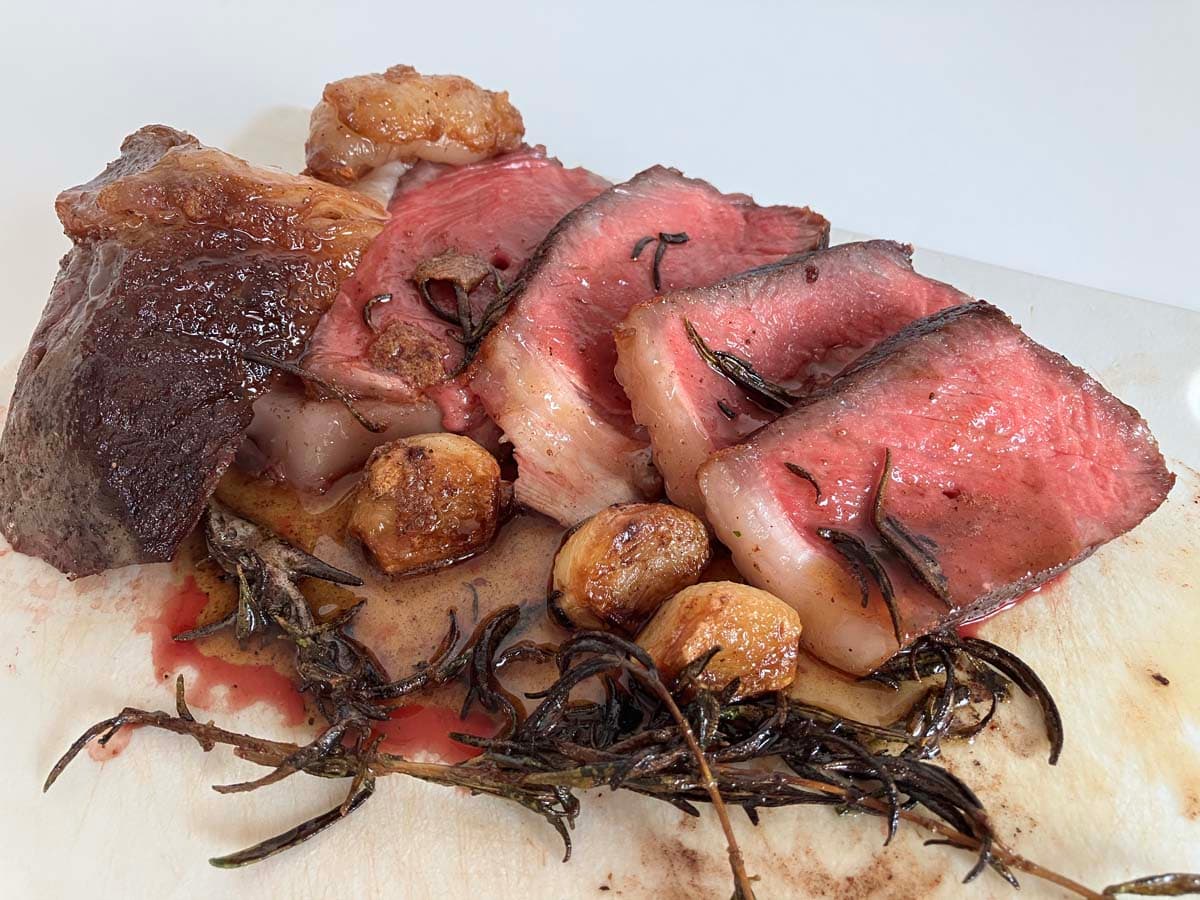
Pan-searing the steak first and finishing it slowly in the oven gives you far more control over doneness than searing alone. It’s a simple, reliable way to cook a thick 2-inch (5 cm) steak at home without overthinking it. If you want a steak with a juicy, edge-to-edge pink center and a beautifully browned crust, this recipe is hard to beat.
To finish it off, I like to add a thin slice of garlic-herb compound butter right on top of the hot steak. It melts immediately, adding richness and an incredible aroma.
Important
For this recipe, I’m sticking with one of the most practical ways to cook a 2-inch (5 cm) thick steak at home without any fancy tools: the pan-sear-and-oven-finish method. But if you prefer a different technique, here are a few great options to consider:
- Sous Vide: The most foolproof method for steaks about 2 inches (5 cm) thick. It’s perfect if you’re working with a well-marbled or expensive cut and want to avoid any risk of overcooking. No thermometer required, just a sous vide machine and a pan or grill to sear for the crust at the end. For a cut this thick, expect a cook time of about 3.5 to 4 hours. The payoff? Perfect, edge-to-edge doneness every time.
- Reverse Sear: Takes about half the time of sous vide and still gives you great control. It’s not quite as foolproof, but as long as you follow the steps, it’s still very beginner-friendly. Reverse searing gives you a beautiful golden-brown crust on the outside and perfect edge-to-edge doneness inside. You can do it oven-to-pan or entirely on the grill.
- Broiling: Broiled steak cooks quickly and fairly evenly, but the crust won’t be as good, and the gray band will be a bit thicker than with reverse searing. It’s also less consistent than other methods, since results depend on the oven, how hot the broiler actually gets, and a few other variables. Still, it’s a good option if all you have is an oven with a broiler.

You can’t cook a steak that’s about 2 inches (5 cm) thick, over direct high heat alone. The outside will burn long before the inside has a chance to cook, and the steak will cook unevenly. Thick steaks need a different approach, a two-stage cooking method. You can use techniques like the reverse sear (low heat first, then a final sear) or sous vide, but for this recipe, I’m keeping it simple with the pan-sear and oven-finish method.
With this recipe, a 2-inch (5 cm) steak takes about 35–40 minutes from start to finish (including the 10-minute rest). That’s a lot quicker than sous vide or a standard reverse sear.
Here’s how it works: you start cooking the steak in a hot pan to build a deep, golden-brown crust, then finish it in the oven until it reaches your ideal doneness. It’s one of the easiest and most reliable ways to cook a 2-inch (5 cm) thick steak at home, and it doesn’t require anything special, just a pan, an oven, and a meat thermometer to monitor the steak’s internal temperature. A wire rack and baking sheet are optional, but they’re great if you want to dry-brine the steak for better flavor and an even nicer crust.
The Ingredients You’ll Need
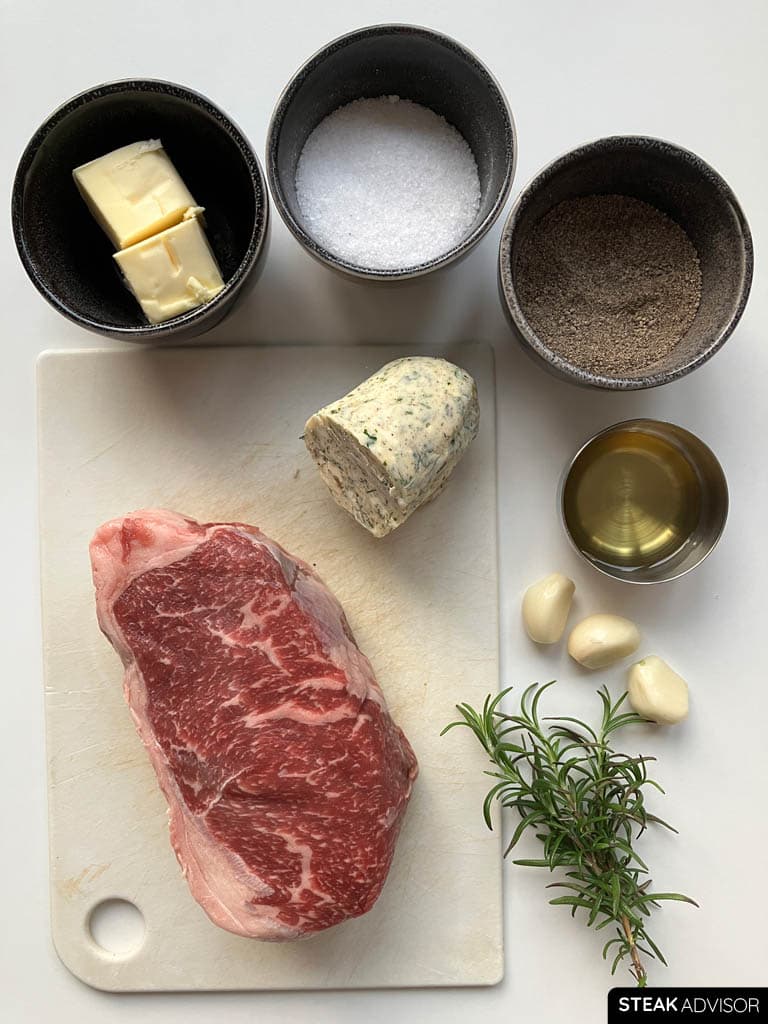
- Steak: This recipe is perfect for ribeye, strip steak, tomahawk, cowboy steak, filet mignon, or any tender cut that’s about 2 inches (5 cm) thick.
- High-Smoke-Point Oil: 1 tablespoon (15 ml). I recommend refined avocado oil.
- Kosher Salt: 2 teaspoons (about 10 g). A good rule of thumb is 1 teaspoon of kosher salt per side for a steak that’s at least 2 inches (5 cm) thick.
- Black Pepper: 1/2 teaspoon per pound (454 g) of steak. Use only finely ground black pepper.
- Steak Butter: A simple mix of butter, garlic, and herbs that adds tons of flavor. Make garlic herb compound butter ahead of time so it has at least 1 hour to firm up in the freezer. Store extras in the fridge for a few days or in the freezer for up to 3 months. If you don’t have compound butter ready, you can use unsalted butter with 2–3 garlic cloves and a few sprigs of rosemary or thyme.
The Tools You’ll Need
- Pan: A cast-iron skillet, a carbon-steel pan, or a heavy-bottomed stainless-steel skillet works best for getting a great sear and handling high heat.
- Wire Rack: Ideal for dry brining, allowing air to circulate evenly around the steak.
- Meat Thermometer: A leave-in probe thermometer is the best because it allows you to monitor the steak’s internal temperature in real-time. An instant-read thermometer also works if that’s what you have.
- Tongs: For flipping and handling the steak safely while searing.
How to Cook a 2-Inch (5 cm) Steak: Ultimate Guide
Start by gathering all the tools and ingredients (including the compound steak butter), then follow the steps below.
Step 1: Prepare the Steak
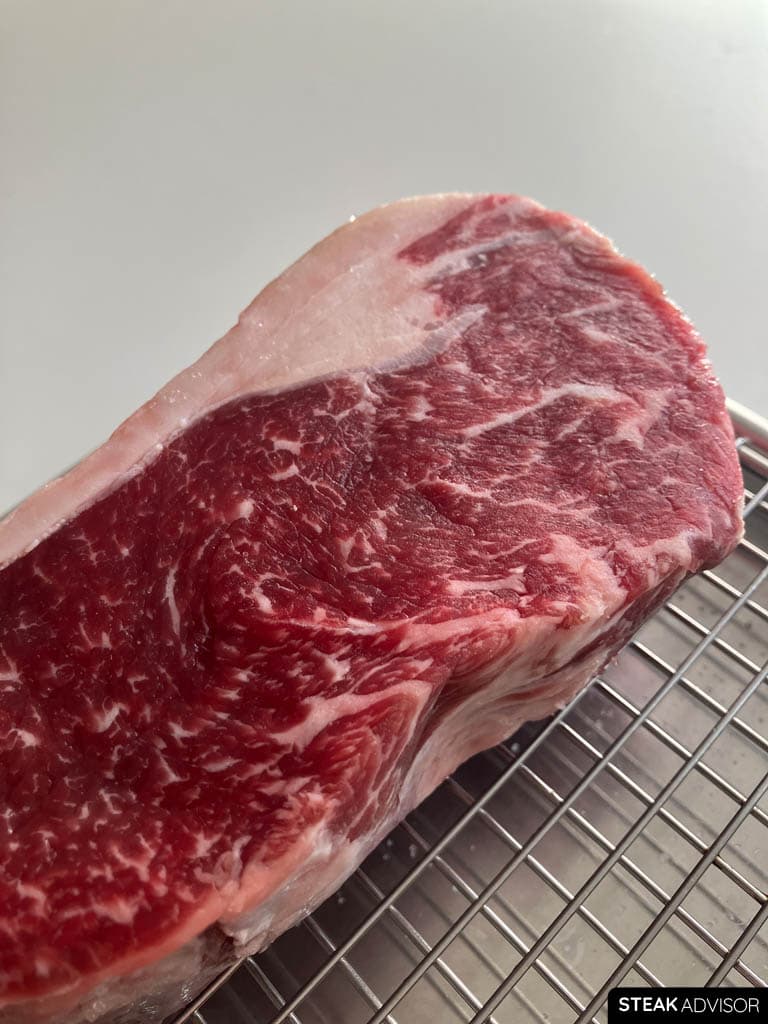
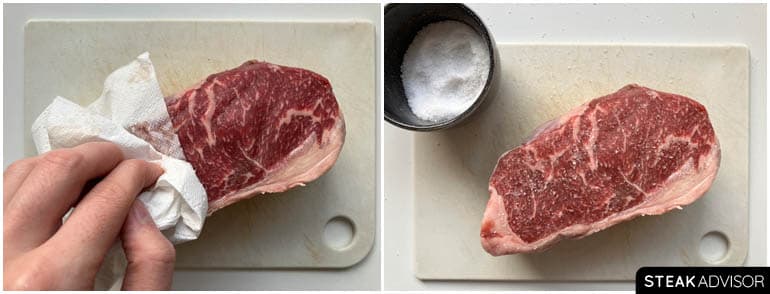
Pat the steak dry on all sides with paper towels, then season both sides generously with kosher salt (about 1 teaspoon per side). Set it uncovered on a wire rack over a baking sheet.
If you plan to cook it soon, let it sit at room temperature for about 1 hour. For even better flavor and a superior crust, leave it uncovered in the fridge for 4–6 hours (that’s my go-to method for thick, 2-inch/5 cm steaks). If you refrigerate it, take the steak out about 30 minutes before cooking so it’s not ice-cold when it hits the pan.
Note
Dry brining does more than help you get a better sear – it takes the flavor to the next level. And honestly, getting a good sear on a steak this thick isn’t that hard. That’s why, for this recipe, I focus more on boosting flavor.
Salt needs time to do its job. One hour is just the bare minimum. For the best results, leave the salted steak in the refrigerator for 4–6 hours. You can go longer if you want, but be ready for a thicker gray band just under the crust. After 8 hours, you’ll start to notice it, and by 24 hours, it will be noticeably thicker.
That said, I sometimes do an overnight dry brine (12–24 hours), and the flavor is incredible the next day. You just have to be okay with that gray band. That gray band isn’t a sign of overcooking – the steak will still be juicy and tender, but it won’t have that perfect pink edge-to-edge look. I’m personally fine with it when I want maximum flavor, but it’s totally up to you.
Check out my Comprehensive Salting Steak Guide, where I share the results of testing different salting times side by side (from quick salting to overnight dry brining) and show how it affects flavor, texture, and the gray band after cooking.
Step 2: Preheat the Pan & Oven
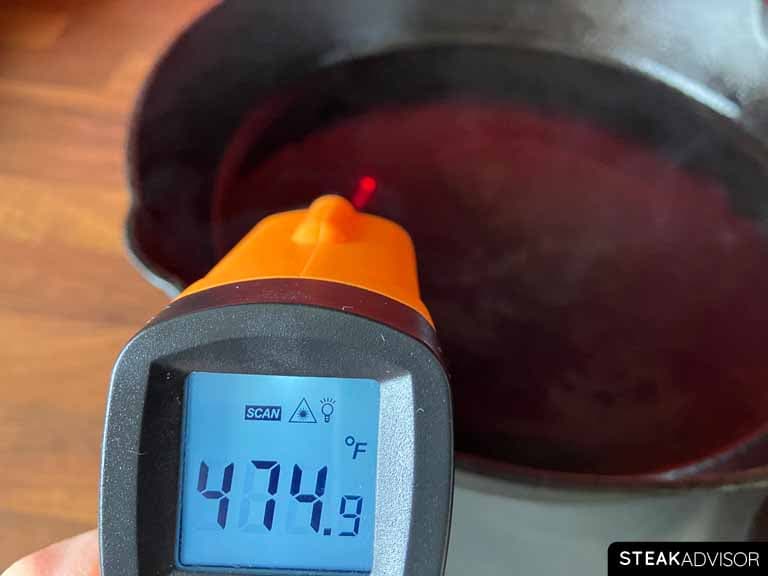
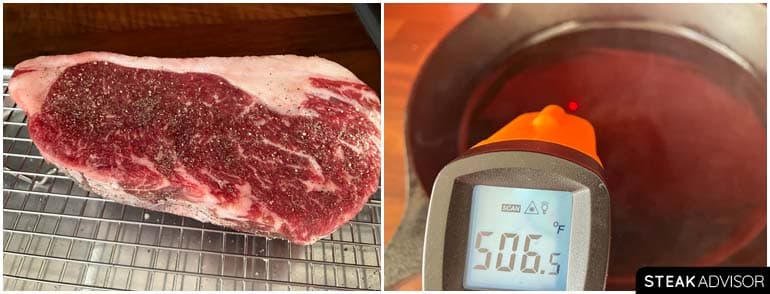
Set your oven to 275°F (135°C). While it warms up, get your pan ready for the sear. Place a heavy pan (cast iron, carbon steel, or a stainless steel skillet) over medium-high heat and let it heat for 3–4 minutes. Add 1 tablespoon (15 ml) of oil and let it heat for another minute. Once the pan and oil are hot, you’re ready to sear.
You don’t need much oil for well-marbled steaks, but if you’re cooking a leaner cut like filet mignon, you can use up to 2 tablespoons (30 ml) to help with browning.
Note
From my experience, a 12-inch cast-iron skillet heated over medium-high on a large gas burner takes about 4–5 minutes to reach about 500°F (260°C). That’s the perfect temperature range for getting a great sear and building a beautiful crust.
Always use a high–smoke-point oil for searing so it doesn’t burn over high heat. I prefer refined avocado oil, but here are a few other great options you can use:
| Type of Fat | Smoke Point ºF | Smoke Point ºC |
|---|---|---|
| Refined Avocado Oil | 520ºF | 270ºC |
| Refined Safflower Oil | 510ºF | 266ºC |
| Beef Tallow | 480ºF | 250ºC |
| Pecan Oil | 470ºF | 243ºC |
| Refined Peanut Oil | 450ºF | 232°C |
Step 3: Pan-Sear the Steak
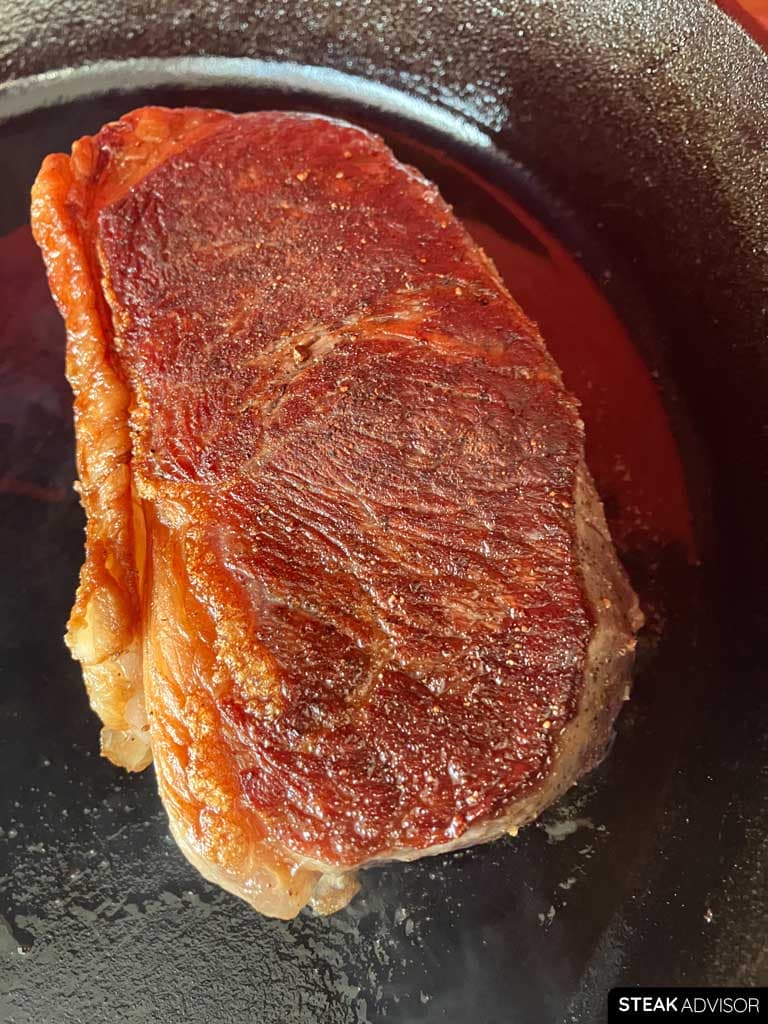
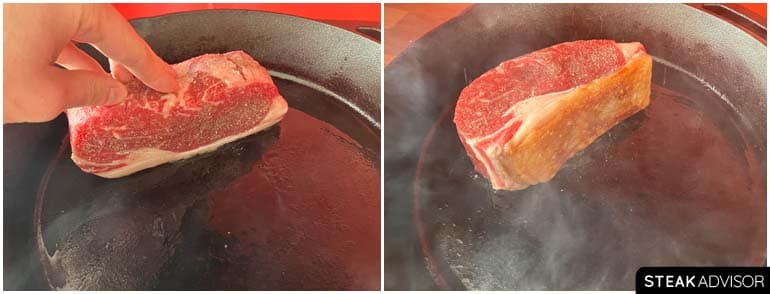
Pat the steak dry again with paper towels, then season both sides with 1/2 teaspoon of finely ground black pepper per pound/454 g of steak (optional). Carefully place the steak in the hot pan and press it down gently so it makes full contact with the surface. Sear it, flipping every 30 seconds, until you build an even, golden-brown crust on both sides. Keep the heat at medium-high.
Optional: If your steak has a fat cap (like picanha or a strip steak), you can start by searing the fat side down for 60–90 seconds to render some of the fat.
For a steak about 2 inches (5 cm) thick, sear it for 5 minutes (excluding the optional fat-side sear). Don’t go longer unless you’re okay with a thicker gray band under the crust. Once you’re happy with the crust, turn off the heat and move on to the next step.
Note
Flipping the steak every 30 seconds helps it cook more evenly, gives you better control over the crust, and even speeds up the cooking a bit.
Step 4: Transfer the Steak to the Oven
You can finish the steak in the oven two different ways. The method you choose affects how evenly it cooks inside and how much of a gray band forms under the crust.
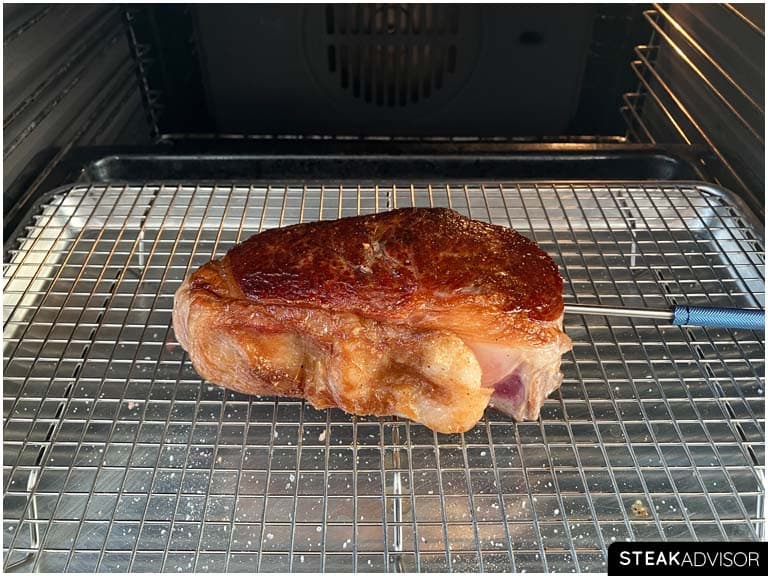
- Option 1 (my preferred method): Transfer the steak to a wire rack set over a baking sheet and place it in the center of your preheated oven. With air circulating all around, the steak cooks more evenly on both sides, and you get a much smaller gray band.
- Option 2 (if you don’t have a wire rack): Place the whole pan (with the steak) into the oven (make sure your pan is oven-safe). With this method, the steak cooks less evenly because the bottom sits on a very hot pan while the top is exposed to the gentler oven heat. A larger temperature difference creates a stronger temperature gradient inside the steak, leading to a thicker gray band just under the crust.
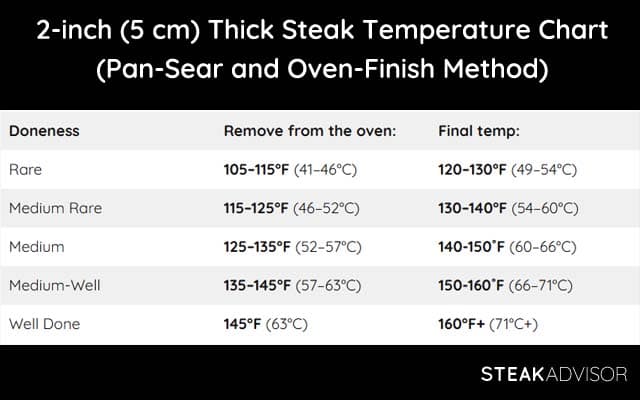
Whichever option you use, bake the steak at 275°F (135°C) until the internal temperature is 15°F (8°C) below your final target doneness (see the chart below). Don’t cook by time, cook by temperature. Use a meat thermometer to monitor the steak’s internal temperature.
Once it hits your target temperature, carefully remove the wire rack and baking sheet (or the pan) from the oven. Transfer the steak to a wooden cutting board and let it rest for 10 minutes (don’t skip this step). As it rests, the heat inside (residual heat) continues to cook the steak, bringing it to your target doneness.
| Doneness | Remove from the oven: | Final temp: |
| Rare | 105–115°F (41–46°C) | 120–130°F (49–54°C) |
| Medium Rare | 115–125°F (46–52°C) | 130–140°F (54–60°C) |
| Medium | 125–135°F (52–57°C) | 140-150˚F (60–66°C) |
| Medium-Well | 135–145°F (57–63°C) | 150-160˚F (66–71°C) |
| Well Done | 145°F (63°C) | 160°F+ (71°C+) |
Note
I don’t include oven cooking times because there are too many factors that affect how long a steak really takes to finish. The type of steak, its thickness, and how hot or how long you seared it earlier all make a big difference. The best way is to use a meat thermometer, ideally a leave-in probe thermometer. Set it to alert you when the steak is about 10-15°F (6-8°C) below your final target doneness, then go relax or do whatever you like. The thermometer will let you know exactly when the steak is ready.
Any time you change the oven temperature, sear the steak for more or less than 5 minutes, or cook a slightly thicker or thinner cut, the carryover rise will be different. Just keep that in mind and follow the recipe as closely as you can for consistent results.
In my case, with a 2-inch (5 cm) strip steak cooked using this method, the internal temperature increased about 10°F (6°C) in the first 5 minutes of resting and settled at a 15°F (8°C) increase after 9 minutes. So it went from 115°F to 130°F as it rested. Your results might vary a bit, but with this method, you can usually expect a 10–15°F (6–8°C) carryover rise in the first 5–10 minutes.
Step 5: Add Aromatics
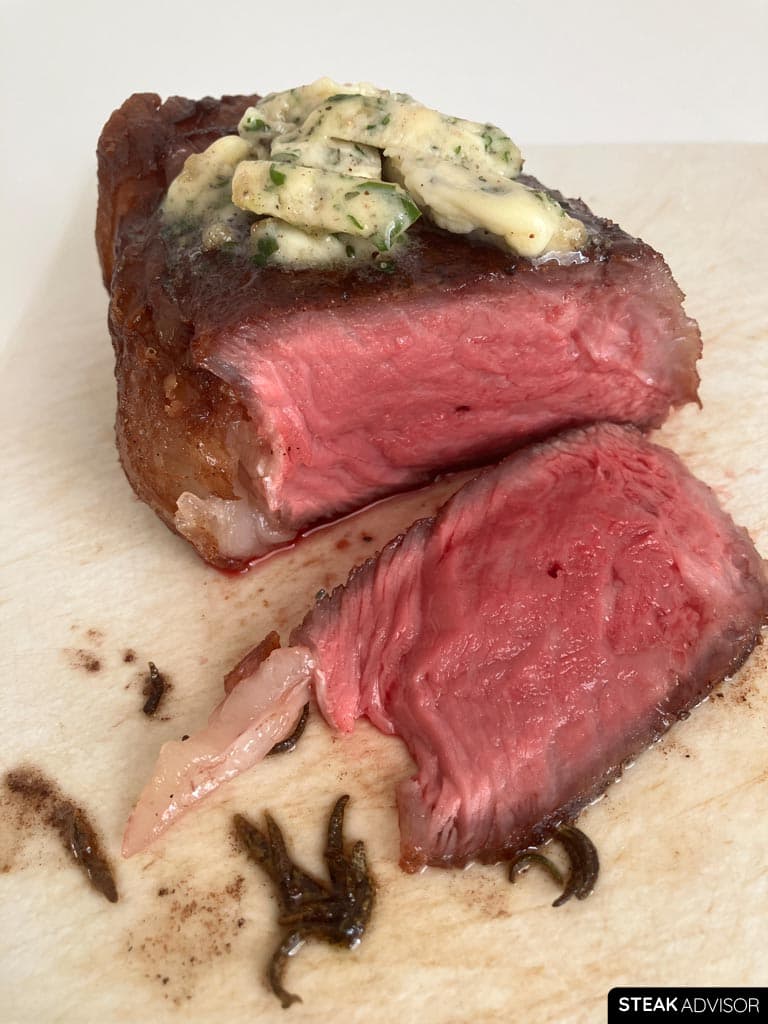
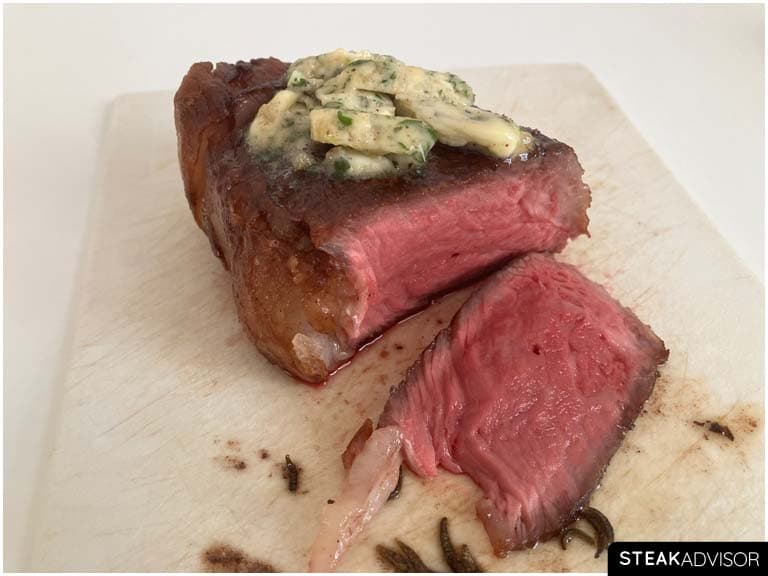
As the steak rests, place two thin slices of compound butter on top. If you don’t have compound butter, place a bit of unsalted butter.
Another option is to sear a few garlic cloves and a couple of sprigs of rosemary or thyme in a pan over medium-high heat while the steak rests. Then, melt some butter in the same pan and spoon that mixture over the steak right before serving. The compound butter is the easiest option, but all of these work great.
Note
Butter has a low smoke point, about 300°F (150°C). Since we sear the steak in a pan that’s closer to 500°F (260°C), butter would burn quickly, which is why I don’t cook the steak in it. Instead, I sear the steak in a high–smoke-point oil, finish it in the oven, and add the butter at the end while the steak rests. This way, the butter melts slowly over the hot steak, giving you all the rich flavor without any burnt taste. Simple, quick, and effective.
Step 6: Serve the Steak
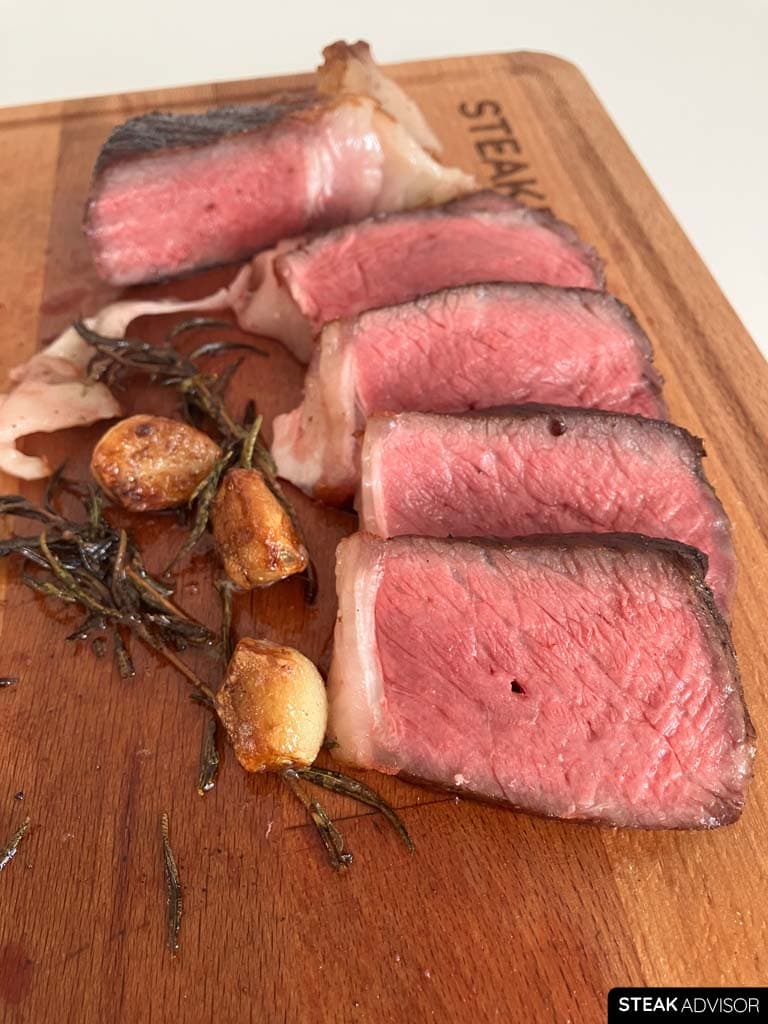
Once the steak has rested, slice it thinly and serve it with your favorite sides. If you skipped the compound butter and used the pan juices instead, pour them over the sliced steak right before serving. Now all that’s left is to dig in and enjoy a juicy, tender steak with a beautiful, edge-to-edge pink center and a crisp, flavorful crust.
FAQs
Should I bake or broil the steak in the oven?
For this recipe, stick with baking. The steak already gets its crust from the hot pan, so there’s no need to broil it afterward. The oven’s role here is to cook the steak gently and evenly until it reaches your target temperature – without burning the outside.
Is it possible to cook a 2-inch (5 cm) thick steak only in the oven?
Yes, it’s possible, but it’s not the method I recommend. You’ll need a broiler and a meat thermometer, and even then, getting a decent crust in the oven is really hard – especially if you like your steak medium-rare or medium. Broiling also leaves a thicker gray band under the crust. If you want better results and still plan to use the oven, go with a reverse sear (cook the steak low and slow in the oven, then finish it in a hot pan for the crust) or a classic forward sear (sear the steak over high heat in a pan to build a beautiful crust, then finish it gently in the oven). Those are foolproof methods that give you a much better crust and work every time.
That said, if all you have is an oven with a broiler, you can still cook a flavorful steak entirely in the oven. For the full details, check out my guide on How to Broil Steak in the Oven.
Print
2-inch (5 cm) Thick Steak Recipe
- Prep Time: 15 mins
- Rest Time: 1 to 6 hours
- Cook Time: 30 mins
- Total Time: 45 minutes
- Yield: 1 Steak
Description
An easy, reliable way to cook a thick 2-inch (5 cm) steak at home using the pan-sear and oven-finish method. You’ll get a juicy, edge-to-edge pink center and a beautifully browned crust. Top it with garlic-herb compound butter for a rich, restaurant-quality finish.
Ingredients
For Steak:
- Any tender steak that’s 2-inch (5 cm) thick (ribeye, strip steak, tomahawk, cowboy steak, filet mignon)
- 1 tablespoon (15 ml) high-smoke-point oil (I recommend refined avocado oil)
- 1–2 teaspoons (about 5-10 g) kosher salt (see notes)
- 1/2 teaspoon finely ground black pepper per pound (454 g) of steak (optional)
- Compound butter (alternatively, use unsalted butter, 2–3 garlic cloves, and a few sprigs of fresh rosemary or thyme)
Tools:
- Pan (a cast-iron, carbon steel, or heavy-bottomed stainless steel skillet)
- Baking Sheet
- Wire Rack
- Meat Thermometer (a leave-in probe thermometer or an instant-read thermometer)
- Tongs
Instructions
Before we start: Gather all the tools and ingredients. If you plan to use compound butter, make it ahead of time.
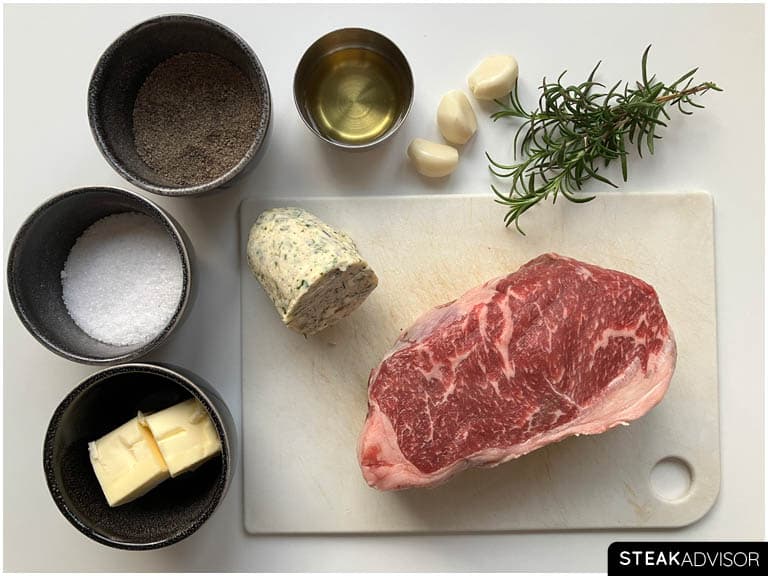
Prepare the Steak
- Pat the steak dry on all sides with paper towels, then season both sides generously with kosher salt (about 1 teaspoon per side). Set it uncovered on a wire rack over a baking sheet.
- If you plan to cook it soon, let it sit at room temperature for about 1 hour. For even better flavor and a superior crust, leave it uncovered in the fridge for 4–6 hours (that’s my go-to method for thick, 2-inch/5 cm steaks).
- If you refrigerate it, take the steak out about 30 minutes before cooking so it’s not ice-cold when it hits the pan.
Preheat the Pan & Oven
- Set your oven to 275°F (135°C). While it warms up, get your pan ready for the sear.
- Place a heavy pan (cast iron, carbon steel, or a stainless steel skillet) over medium-high heat and let it heat for 3–4 minutes. Add 1 tablespoon (15 ml) of high-smoke point oil and let it heat for another minute. Once the pan and oil are hot, you’re ready to sear.
- You don’t need much oil for well-marbled steaks, but if you’re cooking a leaner cut like filet mignon, you can use up to 2 tablespoons (30 ml) to help with browning.
Pan-Sear the Steak
- Pat the steak dry again with paper towels, then season both sides with 1/2 teaspoon of finely ground black pepper per pound/454 g of steak (optional). Don’t use coarse pepper.
- Carefully place the steak in the hot pan and press it down gently so it makes full contact with the surface. Sear it, flipping every 30 seconds, until you build an even, golden-brown crust on both sides. Keep the heat at medium-high.
- Optional: If your steak has a fat cap (like picanha or a strip steak), you can start by searing the fat side down for 60–90 seconds to render some of the fat.
- For a steak about 2 inches (5 cm) thick, sear it for 5 minutes (excluding the optional fat-side sear). Don’t go longer unless you’re okay with a thicker gray band under the crust. Once you’re happy with the crust, turn off the heat and move on to the next step.
Transfer the Steak to the Oven
You can finish the steak in the oven two different ways. The method you choose affects how evenly it cooks inside and how much of a gray band forms under the crust.
- Option 1 (my preferred method): Transfer the steak to a wire rack set over a baking sheet and place it in the center of your preheated oven. With air circulating all around, the steak cooks more evenly on both sides, and you get a much smaller gray band.
- Option 2 (if you don’t have a wire rack): Place the whole pan (with the steak) into the oven (make sure your pan is oven-safe). With this method, the steak cooks less evenly because the bottom sits on a very hot pan while the top is exposed to the gentler oven heat. A larger temperature difference creates a stronger temperature gradient inside the steak, leading to a thicker gray band just under the crust.
A steak placed in the oven to finish cooking. - Whichever option you use, bake the steak at 275°F (135°C) until the internal temperature is about 15°F (8°C) below your final target doneness (see the temperature chart below). Don’t cook by time, cook by temperature. Use a meat thermometer to monitor the steak’s internal temperature.
- Once it hits your target temperature, carefully remove the wire rack and baking sheet (or the pan) from the oven. Transfer the steak to a wooden cutting board and let it rest for 10 minutes. As it rests, the heat inside (residual heat) continues to cook the steak, bringing it to your target doneness.
Add Aromatics
- As the steak rests, place two thin slices of compound butter on top. If you don’t have compound butter, place a bit of unsalted butter.
- Another option is to sear a few garlic cloves and a couple of sprigs of rosemary or thyme in a pan over medium-high heat while the steak rests. Then, melt some butter in the same pan and spoon that mixture over the steak right before serving.
Serve the Steak
- Once the steak has rested, slice it thinly and serve it with your favorite sides.
- If you skipped the compound butter and used the pan juices instead, pour them over the sliced steak right before serving.
Notes
Kosher Salt
Season the steak with about 1% of its weight in salt. If you like a slightly saltier flavor, you can go up to 1.5% or even more. For example, an 18 oz (510 g) steak would need around 0.2 oz (5.1 g) of salt. Measuring by weight is the most accurate because different salts have different densities. For example, kosher salt weighs much less than table salt by volume.
More Steak Recipes
This recipe works best with steaks 2 inches (5 cm) thick or more. If your steak is thinner, you’ll get better results by following one of my other recipes:
