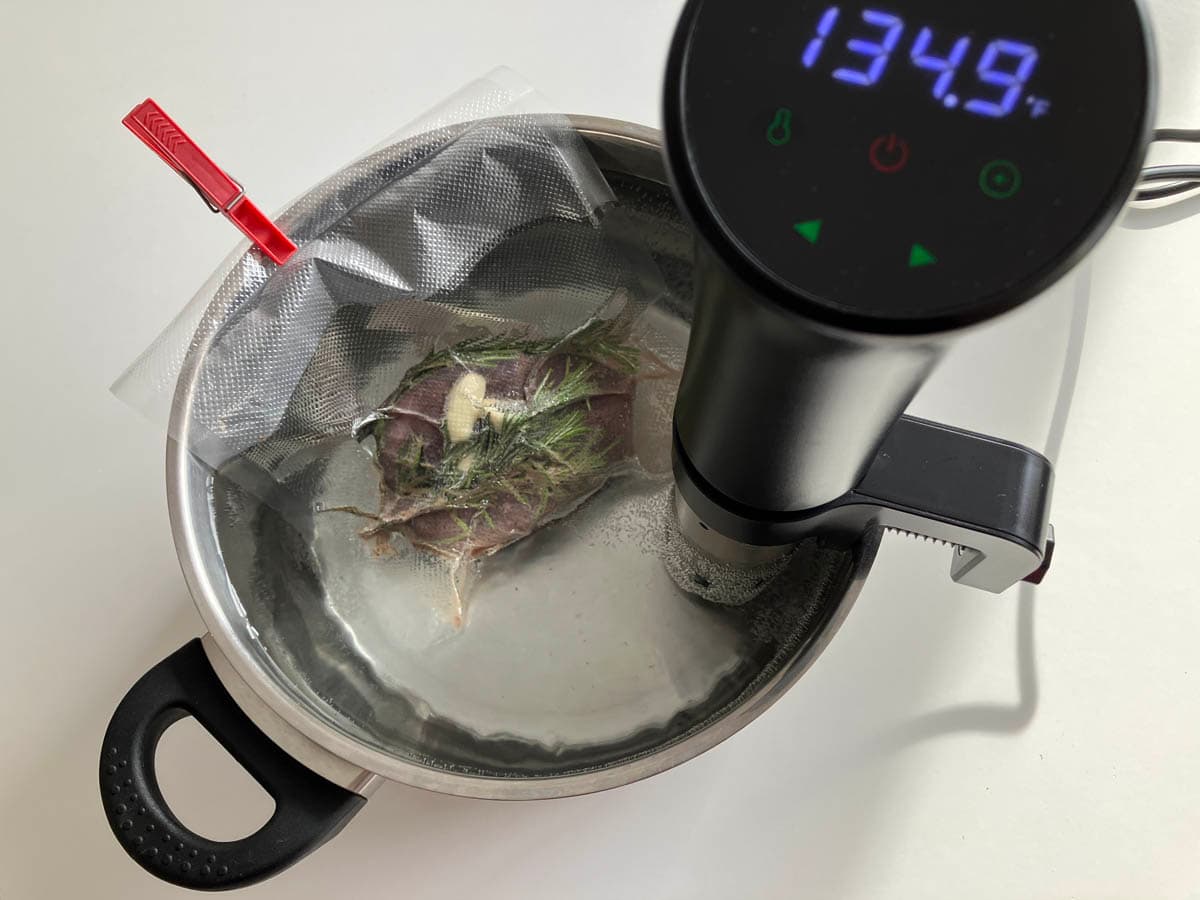

Sous vide guarantees perfectly cooked steak from edge to edge and little to no gray band, with no guesswork. You set the exact temperature you want, and the steak comes out precisely at that doneness. It’s simple, reliable, and almost impossible to mess up.
Honestly, this is the method I use when I’m feeling lazy or when I need to cook multiple steaks and don’t want to stand over the pan or grill the whole time.
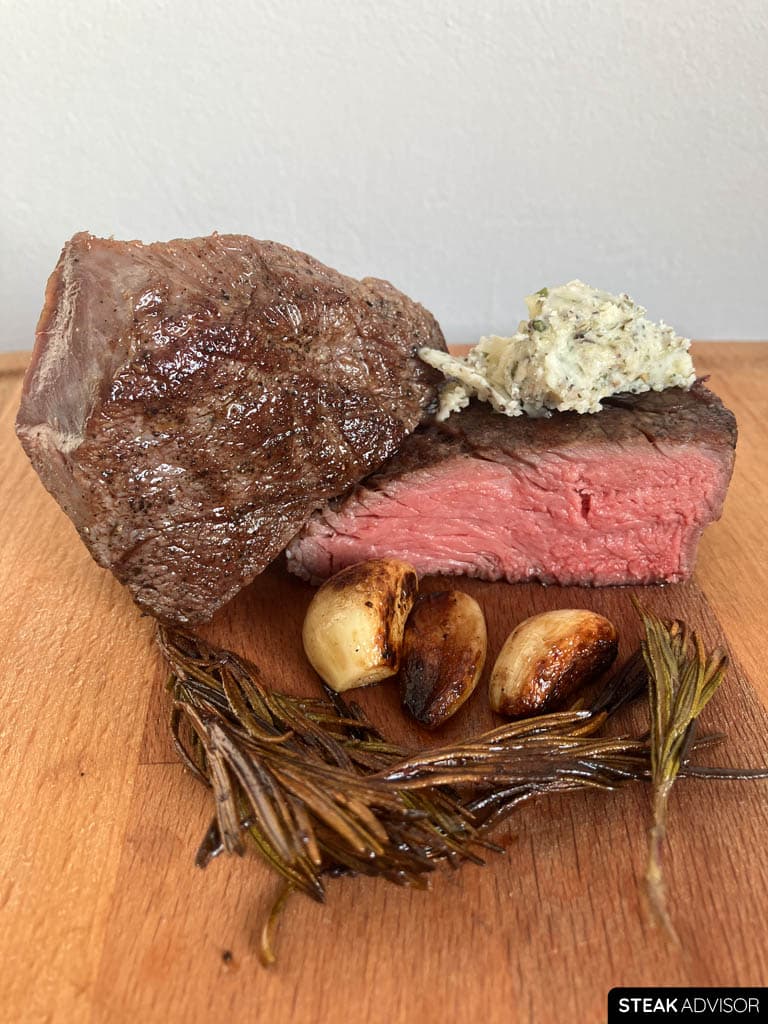
Sous vide is the only method that truly guarantees a steak cooked exactly to the temperature you want, without worrying about over- or undercooking it, especially when you’re dealing with high-grade, expensive cuts. If I’m cooking something like a well-marbled USDA Prime or Wagyu ribeye and I want it at exactly 137°F (58°C), sous vide gives me that precision from edge to edge.
It’s also a game-changer for beginners or anyone who struggles with the traditional high-heat, fast-sear method. If you’re looking for a reliable, almost completely stress-free way to cook the perfect steak, sous vide is hard to beat.
In this guide, I’ll walk you through everything you need to know – the advantages, the downsides, and a step-by-step method to cook steak sous vide without overcooking it during the final sear.
Sous Vide Steak: What Is It?
“Sous vide” literally means “under vacuum” in French. It’s simply a way of cooking steak in water at a precise, controlled temperature for a set amount of time. It’s basically a two-step process. First, you seal the steak in a bag and cook it in a water bath set to your target temperature using a sous vide machine. Once the inside is exactly where you want it, you finish it with a quick, hard sear to build crust.
Here’s the key point: the temperature you set on the sous vide bath determines the final doneness of your steak. That’s it. If you cook it at 137°F (58°C), it will be 137°F (58°C) inside from edge to edge. You can’t overcook it during the sous vide phase in terms of temperature. Once the water reaches the set temperature and the steak reaches that internal temperature, it stays there. It won’t keep climbing, no matter how long it sits in the bath. The only thing that changes over time is texture.
The longer the steak stays in the bath, the more tender it gets. That can be great. But push it too far, and it starts getting too tender, even a bit mushy. And that’s usually not what you want. That’s why sous vide isn’t just about temperature. Cooking time matters too. A tender cut like filet mignon only needs a few hours. A tough cut like round steak? That can go 48–72 hours if you want it really tender.
The only way you can mess this up is at the end. If you take it straight out of the bag and throw it into a ripping-hot pan without cooling it down first, you’ll overshoot your target. That’s where most people go wrong. Hopefully, it’s easy to avoid. I’ll show you exactly how. But first, let’s go through the biggest advantages (and a few downsides) of cooking steak sous vide.
Advantages of the Sous Vide Steak Cooking Method:
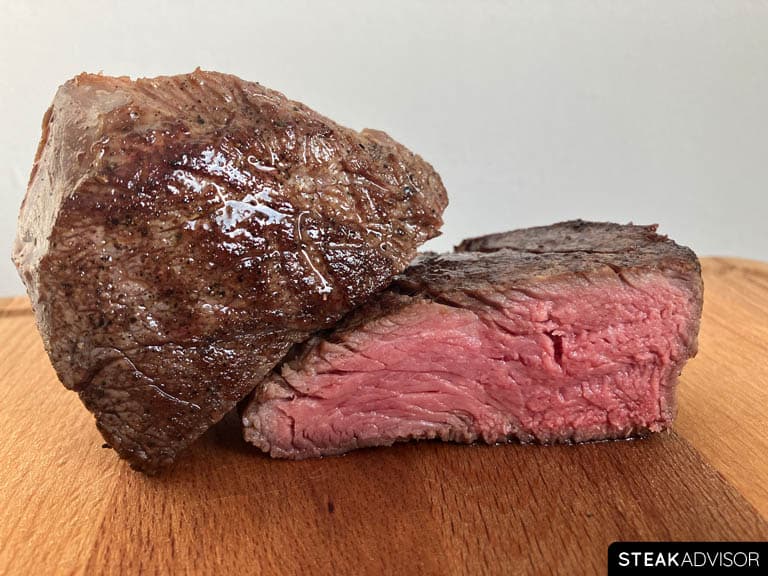
- Even cooking: Sous vide guarantees you true edge-to-edge doneness. The steak is exactly the temperature you set, from the center to the outer layer. No thick gray band. No overcooked outside and undercooked middle. Unless you mess up the final sear, it’s evenly cooked throughout.
- Consistency: You can’t overcook the steak during the sous vide stage. If you set it to 135°F (57°C), it will be 135°F (57°C). The only thing that changes over time is texture. Leave it too long, and it can turn overly tender, but the internal temperature stays exactly where you set it.
- Simple and forgiving: Set the temp, put the steak in the bath, and walk away. No babysitting. No constant flipping. No stress. These days, it’s easy to find the exact time and temperature for any cut, so even if you’re not into gadgets, it’s very beginner-friendly.
- Minimal prep: Season the steak, seal it in a bag, cook it, then sear it at the end. That’s it. Nothing complicated.
- Less mess: The steak cooks in a bag, so there’s almost no cleanup until the final sear. And if you finish it with a torch instead of a pan, it’s even cleaner. No oil splatter everywhere. You can also take it outside and sear it over a hot grill if you want to keep the smoke out of your kitchen.
- Great for cooking for a crowd: This is one of the biggest advantages. You can cook several steaks (even dozens) at once without stressing, as long as they’re not stacked in the bag so that the water can circulate properly. They’ll all cook evenly. Then, at the end, give each one a quick, hard sear to build a crust (about 1–2 minutes per steak). Simple and efficient.
- Wide serving window: Once the steak reaches your target temperature, you don’t have to rush. It can stay in the bath for quite a while. That gives you time to focus on the sides. When you’re ready, dry it, sear it, and serve. No panic. Perfect for parties or larger dinners.
- No resting needed: After the final sear, slice the steak and serve it immediately. In fact, it’s better to eat it right away because sous vide steak cools faster than traditionally cooked steak.
- Keeps more moisture: Since the steak cooks at a lower temperature inside a sealed bag, it loses less moisture than with high, direct-heat cooking methods.
- Versatility: You can season it however you want before sealing the bag. Simple salt and pepper, herbs and butter, dry rubs, even marinades. The flavor develops while it cooks. You have more room to experiment compared to traditional high-heat methods.
- Safer if you care about that: You can pasteurize steak by holding it at a specific temperature for a long enough time. That makes it safer, especially for people who worry about medium-rare steak.
- Great for tough cuts: With sous vide, you can turn tougher, cheaper cuts into something surprisingly tender. Longer cooking times break down connective tissue without overcooking the meat. For example, round steak can cook for 48–72 hours and come out tender.
Disadvantages of the Sous Vide Steak Cooking Method:
- Long cooking time: Sous vide takes time. A thick 2 1/2-inch (6.3 cm) filet mignon cooked with a traditional forward sear takes about 30 minutes total. With sous vide, that same steak takes about 4 hours to fully reach your target internal temperature, and about 30 minutes more if you want it fully pasteurized.
- Special equipment required: You need a sous vide machine, a container for the water, and, if you’re cooking for a long time, something to cover it so the water doesn’t evaporate. You also need proper bags.
- It’s boring: If you actually enjoy cooking steak the traditional way (controlling the heat, flipping, building the crust), sous vide feels boring. You seal it, drop it in water, wait… and then sear. That’s basically it.
- Easy to mess up the final sear: Ironically, the only technical part comes at the very end. If you take the steak straight from the bag and throw it into a ripping-hot pan without cooling it down first, or if you sear it too long, you can overshoot your target temperature and ruin that perfect edge-to-edge doneness.
How to Sous Vide Steak – Ultimate Guide
The sous vide method is simple as long as you stick to the basics. Decide how you want to season and finish your steak, gather your ingredients and tools, and then follow the step-by-step guide below.
Note
While developing this recipe, I ran many tests to see what actually works and where things usually go wrong. If you’re curious about the details, check out the FAQs section, where I break down the sous vide method a bit more. If not, just scroll down and follow the step-by-step guide.
The Ingredients You’ll Need
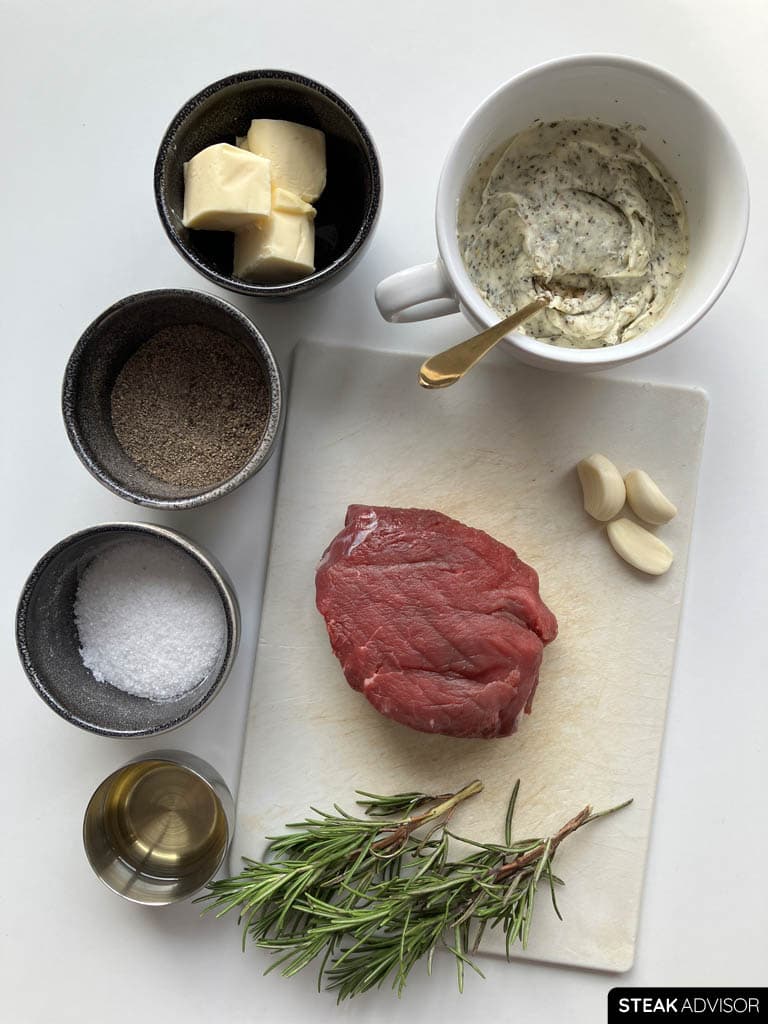
For steak in a bag:
- Steak: Technically, you can cook pretty much any steak using sous vide, no matter the thickness. But realistically, 1 to 2 inches (2.5–5 cm) thick, naturally tender cuts like filet mignon, ribeye, or strip steak work best. They don’t take forever to cook, and the results are consistently great. That said, sous vide is also great for tougher cuts (I explain that more in the FAQs).
- Kosher salt: 1-2 teaspoons (5-10 g), depending on the size of your steak. A good rule is about 1% of the steak’s weight in salt. If you like a slightly deeper, saltier flavor, go up to 1.5%.
- Black pepper (optional): 1/2 teaspoon per pound (454 g) of steak. Use finely ground black pepper.
- Garlic powder (optional): 1/2 teaspoon per pound (454 g) of steak.
- Fresh herbs (optional): A few sprigs of thyme or rosemary.
For the final sear in a pan:
- High-smoke-point oil: 2-3 tablespoons (30-45 ml), I recommend refined avocado oil, with a smoke point of 500°F (260°C) and neutral flavor.
- Unsalted butter (optional): 2 tablespoons (28 g).
- Garlic cloves (optional): 2-3 cloves, peeled. Use these instead of garlic powder if you prefer fresh garlic.
- Herbs (optional): Use what was in the bag.
Note: If you’d rather skip adding butter, garlic, and herbs to the pan (or if you’re finishing the steak with a flamethrower or directly over grill flames), you can use compound butter instead. Just cook the steak in the bag with simple aromatics like salt, pepper, and garlic powder. Sear it however you prefer, then immediately place a bit of compound butter on top. Honestly, that’s one of the easiest options that guarantees tons of flavor with less effort, and it’s the one I use most often.
For compound butter (optional):
- Unsalted butter: 1/4 pound (113 grams), at room temperature
- Garlic: 1 clove, finely chopped or pressed
- Salt: 1/4 teaspoon
- Black pepper: 1/2 teaspoon, finely ground
- Parsley: 1 tablespoon, finely chopped (fresh or dried)
- Rosemary: 1 tablespoon, finely chopped (fresh or dried)
The Tools You’ll Need
- Sous vide machine (immersion circulator): You need this. It heats the water to the exact temperature you set and keeps it there. These days, they’re pretty affordable and easy to use. You can get a solid one for around $50–100. No need to buy the most expensive model.
- Heat-safe food container or pot: You need something deep enough to fully submerge the steak and fit the circulator. For shorter cooks, a large pot works. If you’re going much longer (like 12 hours or more), a plastic container with a lid is better since it helps reduce water evaporation during cooking.
- BPA-free bags suitable for sous vide: Stasher bags, vacuum-seal bags, or Ziploc freezer bags all work well.
- Vacuum sealer (optional): Some bags require a vacuum sealer to remove the air and seal them properly. If you cook sous vide often, I highly recommend getting one. It’s affordable and useful not just for sous vide, but also for storing food in the fridge or freezer.
- Skillet, grill, or flamethrower: You need high, direct heat for the final sear. I usually use a cast-iron skillet, but use whatever method you prefer. The goal is to build a crust quickly, ideally in about 1–2 minutes.
- Meat thermometer (optional): If you’re new to cooking steak, a thermometer will help confirm you’ve hit your target doneness. That said, with sous vide, it’s usually not necessary. Once you slice the steak, you’ll clearly see how it’s cooked, especially if you eat steak often and know what different doneness levels look like.
Step 1: Season the Steak
There are a few ways to season a steak before cooking it sous vide. You can keep it simple with just salt and pepper, or dry-brine it first and then add a rub before sealing the bag. It all comes down to how much time you have and what kind of flavor you’re after.
Basic Seasonings
If you want to keep it super simple, season the steak on all sides with salt, pepper, and garlic powder. It’s the classic method. It never disappoints, and it doesn’t take much time. But for sous vide, I highly recommend other methods.
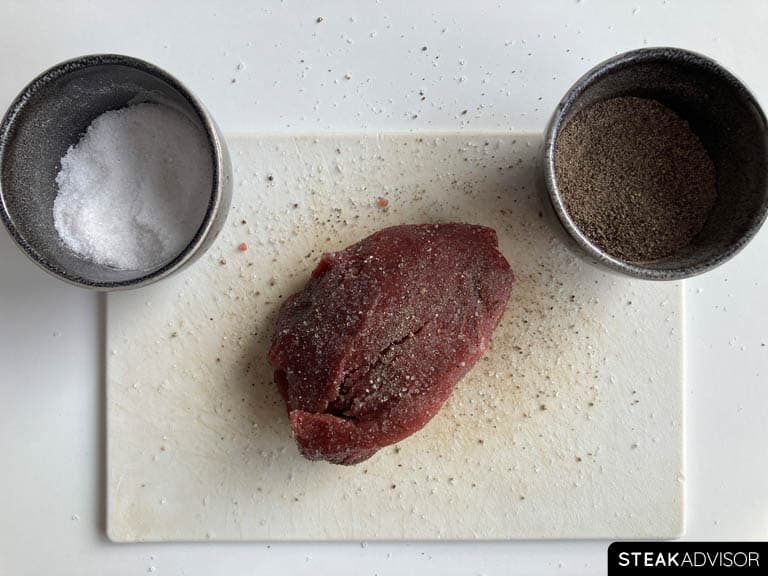
Dry-brining (Optional)
If you like a deeper, more salty flavor throughout the meat, I highly recommend dry-brining before cooking sous vide. With sous vide, dry-brining is mainly about improving flavor.
Here’s how to do it:
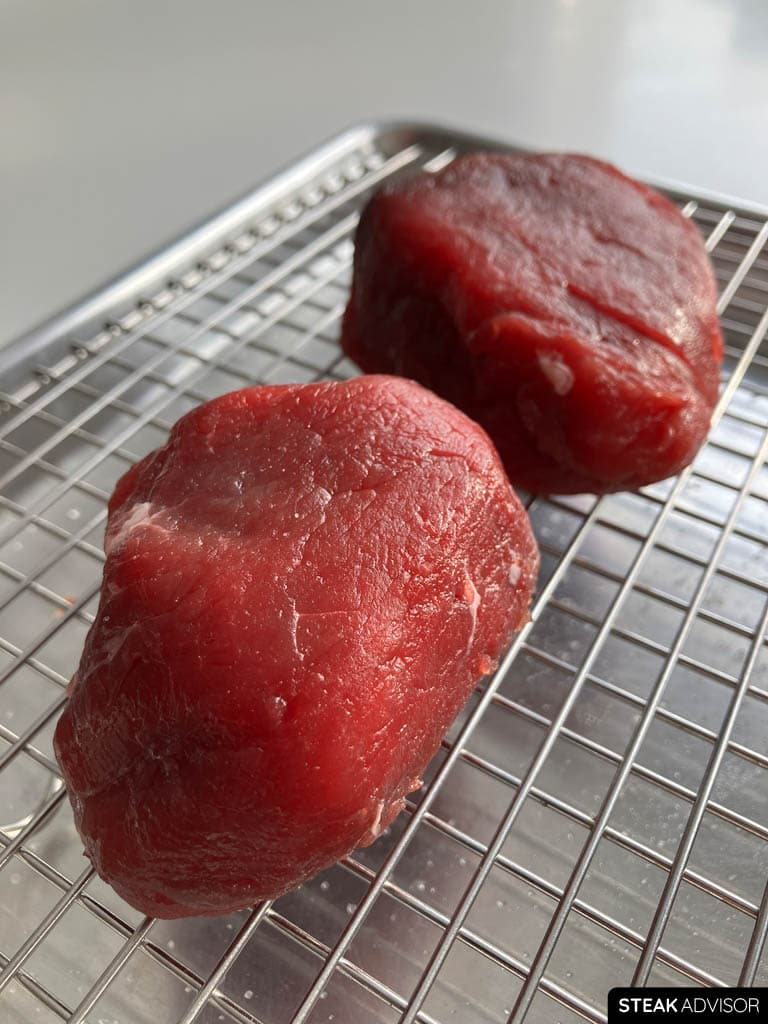
- Season the steak on all sides with 1–2 teaspoons of kosher salt (about 1–1.5% of the steak’s weight). Place it on a wire rack set over a baking sheet and refrigerate uncovered for at least 1 hour, ideally 4–6 hours.
- Once you take it out of the refrigerator, season it with any additional ingredients you like, then seal it in the bag (more on that in the next step).
You can leave it for 12–24 hours for an even deeper flavor. Just keep in mind that the longer a salted steak sits in the refrigerator, the thicker that gray band under the crust becomes. If you want the benefits of dry-brining without too much gray band, stick to about 6 hours. To get most of the benefits while keeping the gray band under the crust to a minimum, I recommend dry-brining for no longer than about 6 hours.
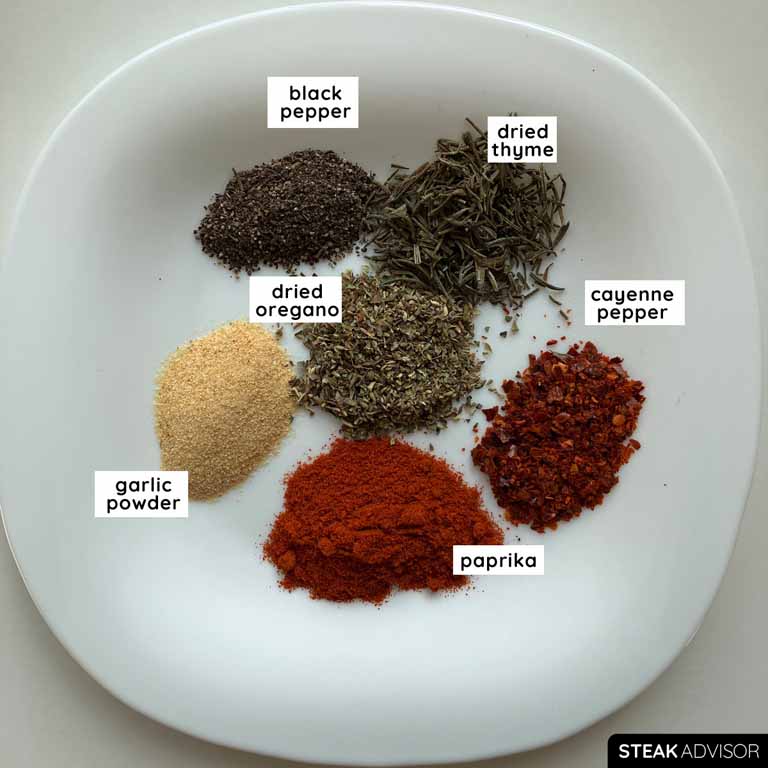
Rubs or Marinades (Optional)
If you like experimenting with different flavors, I highly recommend using rubs or marinades. There are plenty of great options to choose from. Just be careful during the final sear so you don’t burn the rub or marinade. Keep it short and hot.
Note
One of the biggest advantages of sous vide is flexibility. You can experiment with dry-brining, rubs, marinades, or combinations of them and still get consistent results. You can’t really do that with classic hot-and-fast cooking. Most rubs will burn over high, direct heat before the steak reaches your target temperature.
Step 2: Add Aromatics (Optional)
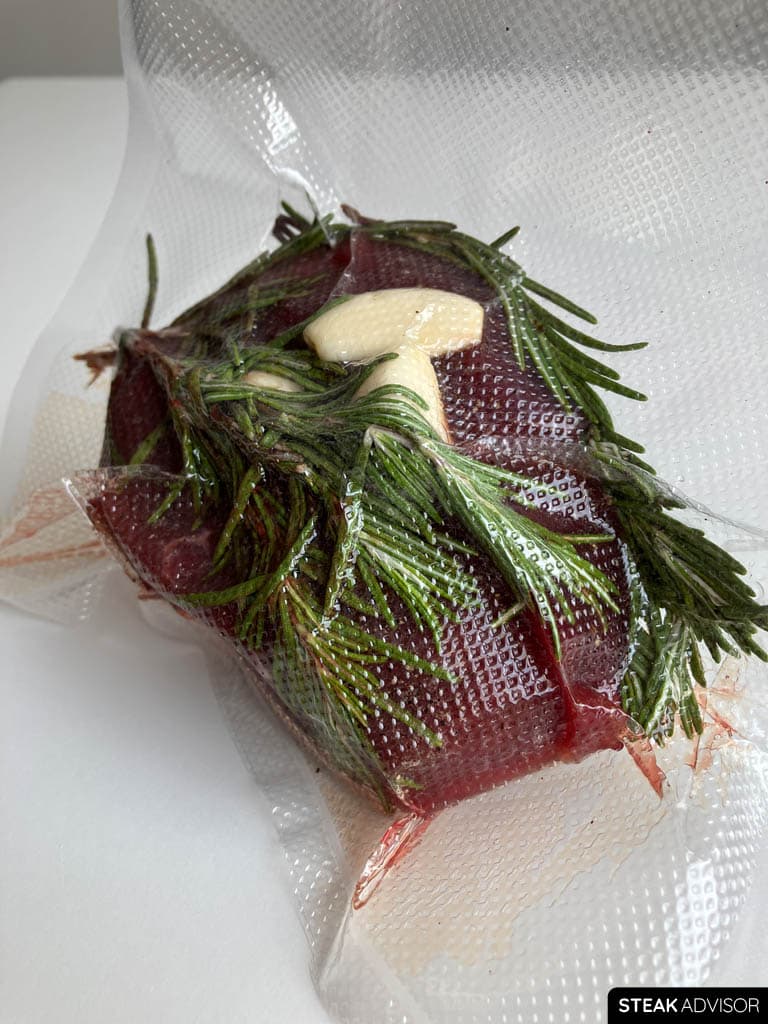
Just before cooking, place the seasoned steak in the bag. Add a few sprigs of rosemary, thyme, or any herbs you prefer. Try to spread them evenly on both sides of the steak.
Note
I highly recommend combining this step with basic seasoning (salt and pepper) or adding aromatics after dry-brining the steak.
Step 3: Seal the Bag
Seal the bag with a vacuum sealer. If you’re using a zipper bag, use the water displacement method instead. Just lower the bag slowly into a pot of water. The water will push most of the air out on its own. Once the air is out, seal the bag just above the water line.
Note
The key is to remove as much air as possible so the steak stays fully submerged in the water.
Step 4: Set up Sous Vide
Fill a large pot or sous vide container with water, keeping the level between the minimum and maximum marks on your circulator. Set the temperature to your preferred doneness (my sous vide steak cooking time calculator will help you pick the right temp and time for your cut), and let the water fully come up to temperature before adding the steak.
Important
One of the first questions people have when starting with sous vide is: What temperature should I set, and how long should I cook the steak? Well, it’s not as simple as picking a number. That’s why I explained it in detail in my guide, How Long to Sous Vide Steak, where I also included a calculator to help you figure out the ideal cooking time based on the cut and your desired results.
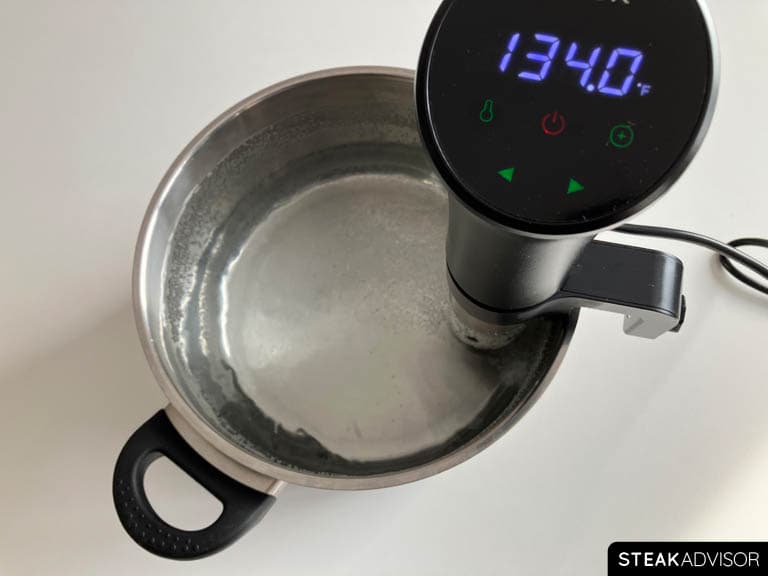
Step 4: Cook the Steak Sous Vide
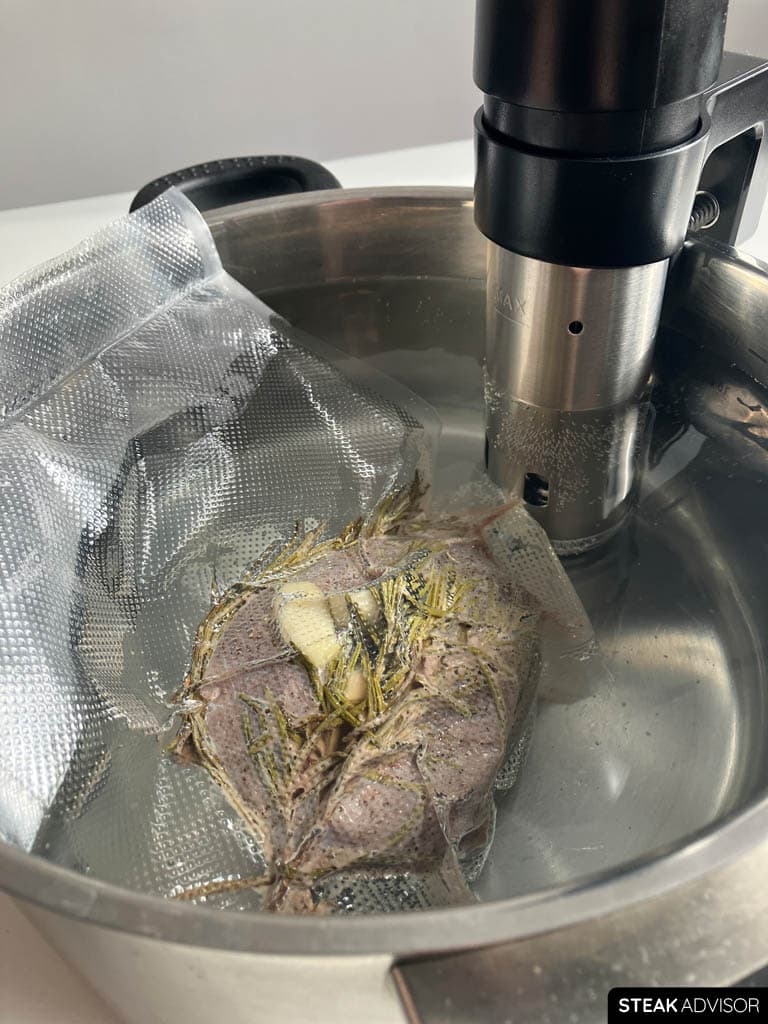
Place the sealed bag into the water bath, making sure it doesn’t block the intake or output of your precision cooker. Water needs to circulate freely for even cooking. If it’s sealed properly, it should sink on its own.
Now let it cook for the exact time recommended by the sous vide steak calculator. Don’t guess. Thickness, cut, and whether you’re pasteurizing all affect the total time. Follow the calculator, and you’ll know the steak has reached your target temperature – and stayed there long enough if you chose to pasteurize.
Step 5: Make the Compound Butter (Optional)
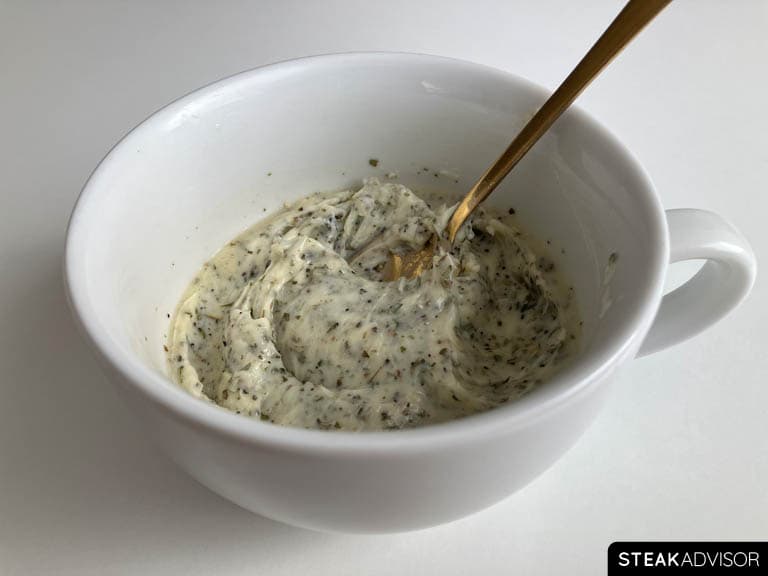
This step is optional, but I recommend it. While the steak cooks in the sous vide bath, take a few minutes to make the compound butter.
In a bowl, mix 1/4 pound (113 g) softened butter with 1/4 teaspoon salt, 1/2 teaspoon finely ground black pepper, 1 finely chopped or pressed garlic clove, and 1 tablespoon of finely chopped parsley or rosemary (fresh or dried, both work). If you’re cooking more than two steaks, double the recipe.
If you want to make a bigger batch, do it a day ahead. Roll the butter into a log, wrap it tightly, and refrigerate until firm. Then you can slice off what you need anytime (see my garlic-herb steak butter recipe for a step-by-step guide).
If you don’t feel like making it ahead of time, no problem. After the final sear, add butter, garlic, and herbs directly to the pan. Let everything sizzle together for a minute, then pour it over the sliced steak. You’ll get a very similar boost of flavor.
Step 6: Remove Steak From Bag
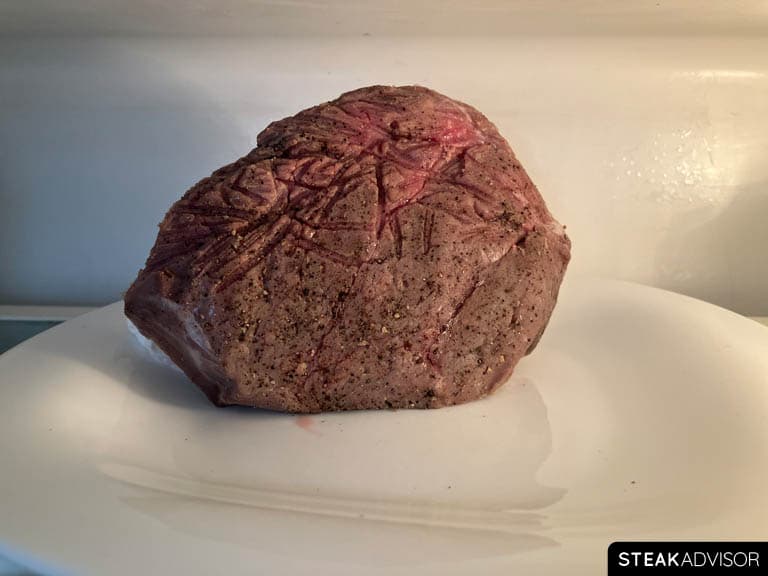
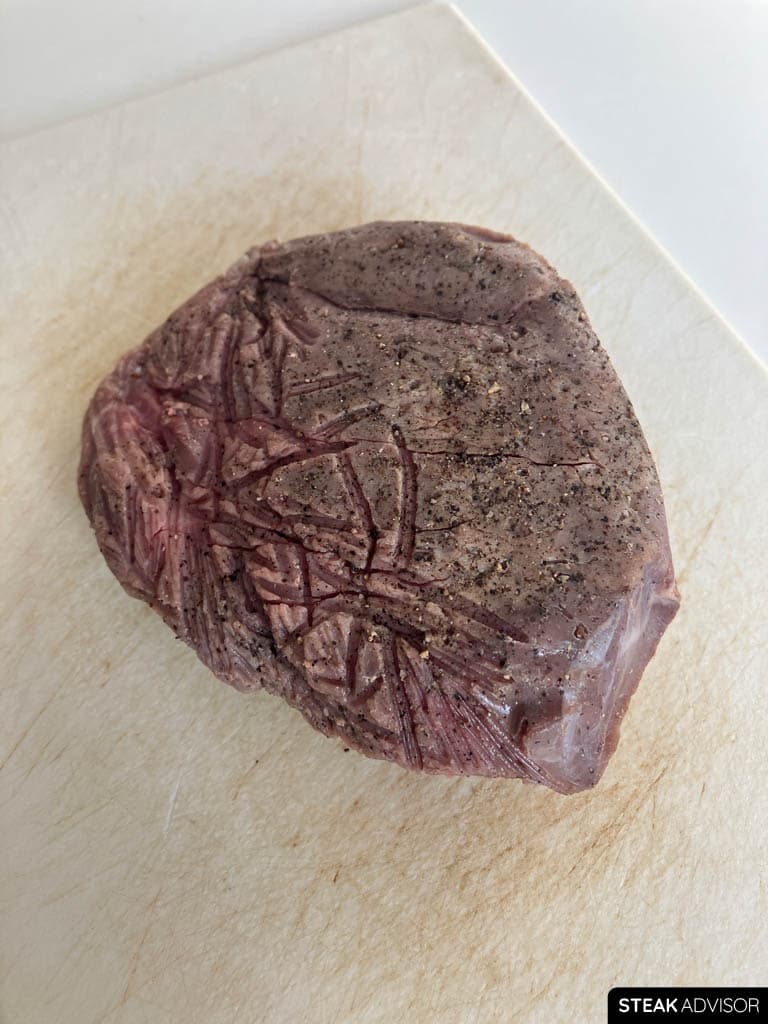
Once the steak has cooked for the time you planned, remove the bag from the water bath and drop it straight into an ice bath for about 5 minutes. After that, remove the steak from the bag and pat it dry really well on all sides with paper towels. Don’t be gentle here and get it properly dry. Then place it on a plate in the fridge, standing it up on its side, for about 15 minutes before you move on to the final sear.
Note
Of course, depending on your setup and the result you’re going for, you can adjust the resting time slightly. You can extend the ice bath or the fridge rest by another 5–10 minutes if you want the steak even cooler before searing. Or you can shorten it a bit.
For example, if you’re searing the steak quickly with a flamethrower or directly over an open flame on a grill, you don’t need to cool it down as long. But if you’re doing a classic pan-sear over high heat, stick to the rest times mentioned above. That extra cooling time gives you more control and makes it much easier to build a proper crust without overcooking the inside.
Sous vide is easy. The part where most people mess up is the final sear step.
When the steak comes out of the sous vide bath, it’s already at your exact target doneness. If you throw it straight into a ripping-hot pan, even for a minute, you’ll push it past that temperature and build a thicker, gray band under the crust. Cooling the steak first fixes that.
The ice bath quickly lowers the surface temperature and slightly lowers the internal temperature. That gives you more time in the pan to build a proper crust without overcooking the inside.
Now let’s talk about moisture. Sous vide steak comes out of the bag wet. And moisture is the enemy of a good crust. Moisture has to evaporate before a crust can form. If the surface is wet, you’re just steaming the steak. That’s why drying it thoroughly matters. Letting it sit in the fridge helps even more. It dries the surface and cools it slightly again.
That’s why patting it dry really well matters. And the 15 minutes in the fridge helps even more. As it sits on its side in the fridge, the surface dries out further, and the internal temperature drops slightly again. The result? A cooler steak with a drier surface. That means you can sear harder and longer to build a real crust – without overcooking the inside or forming a thick gray band.
- Ice bath + fridge = more control during the sear.
- Less risk of overcooking.
- Better crust.
That’s how you build a real crust on a sous vide steak without pushing it past your target doneness.
Step 7: Sear the Steak
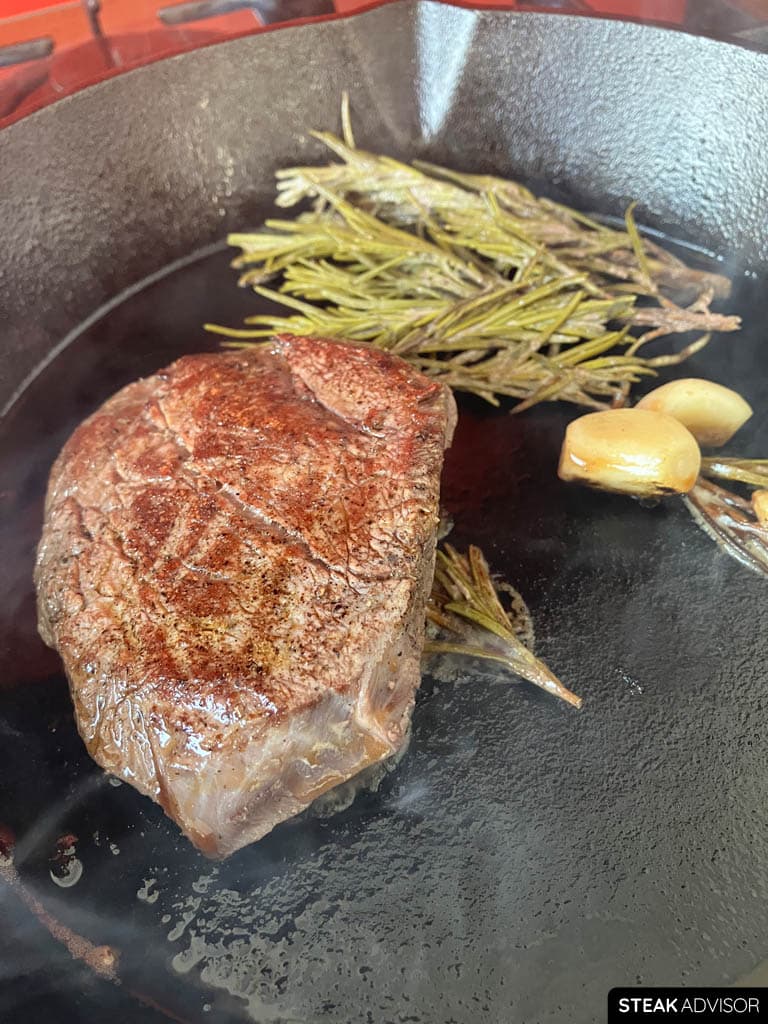
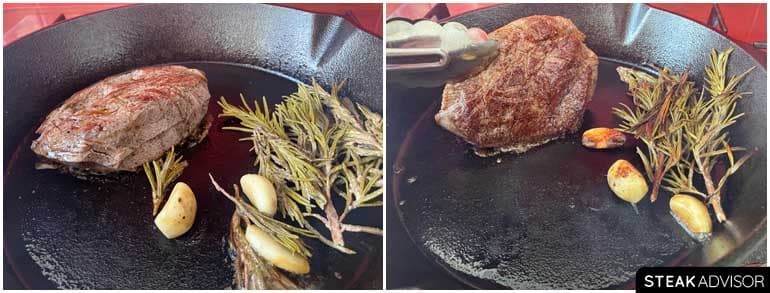
Set a pan over medium-high heat and let it heat for 3–4 minutes. Add 2 tablespoons of a high-smoke-point oil and let it heat for another minute. You want serious heat here. While the pan is heating, pat the steak dry again. Even if it looks dry, do it again. The drier the surface, the better the crust.
Place the steak in the pan and sear for 2 minutes total, flipping every 30 seconds. Each time you flip it, press it down gently to ensure the surface is in full contact with the pan and build a better crust.
If the steak has a fat cap (like a strip steak or picanha), sear it fat cap-side down for 60 seconds to help render the fat. If there’s no fat cap, quickly sear the other edges for about 15 seconds. Once the crust looks good, take the steak out and serve it immediately.
Note
If you’re using a grill or torch instead of a pan, remember to keep the sear short. The goal is to build a crust, not cook the inside any further.
Depending on how long you cool the steak in the ice bath and the fridge, you may be able to sear it for a little longer (even up to 3 minutes). But that really depends on your setup, your target doneness, and how aggressive your heat is. You’ll need to test what works best in your kitchen. Treat the 2-minute mark as a starting point. If you want to push the sear longer, do it carefully, ideally with a less expensive cut first, to see how it turns out on your setup.
Step 8: Serve the Steak
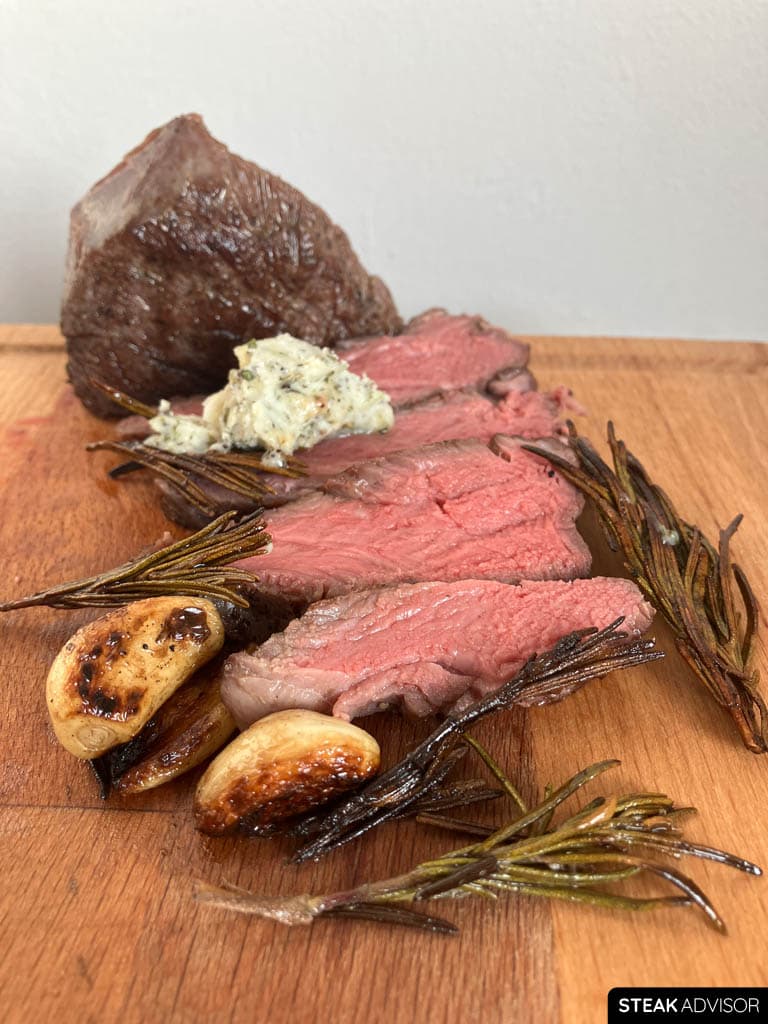
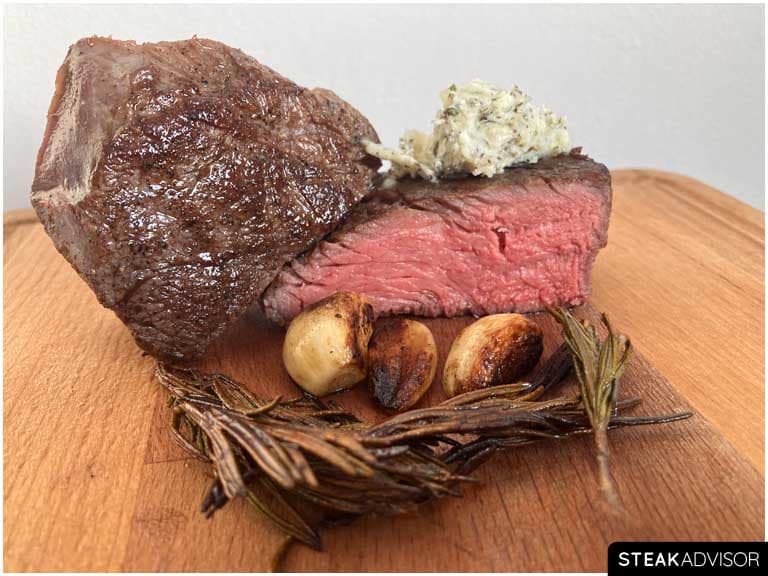
Don’t let the sous vide steak rest after the final sear. Just serve it straight away. Add a bit of compound butter or any aromatics on top and let it melt over the crust. Then serve it with whatever sides you like.
Note
Unlike traditional pan-seared or grilled steak, sous vide steak cools quickly after the final sear. There’s very little carryover cooking, and you’ve already cooled it down before searing. That’s why you should serve it immediately. Have your sides ready before you start the final sear, sear it, plate it, and serve immediately.
Sous Vide Steak FAQs
What are the best cuts of steak for sous vide?
Sous vide is one of those steak-cooking methods that works well with almost any cut of steak, regardless of its fat content or natural tenderness. What matters more is the kind of result you want and how tender you want the steak.
The best steaks for sous vide are naturally tender cuts about 1 to 2 inches (2.5–5 cm) thick, such as ribeye, strip steak, filet mignon, porterhouse, T-bone, picanha, flat iron steak, denver steak, tomahawk steak, and cowboy steak. These cuts cook relatively quickly. But sous vide also works very well for tougher cuts like chuck steak, round steak, or sirloin. These cuts have more connective tissue, and cooking them for a very long time (even 1 to 3 days at a precise temperature) makes them much more tender.
That’s why sous vide is one of the most versatile steak-cooking techniques. It works great for naturally tender cuts, but it also does a great job with tougher ones. What’s really amazing is that there’s basically no other cooking method this easy that can turn a really tough cut into a tender one without using marinades or other tenderizing techniques. It opens up many possibilities. You can take relatively cheap and naturally tough cuts and turn them into something surprisingly tender.
If you’re not familiar with the differences between steaks, take a look at my guide to the different types of steak.
How thick should a steak be for sous vide?
In most cases, the best thickness for a steak cooked sous vide is 1 1/2 to 2 inches (3.8–5 cm), with 1 inch (2.5 cm) as the absolute minimum. This range works best for most people because the steak doesn’t take too long to cook. Depending on the cut and whether you plan to pasteurize it, steaks in this range usually take about 1 to 4 hours to reach a target temperature of 135°F (57°C).
Very thick steaks take much longer to cook. In many cases, it’s simply better to use the reverse sear, or even better, the forward sear cooking method, which can cook a 2 1/2-inch (6.3 cm) steak much faster than sous vide. On the other hand, you can cook naturally tender steaks thinner than 1 inch (2.5 cm) with sous vide, but building a decent crust during the final sear becomes more difficult (sometimes even impossible) without overcooking the inside.
For very thin steaks, cooking them directly over high heat in a pan or on a grill usually works better and only takes a few minutes. The exception is tougher cuts, which benefit from longer cooking times that break down connective tissue, making the meat more tender.
Which containers work best for sous vide?
The best container for sous vide depends on how often you cook, how long you cook, and how much food you make. Ideally, the best option is a polycarbonate tub designed specifically for sous vide machines, as it’s the most convenient setup. But not everyone wants to spend extra money on a dedicated container. If that’s the case, you can use a stockpot or even an insulated cooler if you already have one at home.
The key is to choose a container that fits your needs. Each option has its own advantages, so below I’ll briefly explain when each one works best.
1. Polycarbonate Food Containers (Best overall)
These are the most commonly recommended containers for immersion circulators and are ideal if you cook sous vide regularly. I especially recommend them if you often cook several steaks at once.
Pros
- Food-safe polycarbonate withstands sous vide temperatures well
- Transparent so you can see the food
- Available in practical sizes.
- Compatible with lids that reduce evaporation
- Durable and commonly used in professional kitchens.
Cons
- You need to buy a lid or cut a hole for the circulator
2. Large Stockpot or Dutch Oven (Best if you already own one)
If you don’t cook sous vide often or usually cook only 1–2 steaks, a stockpot or dutch oven works perfectly fine. Almost everyone already has one, so it’s a good option if you don’t want to spend extra money on equipment you’ll only use occasionally.
Pros
- No extra equipment needed
- Durable stainless steel
- Works well for small batches
Cons
- More heat loss than plastic containers
- More evaporation during long cooks
3. Insulated Coolers (Best for long cooks)
A cooler’s thick insulated walls
An insulated cooler has thick walls that significantly reduce heat loss. That’s why it’s a great option for long sous vide cooks. For example, when cooking tough cuts like chuck steak or round steak, which can take 24–72 hours.
Pros
- Excellent temperature stability
- Less evaporation
- Lower electricity use during long cooks
Cons
- Bulkier
- You need to cut a hole for the circulator
- You can’t see the food while it cooks
So let me summarize it quickly:
- Most people: polycarbonate container with lid
- Budget/starter: Stock pot you already own
- Long cooks: Insulated cooler
If you want to step things up, consider using a wire rack and a lid with a hole for the circulator. The wire rack sits inside the container and holds the bags in place. It keeps them from floating even if there’s some air left in the bag. Because of that, you don’t always need a perfect vacuum seal. You can also use reusable silicone bags, since the rack helps keep them submerged. The lid helps keep the circulator stable and reduces evaporation during long cooks.
What are the doneness temperatures for sous vide steak?
Because sous vide lets you cook steak so precisely, the doneness ranges are slightly different from traditional methods like pan-searing or grilling. With sous vide, it’s not just about hitting “medium-rare” or “medium” range. It’s about choosing an exact temperature.
Here’s how doneness typically looks for sous vide steak:
- Very Rare: 115°F to 119°F (46.1°C to 48.3°C)
- Rare: 120°F to 129°F (48.9°C to 53.9°C)
- Medium Rare: 130°F to 139°F (54.4°C to 59.4°C)
- Medium: 140°F to 149°F (60°C to 65°C)
- Medium Well: 150°F to 155°F (65.6°C to 68.3°C)
- Well Done: 156°F (68.9°C) and above
Keep in mind that these ranges can vary slightly. There isn’t a strict, universal standard for steak doneness, and different regions, restaurants, and chefs may define the levels slightly differently.
Important!
If you drop the temperature below 130°F (54.4°C), you’re entering the food safety danger zone where harmful pathogens may survive. Because of that, you shouldn’t cook the food at those temperatures for more than 2 hours. For wild game, it’s especially important to cook the steak at a high enough temperature to kill potential parasites or bacteria.
If you want to learn more about sous vide food safety, I recommend reading “Is Sous Vide Safe? Key Safety Guidelines” by Jason Logsdon, “Basic Sous Vide Food Safety” by the International Sous Vide Association, and “A Practical Guide to Sous Vide Cooking” by Dr. Douglas Baldwin.
At what temperature should I set the sous vide to cook steak?
Use my sous vide steak time calculator to figure out how long to cook your steak and at what temperature based on its thickness, target doneness, the specific cut, and whether you want it heated through or fully pasteurized. It removes the guesswork.
Under the calculator, you’ll also find a detailed breakdown explaining why the timing matters and how temperature and cook time affect different cuts when cooking sous vide. Once you understand that part, everything becomes much more predictable.
Why does cooking time matter when cooking steak sous vide?
For this article, I’ll keep it short and explain why cooking at the right temperature (and for the right amount of time) matters so much.
When cooking steak sous vide, there are three main goals:
- First, heat the steak to your target doneness. That’s the whole point of sous vide. You set the temperature, and the steak cooks evenly from edge to edge. No guessing, no gray band. For example, 137°F (58°C) for a well-marbled ribeye. That’s the beauty of sous vide.
- Second, make the steak safe to eat: Food safety comes down to time and temperature. Bringing the steak to your target temperature heats it through, but holding it there long enough pasteurizes it. You don’t have to pasteurize – heating it through is enough for many people. But personally, I prefer to pasteurize, especially when cooking medium-rare. The extra time doesn’t hurt the steak, and I’d rather know it’s much safer to eat.
- Third, tenderize it (if the cut needs it): Sous vide isn’t just about temperature. Time matters just as much. Longer cooking helps break down tough connective tissue, making certain cuts significantly more tender. How much it helps depends on the cut and how long you leave it in the bath. But here’s the thing: not every steak needs that. A naturally tender cut doesn’t benefit from sitting in the water too long. It all depends on what you’re cooking.
Here’s why this matters.
- You can’t accidentally overcook the inside of the steak: Once you set the water temperature, the steak won’t go above it. Set 130°F (54°C), and it stays 130°F. That’s one of the biggest advantages of sous vide.
- Time changes texture: Temperature controls doneness. Time controls texture. The longer a steak sits in the bath, the more muscle fibers and connective tissue break down.
- Tough cuts benefit from longer cooks. Extra time can make naturally tough cuts noticeably more tender.
- Tender cuts don’t need long cooking. They need enough time to heat through or to pasteurize, if that’s your goal. Cook them too long, and you risk turning that natural tenderness into a soft, mushy texture.
- Thickness changes everything. Thicker steaks need more time to heat through, and even more if you want it pasteurized.
- Guessing time is a mistake. If you don’t cook the steak long enough, the center won’t actually be at your target doneness.
How many steaks can I sous vide at a time?
You can cook as many steaks as you want with sous vide, as long as you follow one basic rule: don’t let them touch each other. If they touch, they can insulate each other from the water temperature and won’t cook properly. Don’t stack them.
Ideally, seal each steak in its own bag and use a rack to keep them in place. The rack keeps space between the steaks so the water can circulate around them properly. Leaving space around each steak is important for consistent cooking.
Can I sous vide steak from frozen?
Yes, you can, but you need to give the steak more time to cook through properly. Depending on the thickness, it usually takes about 1-2 hours longer. If you want to be sure, use the sous vide calculator. One important thing: don’t cook the steak in the bag it came in from the store. Those bags usually aren’t safe for sous vide. Always rebag the steak in a proper sous vide-safe bag.
When it comes to seasoning, I recommend one of these two options:
- Option 1: When you buy the steak, put it into a sous vide-safe bag, season it with your favorite seasonings, seal it, and freeze it. Then, when you’re ready to cook, take it straight from the freezer and start cooking.
- Option 2: If the steak is already frozen, unseasoned, and still in the original store packaging, first thaw it using sous vide (it won’t take long). Then put it into a sous vide-safe bag, season it, and either let it rest in the fridge for a while (if you salted it) or move straight to cooking if you’re using dry seasonings.
Is it possible to overcook the steak in sous vide?
Not in the traditional sense. A steak cooked sous vide will never go above the temperature of the water bath, so technically it can’t overcook the way it would in a pan or on a grill. However, leaving a steak in the bath for too long can affect its texture. After many hours, the meat can start to soften too much and eventually turn a bit mushy. It takes quite a while for that to happen, but it’s still something to keep in mind. How long is too long depends mainly on the cut.
Naturally tender steaks shouldn’t stay in the bath much longer than the time suggested by the calculator. For example, if you’re cooking filet mignon and the calculator shows 3–4 hours to reach the target temperature and pasteurize it, don’t leave it in the bath for more than about 5–6 hours in total, or you’ll start to notice a significant change in texture.
Tougher cuts are a different story. Cuts like round or chuck steak contain much more connective tissue, which needs long cooking times to break down. These cuts require 24 to 72 hours in the sous vide bath to become significantly tender. As a result, they can stay in the water bath for much longer without negatively affecting the texture. Still, even with tougher cuts, the steak shouldn’t be left in the bath forever.
Do I need to let the steak rest at room temperature before cooking it sous vide?
No, you don’t need to let the steak sit at room temperature before cooking it sous vide. Just take it straight from the fridge, seal it, and put it in the water bath. You can even cook steak directly from frozen. The only difference is that frozen steaks take a bit longer to reach the target temperature, so you’ll need to add a bit of extra time to the cook.
Print
Sous Vide Steak Recipe
- Prep Time: 10 minutes
- Rest Time: 1 to 6 hours
- Cook Time: 2 hours
- Total Time: 2 hours 10 minutes
- Yield: 1 steak
Description
Sous vide steak with precise, edge-to-edge doneness and a juicy interior. You set the exact temperature you want, and the steak comes out precisely at that doneness. It’s simple, reliable, and almost impossible to mess up.
Ingredients
For steak in a bag:
- Any steak, ideally 1 to 2 inches (2.5 to 5 cm) thick
- 1–2 teaspoons (5-10g) kosher salt (use roughly 1-1.5% of the steak’s weight in salt)
- 1/2 teaspoon finely ground black pepper per 1 pound (453 g) of steak (optional)
- 1/2 teaspoon garlic powder per pound (454 g) of steak (optional)
- A few thyme sprigs or rosemary (optional)
For the final sear in a pan:
- 2–3 tablespoons (30–45 ml) high-smoke-point oil (I recommend refined avocado oil)
- 2 tablespoons (30 g) unsalted butter (optional)
- 2–3 peeled garlic cloves (optional)
- Fresh herbs of your choice (optional – you can use the herbs from the sous vide bag)
For compound butter (optional):
- 1/4 pound (113 grams) unsalted butter, at room temperature
- 1 garlic clove, finely chopped or pressed
- 1/4 teaspoon salt
- 1/2 teaspoon black pepper, finely ground
- 1 tablespoon parsley, finely chopped (fresh or dried)
- 1 tablespoon rosemary, finely chopped (fresh or dried)
Tools:
- Sous vide machine (immersion circulator)
- Heat-safe food container or pot
- BPA-free bags suitable for sous vide
- Vacuum sealer (optional)
- Skillet, grill, or flamethrower
- Meat thermometer (optional)
Instructions
- Before you start, decide which aromatics you want to use (compound butter, pan juices made after the final sear, or none at all).
- Gather all your tools and ingredients, then follow the steps below.
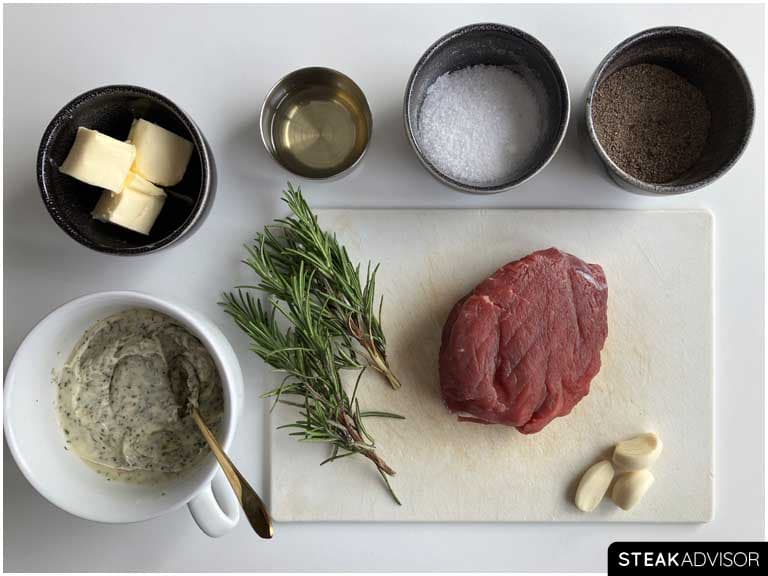
Season the Steak
- You can keep it simple or combine methods. For example, dry-brine first, then add a rub before sealing the bag. Pick what works for you and how much time you have.
- Option 1: Basic Seasonings – If you want to keep it super simple, season the steak on all sides with salt, pepper, and garlic powder. It’s the classic method. It never disappoints, and it doesn’t take much time.
- Option 2: Dry-brining (Optional) – For more salty flavor throughout the meat, I highly recommend dry-brining before cooking sous vide. Here’s how to do it:
- Season the steak on all sides with 1–2 teaspoons of kosher salt (about 1–1.5% of the steak’s weight). Place it on a wire rack set over a baking sheet and refrigerate uncovered for at least 1 hour, ideally 4–6 hours.
- Once you take it out of the refrigerator, season it with any additional ingredients you like, then seal it in the bag (more on that in the next step).
- Option 3: Rubs or Marinades (Optional) – If you like experimenting with different flavors, I highly recommend using rubs or marinades. There are plenty of great options to choose from. Just be careful during the final sear so you don’t burn the rub or marinade. Keep it short and hot.
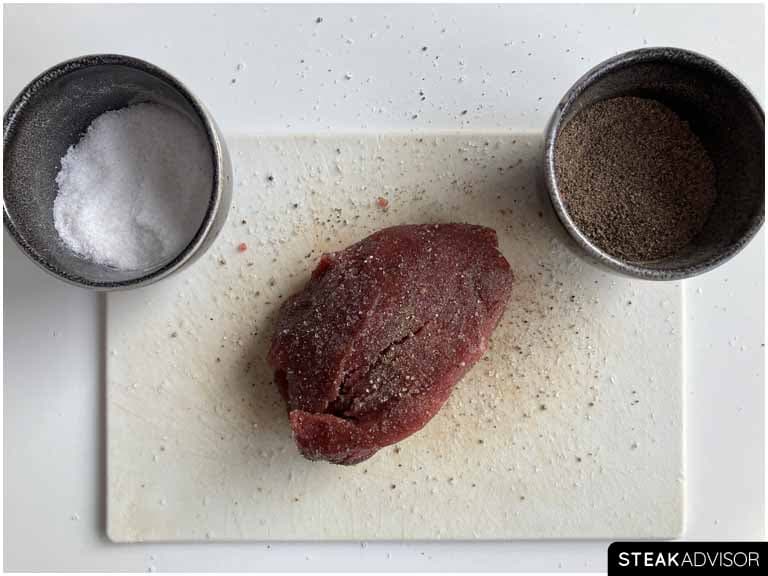
Add Aromatics (Optional)
- Just before cooking, place the seasoned steak in the bag. Add a few sprigs of rosemary, thyme, or any herbs you prefer. Try to spread them evenly on both sides of the steak.
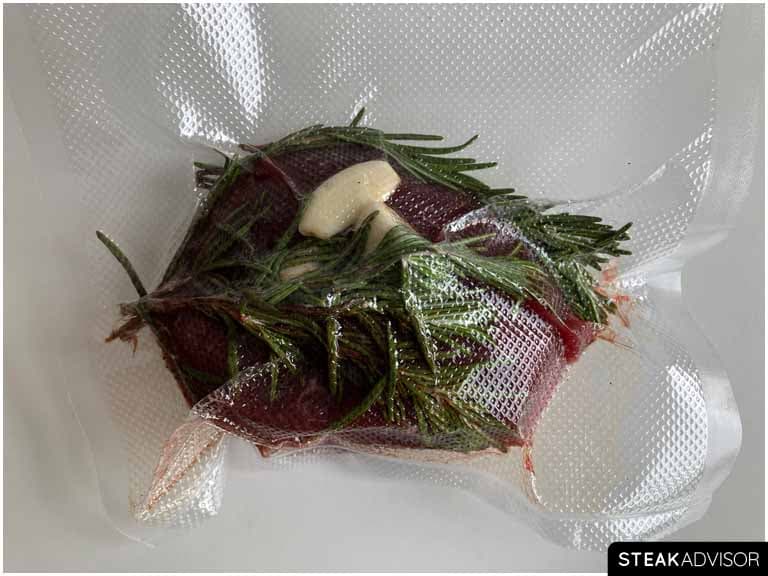
Seal the Bag
- Seal the bag with a vacuum sealer. If you’re using a zipper bag, use the water displacement method instead. Just lower the bag slowly into a pot of water. The water will push most of the air out on its own. Once the air is out, seal the bag just above the water line.
Set up Sous Vide
- Fill a large pot or sous vide container with water, keeping the level between the minimum and maximum marks on your circulator.
- Set the temperature to your preferred doneness (my sous vide steak cooking time calculator will help you pick the right temp and time for your cut), and let the water fully come up to temperature before adding the steak.
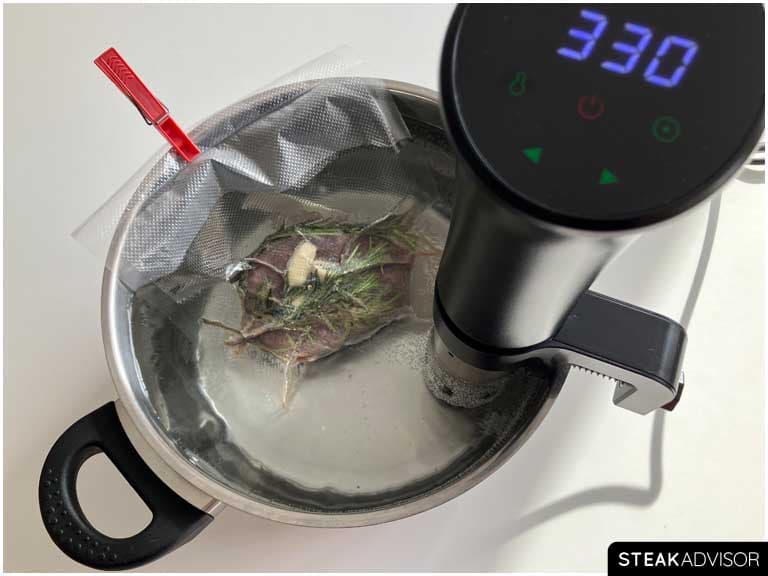
Cook the Steak Sous Vide
- Place the sealed bag into the water bath, making sure it doesn’t block the intake or output of your precision cooker.
- Now let it cook for the exact time recommended by the sous vide steak calculator.
Make the Compound Butter (Optional)
- In a bowl, mix 1/4 pound (113 g) softened butter with 1/4 teaspoon salt, 1/2 teaspoon finely ground black pepper, 1 finely chopped or pressed garlic clove, and 1 tablespoon of finely chopped parsley or rosemary (fresh or dried, both work). If you’re cooking more than two steaks, double the recipe.
- If you want to make a bigger batch, do it a day ahead. Roll the butter into a log, wrap it tightly, and refrigerate until firm. Then you can slice off what you need anytime (see my garlic-herb steak butter recipe for a step-by-step guide).
- If you don’t feel like making it ahead of time, no problem. After the final sear, add butter, garlic, and herbs directly to the pan. Let everything sizzle together for a minute, then pour it over the sliced steak. You’ll get a very similar boost of flavor.
Remove Steak From Bag
- Once the steak has cooked for the time you planned, remove the bag from the water bath and drop it straight into an ice bath for about 5 minutes.
- After that, remove the steak from the bag and pat it dry really well on all sides with paper towels. Don’t be gentle here and get it properly dry.
- Then place it on a plate in the fridge, standing it up on its side, for about 15 minutes before you move on to the final sear.
Sear the Steak
- Set a pan over medium-high heat and let it heat for 3–4 minutes.
- Add 2 tablespoons of a high-smoke-point oil and let it heat for another minute. While the pan is heating, pat the steak dry again. Even if it looks dry, do it again.
- Place the steak in the pan and sear for 2 minutes total, flipping every 30 seconds. Each time you flip it, press it down gently to ensure the surface is in full contact with the pan and build a better crust.
- (Optionally) If the steak has a fat cap (like a strip steak or picanha), sear it fat cap-side down for 60 seconds to help render the fat. If there’s no fat cap, quickly sear the other edges for about 15 seconds. Once the crust looks good, take the steak out and serve it immediately.
Serve the Steak
- Don’t let the sous vide steak rest after the final sear. Just serve it straight away. Add a bit of compound butter or any aromatics on top and let it melt over the crust. Then serve it with whatever sides you like.
Notes
Beef Doneness Temperatures
Very Rare: 115°F to 119°F (46.1°C to 48.3°C)
Rare: 120°F to 129°F (48.9°C to 53.9°C)
Medium Rare: 130°F to 139°F (54.4°C to 59.4°C)
Medium: 140°F to 149°F (60°C to 65°C)
Medium Well: 150°F to 155°F (65.6°C to 68.3°C)
Well Done: 156°F (68.9°C) and above
Use my sous vide steak time calculator to figure out how long to cook your steak and at what temperature based on its thickness, target doneness, the specific cut, and whether you want it heated through or fully pasteurized.
Important! If you drop the temperature below 130°F (54.4°C), you’re entering the food safety danger zone where harmful pathogens may survive. Because of that, you shouldn’t cook the food at those temperatures for more than 2 hours. For wild game, it’s especially important to cook the steak at a high enough temperature to kill potential parasites or bacteria.
