
| PREP TIME | REST TIME | COOK TIME |
| 10 mins | 1 to 6 h | 15 mins |
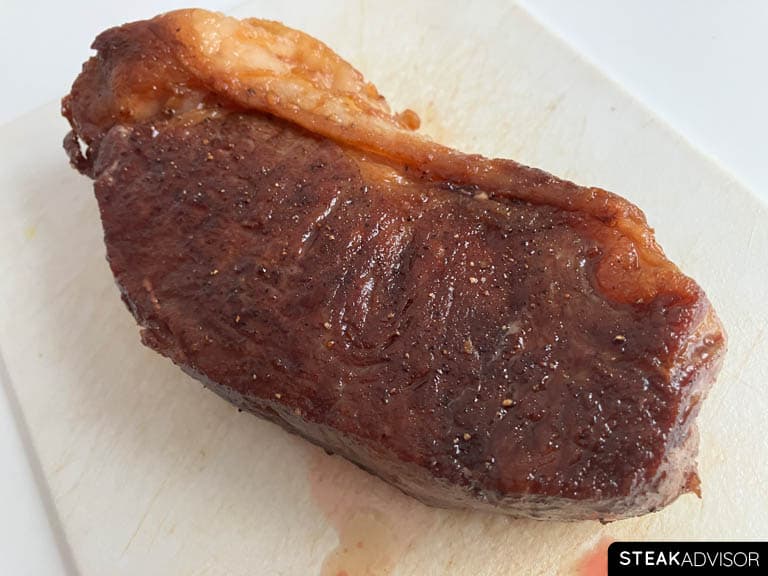
This pan-seared steak has a beautiful golden-brown crust and a juicy interior. It’s seasoned simply with salt and pepper, then finished with butter, garlic, and fresh herbs for a deep, rich flavor that’s hard to beat. This is the method I use to cook steaks entirely in the pan, and it works great for almost any cut, especially high-grade ones.
Important
This recipe works best for steaks that are about 1 1/2 inches (3.8 cm) thick. If your steak is thinner or thicker, you’ll get better results by following one of my other recipes:
If your steak is closer to 2 inches (5 cm) or even thicker, check out my How to Cook a Thick Steak guide. It has tips and recipes for cooking those really thick cuts.

Pan-searing is one of the best ways to cook most steaks. It doesn’t take long, but there are a few key rules you need to follow to get it right. Once you master the technique, you won’t need a recipe anymore.
I’ve divided this article into two sections so you can choose the level of detail you prefer.
The first section is a full step-by-step guide to pan-searing steak on the stove. It includes detailed instructions, photos, and explanations. I’ll show you why I recommend certain techniques over others and what results you can expect. If you want to really understand the process and learn how to apply it to any cut, this section is for you.
The second section is for those who just want a quick and simple recipe. Click “Jump to Recipe” and it’ll take you straight to the recipe card – simple steps, no extra detail, just exactly what you need to cook a great steak.
I’ve also included a FAQ section at the end with answers to the most common questions about pan-searing steak. Click here to jump straight to the FAQ.
Important
This recipe is for steaks that are about 1 1/2 inches (3.8 cm) thick. Steaks this size are much harder to mess up. You get enough time to build a good crust on the outside while keeping the inside tender, juicy, and cooked exactly how you want it. That’s why I recommend them, especially if you’re pan-searing for the first time.
Keep in mind:
- With thinner steaks (1 inch / 2.5 cm or less), it’s hard to get both a good crust and a medium-rare center.
- With very thick cuts (2 1/2 inches / 6.4 cm or more), the outside can burn before the inside reaches medium-rare or medium.
For the best results, use this recipe with naturally thicker, tender cuts (about 1 1/2 inches / 3.8 cm thick), like ribeye, strip steak, picanha, or filet mignon.
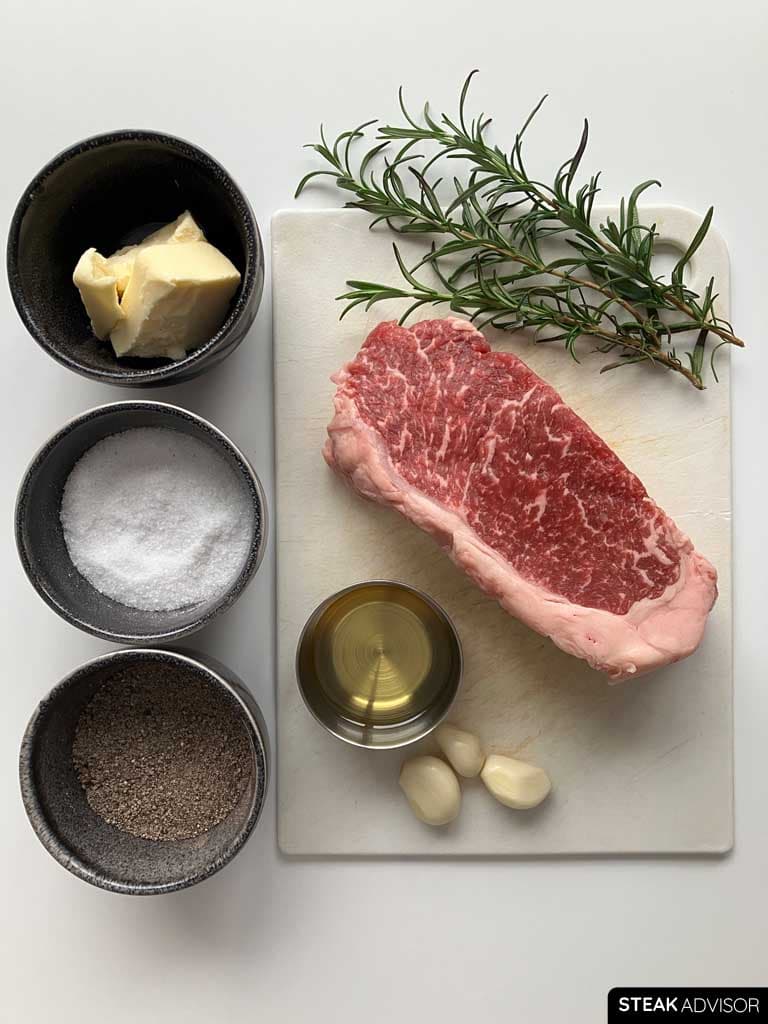
Main Ingredients for Pan-Seared Steak
- Steak: Tender cut about 1 1/2 inches (3.8 cm) thick. For this recipe, I’m using a strip steak, but you can go with any naturally tender, thicker cut. Ribeye, filet mignon, or picanha are all great options. (See the FAQ section for a full list of recommended cuts.)
- High-smoke-point oil: 1-2 tablespoons (15-30 ml). Use one tablespoon for very well-marbled cuts or two tablespoons for leaner cuts. I recommend refined avocado oil, as it has a very high smoke point and a neutral flavor. If you don’t have it, see the FAQ for suitable alternatives.
- Kosher salt (or another coarse salt): 5–10g kosher salt, depending on the size of your steak (go with about 1% of the steak’s weight in salt, or up to 1.5% if you like a stronger, more seasoned flavor). Kosher salt is best for seasoning steak before cooking. Its larger grains distribute more evenly and stick well to the surface. Avoid table salt, as it dissolves too quickly and makes it easy to over-season.
Optional Seasonings
You don’t need much to make a great steak, but these extras take the flavor to another level. I recommend using at least the garlic, butter, and fresh herbs.
- 1/2 teaspoon black pepper per pound (454 g) of steak: Finely ground works best for seasoning right before cooking.
- A few thyme sprigs or rosemary: A sprig or two adds a nice, subtle herbal flavor.
- 2–3 garlic cloves: Smash them lightly and let them infuse the butter while cooking.
- 2 tablespoons (30 g) unsalted butter: Adds richness and helps carry the flavor of garlic and herbs into the steak.
The Tools You’ll Need
- Pan: Cast-iron, carbon steel, or heavy-bottomed stainless steel skillet
- Tongs
- Meat thermometer: The most reliable way to hit your target doneness. Use whichever type you prefer: an instant-read thermometer is perfect for quickly checking the steak’s internal temperature. A leave-in probe thermometer works great if you want to monitor the temperature as the steak cooks (from start to finish).
How to Pan-Sear Steak – Ultimate Guide
Start by gathering your ingredients and tools, then follow the steps below. If it’s your first time pan-searing a steak, read through the steps at least once before you start. Under each step, you’ll find a Note box that explains the “why” behind the technique so you know exactly what to expect and how to get consistent results.
Step 1: Prepare the Steak
Pat the steak dry with paper towels to remove excess surface moisture. Season generously with 1-2 teaspoons of kosher salt (1-1.5% of the steak’s weight) on both sides, then place on a wire rack set over a baking sheet and let the steak rest before cooking:
- If you’re short on time, leave it at room temperature for 1 hour.
- If you have more time, refrigerate it uncovered for 4–6 hours for even better flavor and a drier surface (which means a better sear). I highly recommend this option.
Remove the steak from the refrigerator about 30 minutes before cooking.
Note
Getting step 1 (seasoning with salt) right makes all the difference. The reason most people struggle to achieve a good crust with pan-searing is simple: the steak has too much moisture on its surface. Moisture is the enemy of browning. Before the Maillard reaction can happen and create that beautiful golden-brown crust, any water on the surface must evaporate. So if the surface is wet, you’ll never get that deep, golden crust. Remember, the drier the steak’s surface, the better the sear will be.
Salt plays a big role here. Yes, it’s the most common seasoning for steak. Unfortunately, it initially draws moisture out of the meat. If you cook the steak too soon after salting, the surface will be wet and won’t brown properly. Salt also needs time to work its way inside, improving both flavor and tenderness. This is why the “2 to 30 minute” window after salting is the worst time to cook a steak in a pan.
Based on my testing, it takes at least 45–60 minutes for the steak to reabsorb most of the moisture drawn out by the salt, so that’s the minimum I recommend if you don’t want to wait longer. For even better results, salt the steak and leave it uncovered in the fridge for 4–6 hours.
You can leave it even longer (12–24 hours) for a deeper flavor and an even drier surface. The downside is that the longer the steak sits salted, the more likely you’ll notice a gray band forming just under the crust. It doesn’t mean the steak is overcooked (it’s still tender and flavorful), but it doesn’t look as nice if you like a wall-to-wall pink interior. From my experience, the gray band becomes noticeable after about 12 hours and is very clear at 24 hours. That’s why I recommend 4–6 hours as the sweet spot: great flavor and a dry surface, without much gray band.
If you’re curious to see the salting test results and photos, check out my full guide: How to Salt a Steak.
Another tip: Based on my tests, leaving thicker cuts at room temperature for about 30 minutes before cooking helps them cook more evenly throughout. This step isn’t as important for thinner steaks, but with cuts 1 1/2 inches (3.8 cm) or thicker, it makes a noticeable difference. You can read more about this experiment in this guide: Resting Steak Before Cooking: Why & How Long [Tested].

Step 2: Preheat the Pan
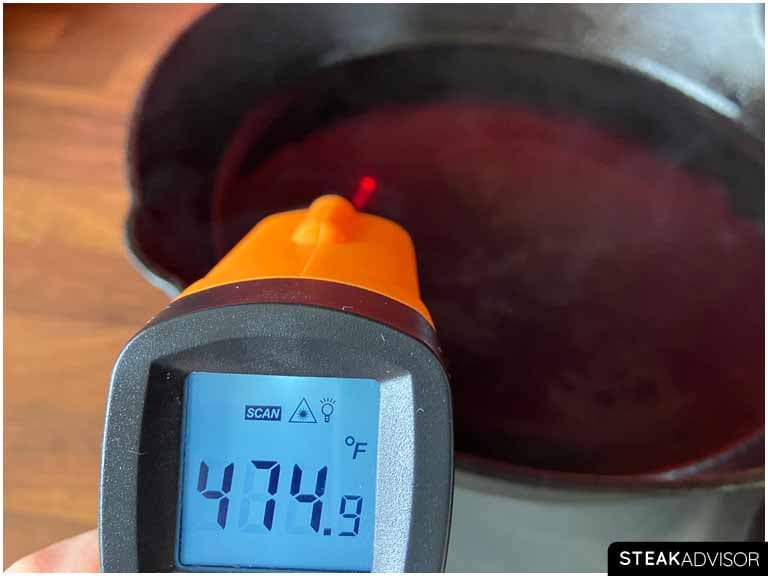
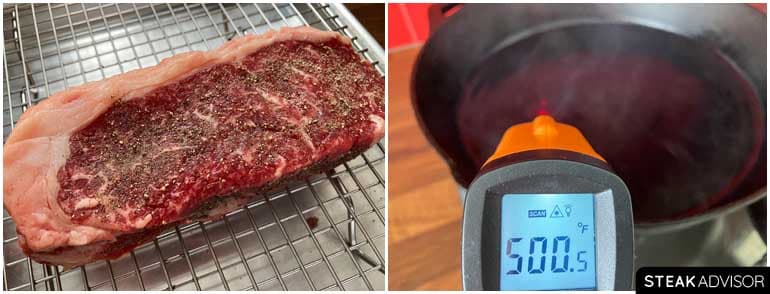
Place a heavy, thick-bottomed pan (ideally cast iron) over medium-high heat. Let it heat for 2–3 minutes, until the surface reaches about 450–500°F (232–260°C). Then add 1–2 tablespoons of oil and wait another minute. For thick, well-marbled cuts, one tablespoon is usually enough.
While the pan is heating, prepare the steak for cooking. Pat it dry again with paper towels, then season with finely ground black pepper if you like (1/2 teaspoon per pound/454 g of steak). Once the pan is hot and the oil is shimmering, you’re ready to start cooking.
Note
For searing, heat is everything. The ideal temperature for browning (the Maillard reaction) is around 140–170°C (285–340°F), but the pan cools the moment the steak is added to it. That’s why you need to preheat the pan hotter than that, ideally to 450–500°F (232–260°C). This ensures the surface stays hot enough to sear properly.
At these temperatures, you need the right oil. Butter and extra-virgin olive oil aren’t suitable because their smoke points are too low, and they’ll burn. Instead, use an oil with a smoke point of around 500°F (260°C) or higher. My top choice is refined avocado oil (smoke point 510°F / 265°C, neutral flavor), but there are other good alternatives (see list below).
| Type of Fat | Smoke Point ºF | Smoke Point ºC |
|---|---|---|
| Refined Avocado Oil | 520ºF | 270ºC |
| Refined Safflower Oil | 510ºF | 266ºC |
| Beef Tallow | 480ºF | 250ºC |
| Pecan Oil | 470ºF | 243ºC |
| Refined Peanut Oil | 450ºF | 232°C |
Finally, the pan. Non-stick pans are not safe for high-heat cooking, as most coatings start to break down around 450°F (232°C). You need a pan that can handle very high heat and retain it well. The best options are:
- Cast iron skillet: The best for searing since it holds heat extremely well, staying hot enough to give a steady sear and great crust.
- Carbon steel pan: excellent heat retention, lighter than cast iron.
- Heavy-bottomed stainless steel skillet: also safe and effective at high heat.

Step 3: Pan-Sear the Steak
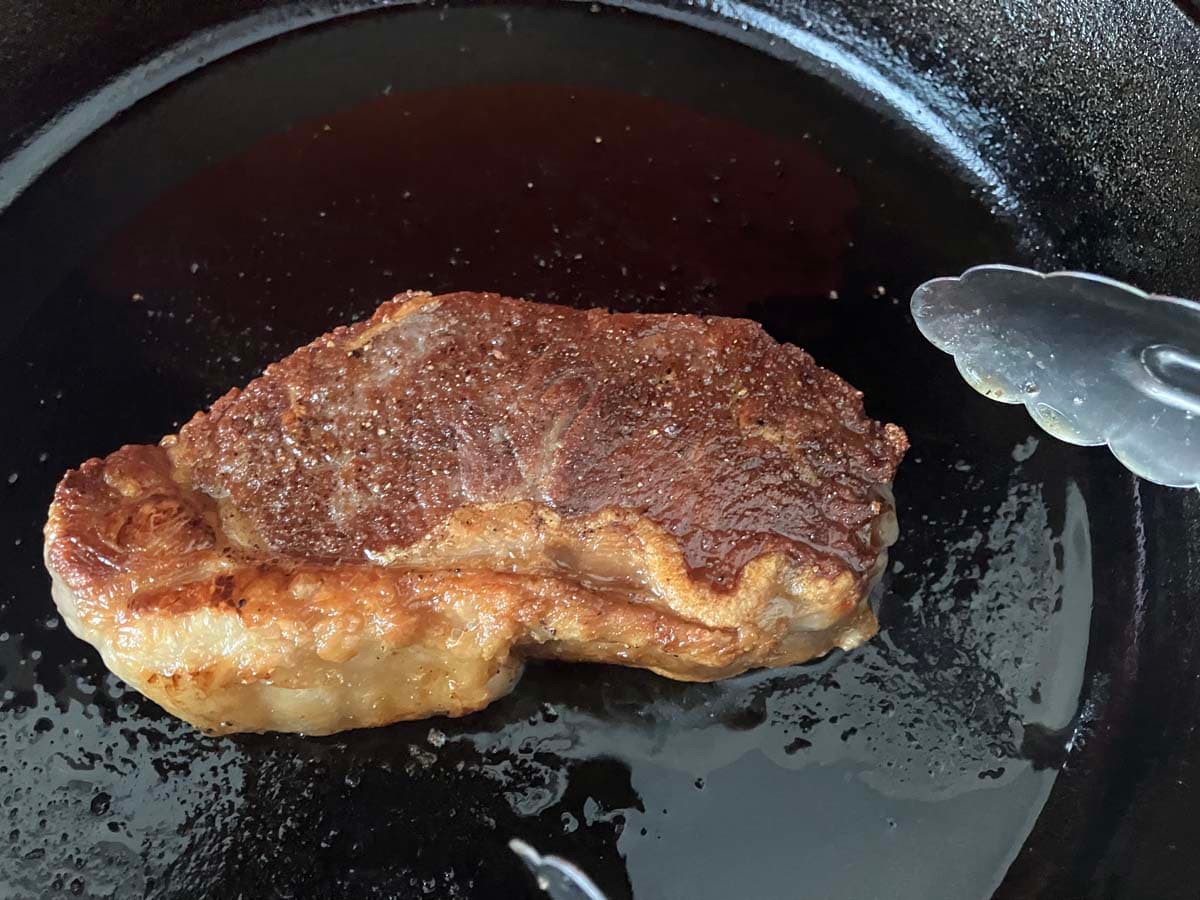
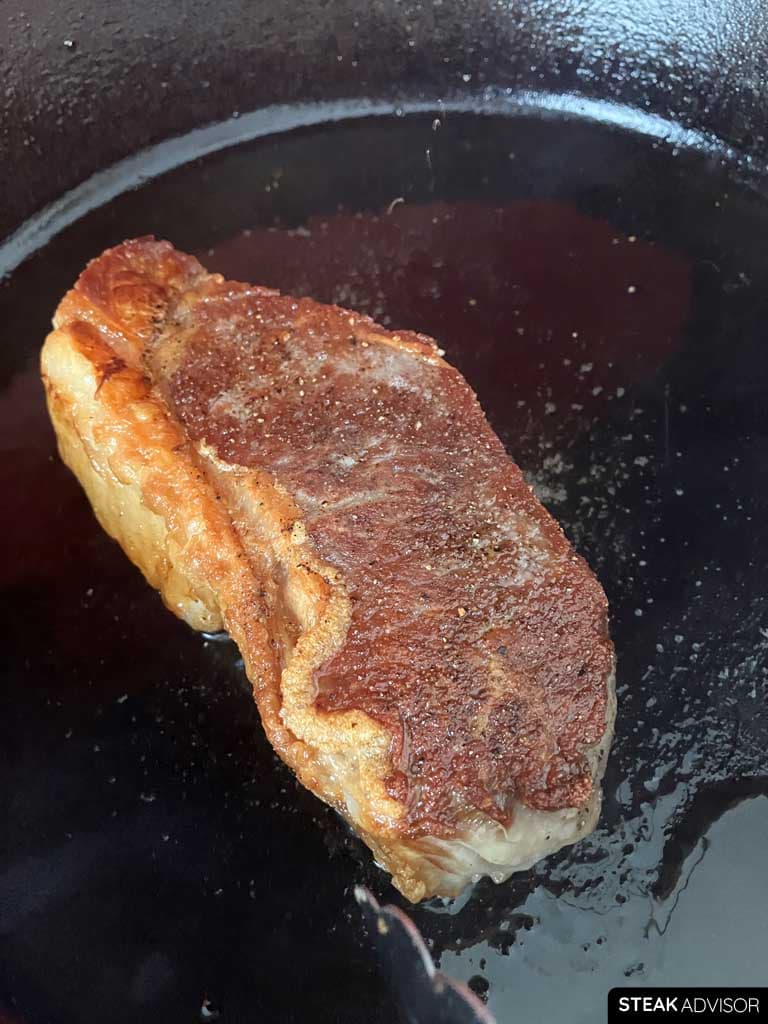
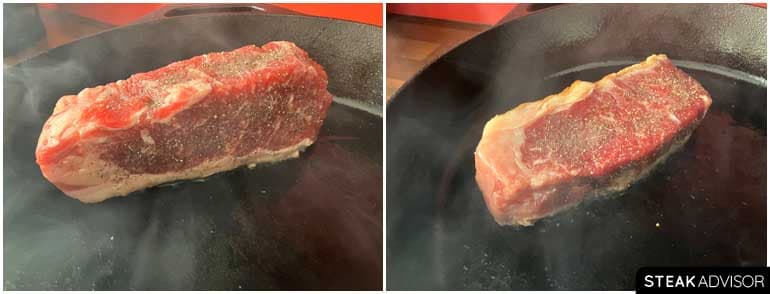
First, turn off the smoke alarm and turn on your exhaust fan or open a window (searing creates smoke). Next, carefully place the seasoned steak in the hot pan and gently press it down with a spoon or tongs to ensure it makes good contact with the pan surface. For some cuts, like strip steak or picanha, you can start by placing the steak fat-side down in the pan for 1–2 minutes to render some of the fat before searing the flat sides.
Cook the steak, flipping it about every 30 seconds. Continue until the steak’s internal temperature reaches around 90°F (32°C). At this point, you can move on to the next step (with butter, garlic, and fresh herbs).
Optionally: If you’d rather keep things simple, you can skip the butter, garlic, and herbs in the next step. In that case, continue flipping and cooking the steak until it’s about 20°F (11°C) below your final target temperature, then remove it from the pan and let it rest.
Skipping the butter and herbs is fine, though I do recommend the butter-and-herb method for extra flavor. As an alternative, you can always finish the steak after cooking with a slice of garlic-herb compound butter on top.
Note
Flipping the steak every 30 seconds helps it cook more evenly on both sides and can even shorten the cooking time slightly.
A steak about 1 1/2 inches (3.8 cm) thick typically reaches 90°F (32°C) in around 4–5 minutes, but this time varies significantly depending on the cut, pan, and stove. That’s why I always recommend using a meat thermometer to monitor the steak’s internal temperature. It’s the only reliable way to know exactly where you’re at and to hit your target doneness.
Forget the finger test or guessing methods, as they’re not accurate. A simple instant-read thermometer (you can find one for around $20) is one of the best investments you can make for consistently perfect steaks.
Step 4: Add the Herbs, Garlic, and Butter
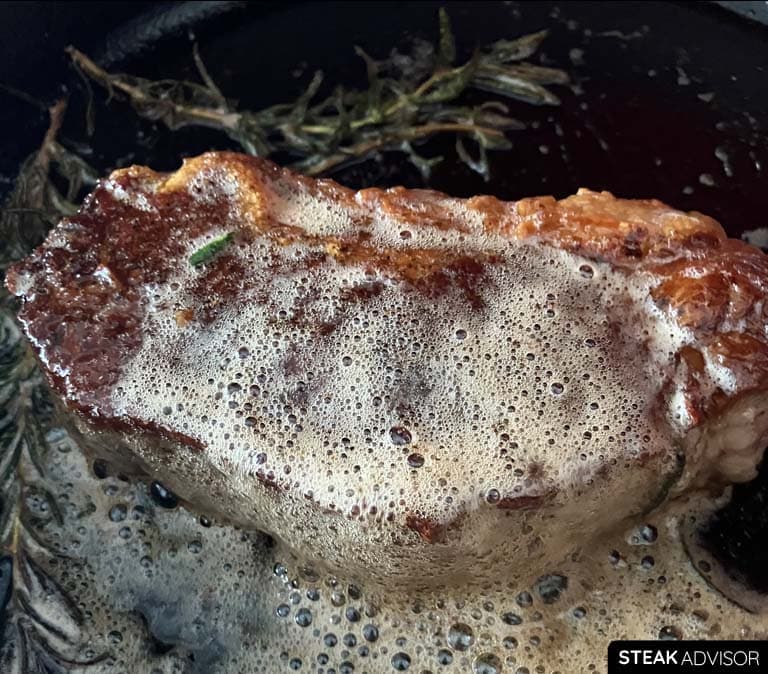
Reduce the heat to medium-low and add two tablespoons (30 g) of butter, a few sprigs of thyme or rosemary, and 2–3 garlic cloves to the pan. Once the butter has melted, tilt the pan so that it pools at the bottom. Move the steak slightly higher in the pan, then spoon melted butter over the steak for about 30 seconds per side.
If you’d rather not spoon-baste, there’s an easier option: tilt the pan so the butter pools, place the steak directly in it, and flip every 30 seconds. This method is easier and gives you the same results.
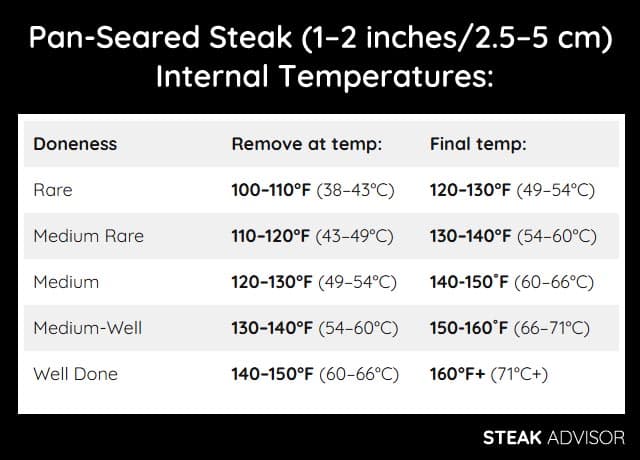
As you baste, keep checking the steak’s internal temperature. Remove it from the pan when it’s about 20°F (11°C) below your target doneness (see the temperature chart below), then turn off the heat and move to the next step.
| Doneness | Remove at temp: | Final temp: |
| Rare | 100–110°F (38–43°C) | 120–130°F (49–54°C) |
| Medium Rare | 110–120°F (43–49°C) | 130–140°F (54–60°C) |
| Medium | 120–130°F (49–54°C) | 140-150˚F (60–66°C) |
| Medium-Well | 130–140°F (54–60°C) | 150-160˚F (66–71°C) |
| Well Done | 140–150°F (60–66°C) | 160°F+ (71°C+) |
Note
Add the butter only after the steak reaches about 90°F (32°C), then lower the heat to medium-low. Adding it too early is risky because butter’s smoke point is only around 300°F (149°C). At higher temperatures, it will burn. Burnt butter gives a bitter taste instead of the rich flavor you want.
That’s why the steak is first seared in a neutral, high-smoke-point oil and finished with butter, garlic, and herbs only once the temperature is under control. This way, you still get the rich flavor from butter, garlic, and herbs without the risk of burning the butter.
Step 5: Let the Steak Rest
Place the steak on a cutting board or, ideally, a rack, and let it rest for a few minutes. Don’t slice or move it during this time; just leave it alone. As the steak rests, residual heat will raise the internal temperature slightly, bringing it to your target doneness.
- For steaks 1 inch (2.5 cm) thick, rest for about 5 minutes.
- For steaks about 1.5 inches (3.8 cm) thick, rest for about 6-7 minutes.
If you’re using compound butter instead of the pan drippings, now’s the moment to place a slice on top of the hot steak. It will slowly melt and cover the surface while the steak rests.
Note
Resting a steak isn’t about “sealing in juices” that’s a common myth (see this article for details). The real reason is carryover cooking. After you take a steak off the heat, the residual heat inside continues cooking it, increasing the internal temperature by about 15–30°F (8–17°C) during the first 5–10 minutes of resting. How much it rises depends on the steak’s thickness, cooking time, and the temperature of the pan.
A lot of recipes say to remove a pan-seared steak when it’s just 5–10°F (3–6°C) below your target, but in my experience, that’s too late, especially for steaks over 1 inch (2.5 cm) thick. I’ve found that the temperature almost always jumps by 20–25°F (11–14°C) as the steak rests (for cuts about 1 1/2 inch / 3.8 cm thick). For steaks about 1 inch (2.5 cm) thick, the carryover is a bit smaller, but still much higher than what many people claim, usually around 15–20°F (8–11°C).
That’s why it’s so important to remove the steak from the pan at the right moment to avoid overcooking. Based on my experience, I recommend removing it when it’s about 20°F (11°C) below your target doneness.
You can read more about my test here: Resting Steak After Cooking: Why You Should and for How Long. I also encourage you to test it yourself and see how much the temperature changes with your own setup and cooking style.
Important: This advice applies to steaks cooked quickly over direct high heat, like pan-seared steaks. It doesn’t apply to sous-vide or reverse-seared steaks, where carryover cooking is much lower.
Step 6: Serve the Pan-Seared Steak
When it’s time to serve, slice the steak thinly, if possible, against the grain (see note below). Don’t forget to pour the leftover butter, garlic, and herbs from the pan over the slices (if you used it instead of compound butter). They’re packed with flavor and make the steak even better.

Note
The “slice against the grain” rule doesn’t apply to every steak. High-quality cuts like filet mignon, ribeye, or strip steak are tender enough that it won’t matter how you slice them. But for steaks with longer, coarser muscle fibers, slicing against the grain makes a big difference in tenderness. Slicing against the grain shortens the muscle fibers, making the steak much easier to chew.
I break this down in more detail (with photos) in my full guide: How to Slice Steak.
Pan Seared Steak FAQs
What are the advantages of pan-searing steak?
- Speed: Pan-searing is one of the fastest ways to cook a steak.
- Great crust: Pan-searing creates an excellent golden-brown crust, especially on thicker steaks.
- Flavor options: Butter, garlic, and herbs can be added directly to the pan to boost flavor.
- Simplicity: Once you learn the basics, it’s so straightforward you won’t even need a recipe.
- No special gear needed: You only need a pan, a stove, tongs, a rack, a tray, and a meat thermometer. Nothing fancy or expensive.
- Perfect for quick sauces: The browned bits in the pan (fond) make an excellent base for simple sauces, which is great for leaner steaks like filet mignon.
- Works anytime: Since it’s an indoor method, you can pan-sear steak year-round, no matter the weather.
What are the disadvantages of pan-searing steak?
- Not ideal for thin steaks: Very thin cuts cook too fast in a hot pan. You’ll usually end up with little to no crust or a steak that’s cooked past medium-rare. Grilling works better for these.
- Not for wet-marinated steaks: Pan-searing works best when the steak is dry. A wet marinade makes it hard to build a good crust. For marinated steaks, grilling is usually the better option.
- Oil splatter: Pan searing means hot oil popping around the pan. It can get messy.
- Lots of Smoke: Pan-searing produces a lot of smoke, so it’s not a good method if your kitchen doesn’t have proper ventilation.
- More cleanup: Oil splatters on the stove, pans, and nearby surfaces, making cleanup more time-consuming.
- Easier to overcook: Since the steak cooks from start to finish in a very hot pan, its internal temperature continues to rise significantly as it rests. If you don’t factor in carryover cooking, the steak can easily end up overdone.
What are the most common mistakes when pan-searing steak?
- Not pat-drying the steak: If the steak is wet, it won’t brown properly (moisture is the biggest enemy of a good crust). Moisture must evaporate before browning can even start. Always pat the steak completely dry before it hits the pan.
- Salting the wrong way: Using too little salt or cooking right after salting are both common mistakes. Salt pulls moisture to the surface, and if you don’t give the steak time to reabsorb it, the surface stays wet. Let the salted steak rest at room temperature for at least 45 minutes, or, even better, 4–6 hours in the fridge.
- Using the wrong oil: Pan-searing needs high heat, about 450°F (232°C) or higher. Make sure you’re using an oil with a high smoke point, like refined avocado oil (smoke point: ~510°F / 265°C). Avoid oils like extra-virgin olive oil, as they burn too easily (smoke point: ~375-430°F / 190-220°C).
- Cooking on a pan that’s not hot enough: Browning (the Maillard reaction) happens around 140–170°C (285–340°F), but the pan temperature drops as soon as the steak comes into contact with it. That’s why you need to preheat the pan hotter than that, ideally to 450–500°F (232–260°C), so it stays in the right zone for proper searing once the steak hits the pan surface.
- Flipping only once: Letting the steak sit too long on one side can make it cook unevenly. Flipping more often, about every 30 seconds, helps the steak cook more evenly on both sides, slightly speeds up the cooking process, and gives you better control over the crust. It also reduces the size of the gray band under the crust.
- Removing the steak too late: This is one of the most common reasons steaks end up overcooked. Taking it off the pan just 5–10°F (3–6°C) below your target doneness isn’t enough. After cooking in a very hot pan, the steak’s internal temperature typically rises about 20°F (11°C) during the 5–7 minutes of resting due to residual heat (carryover cooking). That’s why you need to remove the steak earlier if you want to hit the perfect doneness.
What pan is good for cooking steak on the stove?
Use a heavy pan that can handle high heat and hold it steady. A cast-iron skillet is best, followed by a carbon-steel pan or a thick stainless-steel skillet.
- Cast iron skillet (Best for Searing): Gets extremely hot and stays hot, which is exactly what you want for a really hard sear. Perfect for building a deep, golden-brown, even crust
- Carbon steel pan: Works similarly to a cast-iron skillet but is lighter and heats up faster. Still great for searing.
- Thick stainless steel skillet: Not as heat-retentive as a cast iron skillet, but still very good for searing. It also creates plenty of fond (those browned bits) that are perfect for quick pan sauces.
Avoid non-stick pans, as most coatings start to degrade at around 450°F (232°C). They’re not designed for the high-heat cooking (450–500°F / 232–260°C) needed for proper searing.

Should I sear the steak with oil, butter, or fat?
Use a high–smoke–point oil for searing, something like refined avocado oil. The pan gets well over 450–500°F (232–260°C) during searing, so you need an oil that won’t burn at those temperatures. Add butter with garlic and herbs only near the end for flavor. Don’t sear in butter or other low–smoke point oils, as they burn quickly at high heat.
How hot should the pan be for proper searing?
For a proper sear, the pan needs to be very hot, at least 450°F (232°C), before the steak goes in. The Maillard reaction (the browning that builds flavor and crust) happens around 285–340°F (140–170°C), but the pan loses heat the moment the steak hits it. Preheating to around 450–500°F (232–260°C) keeps it hot enough to sear properly even after that drop.
In my experience, a cast-iron skillet on a gas stove needs about 4–5 minutes over medium-high heat to reach about 450°F (232°C).
What steaks are best for pan-searing?
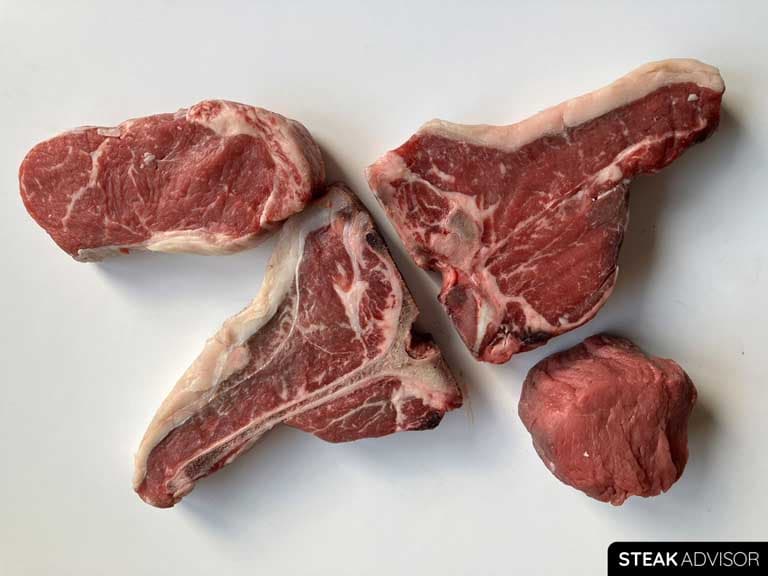
You can technically sear any steak in a pan, but if you want a great crust while keeping the center medium-rare, thicker cuts work best, ideally around 1 1/2 inches (3.8 cm). Thicker cuts give you more time to build that crust without overcooking the inside. Additionally, I recommend choosing naturally tender steaks with good marbling (for a richer flavor and better texture).
Here are the cuts I find work best for pan-searing:
- Ribeye Steak
- Strip Steak (New York Strip)
- Tenderloin Steak (Filet Mignon)
- Picanha Steak (Coulotte Steak)
- Hanger Steak
- Flat Iron Steak
- Porterhouse or T-Bone Steak
- Denver Steak
- Chuck Eye Steak
- Teres Major Steak
Of course, you can pan-sear thinner steaks too, but there’s a catch. With cuts under 1 inch (2.5 cm) thick, it’s much more difficult or even impossible to get a deep crust and keep the center medium-rare at the same time. If you’re okay with a lighter crust or you prefer steak cooked past medium-rare, these thinner cuts can still turn out great in a pan:
- Outside Skirt Steak
- Ribeye Cap Steak
- Flank Steak
- Flap Steak (Bavette Steak)
- Spider Steak (Oyster Steak)
- Tri-Tip Steak (Newport Steak)
How long to cook a steak on the stove?
There’s no universal cooking time for steak. Too many things affect it: the steak thickness, the type of cut, your pan, the heat, and even the stove you’re using. That’s why I always say: don’t cook by time, cook by temperature. The only reliable way to cook a steak in a pan perfectly is to use a meat thermometer and monitor the steak’s internal temperature as it cooks.
You don’t need anything fancy. A simple instant-read thermometer for around $20 works perfectly, and honestly, that’s cheaper than most steaks you’ll buy anyway. It’s a small investment that pays off, and you’ll end up using it for plenty of other things in the kitchen. It’s a small investment, and you’ll use the thermometer for plenty of other things in the kitchen. Skip the guessing. Use a meat thermometer and a doneness chart, and you’ll hit the right doneness every single time. That’s what I do myself, even after years of cooking steaks.

Why is it important to remove the steak from the pan earlier?
When you take a steak off the pan, it doesn’t stop cooking right away. As it rests, the leftover heat inside the meat continues to cook the steak, and as a result, its internal temperature keeps rising – this is called carryover cooking. In just a few minutes, the temperature can jump by 15–30°F (8–17°C).
From my own tests, the internal temperature of a steak about 1 1/2 inches (3.8 cm) thick usually rises by about 20°F (11°C) during the first 5–7 minutes after taking it off the pan. That’s a bigger jump than most people expect, and it’s why the usual advice to pull a steak off the pan just 5–10°F (3–6°C) early isn’t enough. If you follow that advice, your steak will almost always end up overdone.
For example, if you pull a 1 1/2-inch (3.8 cm) thick steak at 130°F (54°C), aiming for medium-rare, the temperature can rise to 150°F (66°C) as it rests, which is medium or even medium-well doneness. That’s why I always recommend taking the steak off the pan about 20°F (11°C) before your target temperature.
Note: This advice applies to high-heat, direct-cooking methods like pan-searing. With slower, gentler methods (like sous vide, reverse searing, or indirect grilling), the carryover rise is much smaller, and sometimes it doesn’t happen at all.
Print
Pan-Seared Steak Recipe
- Prep Time: 10 minutes
- Rest Time: 1 to 6 hours
- Cook Time: 15 minutes
- Total Time: 25 minutes
- Yield: 1 steak
Description
Learn how to cook steak on the stove in a pan the right way. This method gives you a golden-brown crust, a juicy interior, and restaurant-quality flavor using just a few simple ingredients: steak, salt, pepper, garlic, herbs, and butter. Perfect for beginners and a go-to technique for any thick, tender cut.
Ingredients
For Steak:
- About 1 1/2 inches (3.8 cm) thick steak (any naturally tender steak)
- 1–2 tablespoons (15–30 ml) of high-smoke-point oil (I recommend refined avocado oil)
- 1–2 teaspoons (about 5–10 g) kosher salt (use roughly 1-1.5% of the steak’s weight in salt)
- 1/2 teaspoon finely ground black pepper per 1 pound (453 g) of steak (optional)
- A few thyme sprigs or rosemary (optional)
- 2–3 garlic cloves (optional)
- 2 tablespoons (30 g) unsalted butter (optional)
- Compound butter (optional)
Tools:
- Pan (cast-iron, carbon steel or heavy-bottomed stainless steel skillet)
- Tongs
- Meat thermometer (instant-read or probe thermometer)
Instructions
- Before we start. If you want to keep things simple and reduce the risk of overcooking, skip the butter basting and add a slice of compound butter on top of the steak immediately after you remove it from the pan.
- Start by gathering your ingredients and tools, then follow the steps below. If it’s your first time pan-searing a steak, read through the steps at least once before you start.

Prepare the Steak
- Pat the steak dry with paper towels to remove excess surface moisture. Season generously with 1-2 teaspoons of kosher salt (1-1.5% of the steak’s weight) on both sides, then place on a wire rack set over a baking sheet and let the steak rest before cooking:
- If you’re short on time, leave it at room temperature for 1 hour.
- If you have more time, refrigerate it uncovered for 4–6 hours for even better flavor and a drier surface (which means a better sear). I highly recommend this option.
- You can dry-brine the steak for 12-24 hours for a much better flavor and crust, but keep in mind that steaks dry-brined longer than 8 hours form a significantly thicker gray band under the crust.

Preheat the Pan
- Remove the steak from the refrigerator about 30 minutes before cooking.
- Place a heavy, thick-bottomed pan (ideally cast iron) over medium-high heat. Let it heat for 2–3 minutes, until the surface reaches about 450–500°F (232–260°C). Then add 1–2 tablespoons of high-smoke-point oil and wait another minute. For thick, well-marbled cuts, one tablespoon is usually enough.
- While the pan is heating, prepare the steak for cooking. Pat it dry again with paper towels, then season with finely ground black pepper if you like (1/2 teaspoon per pound/454 g of steak). Once the pan is hot and the oil is shimmering, you’re ready to start cooking.
Pan-Sear the Steak
- First, turn off the smoke alarm and turn on your exhaust fan or open a window (searing creates smoke).
- Carefully place the seasoned steak in the hot pan and gently press it down with a spoon or tongs to ensure it makes good contact with the pan surface. For some cuts, like strip steak or picanha, you can start by placing the steak fat-side down in the pan for 1–2 minutes to render some of the fat before searing the flat sides.
- Cook the steak, flipping it about every 30 seconds. Continue until the steak’s internal temperature reaches around 90°F (32°C). At this point, you can move on to the next step (with butter, garlic, and fresh herbs).
- Optionally: If you’d rather keep things simple, you can skip the butter, garlic, and herbs in the next step. In that case, continue flipping and cooking the steak until it’s about 20°F (11°C) below your final target temperature (see the temperature chart below), then remove it from the pan and let it rest.
Skipping the butter and herbs is fine, though I do recommend the butter-and-herb method for extra flavor. As an alternative, you can always finish the steak after cooking with a slice of compound butter on top.
Add the Herbs, Garlic, and Butter
- Lower the heat to medium-low. Add 2 tablespoons (30 g) butter, 2–3 garlic cloves, and a few sprigs of thyme or rosemary to the pan. Once the butter melts, tilt the pan so it pools at the bottom.
- Move the steak slightly higher in the pan, then spoon melted butter over the steak for about 30 seconds per side. If you’d rather not spoon-baste, there’s an easier option: tilt the pan so the butter pools, place the steak directly in it, and flip every 30 seconds. This method is easier and gives you the same results.
- As you baste, continue to check the steak’s internal temperature. Remove it from the pan when it’s about 20°F (11°C) below your target doneness (see the temperature chart below), then turn off the heat and move to the next step.
Let the Steak Rest
- Place the steak on a cutting board or, ideally, a rack, and let it rest for a few minutes. Don’t slice or move it during this time; leave it alone. As the steak rests, residual heat will raise the internal temperature slightly, bringing it to your target doneness.
- For steaks 1 inch (2.5 cm) thick, rest for about 5 minutes.
- For steaks about 1 1/2 inches (3.8 cm) thick, rest for about 6-7 minutes.
- Add Compound Butter (optional): If you’re using compound butter instead of pan drippings, place a slice on the hot steak while it rests. The butter will melt slowly, coating the surface with flavor.
Serve the Pan Seared Steak:
- When it’s time to serve, slice the steak thinly, if possible, against the grain (see notes below). Don’t forget to pour the leftover butter, garlic, and herbs from the pan over the slices (if you used it instead of compound butter). They’re packed with flavor and make the steak even better.
Notes
How to Slice the Steak After Cooking
Naturally tender cuts, such as ribeye, a good-quality strip steak, or filet mignon, can be sliced however you prefer. However, cuts with long, coarse muscle fibers (such as skirt, hanger, flank, or flap steak) should always be sliced against the grain. Slicing against the grain shortens the muscle fibers, making the steak much easier to chew. If you’re unsure how to slice a specific cut, check out my slicing steak guide for clear, step-by-step examples.
