

| PREP TIME | REST TIME | COOK TIME |
| 5 mins | 1 to 6 h | 15-30 mins |
No grill? No pan? No problem. With an oven and a broiler, you can still cook a decent steak. In this guide, I’ll walk you through, step by step, how to broil a steak using the oven broiler only. This method works best for steaks that are at least 1 inch (2.5 cm) thick.
Broiling won’t give you the same crust as a classic forward-sear (pan-to-oven) or reverse-sear (oven-to-pan) method unless the steak is very thick, about 2 inches (5 cm). With thinner cuts, you’ll get some browning on the outside, just not the deep, crisp crust you get from a hot pan. Inside, you’ll see a slightly thicker gray band under the crust, but the steak still cooks fairly evenly from edge to edge.
Important
I developed this recipe specifically for electric ovens with a top-mounted broiler.

What Is Broiling?
Broiling is a high-heat cooking method that uses intense, direct radiant heat from the oven’s heating element. The food sits close to that heat source, so it cooks fast and browns well on the surface. That’s great for building crust, but it also means food can burn quickly, which is why broiling isn’t a “set it and forget it” method. It works especially well for searing, browning, or adding a crispy finish to meats, vegetables, and casseroles as long as you keep a close eye on it.
Broilers aren’t all the same. They differ mainly by where the heat source sits and what kind of heat it uses:
- Electric broiler (most common): The heating element is usually at the top of the oven.
- Gas broiler: Often at the bottom, sometimes in a pull-out drawer, and the heat comes from an open flame.
- Main cavity vs. drawer: Some ovens broil in the main oven cavity, some in a separate drawer, and some offer both.
How Does Broiling Affect Steak?
When broiling steak, the idea is simple: the steak cooks under intense heat from start to finish. The result is a relatively evenly cooked steak with a slightly thicker gray band. The crust you get depends on how powerful your broiler is and the thickness of the steak. With thin cuts, around 1 inch (2.5 cm) thick, it’s hard to get a nice crust because they cook so quickly. Thicker cuts, at least 1 1/2 inches (3.8 cm), give you more room to get a nice, deep crust without overcooking the inside.
Below, I’ll break down the main advantages and disadvantages of broiling a steak so you can decide if it’s the right method for you.
Advantages of Broiling a Steak
- Fast cooking: Broiling uses intense, direct heat, so steaks cook very quickly. Depending on the steak’s thickness and the broiler’s power, the steak is usually ready in about 5 to 10 minutes. Of course remmeber to factor in the extra time needed to preheat the broiler, usually around 10 minutes.
- Works year-round: Weather doesn’t matter. You can broil steaks any time of year.
- No pan or grill required: All you need is a wire rack, a baking sheet lined with aluminum foil, and a meat thermometer to monitor the steak’s internal temperature.
- Fairly even cooking: While it’s not as even as a reverse sear, a broiled steak still cooks relatively evenly.
- Good for cooking multiple steaks: Broiling works well for cooking several steaks at once, but only once you master the technique and figure out the cold/hot spots in your oven.
- Easy cleanup: Everything happens in the oven, and lining the baking sheet with foil makes cleanup simple.
- Consistent once dialed in: Once you figure out rack height and timing, results are very repeatable. I recommend dialing this in with a less expensive steak first, like choice-grade strip steak or sirloin.
Disadvantages of Broiling a Steak
- Not all broilers are made the same: Every oven is different, so you need to learn how hot your broiler runs and where the hot spots are. A meat thermometer helps avoid overcooking the steak, but testing is still necessary.
- Not very forgiving: Small mistakes matter; steak prep, rack height, placement under the broiler, and timing all have a big impact. One mistake can ruin the steak.
- Very little control: Broiling is fast and intense, so there’s not much time to adjust once cooking starts.
- Steak prep matters a lot: To get decent browning, the steak must be dry-brined and thoroughly patted dry. Excess outer fat must be trimmed, since it burns easily under a broiler.
- Doesn’t work for every steak: Steak must be at least 1 inch (2.5 cm) thick and even in thickness, or it’ll cook very unevenly.
- High carryover cooking: Broiling heats the steak’s surface extremely quickly, creating a large temperature difference between the outside and the center. As a result, carryover cooking is high, and the steak’s internal temperature can jump by 20–30°F (11–17°C) after it comes out of the oven.
- Not for very thin steaks: Thin cuts don’t brown well under a broiler, so if crust matters, this isn’t the best method. That said, it can still brown a steak nicely as long as the cut is thick enough. For best results, aim for steaks at least 1 1/2 inches (3.8 cm) thick.
- Hard to build a crust on both sides: Even with thick steaks, it’s hard to get a good crust on both sides. In most cases, it’s better to focus on building a strong crust on one side of the steak without flipping it.
- Requires constant attention: You have to watch the steak the entire time. Broiling leaves no room for stepping away, and it’s very easy to overcook a steak if you’re not paying close attention.
- Smoke: Broiling steak produces a lot of smoke (often comparable to high-heat pan-searing) and may trigger alarms.
- Flare-ups: High heat combined with rendered fat increases the risk of flare-ups, especially if you haven’t trimmed the steak properly. That’s why I avoid placing heavily marbled cuts close to the broiler.
How to Broil Steak in The Oven: Ultimate Guide
Get your ingredients and tools ready first. Then follow the steps below.
Note
While developing this recipe, I ran many tests to figure out what actually works and where things can go wrong. If you’re curious, check out the FAQs section, where I break down the broiling technique in more detail. If not, you can jump straight to the step-by-step recipe below.

The Ingredients You’ll Need
- Steak: Aim for at least 1 inch (2.5 cm) thick, with 2 inches (5 cm) being ideal. Go for a naturally tender, flavorful cut like ribeye, strip steak, picanha, porterhouse, or filet mignon (tenderloin). Keep in mind that with thinner steak it’s much harder (sometimes impossible) to get good browning while still keeping the inside medium-rare or medium. Thicker steaks give you more time to build a nice crust on the surface without overcooking the center.
- Kosher salt: Use about 1–2 teaspoons (5–10 g), or roughly 1% of the steak’s weight in salt. If you prefer a saltier flavor, go up to 1.5%. For example, a 15 oz (425 g) steak needs about 0.15–0.20 oz (4–6 g) of salt. Always measure by weight because different salts vary a lot in density. Kosher salt is much lighter by volume than table salt, so teaspoons aren’t reliable here.
- Compound butter: This is one of my favorite ways to add extra flavor. If you already have compound butter made, great. If not, mix softened butter with minced garlic and chopped herbs (like thyme, rosemary, or parsley) while the steak’s in the oven. You can store it in the fridge or freezer for later. Alternatively, you can place a few slices of unsalted butter on the steak right after broiling.
The Tools You’ll Need
- Oven with broiler: You’ll need an oven with a top-mounted broiler for this recipe. The broiler is what browns the surface of the steak. Without it, the outside will stay gray because a regular oven can’t get hot enough to build a proper crust. Even if your broiler isn’t very powerful, you should still be able to get some nice browning, especially with steaks that are about 2 inches (5 cm) thick.
- Wire rack and baking sheet: A wire rack set over a baking sheet is essential for both dry brining and oven cooking. The rack keeps the steak from sitting in its own juices, helping prevent flare-ups. The foil-lined baking sheet catches the drippings and keeps the oven clean.
- Meat Thermometer: A good thermometer is the one tool that guarantees you won’t overcook your steak. A leave-in probe thermometer is ideal for this recipe. It keeps an eye on the temperature for you, so you don’t have to guess.
- Tongs: Use a sturdy pair of tongs to handle the steak safely, whether you’re flipping it, moving it on the rack, or taking it out of the oven.
Step 1: Prepare the Steak
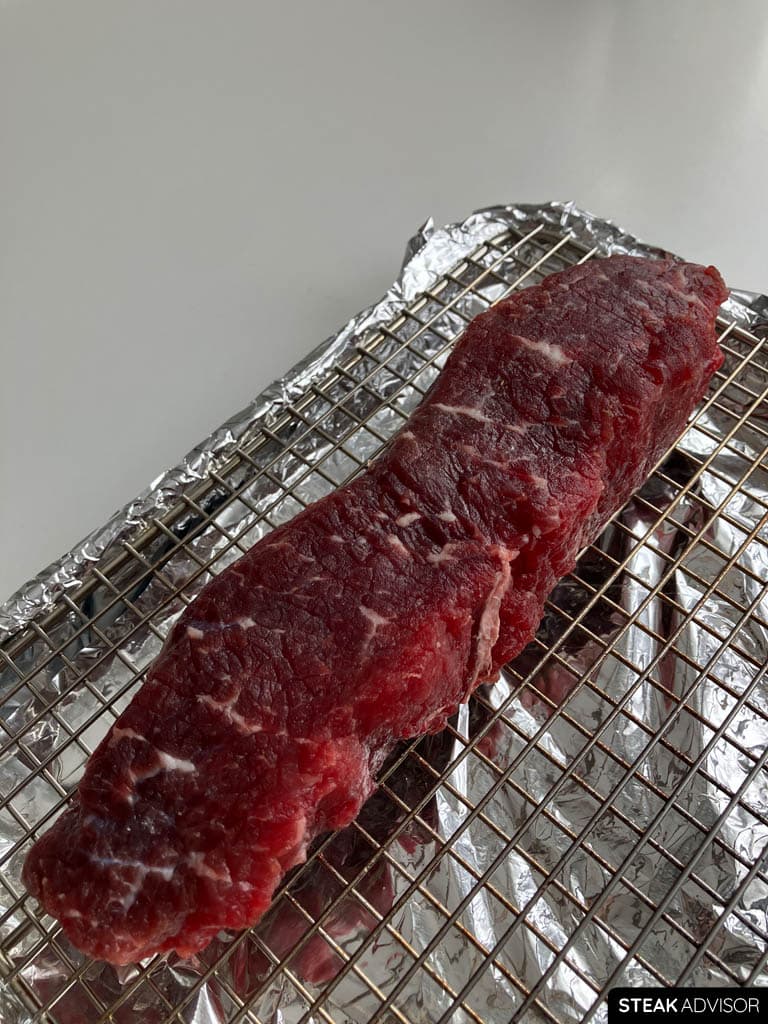
Pat the steak dry on all sides with paper towels to remove any surface moisture, then trim off any excess outer fat. This helps prevent the fat from burning, which is especially important for steaks thicker than 1 inch (2.5 cm). If there isn’t much outer fat on the steak, feel free to skip this step.
Season the steak generously with 1-2 teaspoons of kosher salt (1-1.5% of the steak’s weight). Place the salted steak on a wire rack set over a baking sheet and refrigerate it uncovered for 4 to 6 hours. Remove the steak from the refrigerator about 30 minutes before cooking.

Note
You can dry-brine the steak even longer for deeper flavor, but keep in mind: the longer it sits salted, the more noticeable the gray band just under the crust becomes. If you’re short on time, you can leave the salted steak out at room temperature for about an hour, but for this recipe, I don’t recommend it. The steak needs more time to dry properly if you want good browning under the broiler.
The goal with this recipe is simple: an evenly cooked steak with minimal gray band and a nicely browned surface. The challenge with oven-cooked steak is getting that browning without overcooking the inside. Most home ovens can’t get as hot as a grill or a restaurant broiler, which is why properly preparing the steak makes such a big difference.
Moisture is your biggest enemy when it comes to building a crust. That’s why this recipe focuses on getting the steak as dry as possible on the surface before cooking – and that’s where dry brining really helps. Many people make the mistake of salting a steak and cooking it just a few minutes later. Salt initially pulls moisture to the steak surface, which is then mostly reabsorbed by the meat within 45 to 60 minutes, leaving the outside drier and better for browning. That’s exactly what you want for browning – but an hour is really just the minimum.
For the best results, dry-brine your steak for 4 to 6 hours. After a few hours in the fridge, the steak becomes more flavorful, a bit more tender, and dry enough on the surface to brown better under the broiler.
Step 2: Make the Compound Butter (Optional)
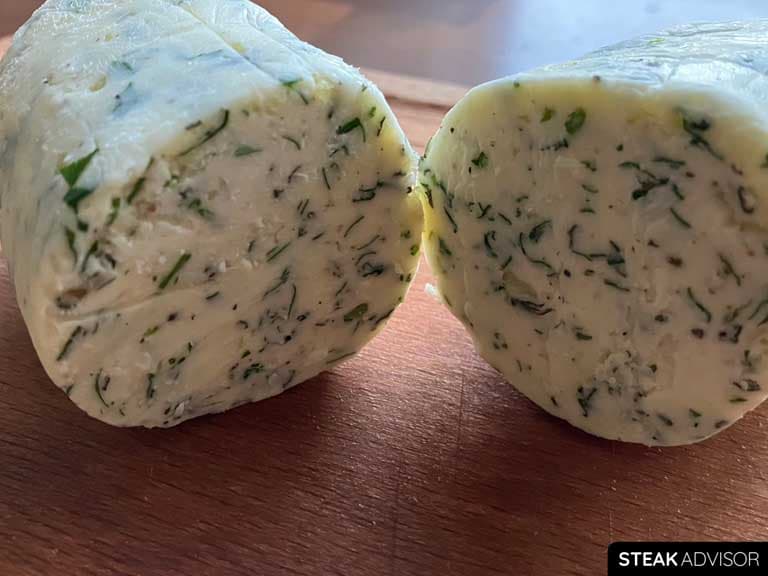
If you want to make a bigger batch to have on hand, I recommend preparing it in advance, either the day before or at least 30 minutes before you start cooking. Roll the compound butter into a log and let it firm up in the fridge or freezer. It’s much easier to store this way, and you can slice off a disc whenever you need it. Here’s my step-by-step recipe for a simple garlic-herb compound butter you can use.
Alternatively, you can make a small batch right before you start cooking. Combine softened butter with minced garlic and chopped herbs in a bowl. Use some right after the steak comes out of the broiler, and store any leftovers in the fridge for up to 7 days. Only have butter on hand? Just place a slice of butter on the steak right after broiling. It won’t have the herbs or garlic, but it’ll still melt beautifully and add tons of flavor with almost no effort.
Note
You can store the compound butter in the fridge for a few days or in the freezer for up to 3 months – it’s one of those little make-ahead tricks that pays off every time.
Step 3: Preheat the Broiler
First, let the salted steak rest for at least 30 minutes before cooking. When you’re ready, set your broiler to high and let it preheat for about 10 minutes. Every oven is a little different, so make sure you choose the highest broiler setting to get the heating element as hot as possible (most home broilers reach around 500–550°F / 260–288°C).
While the broiler heats up, line the baking sheet with aluminum foil to make cleanup easier, then place a wire rack on top so the drippings fall away from the steak. Once the broiler is ready, pat the steak dry again and insert a leave-in probe thermometer into the side of the steak. Make sure the probe tip is centered on the steak so you get an accurate reading. Now the steak is ready to go into the oven.
Note
Always use a wire rack for this recipe, not just a baking sheet or pan. The wire rack lets the fat and juices drip down onto the baking sheet instead of pooling around the steak. Keeping that hot fat away from the broiler reduces the risk of flare-ups.
Not every oven has a broiler indicator light, so the easiest way to be sure it’s ready is just to set a timer for 10 minutes and let it preheat fully. You want the broiler as hot as possible to get some browning without overcooking the inside.
This cooking technique isn’t perfect, since an oven can’t build a crust the way a pan or grill can. If you have a pan or a grill, I’d recommend finishing the steak there for much better browning. But if you only have an oven, this method still works well and gives you an evenly cooked, flavorful steak with some browning on the outside.
Step 4: Broil the Steak
Place the steak on the upper oven rack, about 2 1/2 to 3 inches (6–8 cm) from the broiler, set on a wire rack over a foil-lined baking sheet. Make sure the steak runs parallel to the broiler element and sits fully under it, not turned sideways, so it cooks evenly without cold spots (see the photo below). Broil until the thermometer reads 30°F (17°C) below your target doneness (see the temperature chart below). Then remove the steak from the oven and let it rest uncovered for 5 minutes.
For a 1 1/2-inch (3.8 cm)-thick steak, broiling typically takes about 7-8 minutes to reach an internal temperature of around 110°F (43°C). After resting for at least 5 minutes, the temperature usually rises to about 140°F (60°C) due to carryover cooking. However, don’t cook by time; always use a meat thermometer.
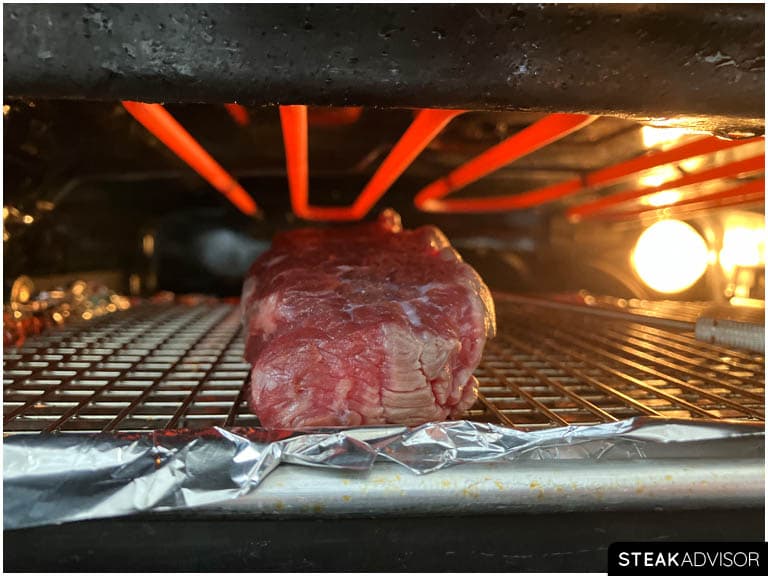
Broiling happens fast, so don’t walk away. Watch the steak closely as it browns and keep an eye on the internal temperature. If needed, crack a window for ventilation. There’s usually no need to flip it unless the crust already looks good on one side. I typically flip only thicker steaks, about 2 inches (5 cm) or more, and only once.
| Doneness | Remove at temp: | Final temp after broiling: |
| Rare | 90–100°F (32–38°C) | 120–130°F (49–54°C) |
| Medium Rare | 100–110°F (38–43°C) | 130–140°F (54–60°C) |
| Medium | 110–120°F (43–49°C) | 140-150˚F (60–66°C) |
| Medium-Well | 120–130°F (49–54°C) | 150-160˚F (66–71°C) |
| Well Done | 130–140°F (54–60°C) | 160°F+ (71°C+) |
Note
Rack placement has a big impact on carryover cooking. When the steak is positioned 2 1/2 to 3 inches (6–8 cm) from the broiler, the steak’s internal temperature typically increases by about 30°F (17°C) during a 5-minute rest. Move the steak farther away around 5 to 6 inches (13–15 cm), which is usually the center rack, and the carryover drops to roughly 20°F (11°C). That difference matters, so for the best results, follow the rack placement and temperature guidelines in the recipe.
Cooking time depends on your steak’s thickness, oven accuracy, and your preferred doneness. That’s why I always recommend using a leave-in probe thermometer with an alarm. It eliminates the guesswork, saving you from constantly opening the oven to check with an instant-read thermometer.

Step 5: Serve the Broiled Steak
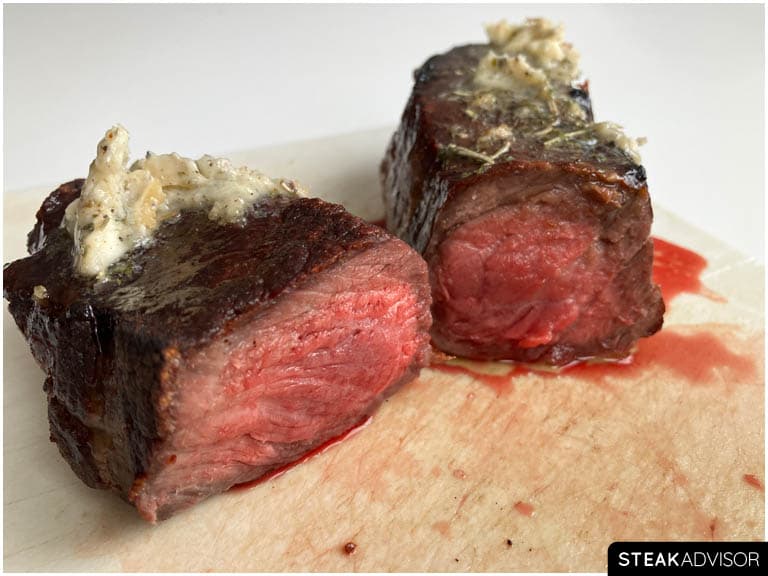
Don’t skip resting! Let the steak rest uncovered for 5 minutes. While the steak rests, place your compound butter on top so it can melt over the hot surface. If you don’t have compound butter, use regular butter; it’ll still add great flavor and moisture. Once the steak has rested, slice it thinly and serve it with your favorite sides.
Broiling Steak FAQs
What are the best cuts of steak for broiling?
Broiling works best with thicker steaks, ideally about 1 1/2 inches (3.8 cm) thick. Good options include porterhouse, T-bone, picanha, filet mignon, ribeye (bone-in or boneless), and strip steak (bone-in or boneless). Why thicker cuts? A home oven does a great job cooking meat evenly at low temperatures, but it’s not nearly as good at building a deep crust while keeping the inside medium-rare or medium. It just can’t get as hot as a pan or grill, so thinner steaks tend to overcook under the broiler before the surface has a chance to brown properly.
If you like your steak medium-rare or medium with more browning on the outside, go with a thicker cut. You’ll get that nice, even cook all the way through, with some browning on the outside. That said, don’t expect a deep, crispy crust as you’d get from a pan or grill. Still, this is a great method for cooking steak at home when you don’t have a grill or a pan. If you prefer your steak medium-well or well-done, thinner cuts (about 1 inch / 2.5 cm) work fine under the broiler.
Can I broil a steak straight from the fridge or freezer?
For best results, I don’t recommend broiling a steak straight from the fridge or freezer, especially thicker cuts. Broiling is a very hot, fast-cooking method, and starting with a cold or even frozen steak creates a large temperature gap between the surface and the cold center. The outside cooks quickly while the inside lags behind, so the steak cooks unevenly from edge to center.
Based on my case study “How Long to Leave Steak Out Before Cooking,” letting the steak rest at room temperature for about 30 minutes before cooking reduces the temperature difference between the surface and the cold center, helping the steak cook more evenly. If you skip that step, the steak often cooks unevenly inside, with a red center that differs noticeably from the rest of the steak.
How long should you broil a steak in the oven?
Honestly, there’s no one-size-fits-all answer. The best way to broil steak perfectly in the oven is to use a meat thermometer. Ideally, a leave-in probe thermometer that monitors the steak’s internal temperature while it cooks. It’s the only way to make sure your steak turns out exactly how you want it.
I’m not a fan of recipes that say, “cook the steak for X minutes per side, then you’re done” In reality, there are too many variables that can change how fast a steak cooks: the steak’s thickness (even a 1/4-inch/0.6 cm difference matters), your oven’s real temperature, how powerful your broiler is, how close the steak sits to the broiler, and even the type of steak you’re using (a lean steak cooks differently than a fatty one). That’s why guessing based on time is just rolling the dice, even if you’re using a steak that’s the same thickness as mine. If you want steak that’s perfectly cooked inside every time, I always recommend using a meat thermometer.
For this recipe, a leave-in probe thermometer is your best friend. It lets you monitor the steak’s internal temperature without opening the oven, and you can set an alarm so you don’t miss the perfect moment to pull your steak out for its final broil. It’s a simple, affordable kitchen tool that makes a huge difference, and once you start using one, you’ll wonder how you ever cooked steak without it.
When should you remove the steak from the broiler?
Based on my testing with this recipe, I recommend removing the steak about 30°F (17°C) below your target final temperature. When cooking very close to the broiler (about 2 to 3 inches / 6–8 cm), carryover cooking is significant, and that extra margin is what prevents overcooking.
Below is a temperature chart showing exactly when to remove a steak cooked close to the broiler, depending on your preferred level of doneness.
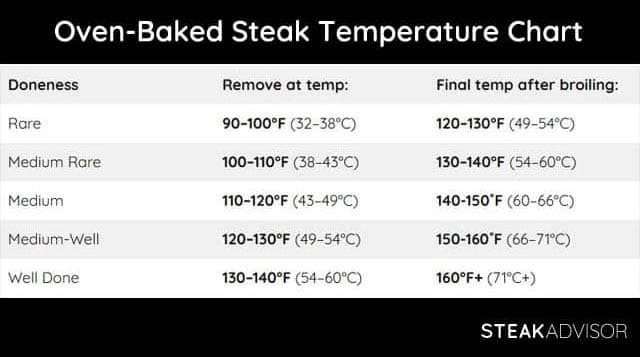
I’ve tested this recipe with steaks of different thicknesses, and one thing stays consistent: broiling causes aggressive carryover cooking, especially when the steak sits close to the heating element. When I broil a steak about 2 1/2 to 3 inches (6–8 cm) from the heating element, I usually remove it at around 110°F (43°C). After it comes out of the oven, the internal temperature rises by about 30°F (17°C) during the first 5 minutes of resting.
Broiling exposes the steak to extremely high heat, creating a large temperature difference between the steak’s surface and its center. The greater the difference, the more significant the carryover cooking. That’s why I always recommend removing the steak much earlier when cooking under very high heat. Waiting until it’s close to your final doneness guarantees an overcooked steak.
How does the distance from the broiler affect carryover cooking?
The closer the steak is to the broiler, the hotter its surface gets, and the larger the carryover cooking once it comes out of the oven. Based on my tests, when a steak is placed about 2 1/2 to 3 inches (6–8 cm) from the broiler, the internal temperature rises by roughly 30°F (17°C) during resting. Move the steak farther from the heat, around 5 to 6 inches (13–15 cm), which is usually the center rack, and the carryover drops to about 20°F (11°C). That’s a big difference, and it directly affects when you should remove the steak from the oven.
This recipe is developed specifically for broiling steaks very close to the broiler. If you cook the steak farther away, carryover cooking will be smaller, and you’ll need to adjust your removal temperature accordingly. That’s why it’s so important to follow the recipe instructions closely. With high-heat methods like broiling, small changes in distance can have a big impact on the final results.
Should you flip the steak while broiling?
For a thinner cut, the answer is no. There’s no real benefit to flipping it under the broiler. For a thicker steak at least 1 1/2 inches (3.8 cm) thick, you can flip it once, but only after the first side has developed a crust you’re happy with.
The problem with broiling is that it’s almost impossible to build a good crust if you flip the steak too often. Take a look at the first photo: it shows a 1 3/4-inch (4.5 cm) thick steak flipped every 30–45 seconds under the broiler. There’s barely any crust.
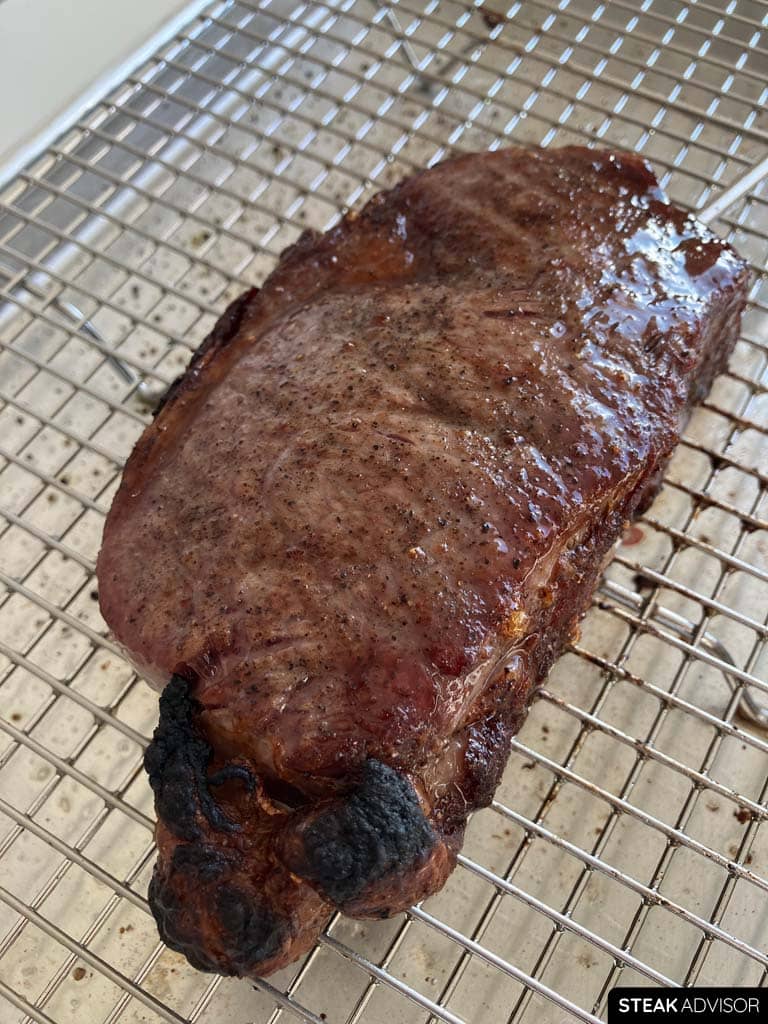
Now compare that to the next photo. This steak is the same thickness and cooked to the same target temperature, but it was flipped only once. The difference in the crust is hard to miss.

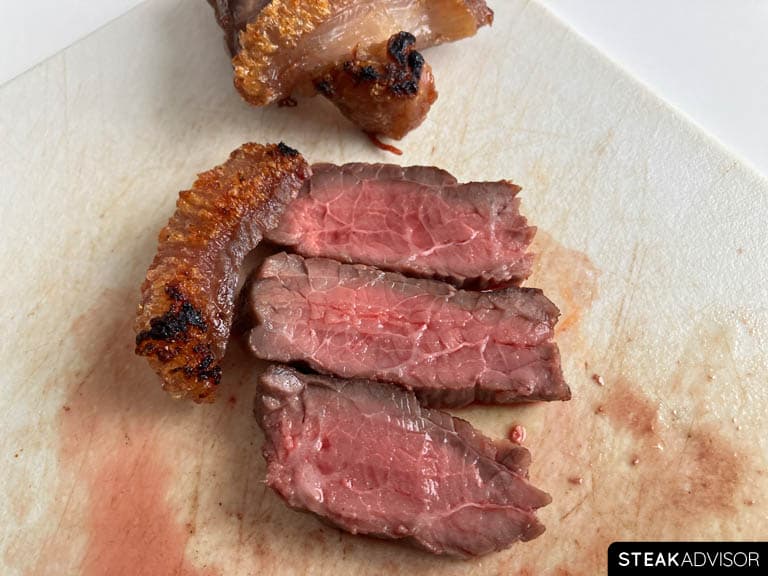
The only small downside for some people is the thicker gray band that forms under the side of the steak that’s flipped only once. You can see what I mean in the photo below.
Why is it so important to place the steak parallel to the broiler heating element?
In this recipe, the steak is cooked very close to the broiler. Because the broiler is a long heating element, it doesn’t distribute heat perfectly evenly across its entire surface. Some areas are hotter than others. If you place the steak perpendicular to the heating element, parts of it can end up sitting under slightly cooler zones. That’s when you start getting uneven cooking across the steak. Placing the steak parallel to the broiler helps expose the entire surface to more consistent heat, which leads to more even browning and doneness.
Below, I’ve included photos showing the correct way to position the steak under the broiler (first photo) and the wrong way (second photo).

Why is dry-brining a steak important before broiling?
Broiling cooks a steak very fast, but it’s not as good at building a deep crust as pan-searing or cooking over an open flame. That’s why proper prep matters so much if you want the best results. Moisture is the enemy of a good crust. Any water sitting on the surface has to evaporate before browning can even start. Dry-brining helps by drying the steak’s surface before cooking. For this recipe, it’s not optional; it makes a noticeable difference.
For best results, dry-brine the steak for 4 to 6 hours, then pat it dry again right before it goes under the broiler. That combination gives the steak the best chance to brown properly.
Why is it so important to trim off the excess outer fat before broiling a steak?
Fat burns very quickly under the broiler and is the main cause of flare-ups and a lot of smoke. That’s why I recommend trimming off the outer fat before broiling a steak. It makes the whole process easier, cleaner, and a lot less smoky.
For the same reason, I don’t recommend broiling highly marbled steaks. If you do want to broil one, don’t place it too close to the broiler. Cooking it very close to the broiler makes flare-ups much more likely.

How to deal with a flare-up when broiling a steak?
If a flare-up happens while broiling, the most important thing is to stay calm.
- If flames start inside the oven, keep the door closed and turn off the broiler. Closing the door cuts off oxygen, and the flames will die out on their own.
- Never use water on a grease fire. Spraying water will only make the flare-up worse and can cause hot grease to splatter.
- If the flare-up is small, you can reduce it by moving the steak farther from the broiler. Increasing the distance from the heating element reduces the heat intensity and helps prevent dripping fat from igniting.
To minimize flare-ups in the first place, make sure the steak is well trimmed and not heavily marbled. Always place it on a wire rack set over a baking sheet or broiler pan, so the fat drips away instead of pooling around the steak. Avoid marinades or oil on the steak surface, and always pat the steak dry before it goes into the oven. If flare-ups keep happening, move the steak farther from the broiler and continue cooking at slightly lower heat.
And again, never use water if a flare-up occurs.
Broiling vs. reverse searing: what’s the difference?
Broiling is a one-step, high-heat, fast-cooking method. It uses intense, direct radiant heat from the oven’s heating element to quickly cook the steak. Reverse searing is a two-step method. You cook the steak slowly first, then finish it with a quick, hot sear.
In most cases, reverse searing is the better option. It’s easier to control, more predictable, and usually gives better results. More even cooking, a better crust, and a much smaller gray band.
Is it possible to reverse-sear a steak using a broiler?
Technically, yes. I’ve tested it, but I don’t recommend it.
The issue is that you don’t have enough time to build a crust. After slowly cooking the steak in the oven to around 90°F (32°C), you still have to account for carryover cooking, which can easily add 20°F (11°C) after it comes out. So if you’re aiming for medium doneness, you need to pull the steak around 110–120°F (43–49°C). That leaves a very short window under the broiler, and in my experience, it’s not enough time to form a good crust. Because of that, I don’t recommend combining reverse searing with broiling.
The steak ends up cooked well on the inside, but the crust is weak or almost nonexistent. That’s why I prefer to just broil the steak from start to finish. It’s simpler, more predictable, and still gives you a nicely cooked interior, even if the gray band is a bit thicker.
Print
Broiled Steak Recipe
- Prep Time: 10 minutes
- Rest Time: 4 to 6 hours
- Cook Time: 10 minutes
- Total Time: 20 minutes
- Yield: 1 steak
Description
In this recipe, I’ll show you how to broil a steak using only an oven with a top-mounted broiler. You’ll end up with a steak that’s cooked relatively evenly on the inside, with a bit of browning on the surface.
Ingredients
For Steak:
- Any tender steak that’s at least 1 inches (2.5 cm) thick (ribeye, strip steak, picanha, porterhouse, or filet mignon)
- 1–2 teaspoons (about 5-10 g) kosher salt (1-1.5% of the steak’s weight)
- 1/2 teaspoon finely ground black pepper per pound (454 g) of steak (optional)
- Compound butter
Tools:
- Oven with broiler (you’ll need an oven with a top-mounted broiler)
- Wire rack and baking sheet
- A leave-in probe thermometer
- Tongs
Instructions
- Get your ingredients and tools ready first. Then follow the steps below.
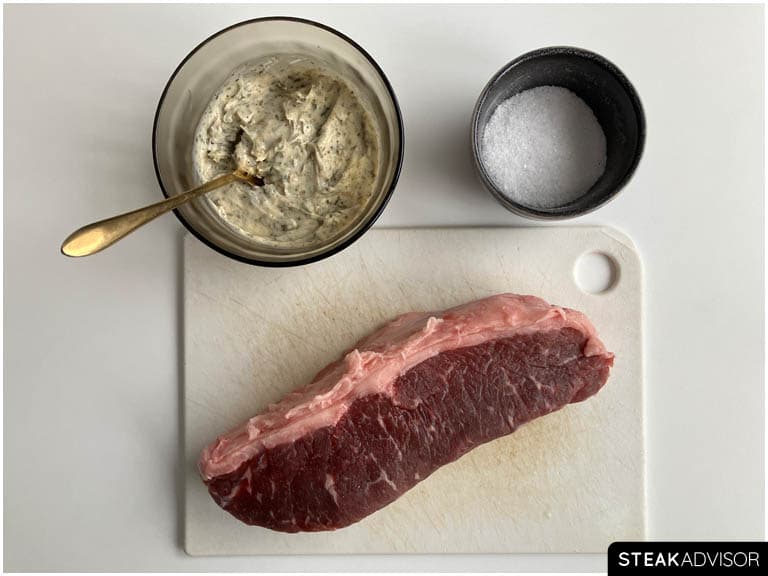
Prepare the Steak
- Pat the steak dry on all sides with paper towels to remove any surface moisture, then trim off any excess outer fat. This helps prevent the fat from burning, which is especially important for steaks thicker than 1 inch (2.5 cm). If there isn’t much outer fat on the steak, feel free to skip this step.
- Season the steak generously with 1-2 teaspoons of kosher salt (1-1.5% of the steak’s weight). Place the salted steak on a wire rack set over a baking sheet and refrigerate it uncovered for 4 to 6 hours (see notes).
- Remove the steak from the refrigerator about 30 minutes before cooking.
Make the Compound Butter (Optional)
- Here’s my step-by-step recipe for a garlic-herb compound butter you can use. I highly recommend making it ahead of time, so you can place a slice right on top of the steak as soon as it comes out of the broiler. (see the notes below for more details)
Preheat the Broiler
- Set your broiler to high and let it preheat for about 10 minutes. Every oven is a little different, so make sure you choose the highest broiler setting to get the heating element as hot as possible (most home broilers reach around 500–550°F / 260–288°C).
- While the broiler heats up, line the baking sheet with aluminum foil to make cleanup easier, then place a wire rack on top so the drippings fall away from the steak.
- Once the broiler is ready, pat the steak dry again and insert a leave-in probe thermometer into the side of the steak. Make sure the probe tip is centered on the steak so you get an accurate reading. Now the steak is ready to go into the oven.
Broil the Steak
- Place the steak on the upper oven rack, about 2 1/2 to 3 inches (6–8 cm) from the broiler, set on a wire rack over a foil-lined baking sheet.
- Make sure the steak runs parallel to the broiler element and sits fully under it, not turned sideways, so it cooks evenly without cold spots (see the photo below).
- Broil until the thermometer reads 30°F (17°C) below your target doneness (see the temperature chart below). Then remove the steak from the oven and let it rest uncovered for 5 minutes.
- Don’t walk away, broiling happens fast. Watch the steak closely as it browns to avoid burning, and monitor the internal temperature (crack a window for ventilation if needed). There’s usually no need to flip it unless the crust already looks good on one side. I typically flip only thicker steaks, about 2 inches (5 cm) or more, and only once.
- Cooking time depends on your steak’s thickness, oven accuracy, and your preferred doneness. That’s why I always recommend using a leave-in probe thermometer with an alarm. It eliminates the guesswork, saving you from constantly opening the oven to check with an instant-read thermometer.
Serve the Broiled Steak
- While the steak rests, place your compound butter on top so it can melt over the hot surface.
- If you don’t have compound butter, use regular butter; it’ll still add great flavor and moisture. Once the steak has rested, slice it thinly and serve it with your favorite sides.
Notes
Flare-ups
If you start seeing flare-ups, I recommend moving the steak a bit farther from the broiler to calm things down and reduce the risk of more flare-ups. For this reason, I don’t recommend this method for highly marbled cuts or steaks with untrimmed outer fat.
Compound Butter
Compound butter is an easy way to add great flavor to steak. I recommend making it ahead of time – either the day before or at least 30 minutes before cooking. Roll it into a log and let it firm up in the fridge or freezer so you can slice off a piece whenever you need it. You can also make a quick batch in a small bowl right before cooking. Use some as soon as the steak comes out of the broiler, then keep the rest in the fridge for up to a week or in the freezer for up to 3 months. And if all you have is butter, add a slice on top of the hot steak. It’ll still melt beautifully and add tons of flavor with almost no effort.
Dry-brining
You can dry-brine the steak even longer than 4-6 hours for deeper flavor, but keep in mind: the longer it sits salted, the more noticeable the gray band just under the crust becomes. If you’re short on time, you can let the salted steak rest uncovered at room temperature for 1 hour, but for this recipe, I don’t recommend it. The steak needs more time to dry properly if you want good browning under the broiler.
