

In a Nutshell
The best ways to cook a steak in the oven:
- Reverse Sear (Oven-to-Pan): Best for beginners and anyone who wants maximum control over doneness. The steak cooks evenly from edge to edge, with very little gray band, good juiciness, and a solid crust. The downside is that it takes much more time than the other methods.
- Forward Sear (Pan-to-Oven): A good balance between speed and results. You get a deep, well-developed crust and a juicy interior, with good control over doneness. The downside is a slightly thicker gray band compared to the reverse sear.
- Broil (No pan): Fast and convenient when a broiler is your only option. Works best for thinner or leaner cuts, but offers less control, a weaker crust, and a thicker gray band.
Over the years, I’ve tested many different methods for cooking steak in the oven. In this article, I focus on the methods that I think work best, explain how each one works, and point out their pros and cons. I’ve also included links to step-by-step recipes for each method.
The 3 Best Ways to Cook Steak in the Oven
Below are the three methods I like the most. Keep in mind, this isn’t a ranking from best to worst. These are the methods I recommend most often when someone asks me how to cook steak in the oven. Each one has its own advantages and disadvantages, so take a look at all of them and decide which method works best for you.
Method 1. Reverse Sear (Oven-to-Pan)
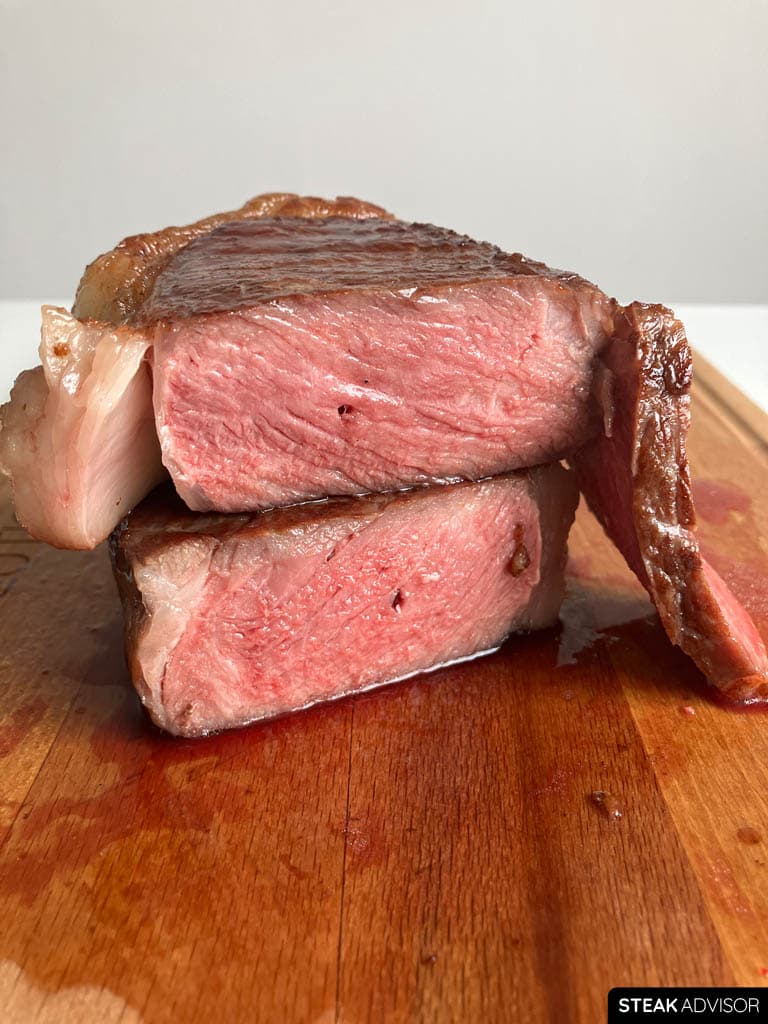
About This Method: The reverse sear is a two-step method for cooking steak. You start by cooking the steak gently in the oven at low heat until it’s close to your target doneness. Then you take it out and finish it in a very hot pan to build a nice, crispy crust on the outside. The inside stays evenly cooked from edge to edge.
Estimated cook time: About 1 hour total for a steak 2 inches (5 cm) thick, cooked to medium-rare (130-140°F / 54-57°C).
Best For:
- Cooks who want maximum control over doneness with a perfect edge-to-edge pink interior
- Thick and/or highly marbled premium cuts you don’t want to risk ruining
- When you want consistent results and don’t mind spending more time
- When you want multiple steaks to finish at the same doneness (great for guests)
Best Steak Cuts & Thickness: Any naturally tender steak cut with a thickness of at least 1 1/2 inches (3.8 cm). Perfect for premium cuts such as ribeye, filet mignon, porterhouse/t-bone, or strip steak.
Advantages:
- Even cooking
- Decent crust
- Minimal gray band
- No need to let the steak sit out first
- Reduced smoke
- Simple and forgiving
- Doesn’t need much attention, so you can focus on the sides while the steak is in the oven
Disadvantages:
- Time-consuming
- Not recommended for thin steaks
- Requires equipment (heavy-bottomed stainless steel or cast iron skillet, wire rack, baking sheet, meat thermometer)
My Takeaway: Reverse-seared steak has very little gray band, an even pink interior from edge to edge, a good crust, and a juicy center. Overall, reverse searing is one of the best ways to cook a steak. The main downside is the time it takes. I do like reverse-searing in a pan and the oven, but in most cases, I prefer to do it on the grill. On the grill, the extra time is worth it because the steak gets a much better smoky flavor.
That said, the reverse-sear method is a great choice for beginners or anyone who likes a slower, more relaxed way of cooking steak. It’s hard to overcook the steak as long as you follow the steps, and the results are very consistent. While it takes more time, it doesn’t need much attention, which makes it easy to prepare side dishes at the same time and serve everything hot. It also works well when you’re cooking more than one steak. Personally, I prefer faster methods, especially when I’m cooking just one or two steaks. But if time isn’t an issue and results matter more, reverse sear is a solid choice.
Method 2: Forward Sear (Pan-to-Oven)

About This Method: A forward sear, also known as a front sear, is a two-step method for cooking steak. You start by searing the steak over high heat in a pan to build a deep, golden-brown crust, then finish it gently over lower heat in the oven to let the inside come up to doneness more gradually and evenly.
Estimated cook time: About 30 minutes total for a steak 2 inches (5 cm) thick, cooked to medium-rare (130-140°F / 54-57°C), roughly half the time of reverse sear.
Best For:
- Cooks who want a faster alternative to reverse sear without giving up good results
- Anyone who wants solid control over doneness
- When time matters, but good results still matter too
- Very thick steaks (about 3 inches / 7.6 cm), which can take a long time with reverse sear
- Cooks who care more about a deep, well-developed crust than a perfectly even pink interior or a thinner gray band
Best Steak Cuts & Thickness: Steaks at least 1 1/2 inches (3.8 cm) thick, with 2 inches (5 cm) or more being ideal. Like reverse sear, it’s best for naturally tender, well-marbled cuts such as ribeye, strip steak, or filet mignon. It also works very well for very large, thick, bone-in steaks (about 3 inches/ 7.6 cm thick) like cowboy, tomahawk, or porterhouse.
Advantages:
- Fast cooking time
- Impressive crust
- Even cooking
- Perfect for really thick cuts (over 3 inches/ 7.6 cm thick)
- Still relatively simple and forgiving
Disadvantages:
- Slightly thicker gray band
- Not for thinner steaks
- Not a good method for cooking for a crowd
- Requires equipment (heavy-bottomed stainless steel or cast iron skillet, wire rack, baking sheet, meat thermometer)
My Takeaway: Forward-seared steak has a deep, impressive crust, an evenly cooked, juicy interior, and a slightly thicker, gray band. This is my favorite method for cooking steak in the oven, mainly because of the time it takes, how easy it is, and the crust it develops. I like a deep crust, and this method is hands down the best at building a deep, dark, crispy crust (much better than reverse sear).
Overall, the forward sear is less set-and-forget than methods like reverse sear. It requires more attention while searing in the pan, but it’s still a relatively straightforward method (even for beginners). It’s my go-to method for really thick steaks (at least 2 1/2 inches / 6.5 cm thick), which take a long time to cook with reverse sear or other slow methods. Forward sear lets you cook a steak much faster while keeping the inside evenly cooked and developing an impressive crust (a win for someone like me who cares more about crust and doesn’t mind a slightly thicker gray band). And even then, the gray band is still small compared to classic fast, high-heat methods like grilling, broiling, or straight pan-searing.
Method 3: Broil (No Pan)

About This Method: Broiling is a one-step, high-heat method that cooks the steak entirely under the oven’s top heating element (the broiler), using intense, direct radiant heat. You place the steak directly under the broiler, where intense, direct heat cooks it fast from start to finish, even in just a few minutes.
Estimated cook time: About 10 minutes total for a steak 2 inches (5 cm) thick, cooked to medium-rare (130-140°F / 54-57°C).
Best For:
- When all you have is an oven with a broiler and no pan
- When time matters, and you want the steak done as fast as possible
- When even doneness, a thin gray band, or a perfect crust aren’t priorities
- When you’re cooking a cheaper cut and don’t want to overthink it
Best Steak Cuts & Thickness: Steaks at least 1 inch (2.5 cm) thick work best, with 1 1/2 to 2 inches (3.8–5 cm) being ideal if you want a slightly better crust. Leaner, cheaper cuts with little marbling are preferable, as they’re less likely to cause flare-ups under the broiler.
Advantages:
- Fast cooking time
- No pan or grill required
- Fairly even cooking
- Good for cooking multiple steaks
- Easy cleanup
- Consistent once dialed in
Disadvantages:
- Not all broilers are made the same
- Not very forgiving
- Very little control
- Steak prep matters a lot
- Doesn’t work for every steak
- High carryover cooking
- Not for very thin steaks
- Hard to build a crust on both sides
- Requires constant attention
- Smoke
- Flare-ups
My Takeaway: This method has many downsides, so I only recommend it when you don’t have a pan and can’t use a forward or reverse sear, and the broiler is your only option. A broiled steak can be flavorful, but it’s usually less juicy, doesn’t develop a deep crust, and ends up with a thicker gray band. It’s also not a good choice for premium, well-marbled cuts. Flare-ups are more likely, and the margin between perfectly cooked and overdone steak is very small. That’s why I wouldn’t choose this method for expensive steaks.
That doesn’t mean broiling is a bad technique. If all you have is a broiler, it’s the fastest way to cook steaks entirely in the oven. It does take some time to learn how your broiler works, but once you get comfortable with it, you can cook a decent, flavorful steak in just a few minutes. It’s also a decent option if you don’t care much about a crust, an even pink interior, or a thinner gray band, or if you prefer your steak cooked more. One thing I do like about broiling is the cleanup: when done right, broiling is far less messy than pan-searing, which splatters oil all over the kitchen.
